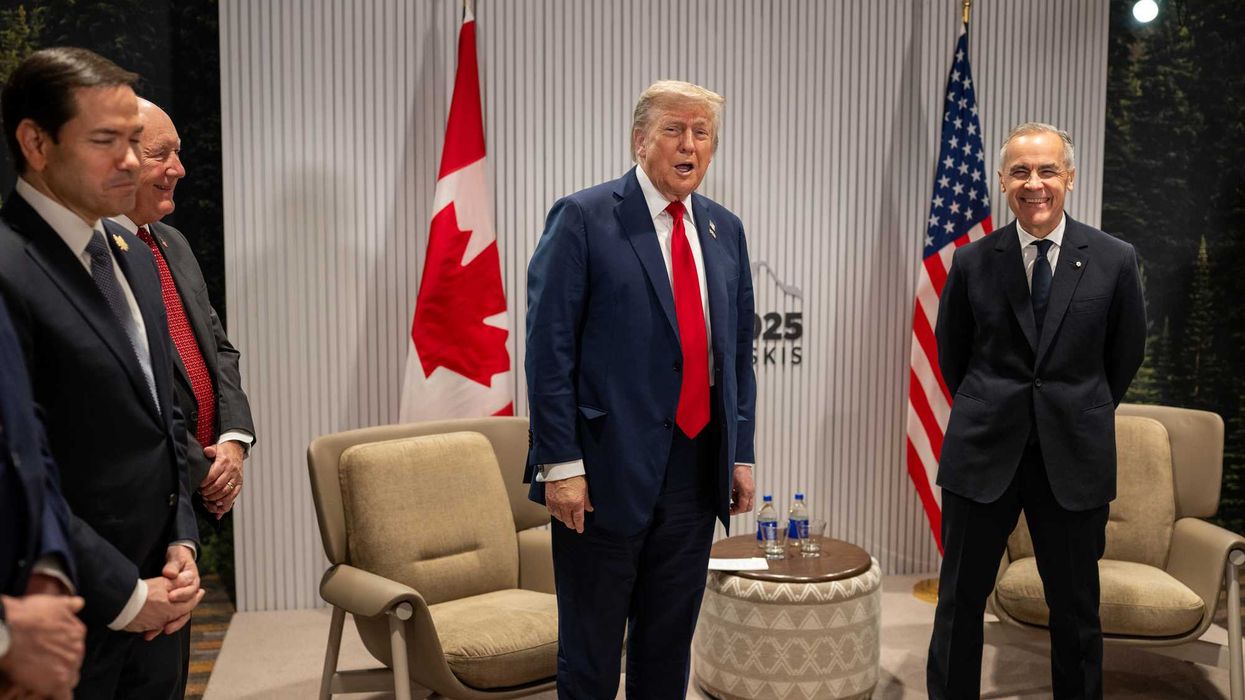
U.S. President Donald Trump with Canadian Prime Minister Mark Carney
and U.S. Secretary of State Marco Rubio on June 16, 2025

December 23, 2025
ALTERNET
The term "Pax Americana" (which means "American Peace" in Latin) is used to describe the period of relative stability that the West enjoyed in the decades following World War 2. According to concept, the United States' alliances with Canada and European countries kept the "Pax Americana" strong for many years. But liberal economist Paul Krugman, a scathing critic of President Donald Trump's foreign policy, believes that the Pax Americana "basically ended on January 20, 2025" — the day Trump returned to the White House following the end of Joe Biden's presidency.
U.S. allies that helped keep the Pax American strong included Canada, France, Germany and the UK (which is four countries in one: England, Scotland, Wales and Northern Ireland). And according to a newly released survey conducted by Politico/Public First, those allies are really worried about the U.S. — especially Canada.
Politico's Erin Doherty, in an article published on December 23, reports, "Unreliable. Creating more problems than solving them. A negative force on the world stage. This is how large shares of America's closest allies view the U.S., according to new polling, as President Donald Trump pursues a sweeping foreign policy overhaul. Pluralities in Germany and France — and a majority of Canadians — say the U.S. is a negative force globally, according to new international Politico-Public First polling. Views are more mixed in the United Kingdom, but more than a third of respondents there share that dim assessment."
The percentage of people who now consider the U.S. a "negative force" in the world, according to Doherty, includes 56 percent of Canada, 40 percent of Germany and France, and 35 percent of the UK.
When Politico/Public First asked if the U.S. "creates problems" or "solves problems," those who said "creates problems" included 63 percent of Canada, 52 percent of Germany, 47 percent of France, and 46 percent of the UK.
Doherty notes, "In the U.K., Trump remains polarizing, but Prime Minister Keir Starmer has largely avoided public confrontation. His priorities now include finalizing a U.K.-U.S. trade deal and coordinating a European response to Trump's efforts to end the war in Ukraine — without angering the White House, the delicate balance many allied leaders are trying to strike. Canada, meanwhile, has seen the sharpest deterioration in relations, which have soured amid a punishing trade war and Trump’s intermittent rhetoric on annexation."
Read Erin Doherty's full article for Politico at this link.
.jpg)

No comments:
Post a Comment