“Finding flour alone took five full days,” says Dema Al-Buhisi, who continued baking in Gaza amid famine and bombings.
By Dalia Abu Ramadan ,
December 26, 2025
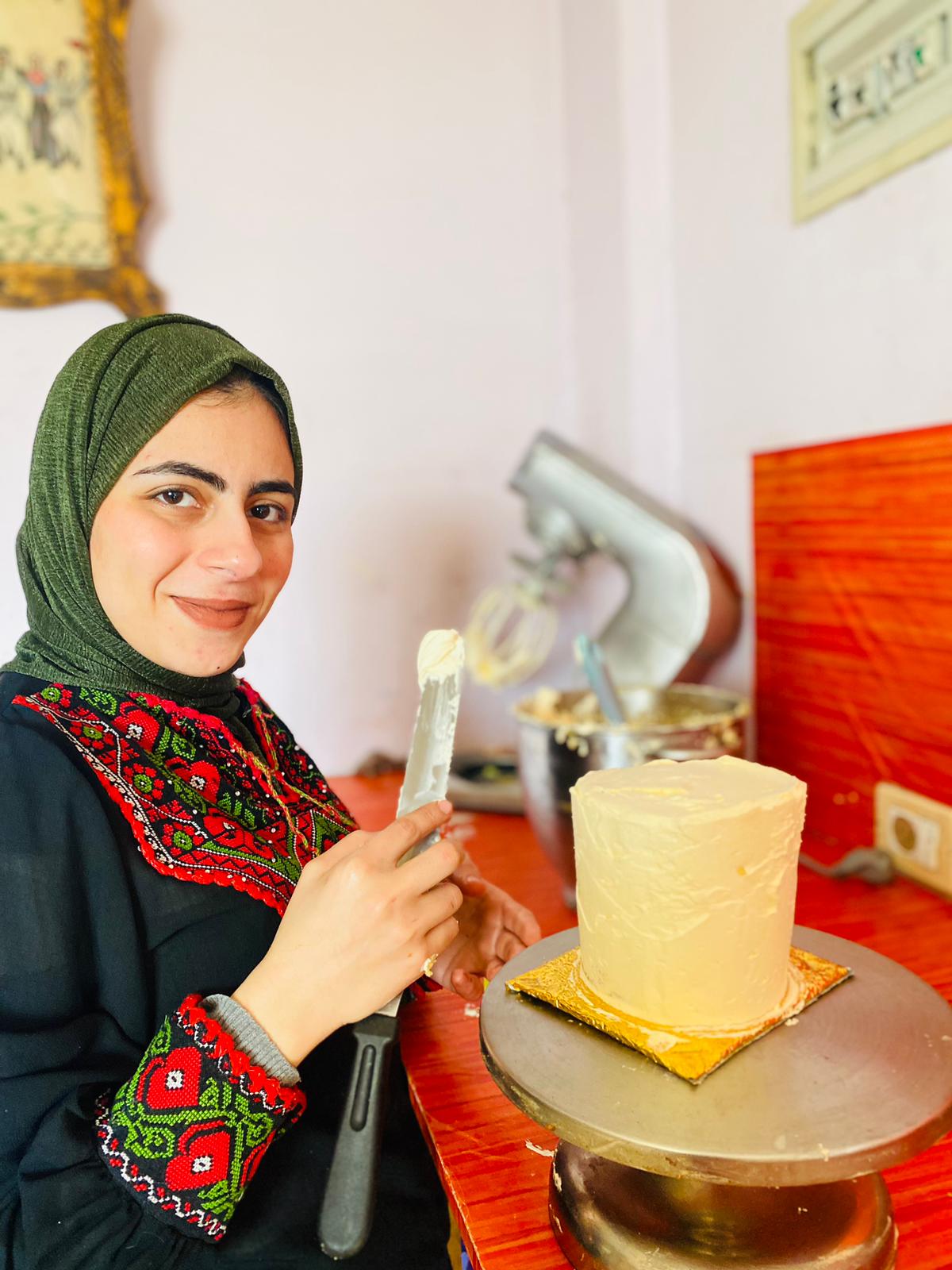
Dema, the cake girl who became known not only for creating cakes but for spreading joy. A young woman with unshakable determination, who began her dream as a university student with “Cake Online” — here she is decorating a cake with all her love, a dream that succeeded and continues to grow with her passion and resilience. Captured by Dema’s sister.
“The hardest part of working during the war was the endless search for the ingredients I needed to make cakes,” 23-year-old Gaza baker Dema Al-Buhisi tells me.
“For months, that struggle consumed me,” she adds. “Finding flour alone took five full days — five days just to get clean, unspoiled flour that hadn’t gone bad. And what about the famine we lived through? There was no meat, no vegetables, no fruit, not even medicine … so how could I possibly find anything related to baking cakes in the middle of all that scarcity?”
And yet with a resourcefulness and tenacity that moved everyone around her, Al-Buhisi found ways to continue baking throughout the worst days of the shelling and starvation inflicted by the Israeli military.
For this, she has become known in Gaza as the “Cake Girl”: she is an embodiment of how so many of us in Gaza have risked death to watch our dreams breathe.
Al-Buhisi has inspired many of us with her creativity and innovation. During the harshest days of famine, I was drawn to photos of her cakes on Instagram — they were colorful and inviting, even though we had no access to eggs or traditional food coloring!
“The hardest part of working during the war was the endless search for the ingredients I needed to make cakes,” 23-year-old Gaza baker Dema Al-Buhisi tells me.
“For months, that struggle consumed me,” she adds. “Finding flour alone took five full days — five days just to get clean, unspoiled flour that hadn’t gone bad. And what about the famine we lived through? There was no meat, no vegetables, no fruit, not even medicine … so how could I possibly find anything related to baking cakes in the middle of all that scarcity?”
And yet with a resourcefulness and tenacity that moved everyone around her, Al-Buhisi found ways to continue baking throughout the worst days of the shelling and starvation inflicted by the Israeli military.
For this, she has become known in Gaza as the “Cake Girl”: she is an embodiment of how so many of us in Gaza have risked death to watch our dreams breathe.
Al-Buhisi has inspired many of us with her creativity and innovation. During the harshest days of famine, I was drawn to photos of her cakes on Instagram — they were colorful and inviting, even though we had no access to eggs or traditional food coloring!
Children Are Dying of Cold Exposure as Winter Hits Gaza
Israel has continued to restrict the entry of tents, tarps, and blankets into Gaza amid the bone-chilling rains. By Shahad Ali , Truthout December 20, 2025
I asked her the secret behind her creativity, and she told me it came from the alternatives she invented herself: She used vinegar instead of eggs, and replaced fruit and coloring with turmeric to give her cakes a beautiful yellow hue.
“When I Work, I Feel Like I Can Breathe Again”
Ten years ago, Al-Buhisi carried a small dream that grew within her: to have her own space in the world of desserts.
“When I was a child, I loved making sweets — especially cakes,” she told me. “I thought it was a normal hobby every girl might have, but with time I realized my passion wasn’t ordinary at all.”
In February 2022, Al-Buhisi launched her online cake business while studying accounting at Al-Azhar University. She ran the entire operation from a small private room in her family’s home in Deir al-Balah, in the south of the Gaza Strip, turning it into a workshop of creativity and determination. Her family believed in her completely; they bought her the tools she needed, and even a refrigerator to start her work. Al-Buhisi says that moment was one of the happiest in her life — it felt like she was finally stepping onto the path she loved.
Her name began to spread, her cakes gained recognition, and her dream was slowly taking shape — until the genocide began. Israel’s sustained assault on Gaza beginning in October 2023 brought life to a halt, forcing us all to focus solely on survival. And just like that, Al-Buhisi stopped making cakes — for six long months.
“The war drained me mentally,” Al-Buhisi said. “I felt a kind of depression I had never experienced before, especially after I stopped doing the things I love.”
Having lost all access to a refrigerator, a working oven, eggs, fruit, food coloring, and much more, she started modifying her recipes and baking small batches of cakes in a clay oven.
Her father, who works in the psychological field, noticed how heavily it was weighing on her. He advised her to return to the work she loved, because it was the only space where she could release her energy — and all the emotional pressure we live under here.
Al-Buhisi said, “When I work, I feel like I can breathe again. I love bringing joy to people. They used to call me the maker of happiness — even though all I do is make cakes — because I get to share their celebrations, their sweet moments.”
But when Al-Buhisi decided to resume baking in mid-March 2023, the shock of the barriers to doing so hit her hard. She had remained in Deir al-Balah, in the south, staying in her home throughout the war, but the room she used to work in — with all her tools, her refrigerator, and her supplies — had been damaged when the Israeli military bombed their neighbors’ house, leaving her own home severely affected. And every ingredient she had previously relied on had expired during those long six months of war.
And yet, Al-Buhisi did not consider giving up. Having lost all access to a refrigerator, a working oven, eggs, fruit, food coloring, and much more, she started modifying her recipes and baking small batches of cakes in a clay oven.
I know very well how exhausting it is to use a clay oven, especially since we have also been relying on one for the past two years due to the lack of gas. Even when gas is available, it comes only once a year.
Now, in order to bake, Dema must set up her clay oven, buy the firewood to burn inside it, and struggle to light it. It takes a long time to get it going, which is especially difficult for baking, because pastries normally require a gas oven.
Even obtaining firewood to fuel our clay ovens has become a challenge, so people have started burning wooden furniture from their homes.
Over time, even obtaining firewood to fuel our clay ovens has become a challenge, so people have started burning wooden furniture from their homes, and some have sold it for the same purpose.
Nevertheless, in the face of these challenges, Al-Buhisi has continued to find creative ways to make cakes throughout the recent years of war. She even gained supporters from abroad who sent her money to bake cakes and cupcakes for distribution in camps of displaced people living in tents in southern Gaza. She told me she personally volunteered to distribute her cakes and cupcakes in the camps because she loves to hear children’s laughter.
During the hepatitis outbreak, Al-Buhisi baked cakes specifically for affected children, using ingredients safe for their kidneys.
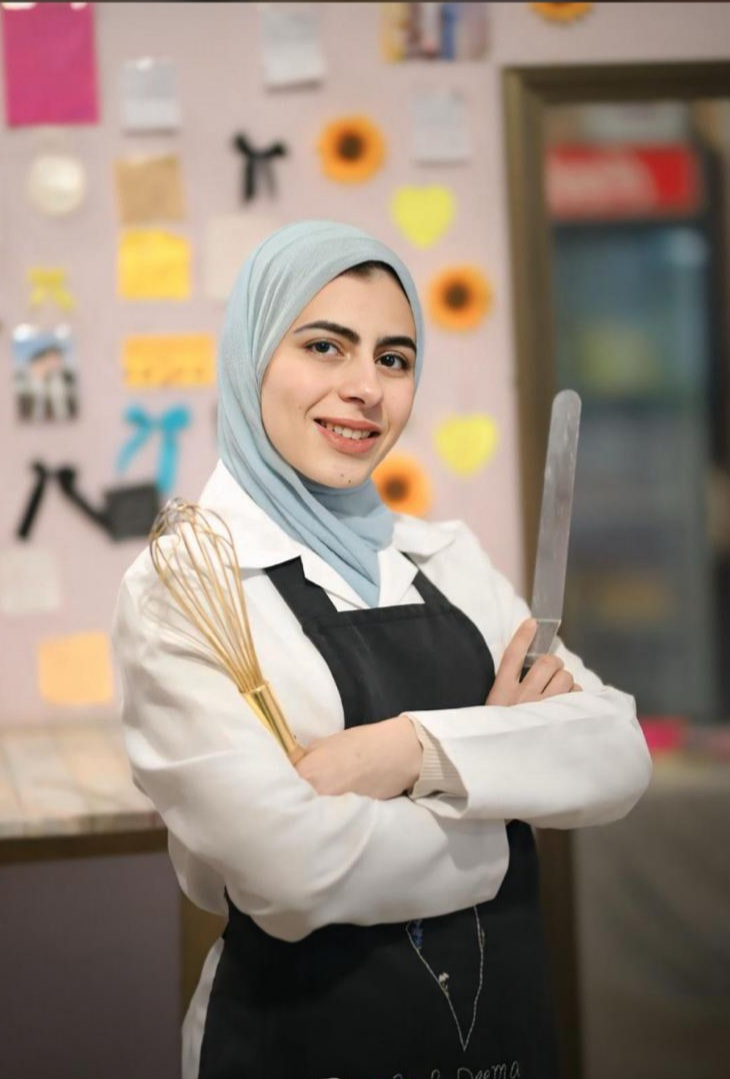
A photo taken on February 2, 2025 to honor Dima’s remarkable journey of success, celebrating the dream she began on February 2, 2022, and kept alive, even in the midst of war. Norma Abu Jaiab
Her project became a source of joy for many families during the war. Parents ordered special cakes for their children’s birthdays in an attempt to offer them moments of happiness and momentarily erase the relentless experience of bombing and killing. As Al-Buhisi says, “Children have the right to feel joy. What we adults endured was unbearable — how could they not deserve a little happiness?”
Now, amid the so-called ceasefire that has in reality been characterized by ongoing attacks by the Israeli military on Palestinians, Al-Buhisi continues her work in the face of many challenges.
Food is still not available in the quantities that were common before the war, nor at the same prices. Food and fuel supplies are still limited, and even when traders manage to bring goods into Gaza, it costs them a great deal due to the blockade, which requires obtaining permission from the occupation authorities for any delivery.
I asked her, “What do you struggle with the most even after the ceasefire?”
Parents ordered special cakes for their children’s birthdays in an attempt to offer them moments of happiness and momentarily erase the relentless experience of bombing and killing.
She told me that she is still baking using the clay oven that she has had to rely on since 2023, and that making cakes with it is extremely difficult — especially during the summer, when it exhausts her completely. She added that the hardships are far from over: Eggs remain very expensive and difficult to find, even long after the official start of the ceasefire in January 2025.
And Al-Buhisi also carries with her the trauma of having lost her dearest and most beloved friend, Tasneem Abu Zakrya, who was killed by the Israeli army a year and a half ago in Al-Nuseirat during an operation carried out by the Israeli forces, supposedly to free Israeli prisoners held in Gaza. Al-Buhisi had talked on the phone with Abu Zakrya right before she was killed.
Moments after their conversation ended, Al-Buhisi received the devastating news — she learned that Abu Zakrya’s body had been reduced to fragments. Al-Buhisi told me that Abu Zakrya was not just a friend; she was part of Al-Buhisi’s soul and family.
Al-Buhisi’s decision to continue pursuing her dream doesn’t mean she is without pain. We all suffer, and we all carry the memories of the war and its hardships.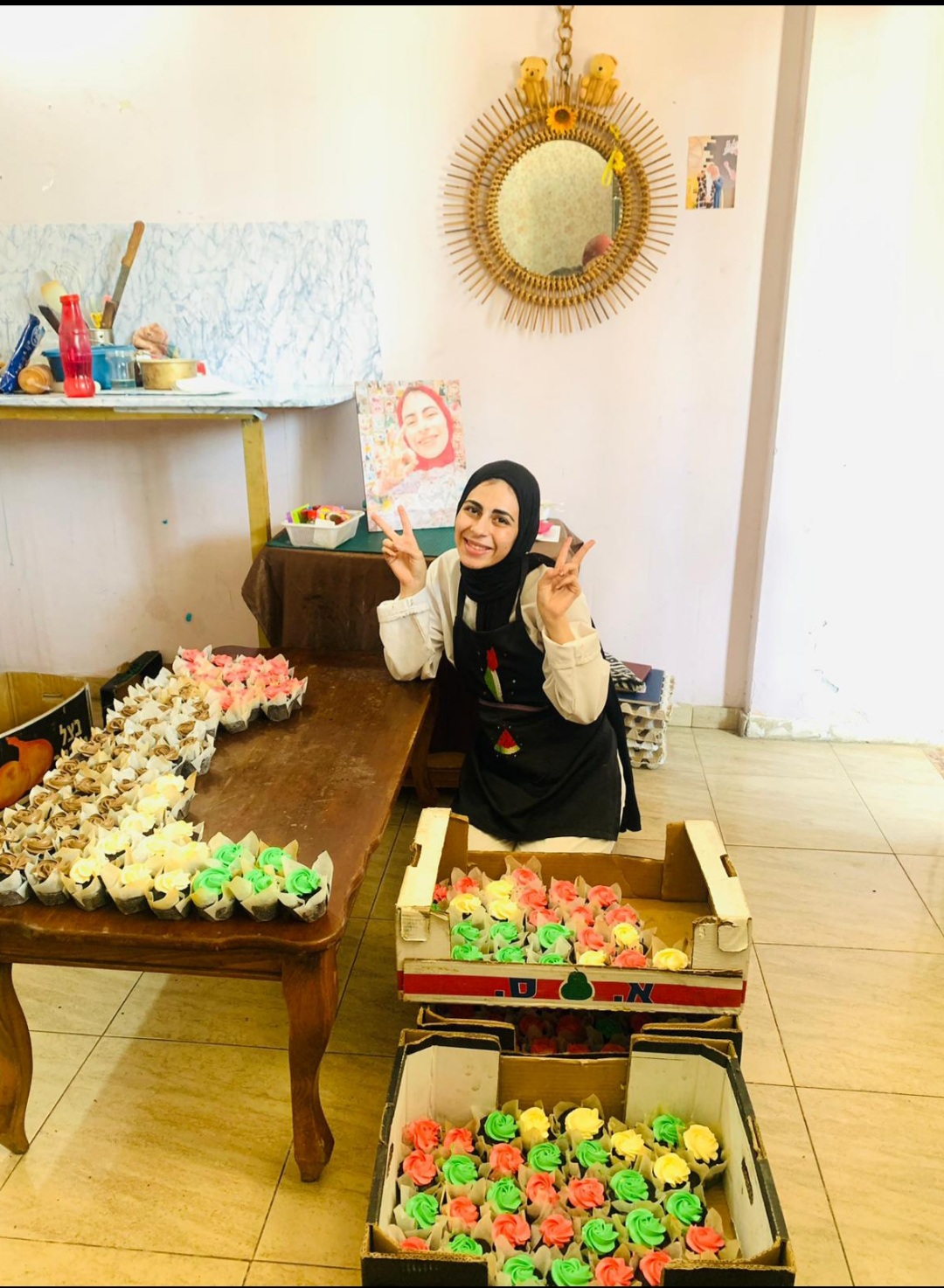
Her project became a source of joy for many families during the war. Parents ordered special cakes for their children’s birthdays in an attempt to offer them moments of happiness and momentarily erase the relentless experience of bombing and killing. As Al-Buhisi says, “Children have the right to feel joy. What we adults endured was unbearable — how could they not deserve a little happiness?”
Now, amid the so-called ceasefire that has in reality been characterized by ongoing attacks by the Israeli military on Palestinians, Al-Buhisi continues her work in the face of many challenges.
Food is still not available in the quantities that were common before the war, nor at the same prices. Food and fuel supplies are still limited, and even when traders manage to bring goods into Gaza, it costs them a great deal due to the blockade, which requires obtaining permission from the occupation authorities for any delivery.
I asked her, “What do you struggle with the most even after the ceasefire?”
Parents ordered special cakes for their children’s birthdays in an attempt to offer them moments of happiness and momentarily erase the relentless experience of bombing and killing.
She told me that she is still baking using the clay oven that she has had to rely on since 2023, and that making cakes with it is extremely difficult — especially during the summer, when it exhausts her completely. She added that the hardships are far from over: Eggs remain very expensive and difficult to find, even long after the official start of the ceasefire in January 2025.
And Al-Buhisi also carries with her the trauma of having lost her dearest and most beloved friend, Tasneem Abu Zakrya, who was killed by the Israeli army a year and a half ago in Al-Nuseirat during an operation carried out by the Israeli forces, supposedly to free Israeli prisoners held in Gaza. Al-Buhisi had talked on the phone with Abu Zakrya right before she was killed.
Moments after their conversation ended, Al-Buhisi received the devastating news — she learned that Abu Zakrya’s body had been reduced to fragments. Al-Buhisi told me that Abu Zakrya was not just a friend; she was part of Al-Buhisi’s soul and family.
Al-Buhisi’s decision to continue pursuing her dream doesn’t mean she is without pain. We all suffer, and we all carry the memories of the war and its hardships.
Dema with her cakes.
Yet what sets us apart — and reveals our true strength — is our ability to rise again, to return to life, and to hold on to what we love.
At the height of Israel’s attacks on Gaza this year, I thought children would never return to their education after their schools were destroyed or turned into shelters for the displaced. I wondered: What about university students whose campuses were completely erased? What about Al-Shifa Hospital, which rose again like a phoenix after being destroyed and besieged more times than we can count?
Yet somehow, even in this landscape of ruin, the universities — like the Islamic University and Al-Azhar University — have begun announcing their slow return. Not full reconstruction, but the first fragile signs of life. And some children, too, have found their way back to learning through small educational centers that have emerged from the rubble, trying to restore the rhythm of a stolen normalcy.
Just like Gaza’s “Cake Girl,” we keep moving forward, cherishing every small moment, and holding on to hope — as long as we remain alive.
This article is licensed under Creative Commons (CC BY-NC-ND 4.0), and you are free to share and republish under the terms of the license.
Yet what sets us apart — and reveals our true strength — is our ability to rise again, to return to life, and to hold on to what we love.
At the height of Israel’s attacks on Gaza this year, I thought children would never return to their education after their schools were destroyed or turned into shelters for the displaced. I wondered: What about university students whose campuses were completely erased? What about Al-Shifa Hospital, which rose again like a phoenix after being destroyed and besieged more times than we can count?
Yet somehow, even in this landscape of ruin, the universities — like the Islamic University and Al-Azhar University — have begun announcing their slow return. Not full reconstruction, but the first fragile signs of life. And some children, too, have found their way back to learning through small educational centers that have emerged from the rubble, trying to restore the rhythm of a stolen normalcy.
Just like Gaza’s “Cake Girl,” we keep moving forward, cherishing every small moment, and holding on to hope — as long as we remain alive.
This article is licensed under Creative Commons (CC BY-NC-ND 4.0), and you are free to share and republish under the terms of the license.
Dalia Abu Ramadan is a Palestinian storyteller and aspiring graduate of the Islamic University of Gaza, sharing powerful narratives that reflect the strength, resilience, and challenges of life in Gaza.
No comments:
Post a Comment