Back to Cold War?
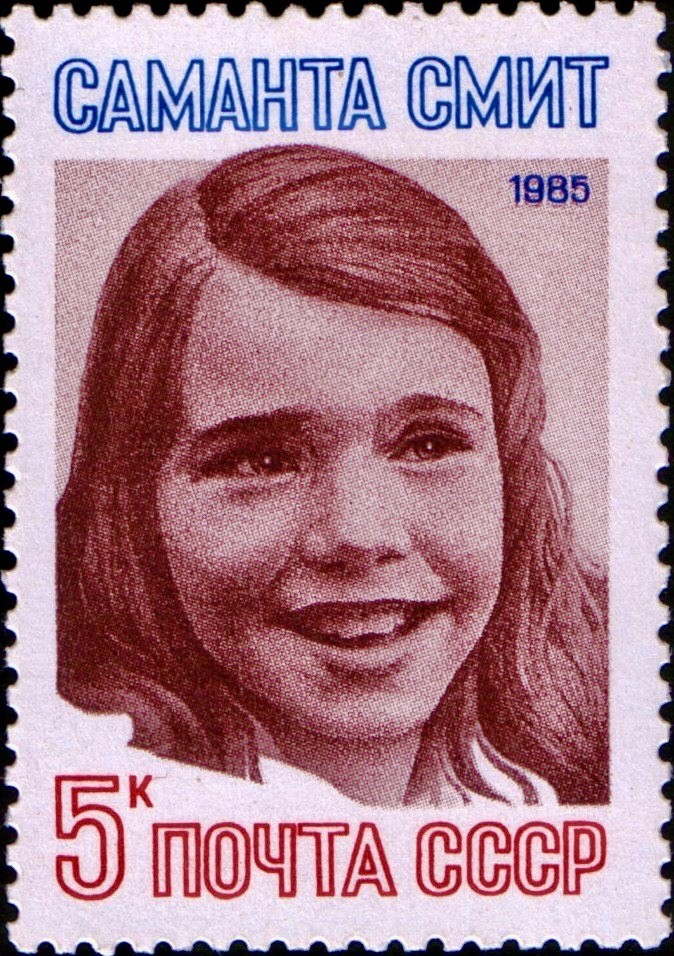
After ten-year-old American Samantha Smith wrote a letter to the leader of the Soviet Union, Yuri Andropov, expressing her fear of nuclear war, Andropov invited Smith to the Soviet Union. USSR stamp, Samantha Smith, 1985, 5 kopecks. Wikipedia, Public Domain.
During December 2025, the Editorial Board of the New York Times published several articles “on why the US military needs to reinvent itself.” It described the state of US military as “Overmatched,” presumably wishing to remind the readers that the US military is threatened by China and Russia. The Editorial Board opened its overview of the US military with the philosophical reflection that “Algorithms and autocrats have rattled global stability. To safeguard liberty, the US must remake its military. A free world needs a strong America.”
Cold War
This rhetoric reminded me of similar war hymns during the dark days of the so-called Cold War, 1945-1989. And indeed the editorial penned for publication on December 14, 2025, was devoted to the “triumph” of America during the Cold War.
“Trump,” says the editorial, “and his administration are grievously wrong to think the “America First” approach they’ve adopted meets the moment. America cannot adequately defend itself and its vital interests unless it recovers the strategies and instincts that served it well in its greatest triumph of the past century — not World War II, but the Cold War.”
There’s no doubt that rethinking the purpose and readiness of the military would be a step in the right direction. The military has been shaped primarily by military contractors and the vast corruption wedded to the billions they earn for proposing and constructing the weapons of the US military.
Drawing models from the near annihilating outcomes of the Cold War is wrong. The US did not win the Cold War. No one did. The Soviet Union and its leader Mikhail Gorbachev decided to abandon communism and empire for something better. Such a self-dismantlement of an empire had no precedent in history. I studied Russian and Soviet history at the University of Illinois. In vain I tried to find a legitimate reason for the collapse. This does not mean I supported the rule of Russia over other countries. No. And, of course, neither do I approve America ruling over other countries. Being Greek I know something about freedom. But neither could I be convinced that American military or American “soft power” had anything to do with the end of the Soviet Union or the end of the Cold War.
The New York Times is right saying: “A country’s military is only as good as the purpose to which it is harnessed. And the central purpose of American power should be to defend political liberty and the rule of law that undergirds it, against all enemies foreign and domestic…. That mission may be impossible for… [the Trump] administration whose defining trait is the assault on the rule of law, which is as much a foreign-policy crisis as it is a domestic one. The United States cannot lead the free world, inspire those who want to be a part of it, or oppose those who seek to undermine and destroy it if we cease to be a model democracy ourselves.”
Back to Gorbachev. His vision, as he explained it to President Reagan, was also unprecedented. The Soviet Union would become history. Yet Gorbachev also urged Reagan to agree with him and eliminate nuclear weapons.
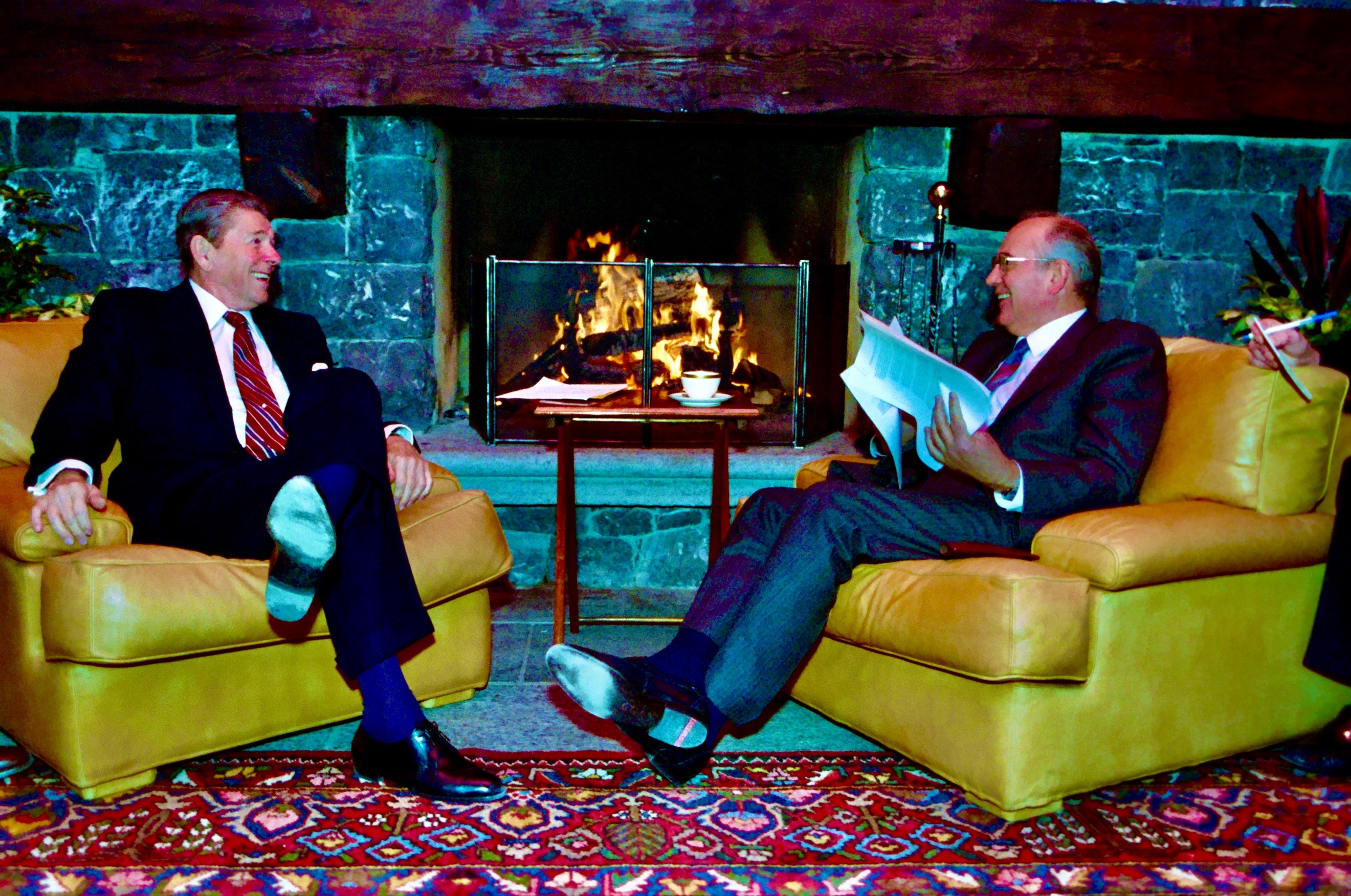
President Ronald Reagan and Soviet General Secretary Mikhail Gorbachev at the First Summit in Geneva Switzerland, 11/19/1985. Wikipedia, Public Domain.
Reagan agreed to reduce the number of nukes, but certainly not to their total elimination. His advisors falsely convinced him America would build a dome that would make the sky above the country impervious to nuclear weapons. The nonsense about a dome continues to this day. In the 2025 Trump National Security Strategy, we read:
“We want the world’s most robust, credible, and modern nuclear deterrent, plus next-generation missile defenses—including a Golden Dome for the American homeland—to protect the American people, American assets overseas, and American allies.”
The near nuclear war between the US and the Soviet Union in 1962 over the Soviet nuclear missiles in Cuba, convinced President John F. Kennedy, who saved the day, to plan nuclear disarmament, though he was assassinated in late 1963. This deadly confrontation between US and Soviet Union and the national tragedy of the assassination of President Kennedy taught nothing to the military advisors of Reagan, other presidents, including the advisors of Trump.
American diplomats, who invented the myth that American strategies and wars against impoverished countries like Vietnam, Laos, Cambodia, and Afghanistan, won the Cold War, promised Gorbachev that NATO would not take advantage of the disappearance of the Soviet Union and the Warshaw Pact military alliance, the Soviet equivalent of NATO. These promises were quickly forgotten. In the 1990s, the Clinton administration started recruiting former Soviet republics into NATO, countries like Bulgaria, Romania, Hungary, Lithuania, Estonia, Latvia, Poland, Slovakia, Czech Republic and Slovenia. The NATO expansion raised anxieties and strategic concerns to Russia that, repeatedly, warned NATO not to entice Ukraine to join it. But NATO recruiters continued and in 2014, with American soft power (money) overthrew Victor Yanukovych, leader of Ukraine who also did not want to join NATO. This started the war in Ukraine in 2014, a war between NATO-Ukraine and Russia.
Despite his unconventional and selfish policies, Trump is trying to bring the war in the Ukraine to an end, thus preventing another and potentially more dangerous Cold War / nuclear war. His National Security Strategy is urging “strategic stability with Russia.” Moreover, it shuts down any more NATO expansion. But Trump is threatening Venezuela with invasion and war to grab its oil. He is also a man who likes deals, especially deals that enrich him. He is extracting promises from Ukraine that US companies will exploit Ukrainian regions for rare earths.
Meanwhile, the war continues in Ukraine and Israel-Palestine-Middle East. Iran probably has built its own nukes. The Cold War rhetoric is pretty loud in Europe that has the dangerous and irresponsible illusion it can defeat Russia by arming Ukraine and the killing of Ukrainian and Russian soldiers.
Epilogue: Luck is not a Strategy
It’s possible we may avoid a repetition of the Cold War, but we are not too far from the precipice. On August 1, 2022, UN Chief Antonio Guterres addressed in New York the conference on the Non-Proliferation of Nuclear Weapons. He warned the world of the gathering storm of “nuclear danger not seen since the height of the Cold War”
Ukraine was in Guterres mind. But he explained that the war in the Ukraine between nuclear-armed states did not come out of nothing. He denounced the massive arsenals of some countries, though he was quick to point out that “entire regions declaring themselves to be nuclear-weapons-free.” He warned that luck has saved the world from “suicidal mistake of nuclear conflict.” He continued:
“But as the years have passed, these fruits of hope are withering. Humanity is in danger of forgetting the lessons forged in the terrifying fires of Hiroshima and Nagasaki. Geopolitical tensions are reaching new highs. Competition is trumping co-operation and collaboration. Distrust has replaced dialogue and disunity has replaced disarmament. States are seeking false security in stockpiling and spending hundreds of billions of dollars on doomsday weapons that have no place on our planet. Almost 13,000 nuclear weapons are now being held in arsenals around the world. All this at a time when the risks of proliferation are growing and guardrails to prevent escalation are weakening. And when crises — with nuclear undertones — are festering. From the Middle East and the Korean Peninsula. To the invasion of Ukraine by Russia, and to many other factors around the world. The clouds that parted following the end of the Cold War are gathering once more. We have been extraordinarily lucky so far. But luck is not a strategy. Nor is it a shield from geopolitical tensions boiling over into nuclear conflict…. Today, humanity is just one misunderstanding, one miscalculation away from nuclear annihilation.”

No comments:
Post a Comment