The so-called war on terror laid the foundations for Trump to turn international waters into one-sided battlefields.
By Emran Feroz ,
December 13, 2025
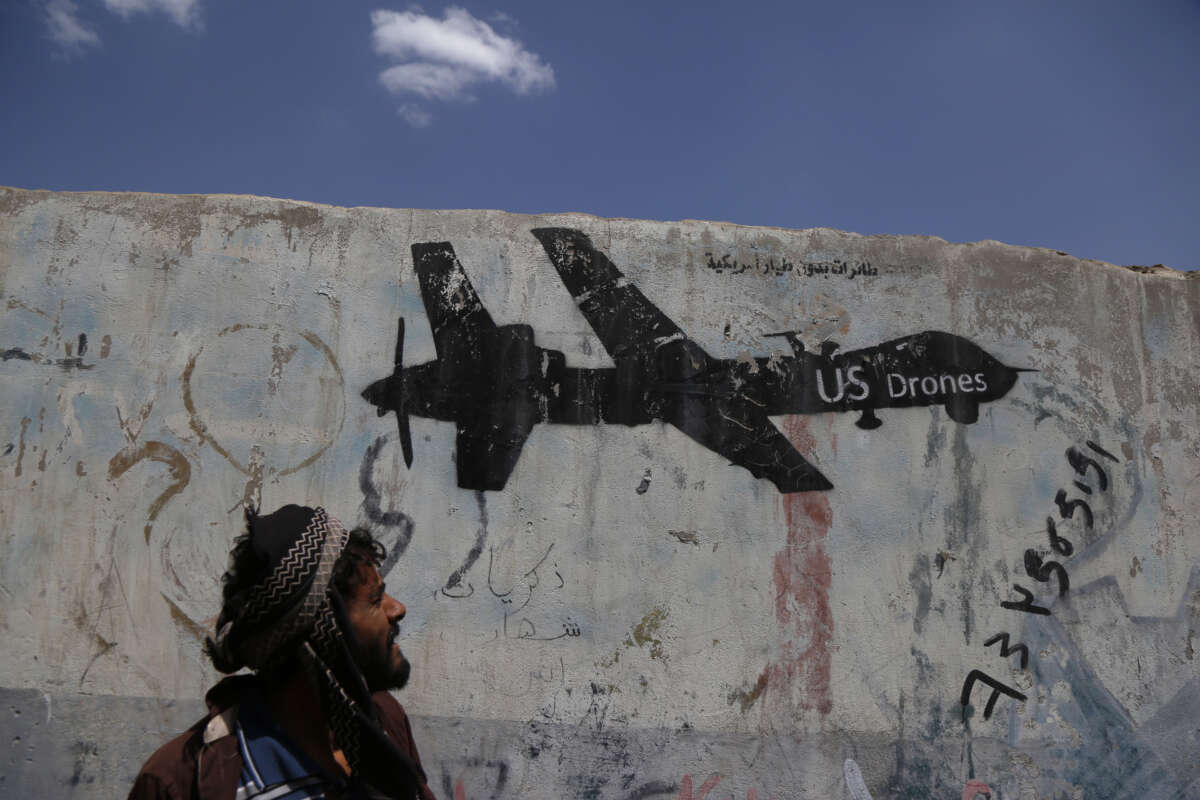
A Yemeni man looks at graffiti protesting against U.S. drone strikes on September 19, 2018, in Sana'a, Yemen.
Mohammed Hamoud / Getty Images
On September 2, 2025, a small fishing boat carrying 11 people was targeted by a U.S. Reaper drone off the coast of Venezuela. Hellfire missiles were fired. Two survivors clung to the wreckage. Their identities and motives were unknown. Their behavior showed no hostility. Moments later, the drone operator launched a second strike — the so-called “double tap” — killing the final survivors. This scene is shocking, but it should not be surprising to anyone who has followed the trajectory of the U.S.’s drone wars. This tactic is familiar from Afghanistan, Pakistan, Yemen, and, most recently, Gaza, where the Israeli military has used much worse violence to conduct genocide.
The U.S.’s first drone strike in the Caribbean, and the footage of the incident, reignited a debate about a conflict that Washington refuses to call a war — because it isn’t one. Instead, the Trump administration is using sheer violence to terrorize non-white populations and, as usual, has normalized lethal force far from declared battlefields and without any legal mandate.
U.S. Defense Secretary Pete Hegseth has approved at least 21 additional strikes in the Caribbean and eastern Pacific since September, killing at least 87 people. He has aggressively defended the very first operation, insisting he would have authorized the second strike as well — despite claiming he did not see it. Hegseth even misinterpreted the visible smoke on the video as the “fog of war,” seemingly unaware that the term refers to uncertainty in conflict, not the physical aftermath of a missile strike.
The details matter because they reveal something essential: the senior leadership overseeing these operations does not appear interested in the law, accuracy, or the basic meaning of proportionality. Instead, it has embraced escalation and mass murder as official policy.
Illegal Violence Dressed Up as Counter-Narcotics
Almost all legal experts agree that the U.S. strikes in the Caribbean violate international law. The Trump administration claims that suspected smugglers are “narco-terrorists” and therefore legitimate targets. But as Khalil Dewan, a legal scholar at London’s School of Oriental and African Studies who has studied U.S. and British drone programs for years, told me: “Drug trafficking is a crime, not an armed conflict.”
Related Story
On September 2, 2025, a small fishing boat carrying 11 people was targeted by a U.S. Reaper drone off the coast of Venezuela. Hellfire missiles were fired. Two survivors clung to the wreckage. Their identities and motives were unknown. Their behavior showed no hostility. Moments later, the drone operator launched a second strike — the so-called “double tap” — killing the final survivors. This scene is shocking, but it should not be surprising to anyone who has followed the trajectory of the U.S.’s drone wars. This tactic is familiar from Afghanistan, Pakistan, Yemen, and, most recently, Gaza, where the Israeli military has used much worse violence to conduct genocide.
The U.S.’s first drone strike in the Caribbean, and the footage of the incident, reignited a debate about a conflict that Washington refuses to call a war — because it isn’t one. Instead, the Trump administration is using sheer violence to terrorize non-white populations and, as usual, has normalized lethal force far from declared battlefields and without any legal mandate.
U.S. Defense Secretary Pete Hegseth has approved at least 21 additional strikes in the Caribbean and eastern Pacific since September, killing at least 87 people. He has aggressively defended the very first operation, insisting he would have authorized the second strike as well — despite claiming he did not see it. Hegseth even misinterpreted the visible smoke on the video as the “fog of war,” seemingly unaware that the term refers to uncertainty in conflict, not the physical aftermath of a missile strike.
The details matter because they reveal something essential: the senior leadership overseeing these operations does not appear interested in the law, accuracy, or the basic meaning of proportionality. Instead, it has embraced escalation and mass murder as official policy.
Illegal Violence Dressed Up as Counter-Narcotics
Almost all legal experts agree that the U.S. strikes in the Caribbean violate international law. The Trump administration claims that suspected smugglers are “narco-terrorists” and therefore legitimate targets. But as Khalil Dewan, a legal scholar at London’s School of Oriental and African Studies who has studied U.S. and British drone programs for years, told me: “Drug trafficking is a crime, not an armed conflict.”
Related Story

Trump’s Illegal Boat Strikes Recall Duterte’s “Drug War” Mass Killings
Former Philippine President Duterte awaits trial in the ICC for using the pretext of a drug war for his murder campaign. By Marjorie Cohn , Truthout December 5, 2025
U.S. Defense Secretary Pete Hegseth has approved at least 21 additional strikes in the Caribbean and eastern Pacific since September, killing at least 87 people.
International law permits lethal force outside war zones only to prevent imminent threats to life. There is no indication that any of the boats the U.S. targeted — including the one in the September 2 video — posed such a threat. Dewan is clear: these are extrajudicial killings taking place on the high seas.
Former Air Force drone technician Lisa Ling, who left the program under the Obama administration due to the civilian casualties she witnessed, shares the same assessment. “Suspicion of smuggling is not an imminent threat. Even if known traffickers were on board, it would not give the military the authority to launch missiles at a civilian vessel,” she told me. Ling emphasizes a point that U.S. officials seem intent on ignoring: The Caribbean is not a war zone.
Ling also raises a question the military prefers not to confront: Who bears responsibility? “We were taught to disobey unlawful orders,” she said. “I’m still waiting to see that principle applied to those who carried out strikes on civilian boats in international waters.”
A Pattern With a Long History
The U.S. drone program did not begin with Trump. Its first lethal strike took place on October 7, 2001, in Kandahar province, targeting Taliban founder Mullah Mohammad Omar. It missed and killed civilians instead. That pattern — high-value targets declared dead, only to reappear alive — became common. Figures like Osama bin Laden’s number-two Ayman al-Zawahiri and Sirajuddin Haqqani were repeatedly targeted with drone strikes, many of which killed civilians, only to reemerge alive.
What happens in the Caribbean today is not an anomaly. It is the outcome of two decades of policy decisions made by presidents of both parties.
As these failures accumulated, the program expanded geographically. Under George W. Bush, the CIA and U.S. military conducted strikes not only in Afghanistan and Iraq but also in Pakistan, Yemen, and Somalia — countries that were never formally declared war zones. The Bush administration embedded the idea that the “war on terror” should have no borders.
But many of the most consequential shifts happened under Barack Obama. He dramatically expanded covert operations, particularly in the Horn of Africa, and added other parts of the continent to the target map. Somalia is still being drone bombed by the U.S. today. The definition of a “combatant” widened beyond recognition. A 2012 New York Times investigation revealed that the Obama administration considered every “military-age male” near a strike zone to be an enemy fighter unless proven otherwise — an inversion of the most basic principles of civilian protection.
In fact, the prime example of this inhumane practice was the murder of a U.S. citizen himself: In October 2011, 16-year-old Abdulrahman al-Awlaki was killed by a U.S. drone strike in Yemen. After his death, Obama’s press secretary blamed Abdulrahman’s father, alleged al-Qaeda militant (and also a U.S. citizen) Anwar al-Awlaki for the aftermath. But Anwar was killed days prior his son, and in fact, the attack against him was illegal too.
Obama also institutionalized the weekly “kill list,” which evolved into a bureaucratic process for targeted killing. Critics warned at the time that any president could inherit this system and use it with fewer constraints. Trump did exactly that.
Trump Escalation and Total Blowback
Trump has not only expanded the use of drone strikes but also removed the few modest oversight mechanisms Obama left behind. Now, under his second administration, the U.S. is openly striking vessels in international waters with almost no pretext.
The administration’s argument — that these strikes disrupt drug smuggling — collapses under scrutiny. Criminal activity does not transform international waters into battlefields, and drug runners do not become combatants simply because Washington declares them so. In fact, this is the ultimate break with decades of legal norms. Nothing comparable exists in modern international law.
For years, critics of the war on terror have warned that a globalized drone program, paired with militarized domestic security agencies, would eventually produce consequences within the Americas too. That moment is here.
At least one family in Colombia has announced legal action after a fisherman, Alejandro Carranza, disappeared at sea. At the same time, Washington claimed to have killed “three violent drug-smuggling cartel members and narco-terrorists.” Carranza leaves behind a wife and five children.
What happens in the Caribbean today is not an anomaly. It is the outcome of two decades of policy decisions made by presidents of both parties. The world was declared a battlefield long before Trump returned to office. What we are seeing now is the cost of refusing to confront that reality.
This article is licensed under Creative Commons (CC BY-NC-ND 4.0), and you are free to share and republish under the terms of the license.
Emran Feroz is an Afghan-Austrian journalist, writer and activist currently based in Germany. He is the founder of Drone Memorial, a virtual memorial for civilian drone strike victims.
No comments:
Post a Comment