DESANTISLAND
Florida Sets the Record for Death Penalties This Year“We’re looking at execution roughly every 16 days,” said Grace Hanna of Floridians for Alternatives to the Death Penalty.
By Nayanika Guha ,
December 27, 2025
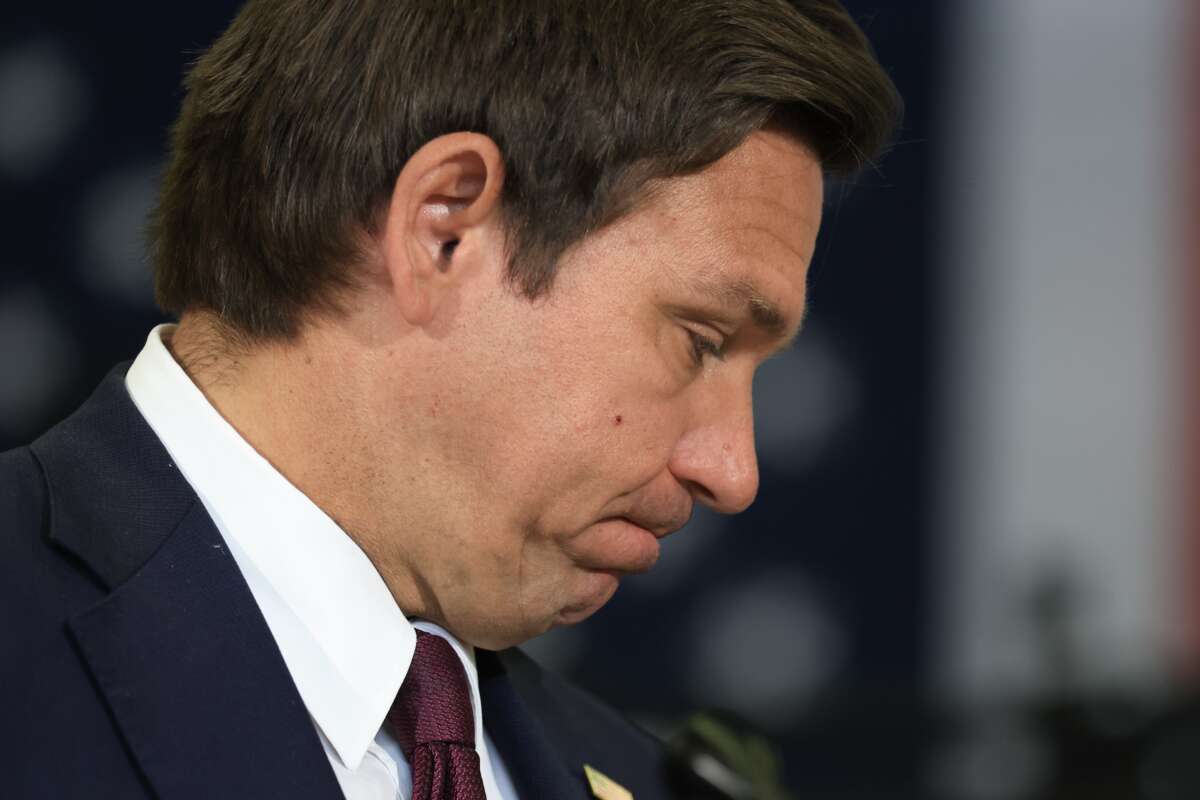
Florida Gov. Ron DeSantis speaks during a press conference on May 1, 2025, in Miramar, Florida. DeSantis has been criticized for setting executions and deciding clemency requests without providing any explanation for his decisions.
Joe Raedle / Getty Images
Edward Zakrzewski’s wife had known him since they were in the fourth grade. Growing up in the same neighborhood in Michigan, she and Zakrzewski had a close friendship. “I always had a crush on him, but I always knew that he was a ladies’ man in high school, and I was a good girl, so I wasn’t having that,” she said. As happens with many childhood friendships, they lost touch when her family moved away to Illinois. After decades of not being in touch, in a conversation with some old friends, she found out that Zakrzewski was on death row in Florida.
“I wrote him a letter, and all I said was, ‘I’m there for you if you need somebody to talk to, you probably don’t even remember me,’” she said. He wrote her back. “I went to visit him. And one thing led to another.” This December would have been their 11th marriage anniversary, but Zakrzewski was executed in July this year for the murder of his then-wife and their two children, in 1994.
His current wife did not want to be named to avoid attracting negative attention as the widow of a man who was executed. “It was like somebody had grabbed my heart and yanked it out of my chest,” she said when she heard that his execution warrant had been signed. “These guys are not all monsters. They are human beings that people exploit in the worst moments of their life. They don’t know the whole entire back story.”
Zakrzewski was an Air Force veteran who pled guilty without a plea agreement from the state, and only faced a jury for sentencing, according to a statement by Floridians for Alternatives to the Death Penalty (FADP). Almost half of his capital jury believed that the murders of his family were heavily mitigated by his exemplary military service and his “deep mental anguish” at the time of the crime. Five jurors wanted to spare his life for two of the murders, and six voted to sentence him to life without parole for the third, according to the same statement. But at the time, Florida law only required a simple majority to sentence someone to death row. Under Florida’s current law passed in 2023, Zakrzewski may not have qualified for execution, as the jury vote currently required for a death sentence is at least 8-4 (and is still the lowest in the nation).
His execution in July was the ninth execution in Florida in 2025, marking a state record for executions in one year since the restoration of the death penalty in the U.S. in 1976. The state surpassed its record of eight executions, which was set in 2014. Florida has executed 19 people since February 13, making it the state with the highest number of executions carried out in any given year since the death penalty was reinstated.

Trump Directs DOJ to Seek the Death Penalty in DC “in All Appropriate Cases”
Trump’s executive order is “designed to spread fear,” Free DC says, “something we know authoritarians always do.” By Elizabeth Weill-Greenberg , Truthout September 29, 2025
“That means we’re looking at execution roughly every 16 days. This is a really phenomenal pace,” said Grace Hanna, Executive Director of FADP. “In [some] other states, there have actually been court orders saying that they need to give 30 or 60 or even 90 days between executions to give the corrections staff time to regroup, but here in Florida, we have gone nonstop.”
In Florida, unlike most other states where the courts are heavily involved in the process, the governor has the sole authority to issue execution warrants. Current Gov. Ron DeSantis has been criticized for setting executions and deciding clemency requests without providing any explanation for his decisions.
“When you ask Governor DeSantis, he says it is for the victims’ families. And while that is certainly true in some cases, we also work with a lot of victims’ families who don’t want the death penalty and don’t feel that that honors their loved one’s legacy,” Hanna said. “I think also, we see political motivations. Perhaps, you know, President Trump has encouraged governors and the attorney general to pursue the death penalty whenever possible. We also look at any potential elections that are coming up, and does someone want to run as a tough on crime candidate.”
Donald Trump, in his first term, carried out a record number of federal executions during his last seven months in office, executing 13 individuals.
“He kind of set this precedent for how quickly you could go with the death penalty. And I think DeSantis for many reasons, wanted to either carry on that legacy or best that legacy,” Hanna said.
In 2023, Florida had a similar spree of executions, though 2025 has tripled that number. The six executions in 2023 followed three years of no executions in the state. In 2023, Governor DeSantis also launched his presidential campaign, and while Bridget Maloney, communications director for FADP, doesn’t “know that that was the reason why he [DeSantis] was doing so many … he was not doing any of them, and then was doing a lot.”
Further, on Trump’s first day in office, he signed an executive order titled “Restoring the Death Penalty and Protecting Public Safety,” encouraging a pro-punishment outlook and encouraging state attorneys general to bring capital charges.
“President Trump’s messaging around the death penalty really shows how out of touch he is with the views of the American public,” said Robin Maher, executive director of the Death Penalty Information Center. “His support for the death penalty is really a message from another era when public support for the death penalty was much higher than it is today, and at its time, that the American public didn’t have the same concerns about the death penalty, cost, effectiveness and accuracy.”
The punitive approach of Trump and Attorney General Pam Bondi, who was the Florida attorney general under Gov. Rick Scott’s administration, has impacted the number of death sentences carried out this year, according to Maloney. Under Scott’s administration, Florida executed eight people, the state record before 2025 for the number of executions in one year. “I think that our administration, Florida, has really taken all of those calls to the extreme,” Maloney said.
“My advice to those who are seeking to avoid the death penalty in Florida would be to not murder people,” said communications director Alex Lanfranconi when Truthout reached out to DeSantis’s office for comment.
Experts are concerned about the seemingly arbitrary nature of the selection process for whose execution warrant will be signed next. They have also expressed concerns about racial motivations for signing execution warrants and inadequate legal representation.
Kayle Bates, who was executed earlier this year in August, had previously gotten a stay on his execution and was ordered a new sentencing hearing due to ineffective counsel. He was ultimately given the death penalty again. Throughout his trials and appeals process, he had challenged being denied DNA testing, and argued that he was tried by a biased jury. Shortly before his planned execution, Bates, who is Black, brought a civil suit against DeSantis alleging Florida’s execution warrant process “is infected with racial discrimination and unconstitutional arbitrariness.” Included in the claim is a statistical analysis showing that “95% of the executions that Governor DeSantis has authorized involved white victims.” They also argued that a defendant who is convicted of killing a white victim is over fifteen times more likely to be executed than a defendant whose victims are not white.” It notes as well that “[n]early 88% of Florida’s modern executions have been for cases with white victims.”
Hours after the lawsuit was filed, DeSantis signed the execution warrant for Curtis Wyndham, who had killed three Black people. In the response to the lawsuit brought by Bates, DeSantis and his team said that four of the 21 warrants signed by Governor DeSantis have been for Black prisoners, which was true at the time that the response was filed, and the number as of today is that 6 of the 28 warrants signed have been for Black defendants. “They signed that warrant specifically to skew the numbers. And we know that this was a rushed warrant. We know that it wasn’t planned,” Hanna said. Prior to Wyndham’s warrant being signed, only 18 percent of the victims involved in those warrants were non-white victims.
“He was hopeful that that [the lawsuit] was going to give him some relief. I was hopeful of that also I thought it was a well litigated claim, and unfortunately, the courts did not,” said Thomas Dunn, a member of Bates’s legal team who became his longtime friend after he no longer represented him.
“Kayle had actually exhausted his first rounds of appeals, and at that point in time this case sat for many years and nothing happened, and I had convinced myself, and I think Kayle had convinced himself, that perhaps he wasn’t going to ever get an execution,” Dunn said. “When I found out that he got a warrant, it was, personally, very devastating to me. I represented hundreds of people facing the death penalty. Kayle’s the only one that was facing an execution.”
He was adamant that people continue to fight for him to the end, and his wish to his daughter and his sister and to Dunn was that they continue to talk about his case, Dunn said. “There’s two issues that still remain open. He had DNA in his case, which I think could have exculpated him. He was denied the testing of DNA evidence twice,” he said. “And then in the late stages of his federal litigation, after I left the case, it was determined that one of the victims’ second cousins, actually sat on the original jury.” The courts prohibited anyone on Kayle’s team from interviewing this person and denied the claim, saying it was 40 years too late, Dunn said.
“I thought we were going to have more time. And I know for years, he’s been pressing to get the DNA tested, and that’s what he wanted,” said Gabrielle Wise-Brice, Bates’s cousin. “The only thing that I felt that I could do was just keep advocating and just just ask, you know, for the DNA to be tested.”
Further, experts believe that the chance for anyone to receive clemency in Florida is also low. The board that decides on matters of clemency is made up of Governor DeSantis; Florida Attorney General James Uthmeier, who succeeded Ashley Moody and is a big proponent of the death penalty; State CFO Blaise Ingoglia, who sponsored the bill for non-unanimous juries being able to recommend the death penalty in 2023; and Commissioner of Agriculture Wilton Simpson.
For a clemency request to be granted, three of the four members need to vote in favor of it, including the governor, who also has sole discretion to deny the request. “Why on earth would two people who are solely responsible for signing and defending this warrant, then, you know, turn around and be objective as to whether or not the person deserves clemency, particularly with a third vote being somebody who led this expansion of the death penalty in the legislature?” said Maloney. “I think it really kind of shows how concentrated power is in Governor DeSantis and the attorney general’s hands.”
For those on death row and their loved ones, the system seems to be working against them. “Zak had made his peace with death, and he was okay with it. I think he was just more concerned on how I would handle it,” Zakrzewski’s widow said. “I feel like it doesn’t do any good to execute these men, because it’s not stifling our criminal records here…. It’s not doing anything and it’s taking away loved ones from people that love people on death row. I mean, it doesn’t make any sense…. They want to just go ahead and kill as many as they can.”
Copyright © Truthout. May not be reprinted without permission.
Nayanika Guha is a freelance writer who focuses on writing about social justice, identity and community. She has a background in psychology and social work, which informs her writing and world view. Her work has appeared in The Guardian, The Lily, Refinery 29, and more.
Edward Zakrzewski’s wife had known him since they were in the fourth grade. Growing up in the same neighborhood in Michigan, she and Zakrzewski had a close friendship. “I always had a crush on him, but I always knew that he was a ladies’ man in high school, and I was a good girl, so I wasn’t having that,” she said. As happens with many childhood friendships, they lost touch when her family moved away to Illinois. After decades of not being in touch, in a conversation with some old friends, she found out that Zakrzewski was on death row in Florida.
“I wrote him a letter, and all I said was, ‘I’m there for you if you need somebody to talk to, you probably don’t even remember me,’” she said. He wrote her back. “I went to visit him. And one thing led to another.” This December would have been their 11th marriage anniversary, but Zakrzewski was executed in July this year for the murder of his then-wife and their two children, in 1994.
His current wife did not want to be named to avoid attracting negative attention as the widow of a man who was executed. “It was like somebody had grabbed my heart and yanked it out of my chest,” she said when she heard that his execution warrant had been signed. “These guys are not all monsters. They are human beings that people exploit in the worst moments of their life. They don’t know the whole entire back story.”
Zakrzewski was an Air Force veteran who pled guilty without a plea agreement from the state, and only faced a jury for sentencing, according to a statement by Floridians for Alternatives to the Death Penalty (FADP). Almost half of his capital jury believed that the murders of his family were heavily mitigated by his exemplary military service and his “deep mental anguish” at the time of the crime. Five jurors wanted to spare his life for two of the murders, and six voted to sentence him to life without parole for the third, according to the same statement. But at the time, Florida law only required a simple majority to sentence someone to death row. Under Florida’s current law passed in 2023, Zakrzewski may not have qualified for execution, as the jury vote currently required for a death sentence is at least 8-4 (and is still the lowest in the nation).
His execution in July was the ninth execution in Florida in 2025, marking a state record for executions in one year since the restoration of the death penalty in the U.S. in 1976. The state surpassed its record of eight executions, which was set in 2014. Florida has executed 19 people since February 13, making it the state with the highest number of executions carried out in any given year since the death penalty was reinstated.
Trump Directs DOJ to Seek the Death Penalty in DC “in All Appropriate Cases”
Trump’s executive order is “designed to spread fear,” Free DC says, “something we know authoritarians always do.” By Elizabeth Weill-Greenberg , Truthout September 29, 2025
“That means we’re looking at execution roughly every 16 days. This is a really phenomenal pace,” said Grace Hanna, Executive Director of FADP. “In [some] other states, there have actually been court orders saying that they need to give 30 or 60 or even 90 days between executions to give the corrections staff time to regroup, but here in Florida, we have gone nonstop.”
In Florida, unlike most other states where the courts are heavily involved in the process, the governor has the sole authority to issue execution warrants. Current Gov. Ron DeSantis has been criticized for setting executions and deciding clemency requests without providing any explanation for his decisions.
“When you ask Governor DeSantis, he says it is for the victims’ families. And while that is certainly true in some cases, we also work with a lot of victims’ families who don’t want the death penalty and don’t feel that that honors their loved one’s legacy,” Hanna said. “I think also, we see political motivations. Perhaps, you know, President Trump has encouraged governors and the attorney general to pursue the death penalty whenever possible. We also look at any potential elections that are coming up, and does someone want to run as a tough on crime candidate.”
Donald Trump, in his first term, carried out a record number of federal executions during his last seven months in office, executing 13 individuals.
“He kind of set this precedent for how quickly you could go with the death penalty. And I think DeSantis for many reasons, wanted to either carry on that legacy or best that legacy,” Hanna said.
In 2023, Florida had a similar spree of executions, though 2025 has tripled that number. The six executions in 2023 followed three years of no executions in the state. In 2023, Governor DeSantis also launched his presidential campaign, and while Bridget Maloney, communications director for FADP, doesn’t “know that that was the reason why he [DeSantis] was doing so many … he was not doing any of them, and then was doing a lot.”
Further, on Trump’s first day in office, he signed an executive order titled “Restoring the Death Penalty and Protecting Public Safety,” encouraging a pro-punishment outlook and encouraging state attorneys general to bring capital charges.
“President Trump’s messaging around the death penalty really shows how out of touch he is with the views of the American public,” said Robin Maher, executive director of the Death Penalty Information Center. “His support for the death penalty is really a message from another era when public support for the death penalty was much higher than it is today, and at its time, that the American public didn’t have the same concerns about the death penalty, cost, effectiveness and accuracy.”
The punitive approach of Trump and Attorney General Pam Bondi, who was the Florida attorney general under Gov. Rick Scott’s administration, has impacted the number of death sentences carried out this year, according to Maloney. Under Scott’s administration, Florida executed eight people, the state record before 2025 for the number of executions in one year. “I think that our administration, Florida, has really taken all of those calls to the extreme,” Maloney said.
“My advice to those who are seeking to avoid the death penalty in Florida would be to not murder people,” said communications director Alex Lanfranconi when Truthout reached out to DeSantis’s office for comment.
Experts are concerned about the seemingly arbitrary nature of the selection process for whose execution warrant will be signed next. They have also expressed concerns about racial motivations for signing execution warrants and inadequate legal representation.
Kayle Bates, who was executed earlier this year in August, had previously gotten a stay on his execution and was ordered a new sentencing hearing due to ineffective counsel. He was ultimately given the death penalty again. Throughout his trials and appeals process, he had challenged being denied DNA testing, and argued that he was tried by a biased jury. Shortly before his planned execution, Bates, who is Black, brought a civil suit against DeSantis alleging Florida’s execution warrant process “is infected with racial discrimination and unconstitutional arbitrariness.” Included in the claim is a statistical analysis showing that “95% of the executions that Governor DeSantis has authorized involved white victims.” They also argued that a defendant who is convicted of killing a white victim is over fifteen times more likely to be executed than a defendant whose victims are not white.” It notes as well that “[n]early 88% of Florida’s modern executions have been for cases with white victims.”
Hours after the lawsuit was filed, DeSantis signed the execution warrant for Curtis Wyndham, who had killed three Black people. In the response to the lawsuit brought by Bates, DeSantis and his team said that four of the 21 warrants signed by Governor DeSantis have been for Black prisoners, which was true at the time that the response was filed, and the number as of today is that 6 of the 28 warrants signed have been for Black defendants. “They signed that warrant specifically to skew the numbers. And we know that this was a rushed warrant. We know that it wasn’t planned,” Hanna said. Prior to Wyndham’s warrant being signed, only 18 percent of the victims involved in those warrants were non-white victims.
“He was hopeful that that [the lawsuit] was going to give him some relief. I was hopeful of that also I thought it was a well litigated claim, and unfortunately, the courts did not,” said Thomas Dunn, a member of Bates’s legal team who became his longtime friend after he no longer represented him.
“Kayle had actually exhausted his first rounds of appeals, and at that point in time this case sat for many years and nothing happened, and I had convinced myself, and I think Kayle had convinced himself, that perhaps he wasn’t going to ever get an execution,” Dunn said. “When I found out that he got a warrant, it was, personally, very devastating to me. I represented hundreds of people facing the death penalty. Kayle’s the only one that was facing an execution.”
He was adamant that people continue to fight for him to the end, and his wish to his daughter and his sister and to Dunn was that they continue to talk about his case, Dunn said. “There’s two issues that still remain open. He had DNA in his case, which I think could have exculpated him. He was denied the testing of DNA evidence twice,” he said. “And then in the late stages of his federal litigation, after I left the case, it was determined that one of the victims’ second cousins, actually sat on the original jury.” The courts prohibited anyone on Kayle’s team from interviewing this person and denied the claim, saying it was 40 years too late, Dunn said.
“I thought we were going to have more time. And I know for years, he’s been pressing to get the DNA tested, and that’s what he wanted,” said Gabrielle Wise-Brice, Bates’s cousin. “The only thing that I felt that I could do was just keep advocating and just just ask, you know, for the DNA to be tested.”
Further, experts believe that the chance for anyone to receive clemency in Florida is also low. The board that decides on matters of clemency is made up of Governor DeSantis; Florida Attorney General James Uthmeier, who succeeded Ashley Moody and is a big proponent of the death penalty; State CFO Blaise Ingoglia, who sponsored the bill for non-unanimous juries being able to recommend the death penalty in 2023; and Commissioner of Agriculture Wilton Simpson.
For a clemency request to be granted, three of the four members need to vote in favor of it, including the governor, who also has sole discretion to deny the request. “Why on earth would two people who are solely responsible for signing and defending this warrant, then, you know, turn around and be objective as to whether or not the person deserves clemency, particularly with a third vote being somebody who led this expansion of the death penalty in the legislature?” said Maloney. “I think it really kind of shows how concentrated power is in Governor DeSantis and the attorney general’s hands.”
For those on death row and their loved ones, the system seems to be working against them. “Zak had made his peace with death, and he was okay with it. I think he was just more concerned on how I would handle it,” Zakrzewski’s widow said. “I feel like it doesn’t do any good to execute these men, because it’s not stifling our criminal records here…. It’s not doing anything and it’s taking away loved ones from people that love people on death row. I mean, it doesn’t make any sense…. They want to just go ahead and kill as many as they can.”
Copyright © Truthout. May not be reprinted without permission.
Nayanika Guha is a freelance writer who focuses on writing about social justice, identity and community. She has a background in psychology and social work, which informs her writing and world view. Her work has appeared in The Guardian, The Lily, Refinery 29, and more.


No comments:
Post a Comment