
Experts Say Even Average Venezuelans Critical of Maduro Won’t Back Regime Change
A US military attack “would bring more chaos, more poverty,” one Caracas resident said.
By Rodrigo Acuña ,
Truthout
PublishedDecember 16, 2025

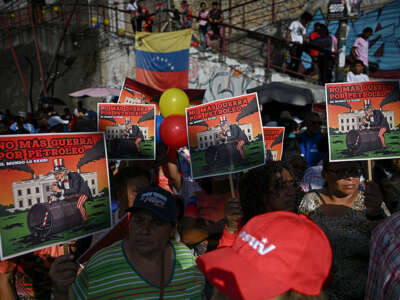
Inside Venezuela, the people Truthout spoke to for this article said that, while they are certainly following the crisis, most people are continuing with their daily lives. According to Fanny Chacón Sánchez, a 39-year-old mother of two who works for a government bank, “the way [the] international media portray things on social networks looks like a completely different reality.” Chacón notes that although the U.S. Navy’s actions are on people’s minds, this is “just another chapter of the illegal blockade we already know” that “suffocate[s] us” — a reference to the U.S. economic sanctions on Venezuela which commenced in 2005.
Living in a state-built apartment, which she is paying off at affordable rates though the government’s massive housing program known as Gran Misión Vivienda Venezuela (Great Mission Housing Venezuela), Chacón used to live in New Horizon, which is part of Catia, one of Venezuela’s largest, poorest and most densely populated areas. A supporter of the Maduro government, Chacón says on the streets of Caracas:
People are focused on their own stuff: working, making ends meet, and now, even more so, getting Christmas ready for the kids. Making sure there are Christmas bonuses and the Nativity scene. Life continues on its “normal” course, as much as this harsh reality allows. It’s not that we ignore everything else; it’s that we’ve been resisting for years and we’re not going to stop now.
Anais Márques, a communal leader at the 5 de Marzo Commune in Caracas, a grassroots community organization in El Valle neighborhood that comprises around 2,270 working-class families, shared a similar perspective with Truthout. With life continuing largely as normal, Márques notes the recent November election in which more than 5,300 community circuits (communes) voted to pick which community proposed projects will obtain state funding. According to Márques, the election saw “civic participation” as “several communal councils renewed their spokespersons through secret ballots.”
Rodrigo Acuña holds a PhD on Venezuelan foreign policy from Macquarie University. Together with journalist Nicolas Ford, last year he released his first documentary Venezuela: The Cost of Challenging an Empire. Rodrigo has been writing on Latin American politics for close to 20 years and publishes a newsletter on Latin America. He works the NSW Department of Education and can be followed on X (Twitter) @rodrigoac7.
A woman walks past graffiti against U.S. President Donald Trump on March 26, 2020, in Caracas, Venezuela.Leonardo Fernandez Viloria / Getty Images
Truthout’s December fundraiser is our most important of the year and will determine the scale of work we will be able to do in 2026. Please support us with a tax-deductible donation today.
President Donald Trump has escalated threats against Venezuelan President Nicolás Maduro in recent weeks, and reports now say the Trump administration is preparing for the days after a potential Maduro overthrow.
What might happen in such a scenario? In November, Michael Crowley at The New York Times pursued this question by reminding readers that, during Trump’s first term, U.S. officials were asked to run a war game to examine what Venezuela in a post-Maduro era would look like. According to Douglas Farah, a national security consultant who specializes in Latin America, the war game showed that the overthrow of Maduro would yield “chaos for a sustained period of time with no possibility of ending it.” Crowley, at his end, adds that the results of the exercise note that “chaos and violence were likely to erupt within Venezuela, as military units, rival political factions and even jungle-based guerrilla groups jockeyed for control of the oil-rich country.”
Currently, no such chaos has erupted in Venezuela despite at least 95 people having been killed by the United States military in the Caribbean Sea and Eastern Pacific as of December 16. Although the White House has repeatedly alleged that those targeted have been involved in smuggling narcotics into the U.S. mainland, the Trump administration has yet to produce any evidence to support its claims.
At least 95 people have been killed by the United States military in the Caribbean Sea and Eastern Pacific.
At the end of November, Trump took to social media, stating: “To all Airlines, Pilots, Drug Dealers, and Human Traffickers, please consider THE AIRSPACE ABOVE AND SURROUNDING VENEZUELA TO BE CLOSED IN ITS ENTIRETY.” And on December 10, Trump told journalists that the U.S. had recently “seized a tanker on the coast of Venezuela, a large tanker, very large, the largest one ever seized actually.” The Venezuelan government condemned the seizure as “blatant theft and an act of international piracy.”
With the arrival of the USS Gerald R. Ford aircraft carrier group in the Caribbean Sea in November, and media reports indicating that there are now 15,000 U.S. troops in the region and approximately 5,000 personnel at bases in Puerto Rico, there are two likely outcomes: Trump is either bluffing to see if the Venezuelan military will carry out a coup against Maduro, or worse, is actually planning for the U.S. to attack Venezuela militarily. Meanwhile, a recent poll conducted by CBS News concluded that 70 percent of people in the United States are opposed to the Trump administration taking military action against Venezuela.
Related Story
Truthout’s December fundraiser is our most important of the year and will determine the scale of work we will be able to do in 2026. Please support us with a tax-deductible donation today.
President Donald Trump has escalated threats against Venezuelan President Nicolás Maduro in recent weeks, and reports now say the Trump administration is preparing for the days after a potential Maduro overthrow.
What might happen in such a scenario? In November, Michael Crowley at The New York Times pursued this question by reminding readers that, during Trump’s first term, U.S. officials were asked to run a war game to examine what Venezuela in a post-Maduro era would look like. According to Douglas Farah, a national security consultant who specializes in Latin America, the war game showed that the overthrow of Maduro would yield “chaos for a sustained period of time with no possibility of ending it.” Crowley, at his end, adds that the results of the exercise note that “chaos and violence were likely to erupt within Venezuela, as military units, rival political factions and even jungle-based guerrilla groups jockeyed for control of the oil-rich country.”
Currently, no such chaos has erupted in Venezuela despite at least 95 people having been killed by the United States military in the Caribbean Sea and Eastern Pacific as of December 16. Although the White House has repeatedly alleged that those targeted have been involved in smuggling narcotics into the U.S. mainland, the Trump administration has yet to produce any evidence to support its claims.
At least 95 people have been killed by the United States military in the Caribbean Sea and Eastern Pacific.
At the end of November, Trump took to social media, stating: “To all Airlines, Pilots, Drug Dealers, and Human Traffickers, please consider THE AIRSPACE ABOVE AND SURROUNDING VENEZUELA TO BE CLOSED IN ITS ENTIRETY.” And on December 10, Trump told journalists that the U.S. had recently “seized a tanker on the coast of Venezuela, a large tanker, very large, the largest one ever seized actually.” The Venezuelan government condemned the seizure as “blatant theft and an act of international piracy.”
With the arrival of the USS Gerald R. Ford aircraft carrier group in the Caribbean Sea in November, and media reports indicating that there are now 15,000 U.S. troops in the region and approximately 5,000 personnel at bases in Puerto Rico, there are two likely outcomes: Trump is either bluffing to see if the Venezuelan military will carry out a coup against Maduro, or worse, is actually planning for the U.S. to attack Venezuela militarily. Meanwhile, a recent poll conducted by CBS News concluded that 70 percent of people in the United States are opposed to the Trump administration taking military action against Venezuela.
Related Story
Inside Venezuela, the people Truthout spoke to for this article said that, while they are certainly following the crisis, most people are continuing with their daily lives. According to Fanny Chacón Sánchez, a 39-year-old mother of two who works for a government bank, “the way [the] international media portray things on social networks looks like a completely different reality.” Chacón notes that although the U.S. Navy’s actions are on people’s minds, this is “just another chapter of the illegal blockade we already know” that “suffocate[s] us” — a reference to the U.S. economic sanctions on Venezuela which commenced in 2005.
Living in a state-built apartment, which she is paying off at affordable rates though the government’s massive housing program known as Gran Misión Vivienda Venezuela (Great Mission Housing Venezuela), Chacón used to live in New Horizon, which is part of Catia, one of Venezuela’s largest, poorest and most densely populated areas. A supporter of the Maduro government, Chacón says on the streets of Caracas:
People are focused on their own stuff: working, making ends meet, and now, even more so, getting Christmas ready for the kids. Making sure there are Christmas bonuses and the Nativity scene. Life continues on its “normal” course, as much as this harsh reality allows. It’s not that we ignore everything else; it’s that we’ve been resisting for years and we’re not going to stop now.
Anais Márques, a communal leader at the 5 de Marzo Commune in Caracas, a grassroots community organization in El Valle neighborhood that comprises around 2,270 working-class families, shared a similar perspective with Truthout. With life continuing largely as normal, Márques notes the recent November election in which more than 5,300 community circuits (communes) voted to pick which community proposed projects will obtain state funding. According to Márques, the election saw “civic participation” as “several communal councils renewed their spokespersons through secret ballots.”
Anais Márques, a leader at the 5 de Marzo Commune in Caracas, poses with members of her commune on November 27, 2025.Yrina Mejías
In Márques’s opinion, “both Chávez and now Maduro have always had the support and backing of an organized, mobilized people,” which “is why they still haven’t defeated us.” Believing that Maduro will resolve the crisis, Márques highlights the civic-military union that exists between the government and the armed forces, stating: “We have a people and we have soldiers, and the soldiers have the people.”
Although mainstream reporting in favor of overthrowing Maduro often (and rather conveniently) ignores this fact, former Venezuelan President Hugo Chávez’s political movement was originally born in the barracks when he was a soldier in the 1980s. Chávez’s came to power through an election in 1999, then suffered a short-lived U.S.-backed coup d’etat in 2002 headed by the upper echelons of the armed forces. Subsequently Chávez proceeded to purge the army and cement his doctrine of Latin American-style socialism. From 2007, Venezuela’s armed forces adopted the slogan: “Patria, socialismo o muerte! Venceremos!” (“Fatherland, socialism or death! We will prevail!”)
With a different perspective from those of Chacón and Márques, Antonio Gonzalez Plessmann, a human rights activist in Caracas and militant leftist since the 1980s, no longer supports Maduro. Plessmann thinks Venezuelans’ main anxiety remains “economic precariousness” and says household incomes for an average family of four cannot cover the cost of food and basic necessities. As a result, Plessmann told Truthout, many people have “several jobs to make ends meet,” a situation that is not uncommon throughout many Latin American countries.
“Madurismo is a mutation of Chavismo, which separates from the strategic postulates of the Bolivarian Revolution: popular participation, democratic radicalism, and anti-capitalist orientation,” Plessmann says. Former President Chávez, in his view, “was hated by Fedecámaras [the main business association] and loved by the poor” while Maduro is “loved by Fedecámaras” and “despised by the majority of the popular sectors, many of whom were once Chavistas.” While Washington has attempted “regime change” on several occasions against Venezuela’s head of state, Plessmann says, Maduro now finds himself “at one of his weakest moments: He lacks popular support and real backing from much of Latin America.”
According to one survey in September, 65 percent of Venezuelans rated Maduro’s management of the country positively, 28 percent said they had a negative opinion, while 7 percent answered with either don’t know or no answer.
“Democracy Now! co-host Juan González asserted in a recent interview with Jyotishman Mudiar, host of the “India & Global Left” podcast, that if the United States attacks Venezuela militarily, the conflict will broaden throughout Latin America. Observing that Maduro has already “put out a call for international volunteers to come to Venezuela to support the Bolivarian Revolution,” González argued that Cubans, Nicaraguans, and Colombians “will be a part of that resistance.” Elaborating on his comments on Colombia, González stated that, up until recently, the country had the “single largest and most extensive revolutionary movement in the history of Latin America,” as was the case with the Revolutionary Armed Forces of Colombia that demobilized in 2016 after reaching a peace agreement with the government.
Colombia’s second-largest guerrilla movement, the Army of National Liberation (ELN) has yet to reach an agreement with the administration of Gustavo Petro, who presides over a broad-left coalition. According to a report from the International Crisis Group, whose analysis is often in line with U.S. political establishment, the ELN “has repeatedly stated its commitment to defend the Maduro government, and has promised to turn its fire on any foreign forces that intervene in the region; its expertise includes use of improvised explosives and, more recently, armed drones.”
While there is no hard evidence of complicity between the Maduro administration at the highest levels and the ELN, the current government in Caracas and the guerrillas are, broadly speaking, both influenced by liberation theology, the Cuban Revolution, and the 18th-century independence fighter Simón Bolívar’s calls for regional unification among Latin American countries. According to the Washington Office on Latin America, the ELN in April this year numbered over 6,000 active guerrillas, while a local report in Colombia claims about 20 percent of the rebels operate in the region of Catatumbo, on the northern border with Venezuela.
González also noted that China has become an important factor in Washington’s calculations and aggression toward Venezuela, given that it has become the main purchaser of the country’s oil. “At one point, something like 70 percent of Venezuela’s oil was going to China,” says González, with that figure now down to “about 45 percent” However, it still remains the largest buyer of the South American country’s oil. As with the case of Panama, where the government ended the Central American country’s participation in China’s Belt and Road Initiative after Trump issued a series of threats ranging from increasing trade tariffs to an outright military invasion to take back the Panama Canal, Trump’s advisers cannot be looking at Beijing’s growing economic presence in Latin America kindly.
Miguel Tinker Salas, a professor of Latin American history at Pomona College in Claremont, California, told Truthout that the massive military deployment off the coast of Venezuela, the exuberant negative press campaign against the Maduro administration, and the crushing economic sanctions all look to “expose fissures within the Venezuelan military and the political apparatus of the governing party.” He adds that despite this pressure, “the concerted campaign fissures have not materialized” as the majority of “Venezuelans are firmly opposed to a U.S. intervention.” From Tinker’s perspective, the majority of Venezuelans reject violence as a tactic to obtain political change.
At Washington’s end, Tinker says Trump’s new approach “involves efforts to isolate China, which has gained an important foothold in the past 20 years” while “investing close to a billion dollars to produce oil in Lake Maracaibo,” — a region located in the northwest of Venezuela in the state of Zulia, which accounts for most of the country’s oil production. Tinker told Truthout he thinks U.S. military forces are aiming for an extended stay in the Caribbean as part of a “Western Hemisphere Strategy.”
Any administration imposed through force will face a “crisis of legitimacy, especially if they begin to implement neoliberal economic policies as they have proposed.”
The problem, he says, is that “U.S.-led efforts at regime change have been disastrous” and any administration imposed through force will face a “crisis of legitimacy, especially if they begin to implement neoliberal economic policies as they have proposed.” He adds that while “important segments of the population may be critical of Maduro,” these Venezuelans “will not stand idly by and allow their rights to be subverted.”
Steve Ellner is a retired professor of economic history and political science from the Universidad de Oriente in Venezuela, where he lived for over 40 years. As things currently stand in the crisis, “the most likely scenario is an extended siege,” because “the other options at this point are too risky for Washington,” Ellner told Truthout. Elaborating on this point, he added:
Venezuela has advanced weapons systems from Russia and training which Washington claims comes from the Wagner mercenaries. It doesn’t matter who does the training; from Caracas’s viewpoint the training is absolutely justifiable, given the intensity and prolonged nature of the threat. From a political viewpoint it’s unlikely that Trump would just pull out, since he would face intense criticism and a loss of MAGA support given everything that has been done up until now.
Back in Caracas, according to Ellner, “many non-Chavistas and anti-Chavistas are enrolling in the militia.” Asked about an article published in The New York Times in October that claimed that secret negotiations around Venezuela’s resources were taking place in order to avoid a military conflict, Ellner said the chance they succeed should not be dismissed entirely. “Maduro,” claimed Ellner, “is willing to make concessions … which would allow Trump to spin a narrative that the U.S. got what it wants.” Such concessions might include handing over individuals accused of being involved in the drug trade as well as “concessions regarding Venezuela’s oil reserves.”
Márques, like all the Venezuelans Truthout spoke to, is hopeful the crisis will be resolved. “It has taken so much effort to achieve our independence, and we cannot believe that a U.S. military intervention in Venezuela would bring stability,” she said. “Without a doubt,” she added, a U.S. military attack “would bring more chaos, more poverty — especially for the working class.”
Our most important fundraising appeal of the year
December is the most critical time of year for Truthout, because our nonprofit news is funded almost entirely by individual donations from readers like you. So before you navigate away, we ask that you take just a second to support Truthout with a tax-deductible donation.
This year is a little different. We are up against a far-reaching, wide-scale attack on press freedom coming from the Trump administration. 2025 was a year of frightening censorship, news industry corporate consolidation, and worsening financial conditions for progressive nonprofits across the board.
We can only resist Trump’s agenda by cultivating a strong base of support. The right-wing mediasphere is funded comfortably by billionaire owners and venture capitalist philanthropists. At Truthout, we have you.
We’ve set an ambitious target for our year-end campaign — a goal of $230,000 to keep up our fight against authoritarianism in 2026. Please take a meaningful action in this fight: make a one-time or monthly donation to Truthout before December 31. If you have the means, please dig deep.
This article is licensed under Creative Commons (CC BY-NC-ND 4.0), and you are free to share and republish under the terms of the license.
In Márques’s opinion, “both Chávez and now Maduro have always had the support and backing of an organized, mobilized people,” which “is why they still haven’t defeated us.” Believing that Maduro will resolve the crisis, Márques highlights the civic-military union that exists between the government and the armed forces, stating: “We have a people and we have soldiers, and the soldiers have the people.”
Although mainstream reporting in favor of overthrowing Maduro often (and rather conveniently) ignores this fact, former Venezuelan President Hugo Chávez’s political movement was originally born in the barracks when he was a soldier in the 1980s. Chávez’s came to power through an election in 1999, then suffered a short-lived U.S.-backed coup d’etat in 2002 headed by the upper echelons of the armed forces. Subsequently Chávez proceeded to purge the army and cement his doctrine of Latin American-style socialism. From 2007, Venezuela’s armed forces adopted the slogan: “Patria, socialismo o muerte! Venceremos!” (“Fatherland, socialism or death! We will prevail!”)
With a different perspective from those of Chacón and Márques, Antonio Gonzalez Plessmann, a human rights activist in Caracas and militant leftist since the 1980s, no longer supports Maduro. Plessmann thinks Venezuelans’ main anxiety remains “economic precariousness” and says household incomes for an average family of four cannot cover the cost of food and basic necessities. As a result, Plessmann told Truthout, many people have “several jobs to make ends meet,” a situation that is not uncommon throughout many Latin American countries.
“Madurismo is a mutation of Chavismo, which separates from the strategic postulates of the Bolivarian Revolution: popular participation, democratic radicalism, and anti-capitalist orientation,” Plessmann says. Former President Chávez, in his view, “was hated by Fedecámaras [the main business association] and loved by the poor” while Maduro is “loved by Fedecámaras” and “despised by the majority of the popular sectors, many of whom were once Chavistas.” While Washington has attempted “regime change” on several occasions against Venezuela’s head of state, Plessmann says, Maduro now finds himself “at one of his weakest moments: He lacks popular support and real backing from much of Latin America.”
According to one survey in September, 65 percent of Venezuelans rated Maduro’s management of the country positively, 28 percent said they had a negative opinion, while 7 percent answered with either don’t know or no answer.
“Democracy Now! co-host Juan González asserted in a recent interview with Jyotishman Mudiar, host of the “India & Global Left” podcast, that if the United States attacks Venezuela militarily, the conflict will broaden throughout Latin America. Observing that Maduro has already “put out a call for international volunteers to come to Venezuela to support the Bolivarian Revolution,” González argued that Cubans, Nicaraguans, and Colombians “will be a part of that resistance.” Elaborating on his comments on Colombia, González stated that, up until recently, the country had the “single largest and most extensive revolutionary movement in the history of Latin America,” as was the case with the Revolutionary Armed Forces of Colombia that demobilized in 2016 after reaching a peace agreement with the government.
Colombia’s second-largest guerrilla movement, the Army of National Liberation (ELN) has yet to reach an agreement with the administration of Gustavo Petro, who presides over a broad-left coalition. According to a report from the International Crisis Group, whose analysis is often in line with U.S. political establishment, the ELN “has repeatedly stated its commitment to defend the Maduro government, and has promised to turn its fire on any foreign forces that intervene in the region; its expertise includes use of improvised explosives and, more recently, armed drones.”
While there is no hard evidence of complicity between the Maduro administration at the highest levels and the ELN, the current government in Caracas and the guerrillas are, broadly speaking, both influenced by liberation theology, the Cuban Revolution, and the 18th-century independence fighter Simón Bolívar’s calls for regional unification among Latin American countries. According to the Washington Office on Latin America, the ELN in April this year numbered over 6,000 active guerrillas, while a local report in Colombia claims about 20 percent of the rebels operate in the region of Catatumbo, on the northern border with Venezuela.
González also noted that China has become an important factor in Washington’s calculations and aggression toward Venezuela, given that it has become the main purchaser of the country’s oil. “At one point, something like 70 percent of Venezuela’s oil was going to China,” says González, with that figure now down to “about 45 percent” However, it still remains the largest buyer of the South American country’s oil. As with the case of Panama, where the government ended the Central American country’s participation in China’s Belt and Road Initiative after Trump issued a series of threats ranging from increasing trade tariffs to an outright military invasion to take back the Panama Canal, Trump’s advisers cannot be looking at Beijing’s growing economic presence in Latin America kindly.
Miguel Tinker Salas, a professor of Latin American history at Pomona College in Claremont, California, told Truthout that the massive military deployment off the coast of Venezuela, the exuberant negative press campaign against the Maduro administration, and the crushing economic sanctions all look to “expose fissures within the Venezuelan military and the political apparatus of the governing party.” He adds that despite this pressure, “the concerted campaign fissures have not materialized” as the majority of “Venezuelans are firmly opposed to a U.S. intervention.” From Tinker’s perspective, the majority of Venezuelans reject violence as a tactic to obtain political change.
At Washington’s end, Tinker says Trump’s new approach “involves efforts to isolate China, which has gained an important foothold in the past 20 years” while “investing close to a billion dollars to produce oil in Lake Maracaibo,” — a region located in the northwest of Venezuela in the state of Zulia, which accounts for most of the country’s oil production. Tinker told Truthout he thinks U.S. military forces are aiming for an extended stay in the Caribbean as part of a “Western Hemisphere Strategy.”
Any administration imposed through force will face a “crisis of legitimacy, especially if they begin to implement neoliberal economic policies as they have proposed.”
The problem, he says, is that “U.S.-led efforts at regime change have been disastrous” and any administration imposed through force will face a “crisis of legitimacy, especially if they begin to implement neoliberal economic policies as they have proposed.” He adds that while “important segments of the population may be critical of Maduro,” these Venezuelans “will not stand idly by and allow their rights to be subverted.”
Steve Ellner is a retired professor of economic history and political science from the Universidad de Oriente in Venezuela, where he lived for over 40 years. As things currently stand in the crisis, “the most likely scenario is an extended siege,” because “the other options at this point are too risky for Washington,” Ellner told Truthout. Elaborating on this point, he added:
Venezuela has advanced weapons systems from Russia and training which Washington claims comes from the Wagner mercenaries. It doesn’t matter who does the training; from Caracas’s viewpoint the training is absolutely justifiable, given the intensity and prolonged nature of the threat. From a political viewpoint it’s unlikely that Trump would just pull out, since he would face intense criticism and a loss of MAGA support given everything that has been done up until now.
Back in Caracas, according to Ellner, “many non-Chavistas and anti-Chavistas are enrolling in the militia.” Asked about an article published in The New York Times in October that claimed that secret negotiations around Venezuela’s resources were taking place in order to avoid a military conflict, Ellner said the chance they succeed should not be dismissed entirely. “Maduro,” claimed Ellner, “is willing to make concessions … which would allow Trump to spin a narrative that the U.S. got what it wants.” Such concessions might include handing over individuals accused of being involved in the drug trade as well as “concessions regarding Venezuela’s oil reserves.”
Márques, like all the Venezuelans Truthout spoke to, is hopeful the crisis will be resolved. “It has taken so much effort to achieve our independence, and we cannot believe that a U.S. military intervention in Venezuela would bring stability,” she said. “Without a doubt,” she added, a U.S. military attack “would bring more chaos, more poverty — especially for the working class.”
Our most important fundraising appeal of the year
December is the most critical time of year for Truthout, because our nonprofit news is funded almost entirely by individual donations from readers like you. So before you navigate away, we ask that you take just a second to support Truthout with a tax-deductible donation.
This year is a little different. We are up against a far-reaching, wide-scale attack on press freedom coming from the Trump administration. 2025 was a year of frightening censorship, news industry corporate consolidation, and worsening financial conditions for progressive nonprofits across the board.
We can only resist Trump’s agenda by cultivating a strong base of support. The right-wing mediasphere is funded comfortably by billionaire owners and venture capitalist philanthropists. At Truthout, we have you.
We’ve set an ambitious target for our year-end campaign — a goal of $230,000 to keep up our fight against authoritarianism in 2026. Please take a meaningful action in this fight: make a one-time or monthly donation to Truthout before December 31. If you have the means, please dig deep.
This article is licensed under Creative Commons (CC BY-NC-ND 4.0), and you are free to share and republish under the terms of the license.
Rodrigo Acuña holds a PhD on Venezuelan foreign policy from Macquarie University. Together with journalist Nicolas Ford, last year he released his first documentary Venezuela: The Cost of Challenging an Empire. Rodrigo has been writing on Latin American politics for close to 20 years and publishes a newsletter on Latin America. He works the NSW Department of Education and can be followed on X (Twitter) @rodrigoac7.
No comments:
Post a Comment