Christmas is due to arrive without lights and without warmth, burdened by the memory of a war that has not truly ended.
By Dalia Abu Ramadan ,
December 24, 2025
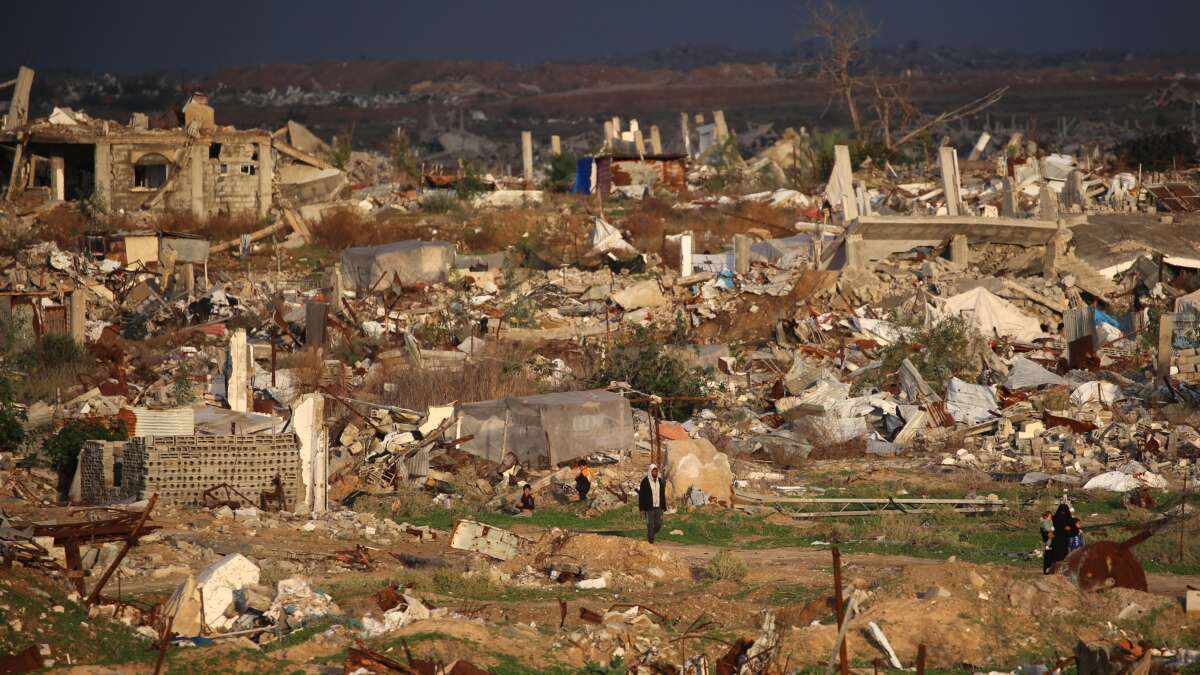
A man walks past homes and buildings destroyed by the Israeli military in the Nuseirat refugee camp in the central Gaza Strip, on December 13, 2025. Heavy rain has flooded tents and temporary shelters across Gaza, compounding the suffering of the territory's residents, nearly all of whom were displaced during more than two years of war.Eyad Baba / AFP via Getty Images
As we produce journalism that combats authoritarianism, censorship, injustice, and misinformation, your support is urgently needed. Please make a year-end gift to Truthout today.
For the third consecutive year, Christmas will pass in Gaza without lights and without fanfare. Bells will not ring, and decorations that once briefly softened the Strip’s pain will be absent from streets long familiar with loss.
In 2023, Christmas arrived in Gaza under the weight of fear and terror, at a time when the war had been ongoing for only two months. Back then, many Palestinians — Muslims and Christians alike — believed it was impossible for a new year to begin while the war was still underway. There was a shared sense of hope that 2024 would bring the war to an end.
I clearly remember how Israeli Prime Minister Benjamin Netanyahu’s statement — declaring that 2024 would be “a year of war” — was met with disbelief and mockery. The assumption was that the world would not allow such a reality to unfold. What followed, however, surpassed even our darkest expectations.
Now, after more than two years, Gaza faces the end of 2025, and Christmas — which some Palestinian Christians observe on December 25, while many others observe in January, in accordance with the Greek Orthodox and Armenian Apostolic Church calendars — arrives after a so-called end to the war. Yet the reality on the ground raises disturbing questions about what this “ceasefire” truly means.
Infants have frozen to death, acute malnutrition is pervasive, and many are living in tents that flood during storms.
The streets that have gone undecorated for the third year in a row are darker and more devastated than ever. While the pace of mass killing has slowed, the consequences of war remain deeply embedded in our daily lives: Infants have frozen to death, acute malnutrition is pervasive, and many are living in tents that flood during storms.
What does this season mean for Gaza’s Christian community, who once marked Christmas with faith and resilience? And what does it mean for Muslim Palestinians, who were accustomed to sharing this moment — to see the Christmas tree lit, and to witness our neighbors’ joy?
In Gaza, Christmas will arrive without lights, without warmth, and burdened by a war that has not truly ended, even if its cessation has been officially announced.
I recently spoke with my father’s Christian friend, Tawfiq Al-Amash, who lived through the genocide and famine and continues to suffer alongside us. I asked him how he saw Christmas this year.
In Gaza, Christmas will arrive without lights, without warmth, and burdened by a war that has not truly ended, even if its cessation has been officially announced.
He answered, with pain in his voice: “What can I say to you? What can I say?”
I felt ashamed for asking, knowing the depth of the suffering we all face on the threshold of 2026.
Al-Amash then went on to tell me about why he rejected the idea of trying to put up Christmas trees in Gaza this year when a Muslim friend who works with him at the Gaza Municipality called and suggested trying to do so.
“I rejected the idea,” Al-Amash told me. “I asked him why, and how Christmas would even be possible now?”
Al-Amash went on to reflect on what Christmas used to be like in Gaza before the genocide. In the past, most shops in Gaza were decorated for the winter holiday, he told me, and Christians in Gaza remember how the streets used to shine, beautiful and welcoming for Christmas. He reminisced about how his community used to decorate the Christian Youth Association (where many activities took place, such as celebrations, sporting events, and other gatherings for both Christians and Muslims) to gather and celebrate together.
He told me:
We, as Christians, would visit one another, planning nights to stay up, enjoy, and celebrate together. And of course, there were the gifts we would distribute to our Muslim neighbors — chocolates shaped like Santa Claus. One of the greatest joys was the chance to travel to Bethlehem [which is located in the West Bank]. Before the war, the Israeli occupation coordinated visits so we could go to Bethlehem and pray in its churches.
But now? None of that is possible. All we can do is attend the Holy Mass. That is all. We decided, however, to do something small for our children: We arranged for a company to distribute simple gifts to our children in the church square.
So this is what Christmas will look like for my Christian neighbors: no celebration, only prayer, and painful remembrance of their beautiful past celebrations. And how much more painful it is that for more than two years, the Israeli occupation has stopped coordinating visits to Bethlehem.
I know firsthand what Christians in Gaza endured during the genocidal war. Many of them were killed, and they lived exactly as we Muslims did, for the war targeted every living thing in Gaza: humans, animals, plants — even the stones were not spared by the occupation.
When I think of the suffering of Christians in Gaza, I immediately think of our family friend, Tareq Al-Souri, a prominent businessman and well-known merchant, a man of great reputation and deeply beloved in Gaza, whose family was erased from the civil registry at the start of that genocide.
On October 20, 2023, funerals were held for the 17 Christians, most of them children and women, who perished in an Israeli airstrike on the church where dozens of families had sought refuge after their homes were destroyed or evacuated in search of safety.
The bells of mourning rang that day as the Al-Souri family and other Christian families were laid to rest: Yara Jreis Al-Amash, Viola Jreis Al-Amash, Abdelnour Sami Al-Souri, Tareq Sami Al-Souri, Liza Walid Al-Souri, Suhail Ramez Al-Souri, Majed Ramez Al-Souri, Julie Ramez Al-Souri, Ellen Helmy Terzi, Marwan Salim Terzi, Nahed Terzi, Suleiman Jamil Terzi, Sanaa Attallah Al-Amash, Alya Abdelnour Al-Souri, Issa Tareq Al-Souri, Juliette Sobhi Al-Souri, and George Sobhi Al-Souri. Prayers were held for them in the courtyard of the Greek Orthodox Church.
I remember how unbearably difficult that day was, especially since Christians had never faced these kinds of massacres during Israel’s previous assaults on Gaza.
Recently I listened to an interview on Al Jazeera with some of the Christians living in Gaza. Among them was Faten Al-Safliti, who recounted how she lost her husband and son to shelling and bombardments of the church.
In the same interview, a young girl named Maryam Tarzi said, “We still hear the shelling every day, even after the war has ended!” Meanwhile, a Christian man in Gaza named Edward Anton recalled how he used to spend the holiday at his family home, but he told Al Jazeera that this year he mourns the loss of his mother and sister, who were killed by an Israeli sniper while seeking refuge in a church.
I tried to contact Edward Anton’s brother, Issa Anton, who is a family friend of mine, but received no response. I hesitated to call him again, not wanting to be a burden amid the heavy grief and difficult circumstances he is enduring.
Happiness has become a distant dream for the people of Gaza. Memories and continuous loss have stripped us of the joy of life. Everything that has passed was filled with suffering, and everything that is to come seems bound to the same pain.
The holy month of Ramadan approaches in February, and all of us who are Muslim ask ourselves: What will it be like this year? Especially since the Eid holiday follows immediately after. This is Gaza — a place where the suffering inflicted by Israel robs religious celebrations of joy from everyone, without exception.
This article is licensed under Creative Commons (CC BY-NC-ND 4.0), and you are free to share and republish under the terms of the license.
As we produce journalism that combats authoritarianism, censorship, injustice, and misinformation, your support is urgently needed. Please make a year-end gift to Truthout today.
For the third consecutive year, Christmas will pass in Gaza without lights and without fanfare. Bells will not ring, and decorations that once briefly softened the Strip’s pain will be absent from streets long familiar with loss.
In 2023, Christmas arrived in Gaza under the weight of fear and terror, at a time when the war had been ongoing for only two months. Back then, many Palestinians — Muslims and Christians alike — believed it was impossible for a new year to begin while the war was still underway. There was a shared sense of hope that 2024 would bring the war to an end.
I clearly remember how Israeli Prime Minister Benjamin Netanyahu’s statement — declaring that 2024 would be “a year of war” — was met with disbelief and mockery. The assumption was that the world would not allow such a reality to unfold. What followed, however, surpassed even our darkest expectations.
Now, after more than two years, Gaza faces the end of 2025, and Christmas — which some Palestinian Christians observe on December 25, while many others observe in January, in accordance with the Greek Orthodox and Armenian Apostolic Church calendars — arrives after a so-called end to the war. Yet the reality on the ground raises disturbing questions about what this “ceasefire” truly means.
Infants have frozen to death, acute malnutrition is pervasive, and many are living in tents that flood during storms.
The streets that have gone undecorated for the third year in a row are darker and more devastated than ever. While the pace of mass killing has slowed, the consequences of war remain deeply embedded in our daily lives: Infants have frozen to death, acute malnutrition is pervasive, and many are living in tents that flood during storms.
What does this season mean for Gaza’s Christian community, who once marked Christmas with faith and resilience? And what does it mean for Muslim Palestinians, who were accustomed to sharing this moment — to see the Christmas tree lit, and to witness our neighbors’ joy?
In Gaza, Christmas will arrive without lights, without warmth, and burdened by a war that has not truly ended, even if its cessation has been officially announced.
I recently spoke with my father’s Christian friend, Tawfiq Al-Amash, who lived through the genocide and famine and continues to suffer alongside us. I asked him how he saw Christmas this year.
In Gaza, Christmas will arrive without lights, without warmth, and burdened by a war that has not truly ended, even if its cessation has been officially announced.
He answered, with pain in his voice: “What can I say to you? What can I say?”
I felt ashamed for asking, knowing the depth of the suffering we all face on the threshold of 2026.
Al-Amash then went on to tell me about why he rejected the idea of trying to put up Christmas trees in Gaza this year when a Muslim friend who works with him at the Gaza Municipality called and suggested trying to do so.
“I rejected the idea,” Al-Amash told me. “I asked him why, and how Christmas would even be possible now?”
Al-Amash went on to reflect on what Christmas used to be like in Gaza before the genocide. In the past, most shops in Gaza were decorated for the winter holiday, he told me, and Christians in Gaza remember how the streets used to shine, beautiful and welcoming for Christmas. He reminisced about how his community used to decorate the Christian Youth Association (where many activities took place, such as celebrations, sporting events, and other gatherings for both Christians and Muslims) to gather and celebrate together.
He told me:
We, as Christians, would visit one another, planning nights to stay up, enjoy, and celebrate together. And of course, there were the gifts we would distribute to our Muslim neighbors — chocolates shaped like Santa Claus. One of the greatest joys was the chance to travel to Bethlehem [which is located in the West Bank]. Before the war, the Israeli occupation coordinated visits so we could go to Bethlehem and pray in its churches.
But now? None of that is possible. All we can do is attend the Holy Mass. That is all. We decided, however, to do something small for our children: We arranged for a company to distribute simple gifts to our children in the church square.
So this is what Christmas will look like for my Christian neighbors: no celebration, only prayer, and painful remembrance of their beautiful past celebrations. And how much more painful it is that for more than two years, the Israeli occupation has stopped coordinating visits to Bethlehem.
I know firsthand what Christians in Gaza endured during the genocidal war. Many of them were killed, and they lived exactly as we Muslims did, for the war targeted every living thing in Gaza: humans, animals, plants — even the stones were not spared by the occupation.
When I think of the suffering of Christians in Gaza, I immediately think of our family friend, Tareq Al-Souri, a prominent businessman and well-known merchant, a man of great reputation and deeply beloved in Gaza, whose family was erased from the civil registry at the start of that genocide.
On October 20, 2023, funerals were held for the 17 Christians, most of them children and women, who perished in an Israeli airstrike on the church where dozens of families had sought refuge after their homes were destroyed or evacuated in search of safety.
The bells of mourning rang that day as the Al-Souri family and other Christian families were laid to rest: Yara Jreis Al-Amash, Viola Jreis Al-Amash, Abdelnour Sami Al-Souri, Tareq Sami Al-Souri, Liza Walid Al-Souri, Suhail Ramez Al-Souri, Majed Ramez Al-Souri, Julie Ramez Al-Souri, Ellen Helmy Terzi, Marwan Salim Terzi, Nahed Terzi, Suleiman Jamil Terzi, Sanaa Attallah Al-Amash, Alya Abdelnour Al-Souri, Issa Tareq Al-Souri, Juliette Sobhi Al-Souri, and George Sobhi Al-Souri. Prayers were held for them in the courtyard of the Greek Orthodox Church.
I remember how unbearably difficult that day was, especially since Christians had never faced these kinds of massacres during Israel’s previous assaults on Gaza.
Recently I listened to an interview on Al Jazeera with some of the Christians living in Gaza. Among them was Faten Al-Safliti, who recounted how she lost her husband and son to shelling and bombardments of the church.
In the same interview, a young girl named Maryam Tarzi said, “We still hear the shelling every day, even after the war has ended!” Meanwhile, a Christian man in Gaza named Edward Anton recalled how he used to spend the holiday at his family home, but he told Al Jazeera that this year he mourns the loss of his mother and sister, who were killed by an Israeli sniper while seeking refuge in a church.
I tried to contact Edward Anton’s brother, Issa Anton, who is a family friend of mine, but received no response. I hesitated to call him again, not wanting to be a burden amid the heavy grief and difficult circumstances he is enduring.
Happiness has become a distant dream for the people of Gaza. Memories and continuous loss have stripped us of the joy of life. Everything that has passed was filled with suffering, and everything that is to come seems bound to the same pain.
The holy month of Ramadan approaches in February, and all of us who are Muslim ask ourselves: What will it be like this year? Especially since the Eid holiday follows immediately after. This is Gaza — a place where the suffering inflicted by Israel robs religious celebrations of joy from everyone, without exception.
This article is licensed under Creative Commons (CC BY-NC-ND 4.0), and you are free to share and republish under the terms of the license.
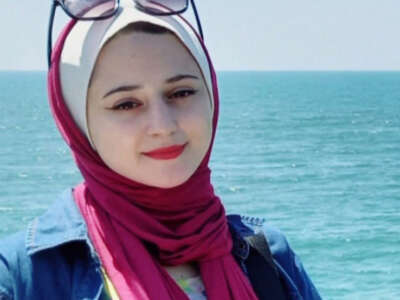
Dalia Abu Ramadan is a Palestinian storyteller and aspiring graduate of the Islamic University of Gaza, sharing powerful narratives that reflect the strength, resilience, and challenges of life in Gaza.
Christmas Eve: Christians light red candles for Palestine across 20+ countries
RNS Press Release Distribution Service
December 22, 2025
Grassroots movement launched from Bethlehem spreads globally; thousands to participate Wednesday
WASHINGTON — Thousands of Christians across more than 20 countries will light red candles on Christmas Eve – a new symbol of solidarity with Palestinian Christians, culminating a grassroots movement that launched three weeks ago from Bethlehem.
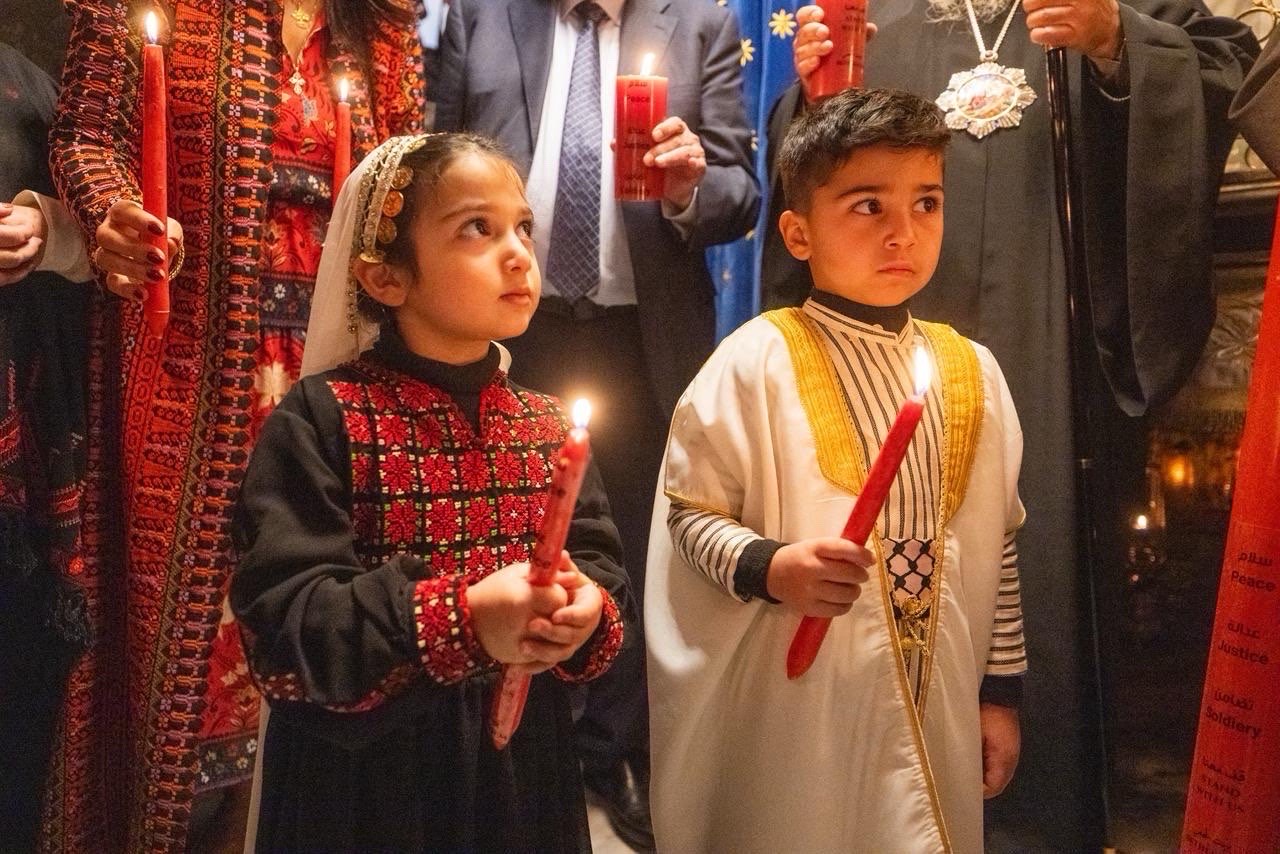
Red Candle: Light for Palestine began November 29 with a ceremony in the Grotto of the Nativity, where two Palestinian children lit the first candle alongside clergy from Catholic, Orthodox, and Protestant traditions. The movement has since spread across denominational and political divides, to churches and individuals across Palestine, the United States. South Africa, South Korea, Brazil, Spain, Paraguay, Norway, Denmark, Germany, Sweden, Ireland, Singapore, Uruguay, and New Zealand and more.
Participants and Leadership
Participating Christian leaders include Rev. Munther Isaac (known for his “Christ in the Rubble” sermon), the World Council of Churches, Archbishop Theodosios Atallah Hanna of the Greek Orthodox Patriarchate of Jerusalem, Metropolitan Benedictos of Diocesarea, Father Issa Thaljieh of the Church of the Nativity, Mother Agapia Stephanopoulos, Shane Claiborne of Red Letter Christians, Greg Khalil, Dr. Fares Abraham, Bethlehem University Foundation, Churches for Middle East Peace, United Methodist Church – Chuch and Society and Pax Christi USA.
Priests Against Genocide, established in Italy in September 2025, has grown to more than 2,200 priests from 56 countries in three months and joined as a partner organization.
Palestinian Christian Witness
In Taybeh—Palestine’s last all-Christian village, which has endured six settler attacks since July—all three churches representing the town’s whole population, gathered to light red candles and plant olive trees at a site damaged by settler arson.
Father Bashar Fawadleh of the Latin Catholic Church in Taybeh said: “From the same place where settlers burned fire behind the church, we light a candle of peace and justice, and we’re planting also olive trees… We just spread the light of peace from this land, and we believe that this light will be spreading from this land to all around the world.” The video was shared more than 3,000 times in days.
“We light this red candle and we send it to the world from the land of Christmas,” said Rev. Munther Isaac of Hope Evangelical Lutheran Church in Ramallah. “Despite the circumstances, we insist that the message of Christmas remains alive here, rooted in our land. Glory to God in the highest, peace on earth, goodwill to all.”
Context: Christian Polarization
The movement comes as American Christians navigate competing visions. Recent research shows 41% of American Christians embrace the Seven Mountains Mandate, a dominion theology framework. This weekend’s AmericaFest conference in Phoenix drew 31,000 attendees, with Turning Point USA Faith announcing its network doubled to 9,500 churches.
Simultaneously, a new December 16 IMEU poll shows 74% of Republicans under 45 want to reduce U.S. weapons funding to Israel, with 24% saying they would switch parties over this single issue.
Coalition and Participation
Red Candle is volunteer-founded and operates through a coalition of 15 partner organizations.
Participants are invited to light red candles on Christmas Eve, share photos tagged @redcandlepalestine, and visit redcandle.org for liturgical resources and information.
###
About Red Candle: Light for Palestine
Red Candle is a Christian movement for peace, justice and solidarity with Palestinians. It invites Christians to reclaim Christmas and Easter as sacred seasons of peacemaking.
Partner organizations include The Telos Group, Bethlehem University Foundation, Red Letter Christians, Pax Christi USA, Churches for Middle East Peace, United Methodist Church General Board of Church and Society, Levant Ministries, Orthodox Christians for Palestine, Friends Committee on National Legislation, Priests Against Genocide, The Happy Givers, Agora Initiative, Chasing Justice, Peace Catalyst, and Bethlehem Institute for Peace and Justice—representing Evangelical, Catholic, Mainline Protestant, Orthodox and Quaker traditions.
Previous coverage: Middle East Eye, Church Times UK, Global Baptist News, Yaffa News Netowrk, Word and Way, Church Leaders.
Press kit with photos, video, quotes, story angles, here.
Sources available.
Media Contact
Renee Tay
Red Candle: Light for Palestine
reneemtay@gmail.com
###
Disclaimer: The views and opinions expressed in this article are those of the authors and do not necessarily reflect the official policy or position of RNS or Religion News Foundation.
RNS Press Release Distribution Service
December 22, 2025
Grassroots movement launched from Bethlehem spreads globally; thousands to participate Wednesday
WASHINGTON — Thousands of Christians across more than 20 countries will light red candles on Christmas Eve – a new symbol of solidarity with Palestinian Christians, culminating a grassroots movement that launched three weeks ago from Bethlehem.
Red Candle: Light for Palestine began November 29 with a ceremony in the Grotto of the Nativity, where two Palestinian children lit the first candle alongside clergy from Catholic, Orthodox, and Protestant traditions. The movement has since spread across denominational and political divides, to churches and individuals across Palestine, the United States. South Africa, South Korea, Brazil, Spain, Paraguay, Norway, Denmark, Germany, Sweden, Ireland, Singapore, Uruguay, and New Zealand and more.
Participants and Leadership
Participating Christian leaders include Rev. Munther Isaac (known for his “Christ in the Rubble” sermon), the World Council of Churches, Archbishop Theodosios Atallah Hanna of the Greek Orthodox Patriarchate of Jerusalem, Metropolitan Benedictos of Diocesarea, Father Issa Thaljieh of the Church of the Nativity, Mother Agapia Stephanopoulos, Shane Claiborne of Red Letter Christians, Greg Khalil, Dr. Fares Abraham, Bethlehem University Foundation, Churches for Middle East Peace, United Methodist Church – Chuch and Society and Pax Christi USA.
Priests Against Genocide, established in Italy in September 2025, has grown to more than 2,200 priests from 56 countries in three months and joined as a partner organization.
Palestinian Christian Witness
In Taybeh—Palestine’s last all-Christian village, which has endured six settler attacks since July—all three churches representing the town’s whole population, gathered to light red candles and plant olive trees at a site damaged by settler arson.
Father Bashar Fawadleh of the Latin Catholic Church in Taybeh said: “From the same place where settlers burned fire behind the church, we light a candle of peace and justice, and we’re planting also olive trees… We just spread the light of peace from this land, and we believe that this light will be spreading from this land to all around the world.” The video was shared more than 3,000 times in days.
“We light this red candle and we send it to the world from the land of Christmas,” said Rev. Munther Isaac of Hope Evangelical Lutheran Church in Ramallah. “Despite the circumstances, we insist that the message of Christmas remains alive here, rooted in our land. Glory to God in the highest, peace on earth, goodwill to all.”
Context: Christian Polarization
The movement comes as American Christians navigate competing visions. Recent research shows 41% of American Christians embrace the Seven Mountains Mandate, a dominion theology framework. This weekend’s AmericaFest conference in Phoenix drew 31,000 attendees, with Turning Point USA Faith announcing its network doubled to 9,500 churches.
Simultaneously, a new December 16 IMEU poll shows 74% of Republicans under 45 want to reduce U.S. weapons funding to Israel, with 24% saying they would switch parties over this single issue.
Coalition and Participation
Red Candle is volunteer-founded and operates through a coalition of 15 partner organizations.
Participants are invited to light red candles on Christmas Eve, share photos tagged @redcandlepalestine, and visit redcandle.org for liturgical resources and information.
###
About Red Candle: Light for Palestine
Red Candle is a Christian movement for peace, justice and solidarity with Palestinians. It invites Christians to reclaim Christmas and Easter as sacred seasons of peacemaking.
Partner organizations include The Telos Group, Bethlehem University Foundation, Red Letter Christians, Pax Christi USA, Churches for Middle East Peace, United Methodist Church General Board of Church and Society, Levant Ministries, Orthodox Christians for Palestine, Friends Committee on National Legislation, Priests Against Genocide, The Happy Givers, Agora Initiative, Chasing Justice, Peace Catalyst, and Bethlehem Institute for Peace and Justice—representing Evangelical, Catholic, Mainline Protestant, Orthodox and Quaker traditions.
Previous coverage: Middle East Eye, Church Times UK, Global Baptist News, Yaffa News Netowrk, Word and Way, Church Leaders.
Press kit with photos, video, quotes, story angles, here.
Sources available.
Media Contact
Renee Tay
Red Candle: Light for Palestine
reneemtay@gmail.com
###
Disclaimer: The views and opinions expressed in this article are those of the authors and do not necessarily reflect the official policy or position of RNS or Religion News Foundation.
No comments:
Post a Comment