Matthew Chapman
December 22, 2025
RAW STORY
The Trump administration's plan to shut down a key weather research agency in Boulder, Colorado, is running into opposition — from Republicans.
According to NOTUS, "Republican Reps. Jeff Hurd, Jay Obernolte, Brian Fitzpatrick, and Jack Bergman joined Democrats, including Rep. Joe Neguse and Sens. Michael Bennet and John Hickenlooper, in a letter to Congressional appropriators Monday asking them to ensure sustained funding for the Colorado-based National Center for Atmospheric Research. Eighty lawmakers from both the Senate and the House signed the letter."
NCAR is responsible, among other things, for research into fire and flood risk.
Hurd put out a statement saying, “Dismantling this institution doesn’t make sense, and I’m glad to work with my colleagues in both chambers to make sure NCAR has the funding it needs to keep operating. The scientists at NCAR are doing work that matters — work that helps families prepare for storms, helps farmers plan their seasons, and keeps us ahead on the world stage."
"Supporting NCAR is a smart investment we should continue to make, not walk away from,” continued Hurd, who represents a sprawling district encompassing the Western Slope of Colorado.
President Donald Trump's Office of Management and Budget director, Russ Vought, announced plans to dismantle NCAR earlier this month, proclaiming it is "one of the largest sources of climate alarmism in the country." He said that functions of the agency the Trump administration deems essential will continue, just delegated to other agencies.
Bennet and Hickenlooper responded by blocking the "minibus" package Republicans hoped would prevent another federal government shutdown at the end of January, when the current continuing resolution expires.
This comes as Trump is also proceeding with a plan, initially devised in his first term, to relocate the U.S. Space Command headquarters from Colorado Springs to Huntsville, Alabama. This plan has drawn bipartisan fury from the entire Colorado congressional delegation, including Rep. Lauren Boebert, normally an unflinching supporter of Trump's agenda.
Trump’s Attack on Weather Center Would End Lifesaving Meteorological Research
The National Center for Atmospheric Research has enabled crucial predictions of wildfires and extreme weather.
By Sasha Abramsky ,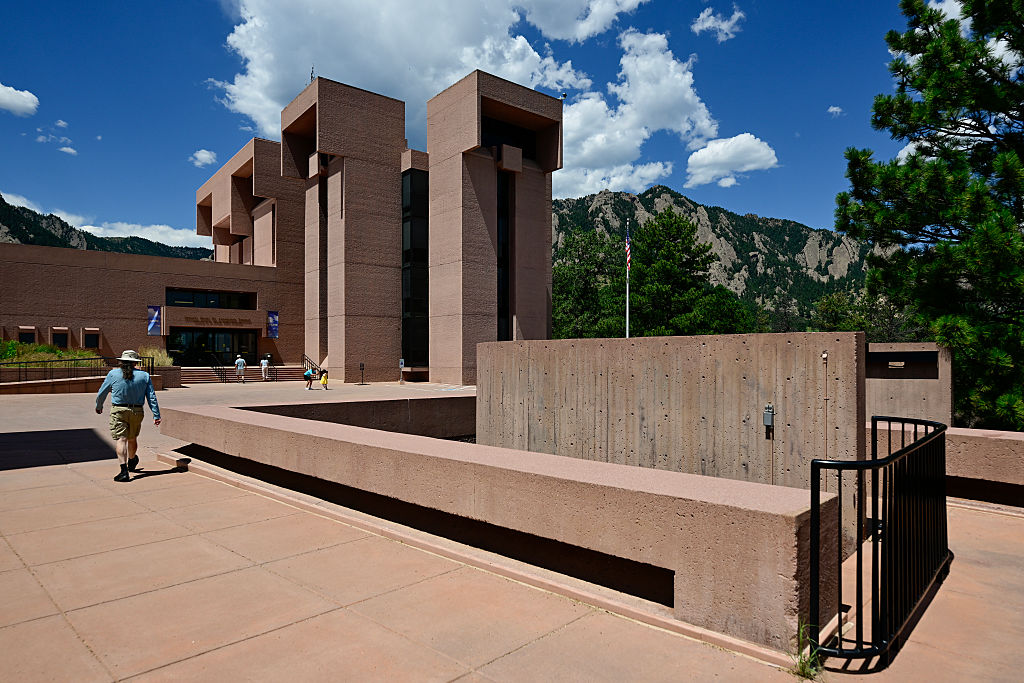
The National Center for Atmospheric Research has enabled crucial predictions of wildfires and extreme weather.
By Sasha Abramsky ,
December 22, 2025
The National Center for Atmospheric Research Mesa Lab is seen in Boulder, Colorado, on July 7, 2025.Matthew Jonas / MediaNews Group / Boulder Daily Camera via Getty Images
On December 16, USA Today broke the news that the Trump administration was planning to eliminate the National Center for Atmospheric Research (NCAR). According to a tweet by Russell Vought, an architect of Project 2025 and current director of the Office of Management and Budget, the administration had determined that the Colorado-based center was a hub for “climate alarmism.” Dismantling it — and farming out its surviving, non-climate-change-related functions to other agencies — would strike a blow against a scientific community that has come to the overwhelming conclusion that global warming is real, caused by human activities, and accelerating. Some commentators also noted that attacking NCAR, which employs 800-plus people, is a stick-in-the-eye to Colorado, a state whose governor has consistently opposed many of Trump’s most extreme policies, and where election conspiracist and former county clerk Tina Peters resides in a state prison, after a federal judge ruled that she had to remain incarcerated despite her being pardoned for federal crimes by Trump. Peters was, after all, sentenced on state, rather than federal, charges, rendering Trump’s pardon largely pointless.
NCAR has long been in team Trump 2.0’s crosshairs. Previous proposals called for its funding to be slashed by 40 percent. The administration has also sought to end most climate-related research at the National Oceanic and Atmospheric Administration, and websites for the Environmental Protection Agency have scrubbed mentions of human-caused climate change. As a result, institutions that were once considered among global gold standards for the delivery of accurate scientific information on the climate crisis are now effectively neutralized.
The administration’s decision to go after NCAR is part of a broader retreat from any acknowledgement of the reality of climate change.
For the nation’s thousands of meteorologists and climate change scientists, the news about the proposed gutting of NCAR landed like a grenade. After all, NCAR — which on a day-to-day basis is administered by the University Corporation for Atmospheric Research on behalf of the National Science Foundation, but which is funded in large part by the federal government — has been the world’s preeminent weather and atmospheric research institution since the 1960s. Its purpose is to pool institutional resources and expertise to provide researchers with cutting edge super-computers, data repositories, specialized aircraft with extremely expensive, sensitive, on-board measurement equipment, and other tools of the trade. No single lab or university, no matter how flush with money, has the ability to replicate all of this single-handedly. Few other institutions anywhere on earth can model weather, climate change, or other atmospheric disturbances so granularly.
NCAR’s whole reason for existing, said University of Wisconsin-Madison Atmospheric and Oceanic Sciences Professor Ankur Desai, is to “supersize” the country’s research resources. Desai did a post-doctoral fellowship at the Boulder institution; his work there led to his publishing a number of papers; those papers were what landed him his professorship in Madison. “It’s the mecca of meteorology, and there’s no place like it in the world,” he enthused.
Desai is not alone in his enthusiasm. Most of the country’s top atmospheric scientists have, at one point or another, trained, studied, or carried out research at NCAR or using NCAR’s resources. “I can write a proposal to the National Science Foundation saying I need a state of the art modeling system, and I need an aircraft,” said Kenneth Davis, professor of atmospheric and climate science at Penn State. Without NCAR’s resources, he continued, “there’s no way in hell that happens. These tools serve the U.S. research community in a way that would not be possible without a centralized institution like this.”
Davis cannot see any upside to breaking apart NCAR. “I don’t see what you gain. The purpose is to smash. All it does is take away our ability to do important research work. U.S. universities get damaged by this.”
Desai’s colleague at the University of Wisconsin, Liz Maroon, agreed. “The idea of losing this crowning jewel in the atmospheric science community, it would be devastating,” she said. “Having access to this kind of science is saving life and property. And its technology goes into improving national security and the economy.” Take away NCAR and you take away much of the country’s ability to predict wildfire patterns, to better and more efficiently irrigate crops, and to give residents and businesses advanced warning about extreme weather.
Maroon explained that in addition to providing researchers with access to expensive technologies and providing storage repositories for decades of research data, NCAR also creates teaching materials used in schools and universities around the country. “NCAR is at the heart of atmospheric and earth systems science in the U.S.,” Maroon continued. “It allows the scientific community to do bigger things together that no one scientist or university could really do. The value of what NCAR has brought to the U.S. scientific community, to its citizens, and to the world should be self-evident.”
Around the country, scientists have begun pushing back against the administration’s proposal, as are members of Colorado’s congressional delegation, including Sen. John Hickenlooper, the former governor who has long been a champion of climate change research. Universities are also mobilizing their teams that liaise on federal issues to explain to the public and to Congress the vital importance of this institute and what will be lost if it is shuttered.
“This really seems existential for our field and certainly the U.S.,” said Desai. “It’s a tantrum being thrown to break things, with no plan for how to fix things.”
Raymond Ban, former executive VP of the Weather Channel and an ex-trustee of the University Corporation for Atmospheric Research, hopes that the realization of what is at stake here will mobilize citizens, political leaders, and industry to push back against the administration’s proposals. After all, he said, for more than 60 years, the NCAR has been “one of the most valuable R&D enterprises that we have in the earth, water, and atmospheric science community.” Want to study the way the sun and the earth interact? NCAR runs a high-altitude observatory, Ban notes. Want to know why there are fewer crash landings of airplanes during episodes of strong wind shear than there used to be?It’s because in the 1980s researchers at NCAR designed a low-level wind shear alert system that was installed in airports around the United States to allow pilots to receive advanced warning if they were about to enter a wind shear zone.
“We need to hope that the value of NCAR and everything it produces will be realized, and there’ll be voices in the decision room that will understand that value,” Ban said. “I’m hopeful that with enough input from the community and enough feedback the senior leadership of the National Science Foundation and the administration will take another look at this.”
On December 16, USA Today broke the news that the Trump administration was planning to eliminate the National Center for Atmospheric Research (NCAR). According to a tweet by Russell Vought, an architect of Project 2025 and current director of the Office of Management and Budget, the administration had determined that the Colorado-based center was a hub for “climate alarmism.” Dismantling it — and farming out its surviving, non-climate-change-related functions to other agencies — would strike a blow against a scientific community that has come to the overwhelming conclusion that global warming is real, caused by human activities, and accelerating. Some commentators also noted that attacking NCAR, which employs 800-plus people, is a stick-in-the-eye to Colorado, a state whose governor has consistently opposed many of Trump’s most extreme policies, and where election conspiracist and former county clerk Tina Peters resides in a state prison, after a federal judge ruled that she had to remain incarcerated despite her being pardoned for federal crimes by Trump. Peters was, after all, sentenced on state, rather than federal, charges, rendering Trump’s pardon largely pointless.
NCAR has long been in team Trump 2.0’s crosshairs. Previous proposals called for its funding to be slashed by 40 percent. The administration has also sought to end most climate-related research at the National Oceanic and Atmospheric Administration, and websites for the Environmental Protection Agency have scrubbed mentions of human-caused climate change. As a result, institutions that were once considered among global gold standards for the delivery of accurate scientific information on the climate crisis are now effectively neutralized.
The administration’s decision to go after NCAR is part of a broader retreat from any acknowledgement of the reality of climate change.
For the nation’s thousands of meteorologists and climate change scientists, the news about the proposed gutting of NCAR landed like a grenade. After all, NCAR — which on a day-to-day basis is administered by the University Corporation for Atmospheric Research on behalf of the National Science Foundation, but which is funded in large part by the federal government — has been the world’s preeminent weather and atmospheric research institution since the 1960s. Its purpose is to pool institutional resources and expertise to provide researchers with cutting edge super-computers, data repositories, specialized aircraft with extremely expensive, sensitive, on-board measurement equipment, and other tools of the trade. No single lab or university, no matter how flush with money, has the ability to replicate all of this single-handedly. Few other institutions anywhere on earth can model weather, climate change, or other atmospheric disturbances so granularly.
NCAR’s whole reason for existing, said University of Wisconsin-Madison Atmospheric and Oceanic Sciences Professor Ankur Desai, is to “supersize” the country’s research resources. Desai did a post-doctoral fellowship at the Boulder institution; his work there led to his publishing a number of papers; those papers were what landed him his professorship in Madison. “It’s the mecca of meteorology, and there’s no place like it in the world,” he enthused.
Desai is not alone in his enthusiasm. Most of the country’s top atmospheric scientists have, at one point or another, trained, studied, or carried out research at NCAR or using NCAR’s resources. “I can write a proposal to the National Science Foundation saying I need a state of the art modeling system, and I need an aircraft,” said Kenneth Davis, professor of atmospheric and climate science at Penn State. Without NCAR’s resources, he continued, “there’s no way in hell that happens. These tools serve the U.S. research community in a way that would not be possible without a centralized institution like this.”
Davis cannot see any upside to breaking apart NCAR. “I don’t see what you gain. The purpose is to smash. All it does is take away our ability to do important research work. U.S. universities get damaged by this.”
Desai’s colleague at the University of Wisconsin, Liz Maroon, agreed. “The idea of losing this crowning jewel in the atmospheric science community, it would be devastating,” she said. “Having access to this kind of science is saving life and property. And its technology goes into improving national security and the economy.” Take away NCAR and you take away much of the country’s ability to predict wildfire patterns, to better and more efficiently irrigate crops, and to give residents and businesses advanced warning about extreme weather.
Maroon explained that in addition to providing researchers with access to expensive technologies and providing storage repositories for decades of research data, NCAR also creates teaching materials used in schools and universities around the country. “NCAR is at the heart of atmospheric and earth systems science in the U.S.,” Maroon continued. “It allows the scientific community to do bigger things together that no one scientist or university could really do. The value of what NCAR has brought to the U.S. scientific community, to its citizens, and to the world should be self-evident.”
Around the country, scientists have begun pushing back against the administration’s proposal, as are members of Colorado’s congressional delegation, including Sen. John Hickenlooper, the former governor who has long been a champion of climate change research. Universities are also mobilizing their teams that liaise on federal issues to explain to the public and to Congress the vital importance of this institute and what will be lost if it is shuttered.
“This really seems existential for our field and certainly the U.S.,” said Desai. “It’s a tantrum being thrown to break things, with no plan for how to fix things.”
Raymond Ban, former executive VP of the Weather Channel and an ex-trustee of the University Corporation for Atmospheric Research, hopes that the realization of what is at stake here will mobilize citizens, political leaders, and industry to push back against the administration’s proposals. After all, he said, for more than 60 years, the NCAR has been “one of the most valuable R&D enterprises that we have in the earth, water, and atmospheric science community.” Want to study the way the sun and the earth interact? NCAR runs a high-altitude observatory, Ban notes. Want to know why there are fewer crash landings of airplanes during episodes of strong wind shear than there used to be?It’s because in the 1980s researchers at NCAR designed a low-level wind shear alert system that was installed in airports around the United States to allow pilots to receive advanced warning if they were about to enter a wind shear zone.
“We need to hope that the value of NCAR and everything it produces will be realized, and there’ll be voices in the decision room that will understand that value,” Ban said. “I’m hopeful that with enough input from the community and enough feedback the senior leadership of the National Science Foundation and the administration will take another look at this.”
No comments:
Post a Comment