.JPG)
In the Face of Anti-Trans Escalation, We Need More Than Legal Strategies
The swiftness with which Trump dismantled decades of meager, hard-fought protections exposed the limits of legal work.
December 31, 2025
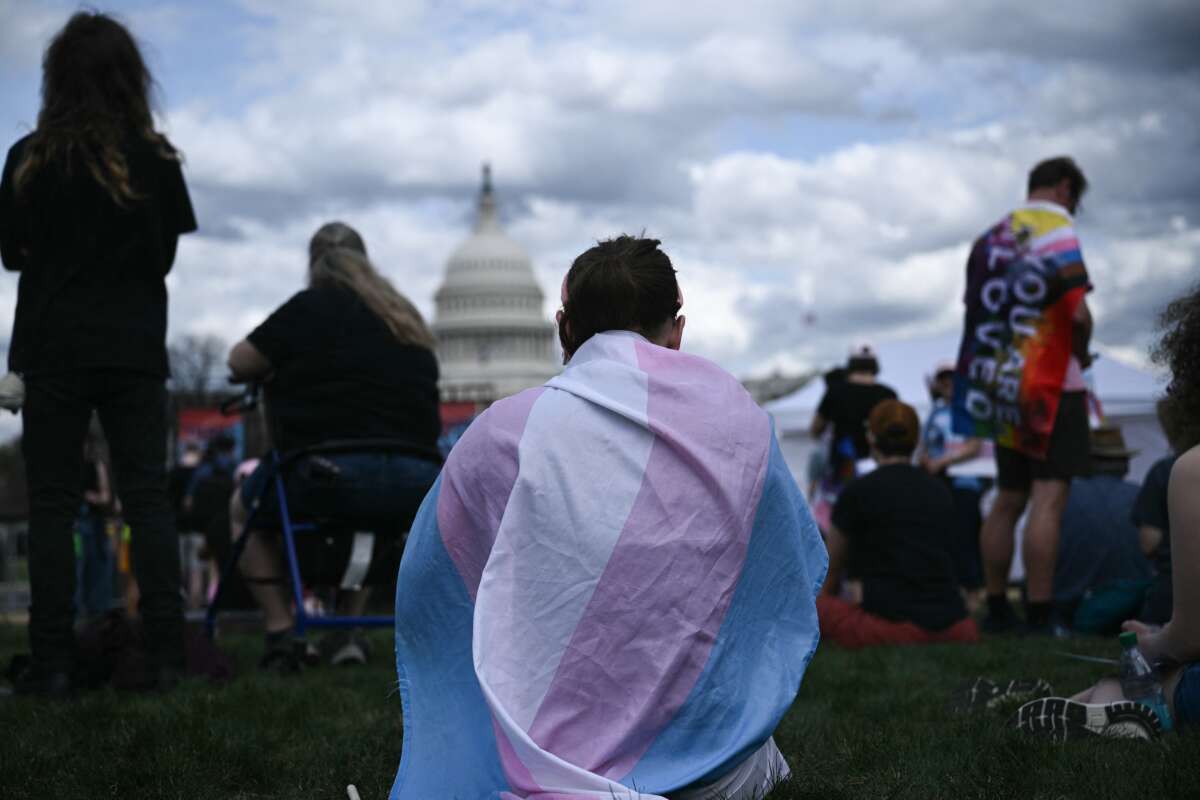
People attend a Trans Day of Visibility rally in Washington, D.C., on March 31, 2025.BRENDAN SMIALOWSKI / AFP via Getty Images
In a year marked by escalating attacks on transgender people, the Trump administration has seemed to outdo its own cruelty at every turn. While the administration has led a series of attempts to curtail trans people’s rights, recognition, and safety, neither Congress nor the Supreme Court seem willing to provide a meaningful check on the administration’s brazen targeting of trans people and other demonized communities. Transgender people are rightly concerned about what the coming years will mean for our rights and survival opportunities. But as we close out 2025, I am convinced that this bleak moment offers us critical opportunities to build outside of the law and across movements for more transformative change.
The Anti-Trans Year in Review
On his first day in office, President Donald Trump made clear that he would follow through on his campaign promises to systematically target transgender people across law and government. He announced in his inaugural address that it would be the policy of the United States that there are only two sexes determined at conception and that being transgender is a “false claim.” To effectuate his declaration that transgender people do not exist, Trump has directed his administration to mandate discrimination against us in education, employment, housing, health care, the military, on our identification documents, and in carceral settings.
While attempting to upend legal protections via executive order and coercive funding threats, the administration has also used deliberately dehumanizing rhetoric to situate trans people as inherently fraudulent. The president has declared that being transgender is inconsistent with “an honorable, truthful, and disciplined life”; referred to medical treatment for transgender minors as “child abuse”; and consistently demeaned transgender life by referring to our very existence as “transgender insanity.”
The administration’s attacks on trans life have continued throughout this first year, culminating in the latest set of attacks by both the Justice Department and the Department of Health and Human Services.
In a year marked by escalating attacks on transgender people, the Trump administration has seemed to outdo its own cruelty at every turn. While the administration has led a series of attempts to curtail trans people’s rights, recognition, and safety, neither Congress nor the Supreme Court seem willing to provide a meaningful check on the administration’s brazen targeting of trans people and other demonized communities. Transgender people are rightly concerned about what the coming years will mean for our rights and survival opportunities. But as we close out 2025, I am convinced that this bleak moment offers us critical opportunities to build outside of the law and across movements for more transformative change.
The Anti-Trans Year in Review
On his first day in office, President Donald Trump made clear that he would follow through on his campaign promises to systematically target transgender people across law and government. He announced in his inaugural address that it would be the policy of the United States that there are only two sexes determined at conception and that being transgender is a “false claim.” To effectuate his declaration that transgender people do not exist, Trump has directed his administration to mandate discrimination against us in education, employment, housing, health care, the military, on our identification documents, and in carceral settings.
While attempting to upend legal protections via executive order and coercive funding threats, the administration has also used deliberately dehumanizing rhetoric to situate trans people as inherently fraudulent. The president has declared that being transgender is inconsistent with “an honorable, truthful, and disciplined life”; referred to medical treatment for transgender minors as “child abuse”; and consistently demeaned transgender life by referring to our very existence as “transgender insanity.”
The administration’s attacks on trans life have continued throughout this first year, culminating in the latest set of attacks by both the Justice Department and the Department of Health and Human Services.

Trump’s Anti-Trans Policies Embolden Far Right, But Our Existence Challenges It
Trans existence challenges the fundamental tenets of fascism and exposes the fragility of authoritarian power. By Zane McNeill , Truthout November 20, 2025
Earlier this month, the Justice Department announced a directive to abandon safety protocols for LGBTQ people in prison. In 2003, Congress passed and President George W. Bush signed the Prison Rape Elimination Act (PREA). PREA directed the Justice Department to address endemic sexual violence in custodial settings. Given the extensive data documenting that transgender people are uniquely vulnerable to sexual violence while in prison, the Justice Department’s PREA standards recommended specific protections to safeguard against violence targeted at individuals because of their LGBTQ status.
Now, the Trump administration is telling agencies to disregard those standards. It is hard to see this latest action as anything other than a command to increase violence against trans people in custody. Linda McFarlane, executive director of Just Detention International, an organization that has spent decades working to implement PREA, puts it plainly: “The Department of Justice would rather see incarcerated people, including children, be sexually abused than allow trans people to express their gender identity.”
In addition to the latest attacks on PREA standards, the administration also published two sets of proposed regulations that seek to block the provision of evidence-based, medically necessary care for transgender people under 18 — care that is supported by every major medical association in the United States, including the American Medical Association and the American Academy of Pediatrics. These rules threaten to cut off all federal Medicaid and Medicare funding to hospitals that treat transgender minors with puberty blockers, hormone therapy, or surgery to treat gender dysphoria. Though the regulations are not final, they reflect the administration’s far-reaching goal of limiting trans survival opportunities across all areas of life.
The swiftness with which the Trump administration has been able to do away with decades of meager but hard-fought protections exposes the limits of legal and policy work in securing meaningful protection.
Unfortunately, the administration has been helped considerably in its goal of targeting transgender people by a Supreme Court eager to undermine civil rights. While many of the administration’s actions transparently run afoul of longstanding statutory and constitutional protections, the Supreme Court has readily rubber-stamped them on its so-called emergency docket (the Supreme Court’s consideration of cases in a preliminary and “emergency” posture before it addresses the full merits). That has meant that lower court victories blocking the administration’s efforts to expel transgender people from openly serving in the United States military and to force transgender people to use passports that list our sex assigned at birth have been short-lived.
Even more troubling than the practical impact of allowing these sweeping policies to go into effect has been the Supreme Court’s apparent willingness to greenlight even more sweeping discrimination against transgender people. In an abbreviated and unsigned order in Trump v. Orr, the Supreme Court not only permitted the administration’s reversal of decades of policy across administrations that had allowed transgender people to update the sex designation on our passports, but it did so in a way that suggests that it may be impossible for transgender people to claim discrimination in many contexts moving forward. The court’s order reasoned: “Displaying passport holders’ sex at birth no more offends equal protection principles than displaying their country of birth — in both cases, the Government is merely attesting to a historical fact without subjecting anyone to differential treatment.” For this court, it appears that transgender people cannot claim discrimination when the government refuses to honor who we are.
Thinking Beyond Legal Advocacy
The swiftness with which the Trump administration has been able to do away with decades of meager but hard-fought protections exposes the limits of legal and policy work in securing meaningful protection.
Though the mainstream LGBTQ legal movement enjoyed a decade of success at the Supreme Court in cases challenging restrictions on marriage equality and clarifying that federal prohibitions on sex discrimination encompass prohibitions on anti-LGBTQ discrimination, the past year has shown how unstable even the clearest precedents against the pressures of a global movement to retrench norms around gender and sexuality.
Trans people have spent generations mapping possibility onto scarcity.
If we are to measure our prospects of future success solely on the metric of prevailing before the Supreme Court or convincing this administration to reduce its attacks, then there is little to be hopeful about for the coming year.
But if instead we look at this moment as a stark reminder of the limits of legal advocacy and as an opportunity to invest more in community and power-building, then we can begin to map out meaningful strategies for change.
That is not to say we give up on legal advocacy. Bringing challenges to discriminatory policies in state and federal court remains a vital tool for delay and harm reduction, but as the Supreme Court’s Orr order lays bare, it is temporary and limited. But alongside those challenges, those of us who have been fighting primarily on the legal terrain need to connect with broader movements for bodily autonomy, decriminalization, and disability justice, building power and cultural change.
Now is thus the time to dream and act outside of the confines of our legal advocacy. Trans people have spent generations mapping possibility onto scarcity. As just one example, the majority of trans people have had mismatching and inaccurate identification for part or all of our lives. We have a deep well of strategies for navigating around and through systems of governance that never contemplated our existence. And so now, we tap into and deepen that well.
In her recent press tour about her biography of the legendary Black trans leader Marsha P. Johnson, Tourmaline spoke often about problems and solutions. And she did so in the language of dreaming and manifesting, not in the language of law.
What we deserve is something bigger than the law offers us.
“We are in a moment with big, big problems, and we’re wanting to let in big, big solutions,” Tourmaline reflected to NPR. “And I think Marsha is someone who transmutes problems into solutions.”
Tourmaline went on: “And so I’m a big believer, just like Marsha was, in terms of the bigger the problem, the bigger the solution — right? — and that when we’re in these harsh conditions, that is the perfect time to imagine what is the world that we deserve.”
What we deserve is something bigger than the law offers us. While we are confronted with the law’s brutal and unimaginative limits, let’s move into 2026 with a dream for something more.
This article is licensed under Creative Commons (CC BY-NC-ND 4.0), and you are free to share and republish under the terms of the license.

Chase Strangio
Chase Strangio is a lawyer and trans activist in New York City. Follow him on Instagram: @chasestrangio.
No comments:
Post a Comment