
An appeal by the International Federation of Iraqi Refugees to refugee rights organizations, human rights institutions, and international advocacy bodies.
The International Federation of Iraqi Refugees (IFIR) issues this urgent appeal regarding the imminent deportation of Iraqi Kurdish refugees currently held in UK detention centres. Many of these individuals have resided in the UK for over two decades, establishing deep-rooted lives, raising families, and contributing to their communities.
We strongly condemn the recent bilateral agreement between the United Kingdom and the Government of Iraq, which facilitates forced returns. We contend that these actions constitute a clear violation of international law and binding human rights treaties, specifically:
– The 1951 Refugee Convention: Violating the principle of non-refoulement by returning individuals to environments where they face credible threats of harm.
– The ECHR (Article 3): Risking the exposure of individuals to torture or inhuman and degrading treatment.
– The ECHR (Article 8): Systematically dismantling family units and violating the right to private life.
Iraq remains a landscape defined by political instability and security threats. Deporting long-term residents who lack support networks in Iraq is not only a breach of legal duty but a profound humanitarian failure.
Our Demands:
– Immediate Annulment: We call for the cancellation of all agreements facilitating forced deportations to Iraq.
– Political Pressure: We urge Iraqi and Kurdish regional authorities to reject these agreements and refuse to accept forced returnees.
– Civil Society Mobilization: We call upon UK trade unions and human rights groups to publicly oppose these inhumane policies.
Protection is a legal obligation, not a political choice. We urge you to act now to uphold the principles of human dignity.For more information about the International Federation of Iraqi Refugees, see https://www.federationifir.com/en/
BAGHDAD (AP) — The November election didn't produce a bloc with a decisive majority, opening the door to a prolonged period of negotiations.
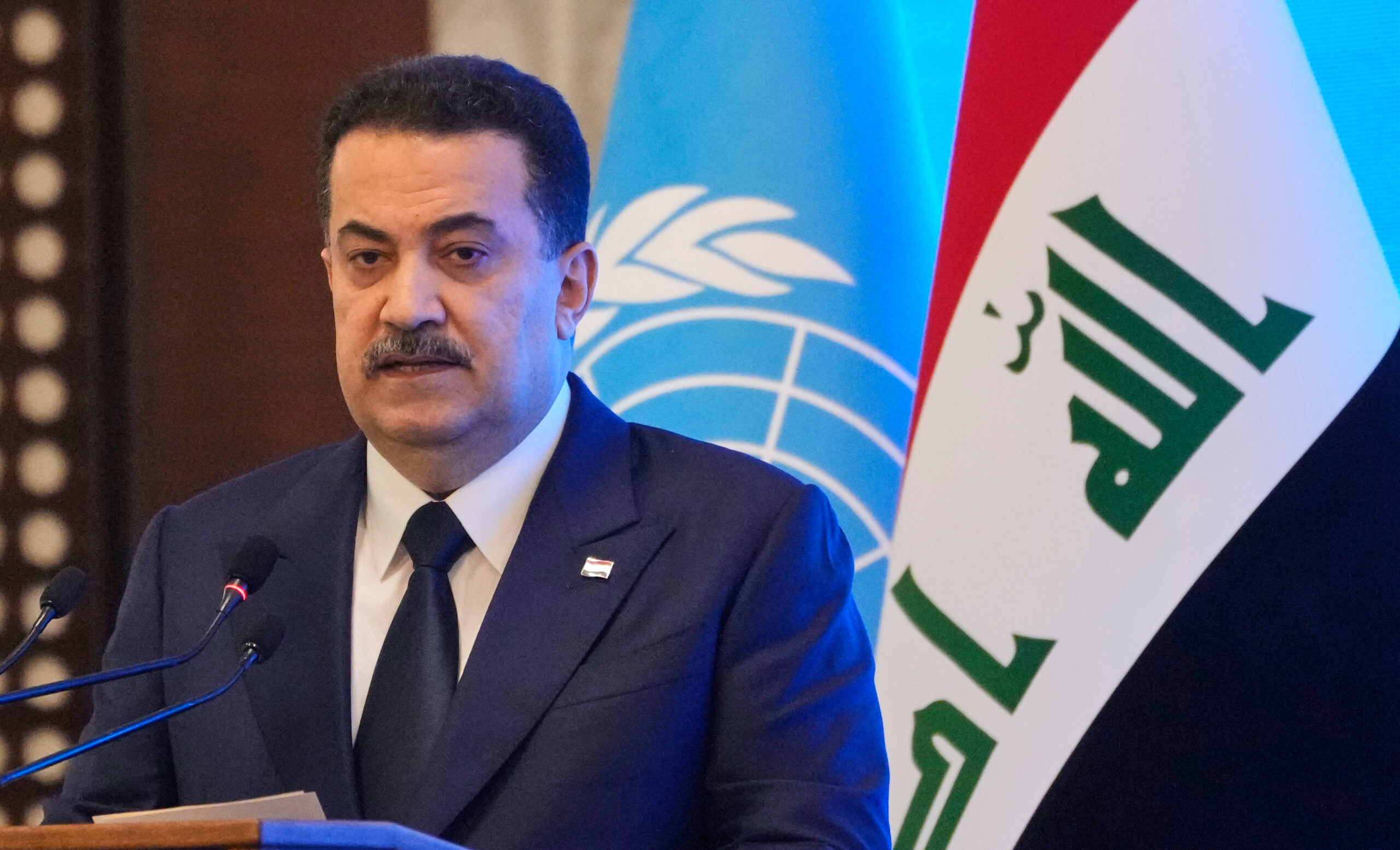
Qassim Abdul-zahra
December 23, 2025
AP
BAGHDAD (AP) — Political factions in Iraq have been maneuvering since the parliamentary election more than a month ago to form alliances that will shape the next government.
The November election didn’t produce a bloc with a decisive majority, opening the door to a prolonged period of negotiations.
The government that eventually emerges will be inheriting a security situation that has stabilized in recent years, but it will also face a fragmented parliament, growing political influence by armed factions, a fragile economy, and often conflicting international and regional pressures, including the future of Iran-backed armed groups.
Uncertain prospects
Prime Minister Mohammed Shia al-Sudani’s party took the largest number of seats in the election. Al-Sudani positioned himself in his first term as a pragmatist focused on improving public services and managed to keep Iraq on the sidelines of regional conflicts.
While his party is nominally part of the Coordination Framework, a coalition of Iran-backed Shiite parties that became the largest parliamentary bloc, observers say it’s unlikely that the Coordination Framework will support al-Sudani’s reelection bid.
“The choice for prime minister has to be someone the Framework believes they can control and doesn’t have his own political ambitions,” said Sajad Jiyad, an Iraqi political analyst and fellow at The Century Foundation think tank.
Al-Sudani came to power in 2022 with the backing of the Framework, but Jiyad said that he believes now the coalition “will not give al-Sudani a second term as he has become a powerful competitor.”
The only Iraqi prime minister to serve a second term since 2003 was Nouri al-Maliki, first elected in 2006. His bid for a third term failed after being criticized for monopolizing power and alienating Sunnis and Kurds.
Jiyad said that the Coordination Framework drew a lesson from Maliki “that an ambitious prime minister will seek to consolidate power at the expense of others.”
He said that the figure selected as Iraq’s prime minister must generally be seen as acceptable to Iran and the United States — two countries with huge influence over Iraq — and to Iraq’s top Shiite cleric, Grand Ayatollah Ali al-Sistani.
Al-Sudani in a bind
In the election, Shiite alliances and lists — dominated by the Coordination Framework parties — secured 187 seats, Sunni groups 77 seats, Kurdish groups 56 seats, in addition to nine seats reserved for members of minority groups.
The Reconstruction and Development Coalition, led by al-Sudani, dominated in Baghdad and in several other provinces, winning 46 seats.
Al-Sudani’s results, while strong, don’t allow him to form a government without the support of a coalition, forcing him to align the Coordination Framework to preserve his political prospects.
Some saw this dynamic at play earlier this month when al-Sudani’s government retracted a terror designation that Iraq had imposed on the Lebanese Hezbollah militant group and Yemen’s Houthi rebels — Iran-aligned groups that are allied with Iraqi armed factions — just weeks after imposing the measure, saying it was a mistake.
The Coalition Framework saw its hand strengthened by the absence from the election of the powerful Sadrist movement led by Shiite cleric Muqtada Sadr, which has been boycotting the political system since being unable to form a government after winning the most seats in the 2021 election.
Hamed Al-Sayed, a political activist and official with the National Line Movement, an independent party that boycotted the election, said that Sadr’s absence had a “central impact.”
“It reduced participation in areas that were traditionally within his sphere of influence, such as Baghdad and the southern governorates, leaving an electoral vacuum that was exploited by rival militia groups,” he said, referring to several parties within the Coordination Framework that also have armed wings.
Groups with affiliated armed wings won more than 100 parliamentary seats, the largest showing since 2003.
Other political actors
Sunni forces, meanwhile, sought to reorganize under a new coalition called the National Political Council, aiming to regain influence lost since the 2018 and 2021 elections.
The Kurdish political scene remained dominated by the traditional split between the Kurdistan Democratic Party and Patriotic Union of Kurdistan parties, with ongoing negotiations between the two over the presidency.
By convention, Iraq’s president is always a Kurd, while the more powerful prime minister is Shiite and the parliamentary speaker Sunni.
Parliament is required to elect a speaker within 15 days of the Federal Supreme Court’s ratification of the election result, which occurred on Dec. 14.
The parliament should elect a president within 30 days of its first session, and the prime minister should be appointed within 15 days of the president’s election, with 30 days allotted to form the new government.
Washington steps in
The incoming government will face major economic and political challenges.
They include a high level of public debt — more than 90 trillion Iraqi dinars ($69 billion) — and a state budget that remains reliant on oil for about 90% of revenues, despite attempts to diversify, as well as entrenched corruption.
But perhaps the most delicate question will be the future of the Popular Mobilization Forces, a coalition of militias that formed to fight the Islamic State group as it rampaged across Iraq more than a decade ago.
NEW: Bring more puzzles and play to your week with RNS Games
It was formally placed under the control of the Iraqi military in 2016, but in practice still operates with significant autonomy. After the Hamas-led attack in southern Israel on Oct. 7, 2023 sparked the devastating war in Gaza, some armed groups within the PMF launched attacks on U.S. bases in the region in retaliation for Washington’s backing of Israel.
The U.S. has been pushing for Iraq to disarm Iran-backed groups — a difficult proposition, given the political power that many of them hold and Iran’s likely opposition to such a step.
Two senior Iraqi political officials, who spoke on condition of anonymity because they weren’t authorized to comment publicly, said that the United States had warned against selecting any candidate for prime minister who controls an armed faction and also cautioned against letting figures associated with militias control key ministries or hold significant security posts.
“The biggest issue will be how to deal with the pro-Iran parties with armed wings, particularly those… which have been designated by the United States as terrorist entities,” Jiyad said.
Kataib Hezbollah, one of the most powerful militias in Iraq, designated by the U.S. as a terrorist organization, issued a statement Saturday rejecting the possibility of giving up its weapons.
The statement said the group’s “weapons will remain in the hands of its fighters, and no discussions with the government can take place before the departure of all occupation forces, NATO troops, and Turkish forces, and before ensuring the protection of the people and the sacred sites from extremist groups.”
Associated Press religion coverage receives support through the AP’s collaboration with The Conversation US, with funding from Lilly Endowment Inc. The AP is solely responsible for this content
Iraq Pulls the Plug on Iranian Gas
Iraq on Tuesday announced a complete suspension of natural gas imports from Iran, a move the electricity ministry said immediately knocked between 4,000 and 4,500 megawatts off the national power grid.
On its face, the decision sounds dramatic. In practical terms, it is but the final step in a process that was already well underway. Iraqi officials have spent the past year declaring victory over fuel imports, first halting shipments of gasoline, diesel, and kerosene while pitching a broader narrative of energy self-sufficiency. Gas was the remaining—and most politically sensitive—piece of that puzzle.
Iranian supplies had been covering roughly 30 to 40 percent of Iraq’s power generation needs. Of course, those volumes had already been diminishing due to payment disputes, U.S. sanctions pressure, and Iran’s own domestic shortages. The “complete suspension” isn’t the sudden cutoff that it appears. Baghdad is merely taking the next logical step in the breakup with Iran through partial import reductions and unreliable flows.
Washington has been steadily pushing Iraq to unwind its dependence on Tehran, and Baghdad has been eager to show compliance without triggering a full-blown electricity crisis. The fallback plan—burning locally produced alternative fuels—is not new, nor is it ideal. It keeps the lights on at a higher cost and with greater strain on infrastructure, but it buys political breathing room.
More importantly, this announcement fits into a much larger strategic shift. Western-backed energy projects are finally moving from paper to production. BP’s $25 billion, five-field development in Kirkuk is now active, with a heavy emphasis on capturing associated gas that would otherwise be flared. TotalEnergies’ multi-billion-dollar integrated gas project in southern Iraq is designed to feed power plants directly, cutting Iran out of the loop altogether.
None of this means that Iraq has solved its power problem. Summer demand still dwarfs the country’s installed capacity, and gas capture takes time. Still, Baghdad wants to send the appropriate message, to Washington, to Tehran, and to investors, that Iranian gas is no longer a pillar of its energy system. Whether the grid can tolerate that ambition is the real test still ahead.
By Julianne Geiger for Oilprice.com
No comments:
Post a Comment