It’s Time For America to Indict Itself: Cruelty and Dehumanization Never End Well
This week marks the 30th anniversary of the war in Bosnia and Herzegovina. On December 14,1995 leaders from Bosnia and Herzegovina, Croatia, and the former Yugoslavia signed the Dayton Peace Agreement, ending a ferocious three-and-a-half-year war that claimed around 100,000 lives, left thousands missing, and reduced entire communities to rubble.
But the war in Bosnia did not begin with bombs or snipers. It began with cruelty and dehumanization, with the deliberate turning of neighbors against neighbors.
Over the last few weeks to mark the impending anniversary of Dayton, social media is filled with images and videos recalling the horrors of that war. More disturbingly, recent reporting has revealed that some tourists came to Sarajevo and other cities not as witnesses, but as participants, joining sniper attacks against Bosniaks (Bosnian Muslims) for sport. These are not grotesque curiosities from the past. They are warnings. Violence does not erupt spontaneously. It is cultivated, normalized, and enabled when dehumanization hardens into practice.
Having lived and worked in Bosnia and Herzegovina for six years, I have seen this reality up close. I lived in an apartment building where chunks of the facade were still missing from sniper fire, silent reminders embedded into everyday life. I walked streets scarred by shelling, listened to survivors carry grief that never fully leaves, and witnessed the enduring physical and psychological toll the war continues to exact.
Maybe it is cheeky to use this moment, and I will take the criticism. Dehumanization and cruelty never end well. Ever. History makes that clear, yet its warnings are lost in the noise of daily chaos. What once shocked us or was unacceptable now barely registers and is casually shrugged off. Cruelty becomes banal. Dehumanization becomes routine. And people grow dangerously accustomed to both.
Recent survey data underscore this normalization. A 2025 Pew Research Center study found that large majorities of Americans say racial, ethnic, and religious minorities, including Black Americans, Muslims, Jews, Hispanics, and Asian Americans, face discrimination in the United States. Yet the same data reveal sharp partisan divides over how serious that discrimination actually is, with many respondents acknowledging bias in the abstract while minimizing its real-world impact. This gap, recognition without urgency, helps explain how dehumanization becomes tolerable. When harm is acknowledged but downplayed, it becomes easier to excuse, ignore, or rationalize. Over time, cruelty does not disappear. It becomes administratively acceptable.
We see this in the way entire communities are spoken about and treated as problems to be managed rather than people to be protected. Somali and Afghan communities are routinely cast under a cloud of suspicion, framed as perpetual outsiders or security threats rather than neighbors who have fled war and displacement, often shaped by U.S. policy itself. We see it in the rise of Islamophobia, where Muslim identity is conflated with extremism, surveillance is normalized, and ordinary expressions of faith are treated as something dangerous or foreign.
This dehumanization is no longer abstract. Muslim women are harassed for wearing hijab. Mosques are vandalized or threatened. Muslim students face intimidation, and communities confront demonstrations that frame Islam as an existential threat. Political rhetoric and online disinformation recast Muslims not as citizens or neighbors, but as enemies within.
At the same time, antisemitism is rising openly and violently, met too often with selective outrage or cynical political instrumentalization rather than moral clarity. What we are witnessing goes far beyond criticism of Israeli or U.S. policy in Gaza. It is the resurgence of conspiratorial antisemitism, assigning collective guilt to Jews, casting them as shadowy manipulators, and blaming them for imagined schemes designed to inflame fear and hostility.
Alongside it all is the quiet whitewashing of overt racism, where racial resentment is softened, excused, or even rewarded. Avowed white supremacist rhetoric, once confined to the margins, now circulates openly with alarming legitimacy, shielded by appeals to free speech. When whole communities are labeled as garbage, it is not a metaphor. It is permission to ostracize, harm, or worse.
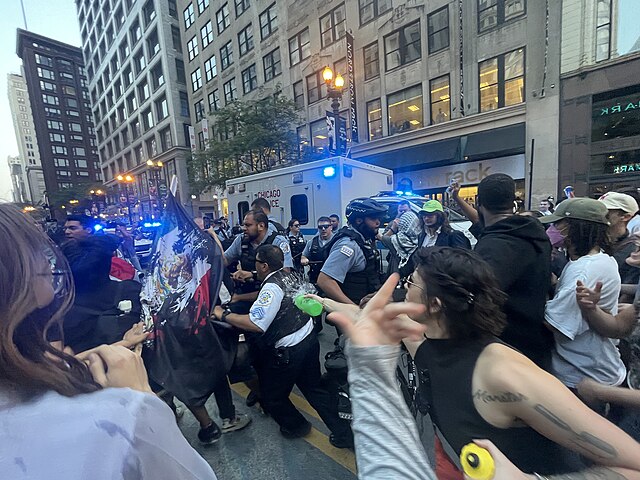
This logic becomes most dangerous when it is absorbed into state power. The weaponization of ICE is one of the clearest examples of dehumanization made operational. Raids, workplace sweeps, and neighborhood operations punish entire communities rather than address individual wrongdoing. Families are torn apart without warning. Parents disappear on the way to work or school. Asylum seekers are treated as criminals for exercising a legal right. When enforcement is untethered from proportionality, due process, and dignity, it ceases to be about law and order and becomes collective terror.
Bosnia is not our only warning. We do not need to look abroad or far back to understand the consequences of dehumanization. The United States has its own record. Jim Crow. The internment of Japanese Americans. The dispossession of Indigenous peoples. Redlining and housing segregation. Mass incarceration. And moments when fear of communists, Muslims, or immigrants transformed into surveillance, blacklists, and collective punishment.
It is time America indicts itself. It is time to look honestly in the mirror and decide what it wants to be. The growing cruelty we are witnessing is not the work of one party or one individual. Complicity can’t be ignored. These impulses are older, deeper, and far more bipartisan than we care to admit. We did not arrive here by accident. Some seek an America built on exclusion, nostalgia for eras when inequality was enforced by law and belonging narrowly defined. America has postponed this reckoning far too long.
The reckoning that follows an honest indictment will be difficult, uncomfortable, and unavoidable. It will require drilling into a national psyche shaped from its inception by racial hierarchy and sanctioned violence, a society that too often defends guns over lives, punishment over prevention, and power over accountability. Without that reckoning, the cycle simply continues.
Indictment is not about self-destruction. It is about deciding whether the country is finally willing to tell the truth about itself. Without that truth, America cannot get better. Cruelty has never delivered justice, stability, or peace, and history makes that plain. From the war in Bosnia and Herzegovina, to the atrocities of Nazi Germany, to the sanctioned injustices of Jim Crow, cruelty has only deepened suffering and delayed reckoning. These are not the foundations of national greatness. They are the very forces that eroded America’s moral standing to begin with. Campaigns of intimidation, collective punishment, and dehumanization directed at immigrant communities will not make America great again. They do the opposite, accelerating moral decline and weakening the democratic values they claim to defend.
Racism, xenophobia, cruelty, and dehumanization function like a cancer within the body politic, and truth is the only treatment capable of stopping their spread. A society can deny the diagnosis for only so long before the consequences become irreversibly devastating.
Jared O. Bell, syndicated with PeaceVoice, is a former U.S. diplomat and scholar of human rights and transitional justice, dedicated to advancing global equity and systemic reform.

No comments:
Post a Comment