Why Russia Is Equipping Its Drones with Starlink Terminals

December 28, 2025
By: Brandon J. Weichert

December 28, 2025
By: Brandon J. Weichert
NATIONAL INTEREST
Russia’s use of Starlink terminals on its drones has complicated Ukraine’s efforts at electronic anti-drone warfare—and raised a difficult conundrum for Elon Musk.
At the start of the Ukraine War, the Russian Armed Forces were intent on cutting the Ukrainians off from the outside world. They targeted the country’s telecommunications network, destroying key land-based communications arrays. But the Russians discovered that the Ukrainians were unaffected by these attacks—specifically because Elon Musk initially allowed Ukraine to use his dynamic Starlink satellite network for free.
This kept the Ukrainians going, as they were able to use the Starlink systems to evade Russian disruptions across the electromagnetic (EM) field and continue running their drone attacks against Russian lines
Moscow naturally protested. The Americans praised Musk. That is, until Musk realized the dangers to his investment.
Russia Is Adapting Starlink for Its Own Purposes
As the war went on, the Russians (and Chinese) began focusing their efforts on developing countermeasures against Starlink. Moscow and Beijing both made it clear that if SpaceX continued allowing for its supposed civilian satellite constellation, Starlink, to be used in combat they would attack the Starlink system.
That attack has yet to occur.
Interestingly, the Russians have chosen to simply use the strange loophole the Americans created that allows for one of their companies—SpaceX—to engage in combat operations without being considered a combatant. Reasoning that Starlink could hardly protest if Ukraine was already using its services, the Kremlin began to place Starlink aboard its own drones. This has allowed for Russian forces to evade much of the EM jamming that the Ukrainians have deployed to stunt the effectiveness of Russian drones against their lines.
And Starlink cannot shut down Russia’s access to their system now without also degrading Ukraine’s access to that system. It’s a giant mess.
Understanding Russia’s Molniya-2 DroneYear Introduced: August 2025
Number Built: Unknown (likely many thousands)
Length: 8.2 ft (2.5 m)
Wingspan: 5 ft (1.5 m)
Weight: 110–150 lb (50–70 kg)
Engines: Electric motors with propellers
Top Speed: 60–120 mph (100–200 km/h)
Range: 19 mi (30 km)
Service Ceiling: Over 18 mi (30 km)
Loadout: Carries a fragmentation or explosive warhead
There are also reports that the Russians integrated powerful processors (such as the NVIDIA Jetson Orin) along with high-quality sensors, like the Sony IMX477, for autonomous target detection, recognition, and attack.
Ukrainian sources have been monitoring the progress that the Russians have made at using makeshift Starlink interfaces with their drones. Initially, they were haphazard and poorly installed. According to the Ukrainians, though, the Russians have now fully integrated Starlink terminals into their offensive drones—and the lethality of those systems has increased tenfold.
One of the Russian Molniya-2 loitering munitions that was successfully downed by Ukrainian defenders was displayed for Western journalists. The crashed drone had a Starlink satellite terminal directly installed to ensure the system had constant contact with its operator as it traversed the battlefield to its intended target.

Starlink Isn’t Designed for War—but It’s Used for It Anyway
Starlink was designed by SpaceX to bring wireless internet connectivity to regions of the world that had little or no reliable internet or wider telecommunications infrastructure—giving places like Sub-Saharan Africa the benefits of access to the internet. Meanwhile, in places, like the United States, users could link up to the internet via Starlink satellites in orbit from anywhere.
The money made from Starlink usage globally, according to Musk, will be used to directly fund SpaceX’s larger mission of getting people to Mars.
Now that Ukraine (and Russia) have weaponized the system, though, Musk and SpaceX find themselves in a bind.
This system was never meant to be used militarily. Musk understands that the longer the system is used in a military capacity, the more likely it is to be targeted—and if the Starlink system becomes the first victim of a major war, then the entire economic model undergirding SpaceX is put at risk.
In response to the development of people weaponizing Starlink, Musk has created a separate but similar system designed specifically for military use. It’s called Starshield. The US military is the primary customer. It remains to be seen if other countries, like Ukraine, will be given direct access to that network or if it will remain an exclusively American military project.
Reciprocity is a key principle in both international relations and warfare.
Or “what’s good for the goose is good for the gander.” The Ukrainians deftly utilized a workaround for preventing their electronic isolation at the start of the war. The Russians figured out that workaround and shoved it down the Ukrainians’ throats.
Now, if NATO wants Russia’s drone systems to be degraded, they are in the uncomfortable spot of having to insist Musk terminate Starlink usage over Ukraine—which means ending Ukraine’s Starlink usage, too. And that would further stymie whatever combat effectiveness remains in the Ukrainian defense.
About the Author: Brandon J. Weichert
Brandon J. Weichert is a senior national security editor at The National Interest. Recently, Weichert became the host of The National Security Hour on America Outloud News and iHeartRadio, where he discusses national security policy every Wednesday at 8pm Eastern. Weichert hosts a companion book talk series on Rumble entitled “National Security Talk.” He is also a contributor at Popular Mechanics and has consulted regularly with various government institutions and private organizations on geopolitical issues. Weichert’s writings have appeared in multiple publications, including The Washington Times, National Review, The American Spectator, MSN, and the Asia Times. His books include Winning Space: How America Remains a Superpower, Biohacked: China’s Race to Control Life, and The Shadow War: Iran’s Quest for Supremacy. His newest book, A Disaster of Our Own Making: How the West Lost Ukraine is available for purchase wherever books are sold. He can be followed via Twitter @WeTheBrandon.
Image: Shutterstock / Jose HERNANDEZ Camera 51.
Russia’s use of Starlink terminals on its drones has complicated Ukraine’s efforts at electronic anti-drone warfare—and raised a difficult conundrum for Elon Musk.
At the start of the Ukraine War, the Russian Armed Forces were intent on cutting the Ukrainians off from the outside world. They targeted the country’s telecommunications network, destroying key land-based communications arrays. But the Russians discovered that the Ukrainians were unaffected by these attacks—specifically because Elon Musk initially allowed Ukraine to use his dynamic Starlink satellite network for free.
This kept the Ukrainians going, as they were able to use the Starlink systems to evade Russian disruptions across the electromagnetic (EM) field and continue running their drone attacks against Russian lines
Moscow naturally protested. The Americans praised Musk. That is, until Musk realized the dangers to his investment.
Russia Is Adapting Starlink for Its Own Purposes
As the war went on, the Russians (and Chinese) began focusing their efforts on developing countermeasures against Starlink. Moscow and Beijing both made it clear that if SpaceX continued allowing for its supposed civilian satellite constellation, Starlink, to be used in combat they would attack the Starlink system.
That attack has yet to occur.
Interestingly, the Russians have chosen to simply use the strange loophole the Americans created that allows for one of their companies—SpaceX—to engage in combat operations without being considered a combatant. Reasoning that Starlink could hardly protest if Ukraine was already using its services, the Kremlin began to place Starlink aboard its own drones. This has allowed for Russian forces to evade much of the EM jamming that the Ukrainians have deployed to stunt the effectiveness of Russian drones against their lines.
And Starlink cannot shut down Russia’s access to their system now without also degrading Ukraine’s access to that system. It’s a giant mess.
Understanding Russia’s Molniya-2 DroneYear Introduced: August 2025
Number Built: Unknown (likely many thousands)
Length: 8.2 ft (2.5 m)
Wingspan: 5 ft (1.5 m)
Weight: 110–150 lb (50–70 kg)
Engines: Electric motors with propellers
Top Speed: 60–120 mph (100–200 km/h)
Range: 19 mi (30 km)
Service Ceiling: Over 18 mi (30 km)
Loadout: Carries a fragmentation or explosive warhead
There are also reports that the Russians integrated powerful processors (such as the NVIDIA Jetson Orin) along with high-quality sensors, like the Sony IMX477, for autonomous target detection, recognition, and attack.
Ukrainian sources have been monitoring the progress that the Russians have made at using makeshift Starlink interfaces with their drones. Initially, they were haphazard and poorly installed. According to the Ukrainians, though, the Russians have now fully integrated Starlink terminals into their offensive drones—and the lethality of those systems has increased tenfold.
One of the Russian Molniya-2 loitering munitions that was successfully downed by Ukrainian defenders was displayed for Western journalists. The crashed drone had a Starlink satellite terminal directly installed to ensure the system had constant contact with its operator as it traversed the battlefield to its intended target.
Starlink Isn’t Designed for War—but It’s Used for It Anyway
Starlink was designed by SpaceX to bring wireless internet connectivity to regions of the world that had little or no reliable internet or wider telecommunications infrastructure—giving places like Sub-Saharan Africa the benefits of access to the internet. Meanwhile, in places, like the United States, users could link up to the internet via Starlink satellites in orbit from anywhere.
The money made from Starlink usage globally, according to Musk, will be used to directly fund SpaceX’s larger mission of getting people to Mars.
Now that Ukraine (and Russia) have weaponized the system, though, Musk and SpaceX find themselves in a bind.
This system was never meant to be used militarily. Musk understands that the longer the system is used in a military capacity, the more likely it is to be targeted—and if the Starlink system becomes the first victim of a major war, then the entire economic model undergirding SpaceX is put at risk.
In response to the development of people weaponizing Starlink, Musk has created a separate but similar system designed specifically for military use. It’s called Starshield. The US military is the primary customer. It remains to be seen if other countries, like Ukraine, will be given direct access to that network or if it will remain an exclusively American military project.
Reciprocity is a key principle in both international relations and warfare.
Or “what’s good for the goose is good for the gander.” The Ukrainians deftly utilized a workaround for preventing their electronic isolation at the start of the war. The Russians figured out that workaround and shoved it down the Ukrainians’ throats.
Now, if NATO wants Russia’s drone systems to be degraded, they are in the uncomfortable spot of having to insist Musk terminate Starlink usage over Ukraine—which means ending Ukraine’s Starlink usage, too. And that would further stymie whatever combat effectiveness remains in the Ukrainian defense.
About the Author: Brandon J. Weichert
Brandon J. Weichert is a senior national security editor at The National Interest. Recently, Weichert became the host of The National Security Hour on America Outloud News and iHeartRadio, where he discusses national security policy every Wednesday at 8pm Eastern. Weichert hosts a companion book talk series on Rumble entitled “National Security Talk.” He is also a contributor at Popular Mechanics and has consulted regularly with various government institutions and private organizations on geopolitical issues. Weichert’s writings have appeared in multiple publications, including The Washington Times, National Review, The American Spectator, MSN, and the Asia Times. His books include Winning Space: How America Remains a Superpower, Biohacked: China’s Race to Control Life, and The Shadow War: Iran’s Quest for Supremacy. His newest book, A Disaster of Our Own Making: How the West Lost Ukraine is available for purchase wherever books are sold. He can be followed via Twitter @WeTheBrandon.
Image: Shutterstock / Jose HERNANDEZ Camera 51.
Russia Bypasses Ukrainian Air Defenses via Belarus, Zelensky Says
Vladyslav Khomenko
December 28, 2025
Vladyslav Khomenko
December 28, 2025
militaryi.com

The Shahed kamikaze drone. Photo credits: IMAGO/Andreas Stroh via Reuters Connect
News
Ukrainian President Volodymyr Zelensky said Russian drones are attempting to bypass Ukraine’s air defense and interception systems by using Belarusian territory.
He said this explains the recent increase in Shahed drone attacks on western regions of Ukraine, RBC-Ukraine reported.
Zelensky mentioned attacks on the city of Kovel, which were discussed during a meeting of the Headquarters of the Supreme Commander-in-Chief.
“They see our interceptor lines and try to bypass them. They do this using Belarusian territory and the technical capabilities that Belarus provides,” the president said.
He added that on December 26, he convened a Headquarters meeting focused on countering Russian drones and developing appropriate defensive measures.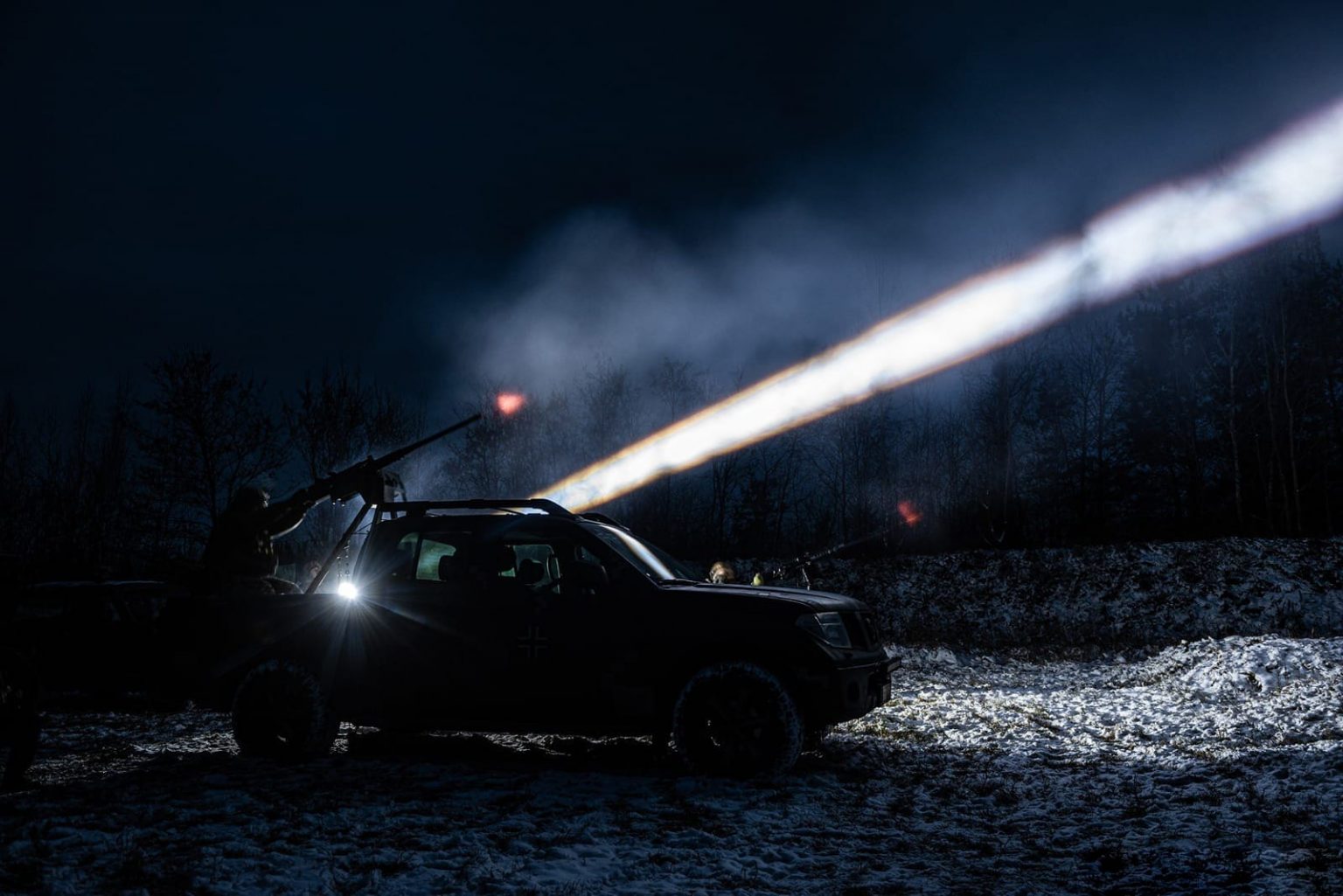 A mobile fire group fires at air targets. Photo credits: Air Command South
It was reported that the Defense Forces are expected to receive Swedish Kreuger interceptor drones ‘this winter,’ Zelensky said earlier.
After receiving feedback from Ukrainian military units, the manufacturer is ready to move to mass production, potentially producing thousands or even tens of thousands of drones per month.
The Shahed kamikaze drone. Photo credits: IMAGO/Andreas Stroh via Reuters Connect
News
Ukrainian President Volodymyr Zelensky said Russian drones are attempting to bypass Ukraine’s air defense and interception systems by using Belarusian territory.
He said this explains the recent increase in Shahed drone attacks on western regions of Ukraine, RBC-Ukraine reported.
Zelensky mentioned attacks on the city of Kovel, which were discussed during a meeting of the Headquarters of the Supreme Commander-in-Chief.
“They see our interceptor lines and try to bypass them. They do this using Belarusian territory and the technical capabilities that Belarus provides,” the president said.
He added that on December 26, he convened a Headquarters meeting focused on countering Russian drones and developing appropriate defensive measures.
A mobile fire group fires at air targets. Photo credits: Air Command SouthIt was reported that the Defense Forces are expected to receive Swedish Kreuger interceptor drones ‘this winter,’ Zelensky said earlier.
After receiving feedback from Ukrainian military units, the manufacturer is ready to move to mass production, potentially producing thousands or even tens of thousands of drones per month.
No comments:
Post a Comment