It’s possible that I shall make an ass of myself. But in that case one can always get out of it with a little dialectic. I have, of course, so worded my proposition as to be right either way (K.Marx, Letter to F.Engels on the Indian Mutiny)
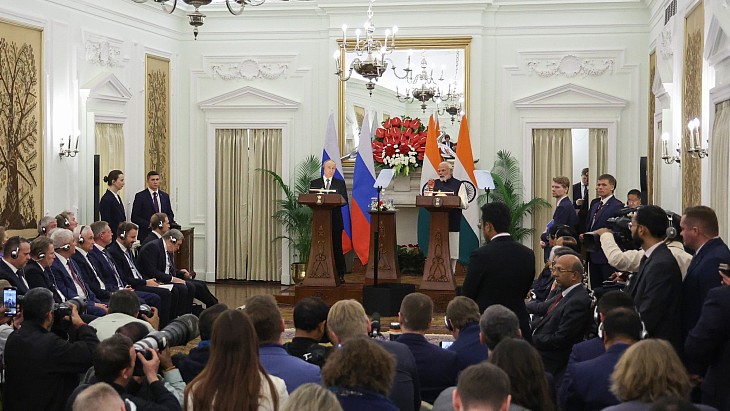
India and Russia discuss new nuclear power plant options
India aims to finalise a site for a second Russian nuclear power plant in the country - and says broader cooperation could include small modular reactors, floating power plants and localisation of fuel supply.
(Image: Kremlin.ru)
A joint statement issued by the Indian Prime Minister's Office after talks between Indian Prime Minister Narendra Modi and Russian President Vladimir Putin said the two sides: "Confirmed their intention to broaden cooperation in nuclear energy, including fuel cycle, life cycle support for operating Kudankulam Nuclear Power Plant and non-power applications, as well as to elaborate a new agenda of interaction in the field of peaceful use of atomic energy and related high technologies.
"The sides noted the importance of further discussion on the second site in India for an NPP; the Indian Side will strive to finalise formal allotment of the second site in accordance with earlier signed agreements.
"The sides agreed to accelerate technical and commercial discussions on the VVER of the Russian design, research and joint development of NPPs, localisation and joint manufacturing of nuclear equipment and fuel assemblies for Russian-designed large capacity NPPs, subject to terms and conditions as mutually agreeable."
In a joint press conference after the talks, Modi said that "enhancing connectivity between our two countries is a key priority for us" and said that they would move forward "with renewed energy" on transport links such as the Northern Sea Route, and the Chennai-Vladivostok route. The two sides also agreed on training Indian sailors on operating in Arctic waters.
Putin said that bilateral trade had reached about USD65 billion a year, and the aim was to increase that volume to USD100 billion. He also noted the progress on building the Kudankulam nuclear power plant and said that once it reaches full capacity "we believe that building small modular reactors and floating NPPs could also be relevant, just as using nuclear technology for non-energy purposes, including in healthcare, agriculture and other sectors".
He also said that Russia and India were collaborating on a project to "to create the North-South corridor linking Russia and Belarus to the Indian Ocean. Infrastructure development along the Trans-Arctic Transport Corridor, including the Northern Sea Route as its main artery, offers ample opportunities for expanding bilateral trade". The Northern Sea Route along Russia's northern coast relies on nuclear-powered ice-breakers for year-round navigation.
Rosatom Director General Alexei Likhachev said, according to the official Russian Tass news agency, that Rosatom and India's Ministry of Ports, Shipping and Waterways had established a working group to examine the potential for floating nuclear power plants in India. Russia has pioneered floating power units with the Akademik Lomonosov, whichhas been operating for more than five years. Russia's designs use modified versions of the small reactors used for the nuclear-powered ice breakers.
Background
The Kudankulam site, about 100 kilometres from the port city of Tuticorin at the southern tip of India, is already home to two operating Russian VVER-1000 pressurised water reactors which have been in commercial operation since 2014 (Kudankulam unit 1) and 2017 (unit 2). Four more are currently under construction, in two phases: construction of units 3 and 4 began in 2017, with work on units 5 and 6 beginning in 2021. Two further units - Kudankulam 7 and 8, larger AES-2006 units with VVER-1200 reactors - have been proposed as a fourth phase of the plant.
Last week, the first delivery took place of nuclear fuel for the initial loading of Kudankulam unit 3.
According to World Nuclear Association information, India currently has 24 operable nuclear reactors totalling 7,943 MW of capacity, with six reactors - 4,768 MW - under construction. (The Indian government often classes two units at Gorakhpur where site works have begun as being under construction, although the first concrete for the reactor buildings has not yet been poured.) A further 10 units - some 7 GW of capacity - are in pre-project stages.
India has a target to expand its nuclear energy capacity to 100 GW by 2047. It plans to achieve this by a two-pronged approach, with the deployment of large-capacity reactors as well as small modular reactors (SMRs). In August Minister of State Jitendra Singh outlined to the country's Parliament the three types of SMR that are being designed and developed by the Bhabha Atomic Research Centre for demonstration: the 200 MWe Bharat Small Modular Reactor (sometimes referred to as BSMR-200); a 55 MWe small modular reactor (SMR); and a 5 MWt high temperature gas cooled reactor for hydrogen production by coupling with suitable thermochemical process for hydrogen production.
EU approves Polish state aid for nuclear plant
The planned public support for Poland's first nuclear power plant complies with EU rules on state aid, the European Commission has concluded.
(Image: Polish Government)
In November 2022, the then Polish government selected Westinghouse AP1000 reactor technology for construction at the Lubiatowo-Kopalino site in the Choczewo municipality in Pomerania in northern Poland. An agreement setting a plan for the delivery of the plant was signed in May 2023 by Westinghouse, Bechtel and Polskie Elektrownie Jądrowe (PEJ) - a special-purpose vehicle 100% owned by Poland's State Treasury. The Ministry of Climate and Environment in July 2024 issued a decision-in-principle for PEJ to construct the plant. The aim is for Poland's first AP1000 reactor to enter commercial operation in 2033. The total investment costs of the project are estimated to be about EUR42 billion (USD47 billion).
In September last year, the Polish government notified the European Commission (EC) about its intention to support this investment through: an equity injection of about EUR14 billion covering 30% of the project's costs; state guarantees covering 100% of debt taken by PEJ to finance the investment project; and a two-way contract for difference (CfD) providing revenue stability over the entire lifetime of the power plant of 60 years.
Under EU state aid rules, the European Commission analyses the compatibility of the measure under Article 107(3)(c) of the Treaty on the Functioning of the European Union, which enables Member States to support the development of certain economic activities under certain conditions. The support should remain necessary and proportionate and not adversely affect trading conditions to an extent contrary to the common interest. The Commission opened a formal investigation into Poland's proposed support package for the nuclear power project in December 2024.
The EC has now completed its investigation of the Polish state aid and concluded that it meets EU rules.
"During the in-depth investigation, Poland revised key elements of the aid package to address the Commission's concerns," the EC noted. "To ensure that the aid is appropriate, proportionate, and does not unduly distort competition in the internal market, Poland committed to several significant adjustments."
These included: a shortened duration of the direct price support, with the period of the CfD reduced from 60 to 40 years; a revised design of the CfD to ensure strong incentives for PEJ to operate the plant efficiently and to make use of its abilities to respond to market signals; and the strike price of the CfD will be set using a 'discounted cash flow' model that takes into account the equity injection and the state guarantees provided, ensuring that the total aid is limited to the project's funding gap.
To mitigate risks related to market concentration and to prevent the aid from being passed through to consumers, Poland has agreed to strict conditions regarding electricity trading. At least 70% of the plant's annual electricity output will be sold on the open power exchange - covering day ahead, intraday and futures markets - throughout the lifetime of the power plant. The remaining output may be sold via auctions conducted under objective, transparent and non-discriminatory terms. Poland also committed to ensure that PEJ will be legally and functionally independent from other major operators in Poland's electricity market.
"The construction of Poland's first nuclear power plant is becoming a reality, and the European Commission's decision underscores the enormous potential of the project we are implementing," said Miłosz Motyka, Poland's Minister of Energy. "It was our government that secured the funding and applied for the Commission's approval, which we received in record time – less than 12 months. This confirms that our actions are not only ambitious but also rapid and extremely effective. Nuclear energy will be one of the foundations of the Polish energy mix. Today, we have taken a crucial step towards its unleashing. Nuclear energy will become the foundation of Poland's energy security and a driver of our economic development. We are already the 20th largest economy in the world. With nuclear energy, we can reach even further."
Wojciech Wrochna, Secretary of State in the Ministry of Energy and Government Plenipotentiary for Strategic Energy Infrastructure, added: "Receiving the final decision from the European Commission is the culmination of our team's extremely hard work. It served to develop a mechanism that will allow for the financing and implementation of the nuclear power plant project, while taking into account the interests of the state, the investor, and, most importantly, the electricity consumers.
"This decision is one of the key stages of this project. During the dialogue, we clarified all the concerns of the European Commission, even the smallest ones. The next step will be to transfer state budget funds to the Polish Nuclear Power Plants company to continue implementing the project according to the established schedule. The Polish nuclear power plant is taking shape. This investment will be built – we are convinced of that."
"The Commission's final decision approving state aid – one of the largest, if not the largest, individual aid in the history of the European Union – within this timeframe and in this form is a huge success for the Polish side and an example of exemplary cooperation between the administration and a state-owned company," said Marek Woszczyk, president of PEJ's management board. "It paves the way for the signing of a contract for the construction of the power plant with a consortium of American companies, Westinghouse (technology supplier) and Bechtel (construction contractor). I thank everyone involved in the dialogue process with the European Commission."
MoU marks next step in potential VC Summer sale
The board of South Carolina’s public power and water utility has approved a memorandum of understanding that marks the next step in the potential sale of the two partially built VC Summer AP1000 units to Brookfield Asset Management.
The VC Summer construction project, abandoned in 2017 (Image: Santee Cooper)
Santee Cooper announced in October that it was in negotiations with Brookfield Asset Management about the potential completion of the units, triggering a six-week week initial project feasibility period. The memorandum of understanding (MoU) that has now been approved establishes a formal feasibility period regarding completing those units, the company said.
The deal terms include USD2.7 billion in cash to Santee Cooper should the parties reach a Final Investment Decision (FID) and commit to constructing the units, plus a targeted 25% ownership share for Santee Cooper, with proportional capacity, once the units begin commercial operation. The ownership benefits could be adjusted depending on the final cost of completing the units.
The agreement also establishes a path to FID, which is estimated to take 18-24 months. Under the MoU, Brookfield must, by 26 June 2026, determine initial feasibility, establish a target date for its FID, and develop a draft economic development plan that "considers a commitment" to using South Carolina companies and workforce, partnerships with the educational sector, investment in workforce development including providing opportunities to veterans, and engagement with communities and stakeholders. Santee Cooper will work with Brookfield on actions needed to evaluate feasibility, as well as actions related to detailed construction planning and analysis, needed to reach FID.
"Santee Cooper has negotiated a strong deal for our customers, including a cash payment that will significantly reduce the debt our customers have been paying, and future electric capacity they will receive from these units at no additional capital cost," Santee Cooper President and CEO Jimmy Staton said. "In addition to enabling completion of units that will generate over 2,000 megawatts in reliable, carbon-free electricity here, this deal also puts South Carolina at the front of the nation’s nuclear resurgence," he added.
Construction of the two units at VC Summer began in 2013. However, the owners of the Summer project - Scana subsidiary South Carolina Electric & Gas Company (SCE&G) and Santee Cooper - decided in August 2017 to abandon construction of the units following reactor vendor Westinghouse's filing for bankruptcy in March that year. Majority owner SCE&G (now Dominion Energy South Carolina) transferred its interest in the assets to Santee Cooper in 2018.
Earlier this year, Santee Cooper launched a competitive bidding process for the potential sale of the VC Summer assets to a third party who would complete the unfinished nuclear units.
Second phase of Nuward review completed
Six European nuclear regulators have completed the second phase of a joint early review of France's Nuward small modular reactor design.
A rendering of a Nuward SMR plant (Image: Nuward)
In June 2022, EDF announced that the Nuward design would be the case study for a European early joint regulatory review led by the Autorité de Sûreté Nucléaire (ASN) with the participation of Finland's Radiation and Nuclear Safety Authority (STUK) and the Czech State Office for Nuclear Safety (SÚJB). The review would be based on the current set of national regulations from each country, the highest international safety objectives and reference levels, and up-to-date knowledge and relevant good practice. The main objectives of the multilateral review were to identify key issues towards the hypothetical licensing of a Nuward small modular reactor (SMR) in the three countries, and to identify divergences and convergences between the regulatory frameworks in these countries - it was not intended to replace any future licensing review of any participating regulator.
The six areas covered during the year-long joint early review were: the general safety objectives; the list of design basis conditions and design extension conditions; the use of passive cooling systems; the development plan for computer codes; the integration of two reactor units in a single facility; and the Probabilistic Safety Assessment approach. The three regulators published their report on the first phase of the review in September 2023.
At that time, a second phase of the review was announced, which was joined Poland's National Atomic Energy Agency (PAA), the Swedish Radiation Safety Authority (SSM) and the Netherlands' Authority for Nuclear Safety and Radiation Protection (ANVS).
This second phase built upon the successes of the pilot phase - particularly the work of reviewing a specific project and establishing a direct dialogue with the designer - while evolving to address new challenges, notably broader participation. During the second phase, the scope of the assessment was extended to new technical topics, including: management of extended design conditions; assessment of containment and radiological effects; architecture of electrical systems and measurement, control and management systems; and criticality risk management.
The final report of the second phase, which was published on 2 December, presents the programme carried out, the working methodology implemented, as well as the main lessons learned.
"This second phase confirmed the benefits of such an initiative in enhancing regulators' effectiveness and responsiveness in licensing new reactors," the report says. "In particular, it was a helpful input for members revising their regulatory framework. It also confirmed that most of the identified divergences stem from differences at the guidance level and the way of implementing regulatory requirements but not really from differences in requirements as such.
It adds: "The results confirmed that the joint regulatory approach increases the efficiency of information exchange, accelerates the identification of technical differences and allows to address key safety issues earlier than would be possible under separate national licensing processes. The Joint Early Review thus strengthens the readiness of individual states for future assessment of SMR proposals and at the same time creates space for further harmonisation of procedures in Europe.
"A dedicated forum where regulators can engage with a vendor on a specific reactor design is a highly effective tool for early interactions. It allows safety-related issues to be addressed at an early stage, minimising findings later in the licensing process, while also enabling the deployment of a reactor design across multiple countries through joint regulatory evaluation. Furthermore, such cooperation facilitates practical, in-depth assessment of safety features, making the process both concrete and results-oriented."
"The project has taught everyone involved how safety assessments can be carried out together in practice," said Eero Virtanen, Principal Advisor for STUK. "During the project, we also saw how different interpretations of safety requirements can affect the final design of the nuclear reactor."
ANVS licensing authority Thierry Louis added: "During a real licensing procedure, an initiator has to convince us substantively that they can guarantee nuclear safety. The Joint Early Review gave Nuward the opportunity to discover what fellow regulators are looking for. Conversely, we learned about a modern SMR and benefited from the collaboration with fellow regulators."
Discussions are currently under way to continue the joint review of the Nuward reactor project, focusing on new topics.
The Nuward project
The Nuward project was launched in September 2019 by the French Alternative Energies and Atomic Energy Commission, EDF, Naval Group and TechnicAtome. The Nuward - consisting of a 340 MWe SMR plant with two pressurised water reactors (PWRs) of 170 MWe each - was jointly developed using France's experience in PWRs. The technology is intended to replace old high CO2-emitting coal, oil and gas plants around the world and support other applications such as hydrogen production, urban and district heating or desalination.
According to Nuward's previously announced SMR roadmap, the detailed design and formal application for a new nuclear facility was scheduled to begin in 2026, followed by first concrete in France in 2030 with the construction of that first unit anticipated to take about three years.
However, in July 2024, EDF said that in response to feedback from potential European customers it planned to optimise the Nuward design, focusing on existing and proven technologies, in order to guarantee that project deadlines and budgets are met.
In January this year, Nuward said: "The studies conducted in recent months have been decisive: Nuward has refined its SMR strategy to fully meet the expectations of the utilities and industry. The Nuward SMR will deliver 400 MW of power and offer an option for cogeneration, up to approximately 100 MWt. It will rely on well-known and perfectly mastered technological building blocks within the nuclear sector to offer a safe product adapted to market needs."
The company said the aim now is to finalise the conceptual design of the reactor by mid-2026 and "market a product for the 2030s", with a first-of-a-kind reactor built in France.
Regulator approves safety case for French repository
The French Nuclear Safety and Radiation Protection Authority has issued a favourable opinion on national radioactive waste management agency Andra's application for a licence to construct the Cigéo deep geological repository for radioactive waste.
(Image: Andra)
Andra submitted its application for the planned Centre Industriel de Stockage Géologique (Cigéo) repository to the Ministry for Energy Transition in January 2023. In March 2023, the ministry asked the Autorité de Sûreté Nucléaire (ASN) to lead the technical appraisal of the application to verify that the project offers all the guarantees required to meet the applicable safety requirements.
Andra plans to construct the Cigéo repository - an underground system of disposal tunnels - in a natural layer of clay near Bure, to the east of Paris in the Meuse/Haute Marne area. The facility is to be financed by radioactive waste generators - EDF, Framatome and the French Alternative Energies and Atomic Energy Commission - and managed by Andra. It will hold 83,000 cubic metres of long-lived high-level waste and intermediate-level waste. Subject to the issuance of the creation authorisation decree in late 2027/early 2028, the receipt of the first waste packages is currently planned for 2050.
The Nuclear Safety and Radiation Protection Authority (ASNR), said its technical appraisal included a standard expert review and investigation process, accompanied by dialogues with stakeholders. Expert assessments were carried out by the Institute for Nuclear Safety and Radiation Protection (IRSN) - which became ASNR on 1 January this year following its merger with the ASN - and then by the ASNR's Research and Environmental Expertise Department in three phases, each focusing on a different theme: baseline data used for the Cigéo safety assessment; safety during the operational phase of the surface and underground facilities; and safety after closure. The Standing Group of Experts on Waste was also consulted and issued three opinions. For each of the three phases of the review, the reports and expert opinions were published and were the subject of an information note issued first by the ASN and then by the ASNR.
It said the entire process involved gathering the expectations and concerns of stakeholders (including the local information and monitoring committee of the Bure laboratory, the National Association of Local Information Committees and Commissions, representatives of associations and civil society in general) in the form of consultation on referrals, technical dialogue during the review of the case and consultation on the draft opinion of the ASNR with stakeholders. In particular, the ASNR's draft opinion was open for public consultation between 3 October and 6 November.
"In its opinion, the ASNR considers that Andra has acquired a sufficient knowledge base regarding the baseline data used for the relative safety assessment and that the safety demonstration for the operational and post-decommissioning phases, based on this knowledge base, is satisfactory at the stage of an application for authorisation to create the facility," ASNR said. "This demonstration will need to be supplemented before commissioning, which is limited to the pilot industrial phase."
ASNR's opinion was presented to the Parliamentary Office for Scientific and Technological Assessment and to the High Committee for Transparency and Information on Nuclear Safety.
Andra said ASNR's opinion validates the measures it has taken in Cigéo's safety demonstration "to achieve its ultimate objective: protecting people and the environment over the very long term from the hazards posed by intermediate- and high-level long-lived waste. The ASNR concludes that Andra’s creation license application may give rise to a public inquiry scheduled for the second half of 2026".
"We are taking a crucial step forward in the development of the Cigéo project, and we can say today that it has been reached successfully," said Lydie Evrard, CEO of Andra. "For 30 years, the Cigéo project has been developed in line with the highest safety standards and, more broadly, with best practices in design, public engagement and dialogue with local communities. I would like to thank Andra's teams for the work accomplished and for their constant commitment. I would also like to commend the quality of the technical dialogue with the ASNR, as well as the quality of our relations with elected officials and representatives in the Meuse and Haute-Marne region, and more broadly with all stakeholders.
Estonia moving ahead on new nuclear planning
Estonia’s Ministry of Economic Affairs and Communications has announced a public procurement for consultancy services for the preparation of work towards selecting a location and environmental impact assessments for a 600 MW nuclear power plant.
Tallin, the Estonian capital (Image: Angelo Giordano/Pixabay)
Minister of Economic Affairs and Industry Erkki Keldo said: "We are looking forward to qualified companies participating in the tender to contribute to the development of Estonia's energy security. This is a good opportunity to pave the way for the future, creating a new opportunity for energy production in Estonia. If the decision to build a nuclear power plant is made, the plan with the most suitable location and solution will already be waiting for the investor."
The Estonian Government initiated the state spatial planning process for the nuclear power plant at the request of Fermi Energia in May. The planning area includes the rural municipalities of Viru-Nigula, Haljala, Rakvere and Vinni and the Rakvere city rural municipality in Lääne-Viru county; the Lüganuse and Toila rural municipalities and Kohtla-Järve city in Ida-Viru county; and the sea area from Kunda Bay to Narva Bay, covering some 1,285 square kilometres in total. This is significantly larger than the actual area where the nuclear power plant and the necessary facilities will be built, but ensures that the best location for the nuclear power plant can be thoroughly considered and assessed, the government said.
A working group has also been established in the country for the project, with representatives from 35 organisations, which aims to ensure the views of experts and communities are taken into account.
The ministry said the current procurement - which has a deadline of 8 January - will lead to the first stage of the project plan, and include setting the criteria for site selection and an environmental impact assessment and various other studies that will be required. It will include a "search for the best possible location for the nuclear power plant in the planning area, where a comprehensive and detailed solution will be planned in the next stage. In doing so, construction conditions will be developed and other issues related to the construction of the plant will be resolved. All necessary infrastructure will also be planned together with the plant, including electrical connections to the existing network, accesses, cooling systems".
Estonia's government says that the proposed nuclear energy capacity will bring more energy security to the country, cheaper prices and create new high-paying jobs.
Fermi Energia was founded by Estonian energy and nuclear energy professionals to develop deployment of SMRs in Estonia. In July 2019, the company launched a feasibility study on the suitability of SMRs for Estonia's electricity supply and climate goals beyond 2030, following a financing round from investors and shareholders.
In February 2023, the company selected GE Vernova Hitachi Nuclear Energy's BWRX-300 SMR for potential deployment by the early 2030s. The BWRX-300 design is a 300 MWe water-cooled, natural circulation SMR with passive safety systems that leverages the design and licensing basis of the company's ESBWR boiling water reactor.
In September this year Fermi Energia signed a three-year teaming agreement with Canadian construction company Aecon during which the parties will strategise, plan, and evaluate paths forward for the deployment of the BWRX-300 in Estonia. They will work together on pre-construction schedule and cost planning, and development of a capable reactor building deployment team, in collaboration with local and international partners.
Fermi Energia expects to submit a construction permit application for the proposed plant in 2029, with construction targeted to begin in 2031. The first of two SMRs is set to be operational by the second half of 2035.
First projects selected for INL reactor experiments
The five initial selections for end user experiments at Idaho National Laboratory's Microreactor Application Research Validation and Evaluation (MARVEL) reactor include projects related to data centres, technology application in commercial and advanced reactors, and applications for nuclear-generated process heat.
(Image: INL)
MARVEL is a sodium-potassium-cooled microreactor being developed by the US Department of Energy (DOE). It will generate 85 kilowatts of thermal energy and up to 20 kilowatts of electricity. It is to be located at the Transient Reactor Test Facility at the Idaho National Laboratory (INL), and will serve as a nuclear test bed to demonstrate microreactor operations and end-use applications, providing a platform for the private sector to access to an operational microreactor to demonstrate innovative new use cases for the technology. The reactor will be connected to INL's microgrid, and is expected to be operational by late 2027.
The projects selected in a competitive process as the first potential end-users for Marvel are:
- Amazon Web Services Inc, which proposes coupling the MARVEL reactor with a modular data centre, which could potentially provide a simple and cost-effective way for government agencies to build data centres anywhere in the world by enabling the creation of a self-sustaining, rapidly deployable system that can operate independently of traditional power infrastructure;
- DCX USA and Arizona State University, with a proposal to use MARVEL to demonstrate the feasibility of a microreactor to power a data centre for artificial intelligence to yield valuable data on how to provide a stable, continuous power supply capable of handling the unique demands of AI processing;
- General Electric Vernova, which proposes to use MARVEL to demonstrate remote and autonomous reactor operations and establish controls standards for broader application of the technology with commercial reactors;
- Radiation Detection Technologies Inc, proposing to use MARVEL to test advanced high-performance sensor technologies that could help monitor the performance of advanced reactors;
- Shepherd Power, NOV and ConocoPhillips with a proposal to leverage MARVEL for a pilot-scale desalination project using nuclear-generated process heat to demonstrate the viability of advanced nuclear energy for addressing produced water challenges in oil and gas operations.
"Nowhere else in the world will you find this level of support for public sector innovation in nuclear energy," said John Jackson, national technical director for the DOE Office of Nuclear Energy's Microreactor Program. "With access to MARVEL, companies can explore how microreactors will potentially help us win the global AI race, solve water challenges and so much more."
The selectees will now work with DOE and national laboratory staff to create implementation plans and to determine the feasibility of their proposed application using MARVEL. Final agreements for proposed projects are expected to be announced in 2026
Niger accuses Orano of radioactive pollution as uranium row deepens
Niger has accused French nuclear fuel group Orano of “predatory behavior” and environmental crimes, escalating a bitter dispute over control of the West African nation’s uranium mines.
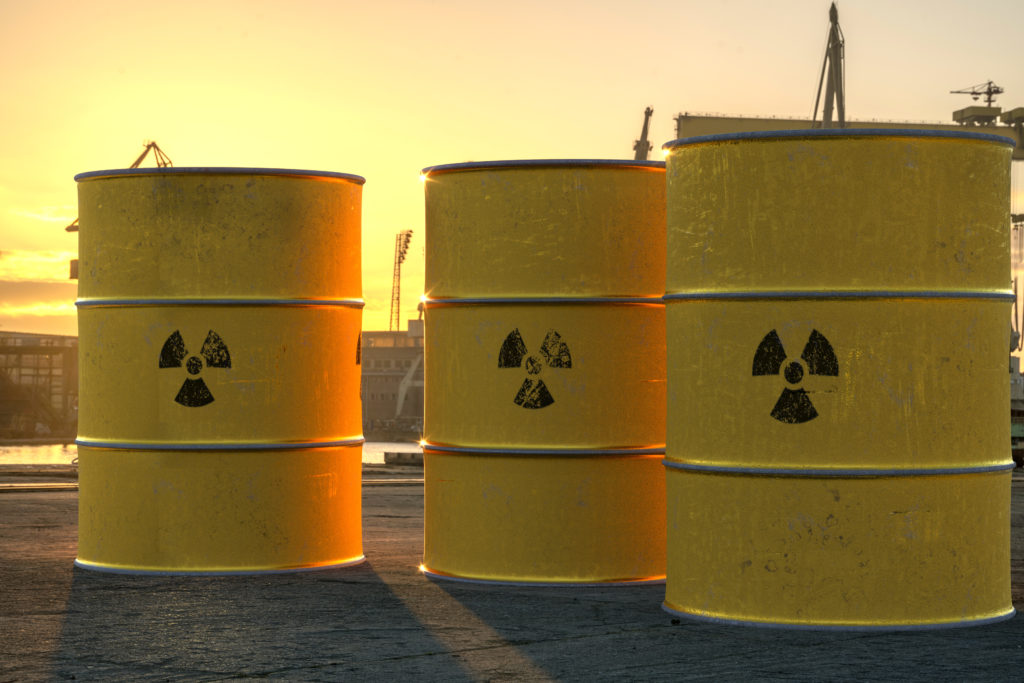
The military-led government said Orano could face criminal proceedings for “mass crimes” after authorities reported finding 400 barrels of radioactive core material in Madaouela, near Arlit, where Orano used to operate its uranium mines.
Orano, 90% owned by the French state, said it had not received any official notice of legal action and denied operating at Madaouela.
“Orano does not hold an operating license for the Madaouela site and has conducted no operations there,” the company said in a written response to Reuters‘ questions.
Justice Minister Alio Daouda said the radiation in the area was much higher than normal — about 7 to 10 microsieverts per hour, compared to the usual 0.5 microsieverts. Tests also found two substances that are linked to breathing problems and could be harmful to people.
Niger began transporting uranium from the site last week, saying it was exercising its sovereign right despite a World Bank tribunal order barring it from accessing the stockpile.
Niger is the world’s seventh-largest producer of the nuclear fuel and cancer treatment material. France, which relies on nuclear power for 70% of its electricity, sourced about 15% of its uranium from Niger when the West African nation’s mines were in full operation.
Niger’s expropriation of Orano’s stake mirrors a broader regional shift, with military-led governments in Mali, Burkina Faso and Guinea asserting more control over resources.
Reuters previously reported that about 1,500 metric tons of uranium were stockpiled at Somaïr, with potential buyers including Turkish, Iranian and Russian interests.
(By Niger Newsroom and Maxwell Akalaare Adombila; Editing by Felix Bate and Tomasz Janowski)
_49205.jpg)
_80831.jpg)
_26274.jpg)
_75753_88057.jpg)
_74422.jpg)
_15595.jpg)

No comments:
Post a Comment