Trump’s Response to Reiner’s Death Shows the Cruelty at the Core of His Politics
This language is not Trump’s alone. It is the language of MAGA politics and everything that enables it.
By Henry A. Giroux ,
December 18, 2025
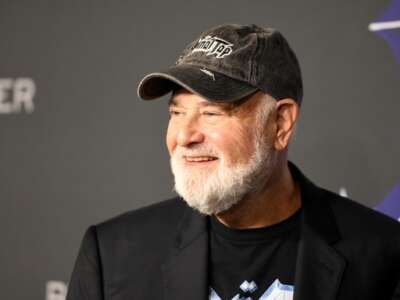
Trump Suggests Rob Reiner Deserved to Be Killed Because of His Liberal Views
The director was brutally killed “due to the anger he caused others” over his criticism of Trump, the president said. By Sharon Zhang , Truthout December 15, 2025
Trump’s response exposes the ugliness at the core of his personality and politics.
Trump’s response to the deaths of Rob Reiner and Michele Singer Reiner belongs squarely to this moral landscape. His rant is not a deviation from political norms but their grotesque culmination, revealing the glaring attributes of the fascist subject on steroids: the absence of empathy, the fetishization of punishment, and the conversion of grief into spectacle. When Trump was asked by a reporter about his widely criticized remarks, he doubled down, claiming, “He was a deranged person … I was not a fan of Rob Reiner in any way, shape or form. I thought he was very bad for our country.”
Given Trump’s long record of ruthless attacks on his critics, there is nothing novel in his venom toward Reiner. What is new, and deeply disturbing, is the evident pleasure he takes in the assault, coupled with the chilling insinuation that one of his own supporters carried out the killing. In that moment, Trump’s language crosses into something almost unthinkable, evoking a moral abyss reminiscent of Kurtz in Heart of Darkness: a descent into a politics stripped of restraint, empathy, and reality itself. Reiner’s politics help explain why he became a target. A filmmaker whose work consistently affirmed democratic values, he was a longtime advocate for social justice, opposing the Iraq War, fighting for marriage equality, supporting early childhood education, and later confronting the rise of Christian nationalism. He was also an unflinching critic of Trump, warning early on that Trump was “mentally unfit” for office and later describing the administration’s assault on the media and public culture as a slide toward autocracy.
In Trump’s world, such dissent is not merely disagreement; it is a provocation. His ideology asserts that those who defend democracy, name authoritarianism, or expose the machinery of power must be stripped of dignity and rendered disposable through a language that dehumanizes, vilifies, and invites punishment. It is precisely this moral inversion, where cruelty becomes a political virtue, that prompts a broader reckoning with the kind of figure Trump is and the culture that sustains him.
This is not simply self-absorption run amok; it is the moral signature of a political culture in which cruelty is normalized.
As New Yorker editor David Remnick observes, such moments force an unsettling reckoning. “And so it is worth asking,” Remnick writes, “do you know anyone quite as malevolent? At your place of work? On your campus? A colleague? A teacher? Much less someone whose impulses and furies in no small measure dictate the direction, fate, and temper of the country? Have you ever in your life encountered a character as wretched as Donald Trump?” Remnick’s questions do not merely condemn a man; they indict a political culture willing to place such a figure at its center, normalizing indecency, rewarding cruelty, and treating moral collapse as a form of strength.
There is more than ugliness and cruelty at work in Trump’s response to the deaths of Rob and Michele Reiner. What is also on display is what Hannah Arendt famously called the banality of evil, a corrosive thoughtlessness that she believed lay at the heart of the making of the fascist subject and totalitarian regimes and the violence they enacted, up to and including genocidal actions. Trump’s comments do not emerge in a vacuum. They resonate with, and reinforce, a culture that traffics in dehumanization while portraying critics and dissidents as dangerous enemies of the state.
The hypocrisy surrounding Trump’s attack on Rob Reiner should not be overlooked. In the wake of his remarks, a number of mainstream outlets, including Time magazine, ran headlines suggesting that many Republicans were offended by Trump’s vilification of Reiner for his political beliefs. Framed this way, the story implies a sudden rediscovery of moral restraint within the Republican Party. But that claim collapses on closer inspection.
The endpoint of such brutalizing rhetoric is the colonization of consciousness, the normalization of state terror, and the steady march toward targeted persecution.
What these accounts largely omit is that MAGA Republicans have shown no such concern for civility or restraint when violence serves their political ends. After the September shooting of conservative commentator and close Trump ally Charlie Kirk, MAGA figures were relentless in condemning what they called “political and celebratory responses,” weaponizing the tragedy to demand greater restrictions on free speech and to justify punishing liberal and progressive groups Trump despised. In this context, outrage was not about decency or respect for the dead, but about exploiting grief to expand authoritarian power.
Trump’s offensive language in the face of personal tragedy, then, is not an aberration but part of a well-established pattern. After Nancy Pelosi’s husband, Paul Pelosi, was brutally attacked in 2022 and left gravely injured, Trump, Elon Musk, and a chorus of MAGA supporters crossed even the minimal boundaries of political decency by mocking the assault. The selective outrage over Reiner thus reveals less about Republican conscience than about the cynicism of a political culture in which cruelty is condemned only when it momentarily becomes inconvenient.
Taken together, these episodes reveal that Trump’s rhetoric is not a lapse in judgment or a matter of personal spite but rather a governing language of power — one that circulates far beyond the man himself and embeds cruelty, selective outrage, and dehumanization into the political culture. This language is not Trump’s alone. It is the language of MAGA politics and everything that enables it, including far right extremism, ICE, reactionary politicians, predatory billionaires, and, increasingly, institutions that surrender their democratic responsibilities in the face of an emerging authoritarianism in the United States. History offers no comfort here. When cruelty becomes routine, and dehumanization becomes common sense, language does not merely reflect violence, it prepares the ground for it. The endpoint of such brutalizing rhetoric is the colonization of consciousness, the normalization of state terror, and the steady march toward targeted persecution, prisons, and torture chambers. To ignore this is not neutrality; it is complicity.
This article is licensed under Creative Commons (CC BY-NC-ND 4.0), and you are free to share and republish under the terms of the license.
Henry A. Giroux
Henry A. Giroux currently holds the McMaster University Chair for Scholarship in the Public Interest in the English and Cultural Studies Department and is the Paulo Freire Distinguished Scholar in Critical Pedagogy. His most recent books include: The Terror of the Unforeseen (Los Angeles Review of books, 2019), On Critical Pedagogy, 2nd edition (Bloomsbury, 2020); Race, Politics, and Pandemic Pedagogy: Education in a Time of Crisis (Bloomsbury 2021); Pedagogy of Resistance: Against Manufactured Ignorance (Bloomsbury 2022) and Insurrections: Education in the Age of Counter-Revolutionary Politics (Bloomsbury, 2023), and coauthored with Anthony DiMaggio, Fascism on Trial: Education and the Possibility of Democracy (Bloomsbury, 2025). Giroux is also a member of Truthout’s board of directors.
There are moments when death demands humility, compassion, and moral restraint. Donald Trump, more often than not, answers such moments with cruelty. His reaction to the deaths of actor and filmmaker Rob Reiner and his wife, Michele Singer Reiner, is not merely a morally repugnant expression of indecency; it is emblematic of an age in which ruthless brutality has become a political style and empathy is treated as a weakness, if not a toxic infirmity.
While Trump’s post about Reiner on Truth Social started off in a relatively straightforward manner, calling the deaths “a very sad thing,” it devolved by the second sentence:
Rob Reiner, a tortured and struggling, but once very talented movie director and comedy star, has passed away, together with his wife, Michele, reportedly due to the anger he caused others through his massive, unyielding, and incurable affliction with a mind crippling disease known as TRUMP DERANGEMENT SYNDROME, sometimes referred to as TDS. He was known to have driven people CRAZY by his raging obsession of President Donald J. Trump, with his obvious paranoia reaching new heights as the Trump Administration surpassed all goals and expectations of greatness, and with the Golden Age of America upon us, perhaps like never before. May Rob and Michele rest in peace!
What should have been a moment of collective mourning was instead seized as an opportunity for ridicule, revenge, hatred, and ideological warfare.
Trump’s response exposes the ugliness at the core of his personality and politics. Two people were murdered, a family was shattered, and yet he responds not with gravity, restraint, or even the pretense of compassion, but instead with gleeful malice, attacking Reiner for the unforgivable crime of refusing to affirm Trump’s corrupt, reactionary, white supremacist worldview — even insinuating that Reiner’s political beliefs may have caused Reiner’s death. This is not simply self-absorption run amok; it is the moral signature of a political culture in which cruelty is normalized, public life is stripped of ethical considerations, and suffering becomes raw material for spectacle and punishment. This is not an aberrant outburst or a momentary lapse. It is the logic of a political identity shaped by ethical tranquilization, hatred, authoritarianism, and a culture that treats cruelty as a form of power.
More broadly, Trump’s conversion of Reiner’s death into an occasion for political opportunism, at a moment that demands humility and collective grief, exposes a deeper rot at work, one that reflects a culture steeped in cruelty, organized indifference, and the collapse of social responsibility. Unable to acknowledge suffering beyond his own ego, he turns public life into a theater of dehumanization and punishment, targeting critics for their refusal to submit to his authoritarian imagination. Trump is the hypertrophied expression of a political culture driven by gangster capitalism, racism, and racial cleansing, a culture in which conscience has collapsed, democracy has been hollowed out, and cruelty has been normalized as a mode of power. In such a culture, death is no longer sacred, mourning is no longer collective, and public language itself becomes a weapon. We live at a time when cruelty is transformed into performance, and politics becomes a more direct extension of violence.
While Trump’s post about Reiner on Truth Social started off in a relatively straightforward manner, calling the deaths “a very sad thing,” it devolved by the second sentence:
Rob Reiner, a tortured and struggling, but once very talented movie director and comedy star, has passed away, together with his wife, Michele, reportedly due to the anger he caused others through his massive, unyielding, and incurable affliction with a mind crippling disease known as TRUMP DERANGEMENT SYNDROME, sometimes referred to as TDS. He was known to have driven people CRAZY by his raging obsession of President Donald J. Trump, with his obvious paranoia reaching new heights as the Trump Administration surpassed all goals and expectations of greatness, and with the Golden Age of America upon us, perhaps like never before. May Rob and Michele rest in peace!
What should have been a moment of collective mourning was instead seized as an opportunity for ridicule, revenge, hatred, and ideological warfare.
Trump’s response exposes the ugliness at the core of his personality and politics. Two people were murdered, a family was shattered, and yet he responds not with gravity, restraint, or even the pretense of compassion, but instead with gleeful malice, attacking Reiner for the unforgivable crime of refusing to affirm Trump’s corrupt, reactionary, white supremacist worldview — even insinuating that Reiner’s political beliefs may have caused Reiner’s death. This is not simply self-absorption run amok; it is the moral signature of a political culture in which cruelty is normalized, public life is stripped of ethical considerations, and suffering becomes raw material for spectacle and punishment. This is not an aberrant outburst or a momentary lapse. It is the logic of a political identity shaped by ethical tranquilization, hatred, authoritarianism, and a culture that treats cruelty as a form of power.
More broadly, Trump’s conversion of Reiner’s death into an occasion for political opportunism, at a moment that demands humility and collective grief, exposes a deeper rot at work, one that reflects a culture steeped in cruelty, organized indifference, and the collapse of social responsibility. Unable to acknowledge suffering beyond his own ego, he turns public life into a theater of dehumanization and punishment, targeting critics for their refusal to submit to his authoritarian imagination. Trump is the hypertrophied expression of a political culture driven by gangster capitalism, racism, and racial cleansing, a culture in which conscience has collapsed, democracy has been hollowed out, and cruelty has been normalized as a mode of power. In such a culture, death is no longer sacred, mourning is no longer collective, and public language itself becomes a weapon. We live at a time when cruelty is transformed into performance, and politics becomes a more direct extension of violence.
Trump Suggests Rob Reiner Deserved to Be Killed Because of His Liberal Views
The director was brutally killed “due to the anger he caused others” over his criticism of Trump, the president said. By Sharon Zhang , Truthout December 15, 2025
Trump’s response exposes the ugliness at the core of his personality and politics.
Trump’s response to the deaths of Rob Reiner and Michele Singer Reiner belongs squarely to this moral landscape. His rant is not a deviation from political norms but their grotesque culmination, revealing the glaring attributes of the fascist subject on steroids: the absence of empathy, the fetishization of punishment, and the conversion of grief into spectacle. When Trump was asked by a reporter about his widely criticized remarks, he doubled down, claiming, “He was a deranged person … I was not a fan of Rob Reiner in any way, shape or form. I thought he was very bad for our country.”
Given Trump’s long record of ruthless attacks on his critics, there is nothing novel in his venom toward Reiner. What is new, and deeply disturbing, is the evident pleasure he takes in the assault, coupled with the chilling insinuation that one of his own supporters carried out the killing. In that moment, Trump’s language crosses into something almost unthinkable, evoking a moral abyss reminiscent of Kurtz in Heart of Darkness: a descent into a politics stripped of restraint, empathy, and reality itself. Reiner’s politics help explain why he became a target. A filmmaker whose work consistently affirmed democratic values, he was a longtime advocate for social justice, opposing the Iraq War, fighting for marriage equality, supporting early childhood education, and later confronting the rise of Christian nationalism. He was also an unflinching critic of Trump, warning early on that Trump was “mentally unfit” for office and later describing the administration’s assault on the media and public culture as a slide toward autocracy.
In Trump’s world, such dissent is not merely disagreement; it is a provocation. His ideology asserts that those who defend democracy, name authoritarianism, or expose the machinery of power must be stripped of dignity and rendered disposable through a language that dehumanizes, vilifies, and invites punishment. It is precisely this moral inversion, where cruelty becomes a political virtue, that prompts a broader reckoning with the kind of figure Trump is and the culture that sustains him.
This is not simply self-absorption run amok; it is the moral signature of a political culture in which cruelty is normalized.
As New Yorker editor David Remnick observes, such moments force an unsettling reckoning. “And so it is worth asking,” Remnick writes, “do you know anyone quite as malevolent? At your place of work? On your campus? A colleague? A teacher? Much less someone whose impulses and furies in no small measure dictate the direction, fate, and temper of the country? Have you ever in your life encountered a character as wretched as Donald Trump?” Remnick’s questions do not merely condemn a man; they indict a political culture willing to place such a figure at its center, normalizing indecency, rewarding cruelty, and treating moral collapse as a form of strength.
There is more than ugliness and cruelty at work in Trump’s response to the deaths of Rob and Michele Reiner. What is also on display is what Hannah Arendt famously called the banality of evil, a corrosive thoughtlessness that she believed lay at the heart of the making of the fascist subject and totalitarian regimes and the violence they enacted, up to and including genocidal actions. Trump’s comments do not emerge in a vacuum. They resonate with, and reinforce, a culture that traffics in dehumanization while portraying critics and dissidents as dangerous enemies of the state.
The hypocrisy surrounding Trump’s attack on Rob Reiner should not be overlooked. In the wake of his remarks, a number of mainstream outlets, including Time magazine, ran headlines suggesting that many Republicans were offended by Trump’s vilification of Reiner for his political beliefs. Framed this way, the story implies a sudden rediscovery of moral restraint within the Republican Party. But that claim collapses on closer inspection.
The endpoint of such brutalizing rhetoric is the colonization of consciousness, the normalization of state terror, and the steady march toward targeted persecution.
What these accounts largely omit is that MAGA Republicans have shown no such concern for civility or restraint when violence serves their political ends. After the September shooting of conservative commentator and close Trump ally Charlie Kirk, MAGA figures were relentless in condemning what they called “political and celebratory responses,” weaponizing the tragedy to demand greater restrictions on free speech and to justify punishing liberal and progressive groups Trump despised. In this context, outrage was not about decency or respect for the dead, but about exploiting grief to expand authoritarian power.
Trump’s offensive language in the face of personal tragedy, then, is not an aberration but part of a well-established pattern. After Nancy Pelosi’s husband, Paul Pelosi, was brutally attacked in 2022 and left gravely injured, Trump, Elon Musk, and a chorus of MAGA supporters crossed even the minimal boundaries of political decency by mocking the assault. The selective outrage over Reiner thus reveals less about Republican conscience than about the cynicism of a political culture in which cruelty is condemned only when it momentarily becomes inconvenient.
Taken together, these episodes reveal that Trump’s rhetoric is not a lapse in judgment or a matter of personal spite but rather a governing language of power — one that circulates far beyond the man himself and embeds cruelty, selective outrage, and dehumanization into the political culture. This language is not Trump’s alone. It is the language of MAGA politics and everything that enables it, including far right extremism, ICE, reactionary politicians, predatory billionaires, and, increasingly, institutions that surrender their democratic responsibilities in the face of an emerging authoritarianism in the United States. History offers no comfort here. When cruelty becomes routine, and dehumanization becomes common sense, language does not merely reflect violence, it prepares the ground for it. The endpoint of such brutalizing rhetoric is the colonization of consciousness, the normalization of state terror, and the steady march toward targeted persecution, prisons, and torture chambers. To ignore this is not neutrality; it is complicity.
This article is licensed under Creative Commons (CC BY-NC-ND 4.0), and you are free to share and republish under the terms of the license.
Henry A. Giroux
Henry A. Giroux currently holds the McMaster University Chair for Scholarship in the Public Interest in the English and Cultural Studies Department and is the Paulo Freire Distinguished Scholar in Critical Pedagogy. His most recent books include: The Terror of the Unforeseen (Los Angeles Review of books, 2019), On Critical Pedagogy, 2nd edition (Bloomsbury, 2020); Race, Politics, and Pandemic Pedagogy: Education in a Time of Crisis (Bloomsbury 2021); Pedagogy of Resistance: Against Manufactured Ignorance (Bloomsbury 2022) and Insurrections: Education in the Age of Counter-Revolutionary Politics (Bloomsbury, 2023), and coauthored with Anthony DiMaggio, Fascism on Trial: Education and the Possibility of Democracy (Bloomsbury, 2025). Giroux is also a member of Truthout’s board of directors.
No comments:
Post a Comment