Islamophobia is being normalized at the highest levels. Christians need to learn to fight it.
(RNS) — Learning about Islam can make one a better and more knowledgeable Christian.

Aerial view of group prayer at a mosque. (Photo by Moh Makhfal Nasirudin/Pexels/Creative Commons)
Anna Piela
December 12, 2025
RNS
(RNS) — In recent weeks, Christian men in Texas and Florida have reportedly harassed praying Muslim students. The hecklers were trying to interrupt the prayers in Jesus’ name. “Kaaba 2.0 Jesus is Lord,” one of their signs read, implying that the Christian God should replace the Kaaba in Mecca, the holiest place in Islam, toward which Muslims pray.
“You need Jesus,” the harassers said.
Earlier this month, President Donald Trump reinforced Islamophobic sentiment by calling the American Somali community “garbage” and by significantly restricting the processing of immigration visas for Afghans following a shooting committed by an Afghan immigrant. This week, he launched into a vitriolic tirade against U.S. Rep. Ilhan Omar of Minnesota, falsely accusing her of being in the U.S. “illegally” and mocking her name and her hijab.
The men who harassed the Muslim students might be surprised to learn that these Muslim students already know Jesus, whose birth story and life are described in the Quran. Muslims venerate Jesus as a prophet but do not believe him to be God. Muslims also know Mary, who is exalted in the Quran. Perhaps these Christian men would insist that the Muslim Jesus is not their Jesus. Fair enough: As a Baptist minister, I say that a Jesus who inspires tormenting others is not my Jesus.
I am tempted to say, further, that this is not real Christianity and that these men are not real Christians. But that would be disingenuous: Christians have a long history of hostility toward Muslims. The fact that Warriors for Christ, a group that livestreamed the disruption of the Muslim prayers and has been designated as a hate group by Southern Poverty Law Center, is just the latest example.
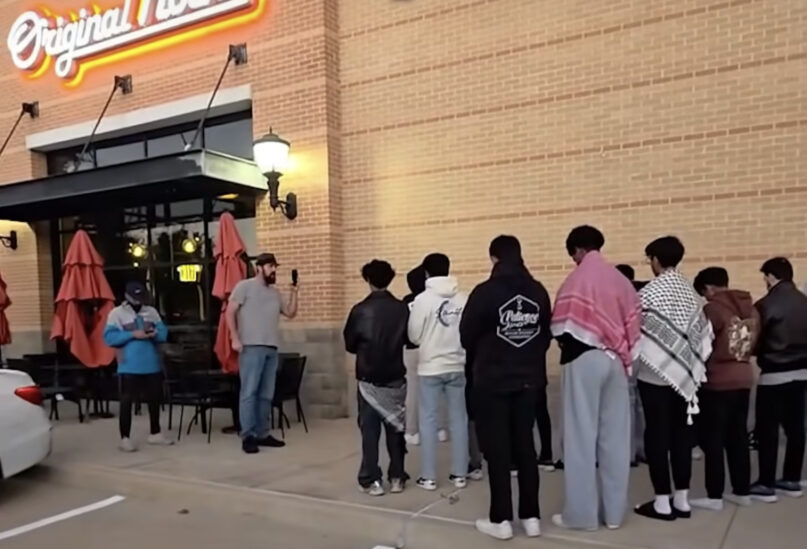
Three men disrupt Muslim teenagers offering their evening prayer outside the Original Mocha coffee house in Murphy, Texas. (Video screen grab)
In one of the earliest recorded Christian responses to Islam, John of Damascus described the new faith as an “Ishmaelite heresy.” His treatise, “The Fount of Knowledge,” written about 743, helped shape negative Christian attitudes toward Islam for centuries. Another eighth-century text, “Storia de Mahometh,” presented for the Christian reader a sort of counter-biography of the Prophet Muhammad, freely mixing fact with highly disparaging fiction. Many such works followed, sowing seeds of anti-Muslim prejudice early on.
These early Christian polemics were produced before the Quran was translated into Latin. Peter the Venerable, the abbot of the Benedictine Abbey of Cluny, who believed that Muhammad was the precursor of the antichrist and the successor of Arius, commissioned the first Latin translation to Robert of Ketton. This 1143 work, “Lex Mahumet pseudoprophete,” was not meant to help build bridges. Rather, its creators hoped to use it to convert Muslims to Christianity.
The first printed Latin publication of the Quran, in 1542, was produced with similar aims. Its preface was written by none other than Martin Luther, the father of the Protestant Reformation, whose goal was to “expose” the Quran as “a work full of lies, fables, and abominations in comparison to Christian scripture,” writes Franzvolker Greifenhagen, a professor at Luther College University of Regina, Canada. Luther, whose view of Islam as Satan’s ploy and, at the same time, divine punishment intended to spur Christian repentance, further entrenched anti-Muslim rhetoric in Christian thought and helped cement it into Protestant identity.
These polemics should be relics of an embattled mindset of medieval and Reformation times, but unfortunately the notions of Islam as an existential threat to Christianity continue to echo across generations and reverberate in vitriolic political rhetoric. Former New York Mayor Andrew Cuomo, who lost to Mamdani in New York City’s mayoral primary and the general election, suggested in the waning days before the election that Mamdani would fail New Yorkers if terrorists attacked while he is mayor: “God forbid another 9/11,” Cuomo said. “Can you imagine Mamdani in the seat?”
Days later, Republican Congressmen Randy Fine of Florida and Andy Ogles of Tennessee demanded that the U.S. Department of Justice investigate Mamdani’s naturalization for fraud. Fine invoked the notion of the “enemy within,” clarifying that he meant “people who have come to this country to become citizens [and] to destroy it.”
Slovakian historian Tomaž Mastnak wrote in his 2002 book, “Crusading Peace: Christendom, the Muslim World, and Western Political Order,” that before the crusades, Christian hostility was directed at all non-Christian peoples. Palestine, once the “Promised Land,” was recast as “Holy Land,” necessitating extermination of Muslims and other non-Christians who inhabited it. Mastnak cites the 12th-century saint Bernard of Clairvaux, who wrote that “a pagan’s death was a Christian’s glory, because, in it, Christ was glorified.”
Bernard’s notion that Christ could be glorified in the suffering of Muslims is likely not consciously driving those who shoot and stab Muslims in the United States and Europe. Their violence can’t be separated from this ancient idea that some places are inherently Christian or that Muslims are inherently evil. The man who murdered 6-year-old Wadea al Fayoume a week after Hamas attacked southern Israel in 2023 shouted, “You devil Muslim, you must die!” as he attacked the boy’s mother.
Islamophobia among Christians of all denominations surveyed by the Institute of Social Policy and Understanding is on the rise. Compared to 2022, in 2025 white evangelical Christians gained 15 points, Catholics 12 points, and Protestants 7 points on the National Islamophobia Index, ISPU’s instrument measuring Islamophobia. The Index is based on the respondent’s level of agreement with five anti-Muslim stereotypes.
In a survey of American Baptist clergy I conducted for a forthcoming book I co-wrote with the Rev. Michael Woolf, “Challenging Islamophobia in the Church: Liturgical Tools for Justice,” more than half of respondents said they had no formal education about Islam. These clergy were less likely to teach about Islam in their congregations, engage with Muslim communities or address Islamophobia in their communities than their peers who had studied Islam in seminary. Some claimed that teaching about a non-Christian faith in church would be heresy and talking about Islam would dilute Christian faith.
In the book, I argue that, on the contrary, learning about Islam can make one a better and more knowledgeable Christian. Learning about Muslim critiques of Christian theological concepts can refine one’s understanding of Christianity. I also argue that standing up for one’s Muslim neighbors is Christian witness and an expression of discipleship.
Such discipleship is embodied by my colleague’s critique of Donald Trump’s recent description of American Somalis as “garbage.” The Rev. G. Travis Norvell, pastor of Judson Memorial Baptist Church in Minneapolis, wrote recently, “I hope the president soon learns that God doesn’t make garbage. God only makes beautiful things. And my Somali neighbors are beautiful.”
The Muslim students who were harassed in Texas and Florida deserve more than legal remedies. They cannot depend solely on state institutions when political leaders spew demeaning rhetoric about Muslims and immigrants. They need and deserve support from neighbors, teachers and fellow students. Christians should be the first to stand with them in solidarity, defend their right to pray in peace and openly reject the acts of hate carried out in the name of Jesus. Our history does not have to define our present or our future.
Anna Piela. (Courtesy photo)
(Anna Piela, an American Baptist Churches USA minister, is a visiting scholar of religious studies and gender at Northwestern University and the author of “Wearing the Niqab: Muslim Women in the UK and the US.” The views expressed in this commentary do not necessarily reflect those of Religion News Service.)
No comments:
Post a Comment