It’s possible that I shall make an ass of myself. But in that case one can always get out of it with a little dialectic. I have, of course, so worded my proposition as to be right either way (K.Marx, Letter to F.Engels on the Indian Mutiny)
Tuesday, December 16, 2025
HD Hyundai Buys Tiny Welding Robots for Human Shipbuilding Tasks
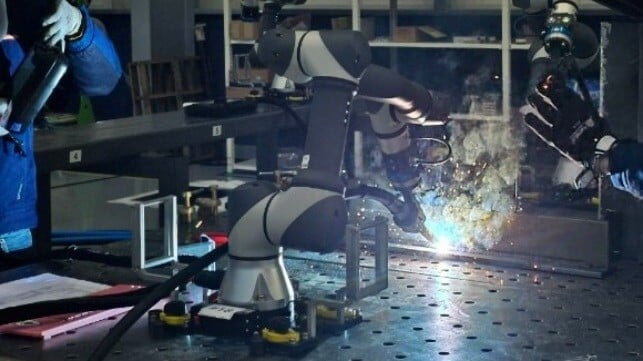
HD Hyundai Heavy Industries has begun using compact, lightweight welding robots that can be moved around the shipyard to automate complex welding tasks - even inside the interior of a ship under construction. The development brings robotic repeatability and speed to tasks that were previously reachable only by human workers, who are in short supply in Korea's shipbuilding industry.
The new capability is the product of a joint initiative between welding robot builder JCT and precision-control company Rainbow Robotics. The robotic arm weighs about 24 pounds and fits in a suitcase, and has been designed and tested for shipyard operations - including welding unusual shapes and curvatures.
The real challenge for this kind of work is not in the hardware - welding robots have been around for decades - but in the controls. Each steel joint location is well-defined in digital drawings of the ship's scantlings, but the task of manually programming each specific arm movement in sequence to carry out each weld would be a challenge every time the robot is picked up and moved.
Instead, software developed by HD KSOE links the digital drawings of the ship to the robot's control systems, and the robot uses these diagrams to figure out where and how to weld, without time-consuming human guidance.
"RB series collaborative robots can be applied to various welding methods without separate coding, enabling rapid automation even in complex environments such as shipyards," Rainbow Robotics CEO Lee Jung-ho confirmed to Chosun Daily.
Chinese shipyard industry publication EWorldShip reports that HD Hyundai has bought 35 of Rainbow Robotics' devices and HD Hyundai Mipo has purchased another 27, for a total of 62. When including all other announced mobile robot buys across the conglomerate's Korean footprint, EWorldShip estimates that HD Hyundai now has on site (or on order) a total fleet of about 170 units - nearly double the number it had the same time last year.
The change is driven in part by Korea's demographics. As experienced welders and fitters retire, there are fewer young Korean nationals interested in taking up a shipbuilding career. The Korean "Big Three" shipbuilders actively recruit in international labor markets to bring in guest workers, including trainees from Vietnam and Thailand. This pattern is now expanding across Korea's manufacturing landscape: a recent survey by the Korea Enterprises Federation found that 45 percent of small manufacturers need more foreign workers, mostly because of difficulty in hiring locals.
In addition, Korea faces fierce shipbuilding competition from China, where heavy state subsidies and government backing have built a globally dominant sector that competes hard on both price and (increasingly) quality. Tech proponents believe that robotic systems provide a direct answer to all of these competitive challenges - labor availability, production cost and consistency - so long as the technical hurdles of integration into the workflow can be solved.
Korea’s HJ Heavy Industries Wins First U.S. MRO Project
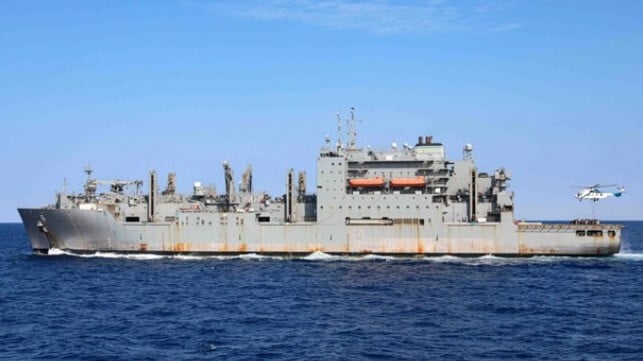
USNS Amelia Earhart will be going to Korea for three months of maintenance and pairs (USNS file photo)
South Korea’s HJ Heavy Industries has signed its first repair and maintenance contract for a U.S. Navy support vessel. It becomes the first of Korea’s mid-sized shipyards to enter the business, which is seen as a lucrative segment for the companies.
The U.S. has sought to undertake more of the repair and maintenance work overseas, close to the area of deployment, to lessen the downtime for critical support ships. It is also a strategic relationship-building opportunity for the yards that look to gain more work as part of the Korean Make American Shipbuilding Great Again program.
HJ reports it had been working since 2024 to be certified to bid for the U.S. maintenance, repair, and overhaul (MRO) market, and this year had completed the inspections with visits from the Commander of the U.S. Naval Forces Korea, the U.S. Navy Supply Systems Command Field Inspection Team, and the U.S. Deputy Assistant Secretary of Commerce. It followed HD Hyundai and Hanwha Ocean, which had previously been certified to undertake contracts. Hanwha Ocean has already completed two MRO contracts, and HD Hyundai recently won its first MRO contract.
The yard reports it won the MRO assignment for the USNS Amelia Earhart, a 40,000-ton displacement dry bulk and ammunition carrier. Commissioned in 2008, the vessel is capable of supplying up to 6,000 tons of ammunition, food, and cargo, as well as 2,400 tons of fuel. It is used for at-sea resupply of the U.S. carriers and warships.
The vessel is due to arrive at the Busan Yeongdo Shipyard in South Korea in January. The project includes maintenance work, inspections, repairs for the hull and major systems, replacement of parts, and painting. The ship is due to be delivered back to the U.S. Military Sealift Command around the end of March.
HJ Heavy Industries, which is the revitalization of the former Hanjin Shipyard, sees this as a turning point with international recognition for the mid-sized shipbuilder. It says this assignment will be its foundation in the MRO market, which is notable for the mid-sized shipbuilder.
The shipyard notes that it is also a continuation of its long heritage with naval shipping. It was the first Korean shipyard designated as a maritime defense contractor in 1974. In the past 50 years, it notes that it has worked on over 1,200 vessels, including construction and maintenance projects.
Hapag-Lloyd Pursues Strategy to Add Feeders that Improve Efficiency
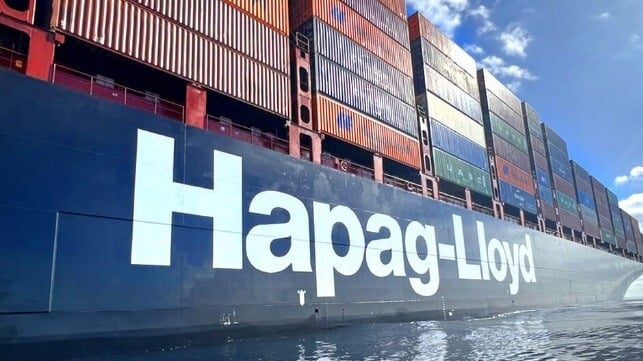
Hapag-Lloyd is pursuing a replacement strategy in the feeder segment (file photo)
Hapag-Lloyd is moving forward with its corporate strategy to expand its fleet of feeder containerships that will enhance the efficiency and environmental performance of the fleet. Feeders have taken on an increasing importance as the carrier is part of the new Gemini Cooperation with Maersk that is built around a network of feeders and hub ports for the liner service between Asia and Europe.
The carrier announced last week that it had ordered eight 4,500 TEU containerships at an investment of more than $500 million. Further, Hapag said it had decided to add another 14 newbuilds, meaning it would add a total of 22 new vessels, each with a capacity of less than 5,000 TEU. It said it would include four 1,800 TEU and four 4,500 TEU vessels on long-term charters. It will also charter six 3,500 TEU vessels.
Hapag cites that the strategy replaces older tonnage while also reducing its dependency on the charter market. As they are new ships, they will also be more cost-efficient and designed to take advantage of new emission reduction technologies and fuels.
The company’s newbuild order was placed with the Chinese shipyard CIMC Raffles for the eight 4,500 TEU vessels. They will be delivered in 2028 and 2029, and they will be the company’s first newbuilds equipped with dual-fuel methanol engines.
Hapag reports these new ships will be up to 30 percent more efficient than older ships of the same size class. They will be able to save up to 350,000 metric tons of CO2 per year when using methanol propulsion.
The move into methanol follows an agreement in April 2024 with Seaspan to retrofit in 2026 and 2027 five 10,100 TEU vessels under charter to dual-fuel methanol propulsion. In anticipation, Hapag-Lloyd in November 2024 also entered a supply agreement with China’s Goldwind for 250,000 metric tons of green methanol per year.
MPC Container Ships of Norway announced another order on December 16, saying the vessels would be under a long-term charter, which reports linked to Hapag. It contracted for six 3,700 TEU vessels to be built by China’s Taizhou Sanfu Ship Engineering. The company reports it will invest $292.5 million and over the 10-year charter expects $479 million in revenue and around $288 million in EBITDA. The initial charter is for 10 years with extension options.
The ships, which will start delivery in the second half of 2028, will employ a design that optimizes speed and fuel consumption for regional and feeder trades. They, however, will be flexible to shift between trade lanes as the markets evolve. The ships will be prepared for alternative fuels and advanced emissions-reduction technologies.
Hapag-Lloyd emphasized that the new ships are part of its overall commitment to be a driver of sustainability in container shipping. It highlights that it currently has in service or planned a total of 37 vessels that are dual-fuel LNG powered, which can also operate using biomethane.
These orders are rounding out a record year for containership orders. The sector is leading the drive toward alternative fuels in commercial shipping and employing new technologies. For the first time, the sector’s total orderbook is topping 5 million TEU of capacity, leading to speculation of potential overcapacity and a resulting acceleration in disposing of the oldest, less efficient tonnage.
No comments:
Post a Comment