COMMENT: Lukashenko plays the Trump card in bid to end Belarus’s isolation
Belarusian leader Alexander Lukashenko has launched a calculated charm offensive towards Washington, using a mix of political prisoner releases, diplomatic gestures and strategic flattery aimed at aligning with US President Donald Trump’s foreign policy instincts. In the process, he is borrowing directly from the playbook he has long used with Russian President Vladimir Putin.
On December 13 after a US-brokered deal, Lukashenko released 123 political prisoners, including some of the most famous: presidential candidate Viktor Babariko, protest leader Maria Kolesnikova, Nobel laureate Ales Bialiatski, and Tut.by editor Maryna Zolatava. In return, the US lifted sanctions on Belarus’s potash industry—its biggest cash cow—and hinted at broader concessions to come.
“Lukashenko is using the same approach in his dealings with Trump that has long proven successful with Putin,” political analyst Artyom Shraibman wrote in a commentary for the Carnegie Endowment for International Peace. “That consists of identifying the senior partner’s soft spots and then massaging them with flattery, demonstrative loyalty, and unexpected offers of crisis management services.”
Relations between Belarus and the US have been warming in the last year, but it is still not clear if this a fundamental change in the relations or just a tactical play by Lukashenko. If Trump successfully concludes his transactional peace deal with Russian President Vladimir Putin and the US goes into business with Russia then the relationship with Minsk can be deepened, but if the war continues, Lukashenko will remain heavily dependent on Moscow which will limit any split.
In the meantime, the White House has been keen to engage in an attempt to peel Belarus away from Putin’s sphere of influence and Lukashenko has been a willing participant as he looks for leverage to balance his almost total dependence on Moscow. The Trump administration also believes Lukashenko provides a useful channel for influencing Putin. And this comes at very little cost to Washington.
“The US side has delegated the actual diplomacy to professionals. All Donald Trump is required to do is periodically pat Lukashenko on the shoulder via the US president’s social media posts, sign whatever his aides put on his desk when they talk to Minsk and bask in the glory of becoming the first Western leader to have secured the release of several hundred Belarusian political prisoners," says Shraibman.
Trump has appointed his former lawyer, John Coale, as special envoy to Belarus in November. Washington now appears willing to deepen ties, despite the limited strategic significance of Belarus compared to Ukraine or Russia. For Lukashenko, the shift presents a rare chance to escape years of diplomatic isolation.
“Trump may well get the credit for having rescued hundreds of hostages in support of his Nobel Peace Prize bid,” Shraibman noted, adding that Lukashenko is trying to capitalise on “Trump’s approach to the region,” which favours symbolic victories and transactional diplomacy.
Lukashenko has already played several of his aces. The release of 16 prisoners, including Sergey Tikhanovsky (Siarhei Tsikhanouskiy), this summer, the husband of Belarusian opposition leader Svetlana Tikhanovskaya (Sviatlana Tsikhanouskaya), and now Bialiatski, Babariko, and Kolesnikova—shows that Minsk sees Trump’s policies as a rare opportunity to end what had looked set to be lifelong isolation.
Domestically, the opposition faces renewed pressure to reorganise. With several 2020-era leaders now free, the previously central figure in exile of Tikhanovskaya may see her position as de facto leader contested. Babariko and Kolesnikova have already taken more moderate stances, calling for dialogue with Minsk and for Europe to reassess its sanctions stance—contrasting with Tikhanovskaya’s harder line. As bne IntelliNews reported, the opposition in exile has already been riven by disputes over the best policy direction and a leadership struggle. After Tikhanovsky’s release, his blunt style and ambition have reportedly already led to several conflicts with his wife’s inner circle.
“The structure of the opposition must inevitably become more polyphonic,” Shraibman says. “Personal capital in the West is not easy to pass on, even if Tikhanovskaya wanted to do so.”
On the economic front, logistical constraints remain a key obstacle to restoring Belarusian potash exports. Despite US sanction relief, viable export routes through the Lithuanian port of Klaipeda remain blocked due to deteriorating relationships driven by a balloon smuggling scandal. While some in Vilnius have floated conditional cooperation—such as allowing potash transit in exchange for US troop deployments— the government has been lobbying the EU for increased sanctions on Minsk.
There are few alternative ports to handle the potash exports. There is a corridor to Russia’s northern ports, but the distances involved mean it is too expensive to transport the potash to them by rail. Poland’s Gdansk port remains politically off limits, as Lukashenko has refused to release Polish citizens in Minsk’s jails. A more radical option of exporting via Ukraine’s port of Odesa has been floated. But that is also unlikely as Kyiv considers Lukashenko complicit in Russia’s invasion after he allowed Russian troops to cross the northern border and attack Kyiv from Belarussian territory at the start of the Russian invasion.
One option for circumventing the remaining EU sanctions is if US companies buy Belarusian potash and then export it as their own. But it’s not clear whether such a scheme would be in keeping with the letter and spirit of EU sanctions.
“But that is precisely what could make it a tempting option for the United States,” said Shraibman. “The economic entanglement of former enemies after the war… fits perfectly with Trump’s approach to the region.”
In a surprise move, most of the released political prisoners were transferred not to Lithuania, but to Ukraine, signalling a shift in diplomatic positioning. According to Shraibman, the aim is twofold: “to exclude Lithuania and the Belarusian opposition-in-exile from the proceedings” and “to insert itself into the Russia–Ukraine peace process.”
“By framing his negotiations with the United States within the context of the Russia–Ukraine talks, Lukashenko is demonstrating his full support for Washington’s peace initiatives and his willingness to contribute as much as possible to them. Lukashenko also began his meeting with Coale on December 12 by praising Trump’s latest efforts to end the war and expressing his support for them.”3
Lukashenko has even offered Belarus as a safe haven for Venezuela’s President Nicolás Maduro—another authoritarian leader Trump is seeking to dislodge. This overture, combined with a media interview given to pro-Trump outlet Newsmax, marks a full-scale attempt to present Minsk as a useful partner in Washington’s geopolitical goals.
“Even if some ideas are not ultimately needed, the enthusiasm and desire to be helpful will not be forgotten,” Shraibman concluded.

Belarusian leader Alexander Lukashenko has launched a calculated charm offensive towards Washington, using a mix of political prisoner releases, diplomatic gestures and strategic flattery aimed at aligning with US President Donald Trump’s foreign policy instincts. In the process, he is borrowing directly from the playbook he has long used with Russian President Vladimir Putin.
On December 13 after a US-brokered deal, Lukashenko released 123 political prisoners, including some of the most famous: presidential candidate Viktor Babariko, protest leader Maria Kolesnikova, Nobel laureate Ales Bialiatski, and Tut.by editor Maryna Zolatava. In return, the US lifted sanctions on Belarus’s potash industry—its biggest cash cow—and hinted at broader concessions to come.
“Lukashenko is using the same approach in his dealings with Trump that has long proven successful with Putin,” political analyst Artyom Shraibman wrote in a commentary for the Carnegie Endowment for International Peace. “That consists of identifying the senior partner’s soft spots and then massaging them with flattery, demonstrative loyalty, and unexpected offers of crisis management services.”
Relations between Belarus and the US have been warming in the last year, but it is still not clear if this a fundamental change in the relations or just a tactical play by Lukashenko. If Trump successfully concludes his transactional peace deal with Russian President Vladimir Putin and the US goes into business with Russia then the relationship with Minsk can be deepened, but if the war continues, Lukashenko will remain heavily dependent on Moscow which will limit any split.
In the meantime, the White House has been keen to engage in an attempt to peel Belarus away from Putin’s sphere of influence and Lukashenko has been a willing participant as he looks for leverage to balance his almost total dependence on Moscow. The Trump administration also believes Lukashenko provides a useful channel for influencing Putin. And this comes at very little cost to Washington.
“The US side has delegated the actual diplomacy to professionals. All Donald Trump is required to do is periodically pat Lukashenko on the shoulder via the US president’s social media posts, sign whatever his aides put on his desk when they talk to Minsk and bask in the glory of becoming the first Western leader to have secured the release of several hundred Belarusian political prisoners," says Shraibman.
Trump has appointed his former lawyer, John Coale, as special envoy to Belarus in November. Washington now appears willing to deepen ties, despite the limited strategic significance of Belarus compared to Ukraine or Russia. For Lukashenko, the shift presents a rare chance to escape years of diplomatic isolation.
“Trump may well get the credit for having rescued hundreds of hostages in support of his Nobel Peace Prize bid,” Shraibman noted, adding that Lukashenko is trying to capitalise on “Trump’s approach to the region,” which favours symbolic victories and transactional diplomacy.
Lukashenko has already played several of his aces. The release of 16 prisoners, including Sergey Tikhanovsky (Siarhei Tsikhanouskiy), this summer, the husband of Belarusian opposition leader Svetlana Tikhanovskaya (Sviatlana Tsikhanouskaya), and now Bialiatski, Babariko, and Kolesnikova—shows that Minsk sees Trump’s policies as a rare opportunity to end what had looked set to be lifelong isolation.
Domestically, the opposition faces renewed pressure to reorganise. With several 2020-era leaders now free, the previously central figure in exile of Tikhanovskaya may see her position as de facto leader contested. Babariko and Kolesnikova have already taken more moderate stances, calling for dialogue with Minsk and for Europe to reassess its sanctions stance—contrasting with Tikhanovskaya’s harder line. As bne IntelliNews reported, the opposition in exile has already been riven by disputes over the best policy direction and a leadership struggle. After Tikhanovsky’s release, his blunt style and ambition have reportedly already led to several conflicts with his wife’s inner circle.
“The structure of the opposition must inevitably become more polyphonic,” Shraibman says. “Personal capital in the West is not easy to pass on, even if Tikhanovskaya wanted to do so.”
On the economic front, logistical constraints remain a key obstacle to restoring Belarusian potash exports. Despite US sanction relief, viable export routes through the Lithuanian port of Klaipeda remain blocked due to deteriorating relationships driven by a balloon smuggling scandal. While some in Vilnius have floated conditional cooperation—such as allowing potash transit in exchange for US troop deployments— the government has been lobbying the EU for increased sanctions on Minsk.
There are few alternative ports to handle the potash exports. There is a corridor to Russia’s northern ports, but the distances involved mean it is too expensive to transport the potash to them by rail. Poland’s Gdansk port remains politically off limits, as Lukashenko has refused to release Polish citizens in Minsk’s jails. A more radical option of exporting via Ukraine’s port of Odesa has been floated. But that is also unlikely as Kyiv considers Lukashenko complicit in Russia’s invasion after he allowed Russian troops to cross the northern border and attack Kyiv from Belarussian territory at the start of the Russian invasion.
One option for circumventing the remaining EU sanctions is if US companies buy Belarusian potash and then export it as their own. But it’s not clear whether such a scheme would be in keeping with the letter and spirit of EU sanctions.
“But that is precisely what could make it a tempting option for the United States,” said Shraibman. “The economic entanglement of former enemies after the war… fits perfectly with Trump’s approach to the region.”
In a surprise move, most of the released political prisoners were transferred not to Lithuania, but to Ukraine, signalling a shift in diplomatic positioning. According to Shraibman, the aim is twofold: “to exclude Lithuania and the Belarusian opposition-in-exile from the proceedings” and “to insert itself into the Russia–Ukraine peace process.”
“By framing his negotiations with the United States within the context of the Russia–Ukraine talks, Lukashenko is demonstrating his full support for Washington’s peace initiatives and his willingness to contribute as much as possible to them. Lukashenko also began his meeting with Coale on December 12 by praising Trump’s latest efforts to end the war and expressing his support for them.”3
Lukashenko has even offered Belarus as a safe haven for Venezuela’s President Nicolás Maduro—another authoritarian leader Trump is seeking to dislodge. This overture, combined with a media interview given to pro-Trump outlet Newsmax, marks a full-scale attempt to present Minsk as a useful partner in Washington’s geopolitical goals.
“Even if some ideas are not ultimately needed, the enthusiasm and desire to be helpful will not be forgotten,” Shraibman concluded.
Oreshnik in Belarus?
 Oreshnik is an elusive missile. It shows up in various statements and there are some pretty tangible signs of its existence, but it is still not quite clear what the actual status of the missile is.
The most notable recent appearance of Oreshnik was in the Belarusian leader's 18 December 2025 address, in which he announced that Oreshnik was delivered to Belarus on 17 December 2025 and that it is "being placed on combat duty." Is it really?
My take is that there are reasons to be skeptical. Yes, there is strong evidence of preparations for the deployment, such as the potential deployment site found by Jeffrey Lewis' team (and confirmed by US intelligence). But there are also reasons not to read this evidence too literally, at least at this point in time.
This post is an attempt to collect what we know about Oreshnik to see how various pieces of the story fit together.
The name Oreshnik first appeared on 21 November 2024, when Russia used this missile to strike the Yuzhmash plant in Ukraine. (Here is a video of warheads hitting their targets.) In a special televised address the president of Russia described the strike as a test of a medium-range "non-nuclear hypersonic ballistic missile."
The missile was launched from Kapustin Yar, which is about 800 km away from Yuzhmash. This means that it is indeed a medium-range missile. Note that the reason it was described as a test is that technically the Russian INF moratorium proposal was still on the table. Apparently, the (not quite convincing) logic was that a test is different from deployment, so it would not violate the moratorium. Speaking at a meeting with designers on 22 November 2024, the Russian president confirmed the very narrow reading of the moratorium when he said that Oreshnik is only one of "a whole line of medium- and shorter-range systems." Nevertheless, the framing of the launch as a test was an interesting detail.
According to the report of the commander of the Strategic Rocket Forces at the 22 November 2024 meeting, the missile was developed in accordance with the presidential decision of July 2023. It appears that the missile was tested at least twice before November 2024 - in October 2023 and June 2024 (MilitaryRussia.ru citing a report by the Ukrainian Main Intelligence Directorate).
The Pentagon assessed that the missile was based on RS-26 Rubezh. The Pentagon spokesperson also said that "the United States was pre-notified briefly before the launch through nuclear risk reduction channels." Technically, since the missile was not a true ICBM, Russia was not under an obligation to send a notification, but it apparently decided to do so to avoid potential misunderstanding. If the missile is indeed based on RS-26, its signature during the boost phase would be very similar to Yars (since RS-26 was said to be based on RS-24 Yars). One can never be too careful. The Kremlin spokesman later said that the notification was "an automated warning [that] was sent 30 minutes before the launch." This is most certainly an error - these notifications are not automatic, and by all indications the warning was sent about 24 hours in advance, as required by the US-Russian agreement. We know that rumors of an upcoming ICBM launch were circulating in Ukraine the day before the strike.
The Belarusian involvement in the Oreshnik story started in December 2024. After a bilateral meeting on 6 December 2024, the president of Belarus asked for the missile to be deployed in Belarus (with a condition, though - that "the targets for these weapons" be determined by Belarus). The Russian president responded that such a deployment "is feasible." He also noted that it would be possible after the serial production of these missiles "is ratcheted up" and they are deployed with Russia's Strategic Rocket Forces (RVSN). Moreover, the Russian president suggested that even though the missiles will be operated by RVSN, it would be up to Belarus "to identify the targets."
This kind of targeting arrangement does not look particularly realistic and suggests that something different is going on here. The exchange clearly followed the pattern that had been established earlier regarding the deployment of nuclear weapons in Belarus. The Belarusian leader makes bold statements and Russia plays along, especially during joint appearances.
A few days after this exchange, on 16 December 2024, the president of Russia said in an address to the Ministry of Defense that the serial production of Oreshnik "should begin in the near future." It's notable, though, that the Russian president did not mention the plan to deploy these missiles in Belarus (although he did say that these systems will be used "to protect Russia and our allies' security").
This pattern will persist through the entire year. While the president of Belarus has been constantly mentioning the deployment plan, his Russian counterpart has been more reserved. With the notable exception of joint appearances. Note, though, that he never seems to volunteer any details, opting to confirm the words of the Belarusian president. For example, at a meeting in August 2025, the Russian president confirmed that the site for the deployment in Belarus had been selected and that the missiles would be delivered by the end of the year.
At the same August meeting, the Russian president said that the industry had produced the first serial production system, which "has already been delivered to the troops." A few days later, the Ministry of Foreign Affairs issued a statement that formally withdrew the INF moratorium proposal made in October 2020. The statement, however, did not mention Oreshnik or any other specific system, noting instead that "decisions on the specific parameters of response measures will be made by the leadership of the Russian Federation" based on the analysis of the situation.
News about Oreshnik continued to come mostly from Belarus. However, the deployment announcement on 18 December 2025 came after the president of Russia said at a meeting at the Ministry of Defense on 17 December 2025 that "[b]y the end of the year, the medium-range missile system armed with the Oreshnik hypersonic missile will be placed on combat duty." Notably, he said nothing that would suggest that the missiles would be deployed in Belarus. Neither did he mention Oreshnik in Belarus when asked directly during the end-of-the-year press conference. The Minister of Defense, who spoke after the president, also said nothing about Belarus when mentioning Oreshnik. The Chief of the General Staff, who spoke the next day at a meeting with military attachés, told them that "a brigade has been formed equipped with a new medium-range missile system, Oreshnik."
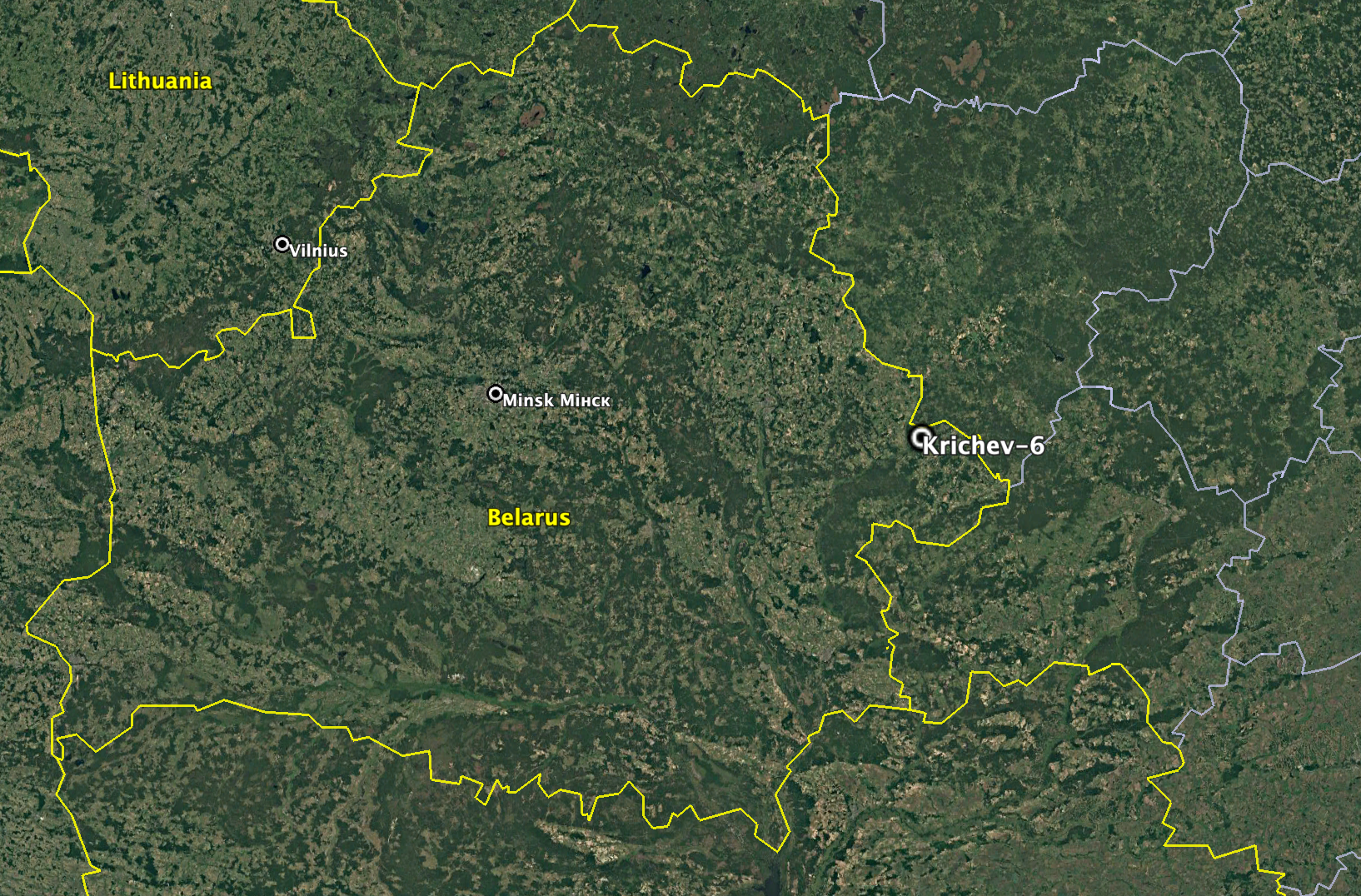
I would say that "a brigade has been formed" is pretty far from "missiles have been delivered to Belarus where they are entering combat duty." I am far from suggesting that Oreshnik is a phantom missile - the evidence suggests that it is not. But at the same time, I do believe that we should be very skeptical about reports of its deployment in Belarus. I find it very hard to believe that the Strategic Rocket Forces, which are expected to operate the missile, will be happy about being stationed outside Russia. Besides, the case for the military utility of the deployment is virtually non-existent. Note that the Krichev-6 site is literally seven kilometers from the Russian border (see the image above).
The "division of labor" between Russia and Belarus regarding virtually all news about Oreshnik also makes me suspicious. We have seen a similar pattern with nuclear weapons - Russia lets Belarus make all kinds of statements about them and even builds a storage facility that should be capable of accepting these weapons if necessary. But there has been no confirmation of the deployment from the Russian side and there are no signs of weapons being actually delivered to Belarus (I believe they will never be deployed there, but that's a topic for another post). The same seems to be the case with the missile base. The infrastructure, of course, could become useful someday, but we are not there yet. For the moment, it appears that both sides are involved in a rather strange political spectacle. I still hope that it will not involve actual movements of missiles (not to mention nuclear weapons), but we cannot exclude that it will.
No comments:
Post a Comment