Condemning the plans, Humanity & Inclusion said antipersonnel mines “render land unusable for agriculture, block access to essential services, and cause casualties decades after conflicts end.”

Polish Deputy Defense Minister Paweł Zalewski speaks during a press conference at the air base in Malbork, Poland on December 10, 2025.
(Photo by Mateusz Slodkowski/Getty Images)
Jessica Corbett
Dec 18, 2025
COMMON DREAMS
Just a couple of weeks after the annual Landmine Monitor highlighted rising global casualties from explosive remnants of war, Reuters reported Wednesday that Poland plans to start producing antipersonnel landmines, deploy them along its eastern border, and possibly export them to Ukraine, which is fighting a Russian invasion.
As both the International Campaign to Ban Landmines (ICBL) monitor and Reuters noted, Poland is among multiple state parties in the process of ditching the Mine Ban Treaty. Citing the Polish Ministry of Foreign Affairs, the news agency reported that “antipersonnel mine production could begin once the treaty’s six‑month withdrawal period is completed on February 20, 2026.”
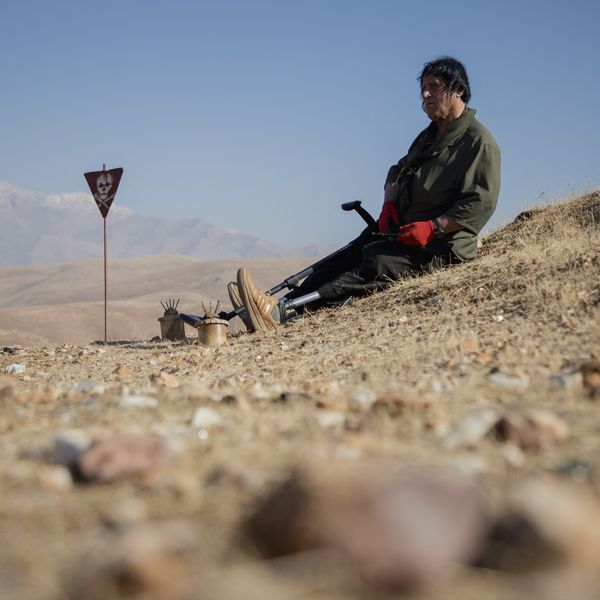
‘Truly Barbaric’: Number of People Killed or Maimed by Landmines Hits Five-Year High
Asked about the prospect of Poland producing the mines as soon as it leaves the convention—also called the Ottawa Treaty—Polish Deputy Defense Minister Paweł Zalewski told Reuters: “I would very much like that... We have such needs.”
“We are interested in large quantities as soon as possible,” Zalewski said. He added that “our starting point is our own needs. But for us, Ukraine is absolutely a priority because the European and Polish security line is on the Russia-Ukraine front.”
Notes from Poland pointed out on social media Thursday that the mine plans come amid other developments in Poland’s East Shield operation. As the Kraków-based outlet detailed Sunday, “Germany will send soldiers to Poland next year to support its neighbor’s efforts to strengthen its borders with Russia and Belarus, which are also NATO and the European Union’s eastern flank.”
Humanity & Inclusion (HI), a group launched in 1982 by a pair of doctors helping Cambodian refugees affected by landmines, said in a statement to Common Dreams that it “strongly condemns Poland’s decision to resume production of antipersonnel mines as soon as its withdrawal from the Ottawa Treaty becomes official in February.”
HI stressed that “antipersonnel mines disproportionately harm civilians. They render land unusable for agriculture, block access to essential services, and cause casualties decades after conflicts end. Their use is devastating for civilian populations. Producing landmines is cheap, but removing them would be even more expensive and complicated.”
“Plus, new production of landmines would make this weapon more available and easier to purchase,” the group warned. “Such a decision normalizes a weapon that has been prohibited since 1999, when the Ottawa Treaty entered into force, and fragilizes the treaty.”
“The Ottawa Treaty has been incredibly effective in protecting civilians and drying up the landmine market, a weapon that was no longer produced in Europe, and only assembled by a limited number of countries, including Russia, Iran, and North Korea, among others,” HI added, citing the drop in landmine casualties since the convention entered into force.
In 1999, casualties were around 25,000 annually, according to ICBL. By 2023, they had dropped to 5,757 injured or killed. However, as the campaign revealed in its latest report at the beginning of December, there were at least 6,279 casualties in 2024—the highest yearly figure since 2020 and a 9% increase from the previous year.
In the report, ICBL outlined recent alleged mine use by not only Russia and Ukraine but also Cambodia, Iran, Myanmar, and North Korea. The group also flagged that, along with Poland, Estonia, Finland, Latvia, and Lithuania are in the process of legally withdrawing from the Ottawa Treaty, while Ukraine is trying to unlawfully “suspend the operation” of the convention during its war with Russia.
ICBL director Tamar Gabelnick said at the time that “governments must speak out to uphold the treaty, prevent further departures, reinforce its provisions globally, and ensure no more countries use, produce, or acquire antipersonnel mines.”
In a statement to Common Dreams this week, ICBL said that “Poland’s announcement marks a deeply alarming escalation and brings Europe closer to the return of weapons that were deliberately banned because of their devastating humanitarian impact. Poland’s announcement comes at a moment when Latvia, Estonia, and Lithuania’s withdrawal from the Mine Ban Treaty takes legal effect on December 27, 2025, compounding a dangerous erosion of civilian protection in Europe.”
“Every antipersonnel landmine laid represents a life put at risk,” ICBL continued. “History shows that around 90% of landmine casualties are civilians, nearly half of them children. This is precisely why the International Campaign to Ban Landmines has long called for the prohibition of these weapons and continues to do so today.”
“Antipersonnel landmines cannot be part of any modern defense strategy. They are indiscriminate weapons whose harm far outweighs any claimed military utility,” the campaign added. “Europe once led the world in rejecting landmines. Allowing their return would not strengthen security. It would undermine the humanitarian norms that protect civilians everywhere.”
This article has been updated with a new comment from the International Campaign to Ban Landmines.
No comments:
Post a Comment