It’s possible that I shall make an ass of myself. But in that case one can always get out of it with a little dialectic. I have, of course, so worded my proposition as to be right either way (K.Marx, Letter to F.Engels on the Indian Mutiny)
Monday, December 29, 2025
World Nuclear News
The AI Arms Race Is Cracking Open the Nuclear Fuel Cycle
The abstract "cloud" of artificial intelligence possesses a massive, structural demand for 24/7 "baseload" power that is equivalent to adding Germany's entire power grid by 2026, a need intermittent renewables cannot meet.
Decades of underinvestment have resulted in a widening uranium supply deficit, with mined uranium expected to meet less than 75% of future reactor needs and an incentive price of $135/lb required to restart mothballed mines.
Big Tech hyperscalers are privatizing energy security by locking in clean baseload nuclear power via long-term agreements, effectively making the public grid's "service" secondary to the "compute-ready" requirements of major platforms.
We are seeing a violent collision between two worlds: the high-speed, iterative world of artificial intelligence and the slow, grinding, capital-intensive world of nuclear physics.
Data from a survey of over 600 global investors reveals that 63% now view AI electricity demand as a "structural" shift in nuclear planning. This isn't a temporary spike or a speculative bubble. It is the physical footprint of every Large Language Model (LLM) query finally showing up on the global balance sheet.
For years, the energy narrative was dominated by "efficiency." We were told that better chips would offset higher usage. That era is over. Generative AI doesn't just use data; it incinerates energy to create it.
Why the "Efficiency" Narrative Failed
The "Reverse-Polish" reality of AI is that the more efficient we make the chips, the more chips we deploy, and the more complex the models become. This is Jevons Paradox playing out in real-time across the data centers of Northern Virginia and Singapore.
When you look at the energy density required for an AI hyperscale center, you aren't looking at a traditional office building. You are looking at a facility that pulls as much power as a mid-sized city, but does so with a 99.999% uptime requirement.
Traditional demand models simply didn't account for a single industry deciding to double its power footprint in less than five years. S&P Global Energy recently highlighted that data center electricity consumption could hit 2,200 terawatt-hours (TWh).
Intermittent renewables…the darlings of the corporate ESG report…cannot provide the 24/7 "baseload" these machines require...
The hyperscalers have realized that if they want to dominate AI, they need to secure physical atoms before the other guy does.
The $135 Ceiling and the Mining Reality Gap
While the demand side is moving at the speed of software, the supply side is stuck in the mud of 20th-century industrial timelines.
The uranium market is currently a "two-speed" machine. On one hand, you have short-term spot price volatility that makes traders nervous. On the other, you have a long-term supply deficit that is widening like a canyon.
We are living through the consequences of twenty years of underinvestment. After 2011, the world essentially stopped looking for uranium. We lived off the "secondary supply"...old Cold War warheads and utility stockpiles. Those stockpiles are now effectively exhausted.
More than 85% of investors surveyed anticipate uranium prices hitting the $100–$120/lb range by 2026. Some are looking at $135/lb.
I see these numbers, and I don't see "growth." I see a desperate incentive price. $135 isn't a sign of a healthy market… it is the price required to beg miners to reopen mothballed pits and navigate the ten-year permitting hellscape required for a greenfield project.
Mining is a "boots-on-the-ground" reality that doesn't care about digital timelines.
Who Collects the Equity and Who Pays the Bill?
There is a massive shift happening in the power dynamics of infrastructure. For decades, nuclear power was a public service…state-funded, state-regulated, and built for the citizen.
Now, we are seeing the "Private Platform" era of nuclear energy. When a hyperscaler signs a twenty-year Power Purchase Agreement (PPA) with a nuclear utility, they are effectively "locking in" the best, cleanest baseload power for private profit.
The question we aren't asking: who pays for the grid upgrades to support this?
The hyperscalers want the green electrons to satisfy their net-zero pledges, but the physical copper and transformers required to move that power often fall on the rate-paying public or the state. We are witnessing the privatization of energy security.
If 63% of investors are right and AI is the new driver of nuclear planning, the "public service" aspect of the grid is about to become a secondary concern to the "compute-ready" requirements of Big Tech.
The equity is being collected by the tech platforms and the uranium miners. The risk is being socialized by the grid.
The Geopolitical Reality of Uranium Supply
We cannot talk about the uranium market without talking about the "Iron Fist" of state policy. The West is currently trying to rebuild a supply chain that it intentionally dismantled.
The U.S. and Europe are aggressively pushing "sustainable finance frameworks" to include nuclear, but they are doing so while facing a massive bottleneck in enrichment and conversion capacity…much of which is still tied to Russian state interests.
China, South Korea, and the UAE aren't waiting for the market to "find a price." They are treating nuclear as a matter of national survival. China is currently building more reactors than the rest of the world combined.
They understand something the West is only just realizing: you cannot run a 21st-century economy on 19th-century energy densities.
If the uranium supply remains constrained, we won't just see higher prices. We will see a geopolitical scramble for "off-take" agreements. The nation that secures the uranium secures the AI lead.
The "vibe" of energy abundance is a lie...We are entering an era of energy rationing by price.
The Technical Friction: Steel vs. Code
The most significant gap in the current market "bull case" is the technical audit of the hardware.
The survey data shows that investors are betting on "restarts" and "greenfield developments" to close the supply gap. But you can't just pour money into a hole and expect uranium to come out the next day.
Uranium mining is plagued by:
Water Management Issues: Especially in places like Kazakhstan (the world's largest producer), where sulfuric acid shortages have already hampered production targets.
Labor Scarcity: We have a generation of mining engineers who were told nuclear was dead. They didn't go to school for this.
The Enrichment Bottleneck: Even if you have the yellowcake, you need to turn it into fuel. The West's capacity to do this is currently maxed out.
Sprott Asset Management correctly notes that utilities can only defer procurement for so long. Eventually, they have to buy. When they do, they will find a market where the physical steel and the chemical reagents are in shorter supply than the capital.
The "catch-up trade" of 2026 isn't just about price. It’s about the reality that we forgot how to build big things in the physical world.
The Bill for the Utopia
We are being sold a vision of AI-driven abundance…health breakthroughs, autonomous cities, and limitless productivity.
But to get that utopia, we need to solve a uranium deficit that has been building for twenty years.
We need to build reactors at a pace not seen since the 1970s.
And we need to do it while the primary producers are facing technical and geopolitical headwinds.
The $100–$120/lb range is just the beginning. If the supply response doesn't materialize…and given the 15-year lead times, why would it? We are looking at a permanent state of high-cost energy for everyone who isn't a trillion-dollar tech company.
We are finally moving from a world of "clicks" back to a world of "kilowatts"...And the kilowatts are getting very, very expensive.
The U.S. government has launched a civil nuclear energy partnership with Kazakhstan, which includes providing a Small Modular Reactor (SMR) simulator for training and funding a feasibility study for US SMR construction.
SMRs are presented as a solution perfectly suited for Kazakhstan, offering advantages like a smaller generating capacity of about 300 megawatts, quicker construction times, and enhanced safety features ideal for remote locations.
Kazakhstan's decision to explore SMRs may indicate a desire to bring new power generation online sooner to support its ambitious plan to become a high-tech innovation hub, especially amid a current electricity deficit and potential delays to large-scale Russian reactors.
While Kazakhstan has big plans to develop its nuclear power capacity, the United States is helping Astana think small.
The US government has agreed to help train Kazakh specialists in the operation of small modular nuclear reactors (SMRs), according to a statement issued December 22 by the US Embassy in Astana. The first phase of the cooperation deal involves the supply of an SMR simulator to Kazakhstan’s Institute of Nuclear Physics in Almaty.
At the same time, a US energy company, Sargent & Lundy, will carry out a feasibility study for the construction of SMRs in Kazakhstan. “This study will identify a shortlist of US SMR options suitable for deployment at potential sites in Kazakhstan,” according to the embassy statement.
Kazakhstan currently has agreements in place with Russia and China to build large-scale reactors. Astana has not previously announced an intention to construct SMRs. But the US statement pointedly mentions that the supply of an SMR simulator is a precursor to US involvement in building SMR units in Kazakhstan and other Central Asian nations. Kyrgyzstan and Uzbekistan are also intent on developing nuclear energy.
“The simulator will serve as a regional training hub to facilitate safe and secure SMR deployment across Central Asia,” the statement notes. “This new facility is a critical step in developing the workforce to expedite US SMR deployment.”
SMRs have a per-unit generating capacity of about 300 megawatts per year, according to the International Atomic Energy Agency (IAEA). That is roughly one-third the annual generating capability of large-scale reactors. The main advantage of SMRs is they are cheaper and faster to build, given their modular specifications. SMRs also can be situated in places that are unsuitable for large-scale reactors, especially remote and sparsely populated areas.
“In areas lacking sufficient lines of transmission and grid capacity, SMRs can be installed into an existing grid or remotely off-grid, as a function of its smaller electrical output, providing low-carbon power for industry and the population,” according to an IAEA assessment of SMRs.
SMRs also tend to be safer to operate given their reliance on passive systems and comparatively low fuel requirements, the IAEA adds. “Passive systems rely on physical phenomena, such as natural circulation, convection, gravity and self-pressurization,” the assessment states. “These increased safety margins, in some cases, eliminate or significantly lower the potential for unsafe releases of radioactivity to the environment and the public in case of an accident.”
SMRs would seem ideally suited for helping Kazakhstan fulfill a plan announced by President Kassym-Jomart Tokayev in September to turn the country into a high-tech innovation hub, driven by the construction of data centers. The plan requires a sizeable increase in power-generating capacity at a time when Kazakhstan is already grappling with an electricity deficit.
In opting to explore the construction of SMRs at this point in time, Kazakhstan may also be expressing doubt that Russia’s nuclear energy entity, Rosatom, can meet the projected timeline to build large-scale VVER-1000 reactors in the country. Those reactors are tentatively slated for completion in the mid-2030s. Given Kazakhstan’s ambitious economic development agenda, officials in Astana are growing increasingly eager to start bringing nuclear power plants on line sooner, rather than later.
How are nuclear geological repository projects progressing?
By Alex Hunt
World Nuclear News, in Vienna
A growing number of countries are planning a permanent solution to the issue of radioactive waste by burying it deep underground. Schemes take many years to plan, and many more years to build, but progress is being made.
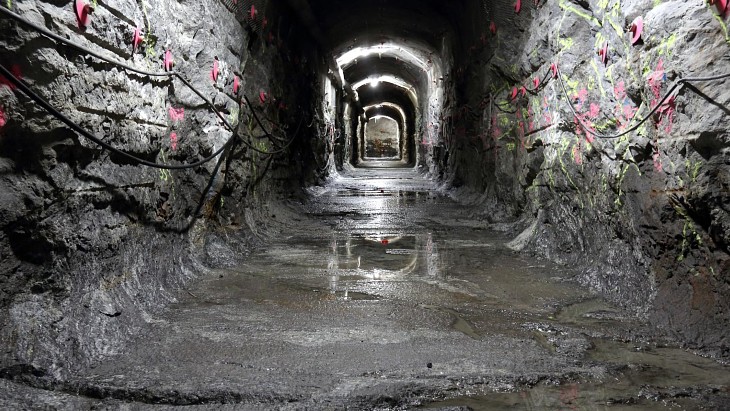
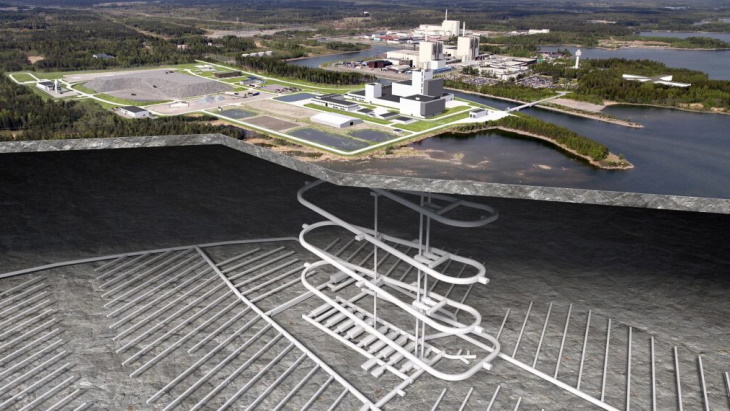
Finland's Onkalo is the most advanced project (Image: Posiva Oy)
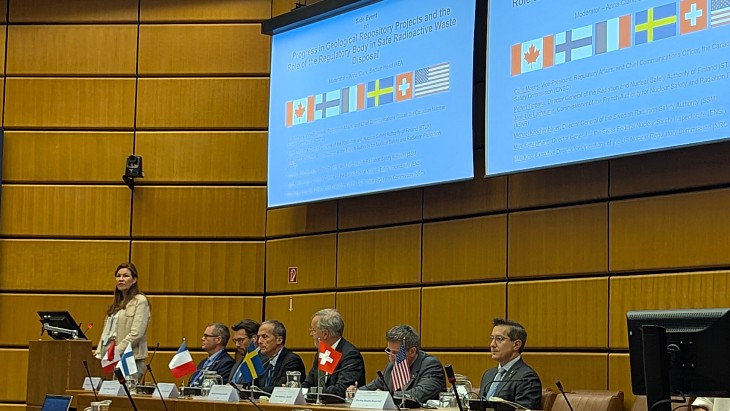
Some of the countries that have been planning such a facility - Canada, Finland, France, Sweden, Switzerland and the USA - took part in an event at the International Atomic Energy Agency’s General Conference in September where they outlined how things were going in their country.
Setting the scene: Why deep geological repository projects matter
A deep geological repository comprises a network of highly-engineered underground vaults and tunnels built to permanently dispose of higher activity radioactive waste so that no harmful levels of radiation ever reach the surface environment. They need to be located deep enough, and in suitable geological conditions, to ensure they will be safely secured for thousands of centuries.
The disposal of used nuclear fuel and other high-level waste has long been a pressing issue in terms of the perceived sustainability of nuclear energy programmes. For many decades this material has been stored safely in pools or special containers and facilities at surface, or near-surface, locations, often close by nuclear power plants. These are seen as interim storage measures pending a permanent solution.
The sharing of information between countries is seen as key to development of projects (Image: WNN)
Hildegarde Vandenhove, Director of the IAEA Division of Radiation Safety, Transport and Waste Safety said: "There is often a perception that no long-term solutions exist for protecting people and the environment from this type of waste. But that perception does not reflect reality. We have known for a long time that deep geological disposal is technically feasible and demonstrably safe. It remains the internationally recognised solution. And yet, developing these facilities is a long and a complex process. It requires rigorous studies and extensive safety demonstrations. These are all first-of-a-kind facilities, and their construction takes time."
The process of selecting a site, and getting approval for it, takes decades, with Anna Clark, head of the Waste and Environmental Safety Section in the Division of Radiation Transport and Waste Safety at the IAEA, saying that "before operations can begin, there's a lengthy pre-operational phase with conceptual design, the planning, the surveys, the site investigations, site selection, narrowing down the number of sites, doing detailed characterisation of your preferred site, it's a long process before you even begin with the licensing of construction. And throughout that period, the safety case evolves and the role of the regulator also evolves, and the regulators have to adapt their expertise and knowledge as they go".
Canada
Colin Moses, Vice-President, Regulatory Affairs, and Chief Communications Officer at the Canadian Nuclear Safety Commission, outlined the status of the country’s deep geological repository which, he noted, started being discussed in the 1970s. It is being taken forward by the Nuclear Waste Management Organization, a government agency fully funded by the producers of waste with a mandate to determine and find and build and operate a long-term solution for disposal of used fuel in Canada.
Its concept is for a "geosphere which forms a natural barrier of rock to protect the waste from disruptive natural events, water flow and human intrusion".
The current status is that Wabigoon Lake Ojibway Nation and the Township of Ignace were selected in November 2024 as the host communities for the proposed repository, following a consent-based siting process that had begun some 14 years earlier. Pre-licensing activities, including stakeholder engagement, pre-environmental assessment and technical reviews, have been taking place.
A concept for the Canadian used nuclear fuel repository (Image: NWMO)
Construction of the facility will only begin once the deep geological repository has successfully completed the federal government’s multi-year regulatory process and the Indigenous-led Regulatory Assessment and Approval Process, a sovereign regulatory process that will be developed and implemented by Wabigoon Lake Ojibway Nation.
The Nuclear Waste Management Organization explored more than 20 different potential locations in Canada looking for local communities to raise their hand and express an interest in potentially hosting the repository, with the last decade spent refining that list down to the one preferred site.
Moses said he was expecting the formal regulatory process to begin this year and "will play out over several years, looking to give an initial decision in 2030. That will allow them to advance construction in 2032, move into operation in 2042 and ultimately to operate that facility for many decades, expecting a current closure date of 2092".
"So this is a project that's playing out over multiple decades and has spent multiple decades getting ready."
Finland
Progress is furthest advanced with Finland’s Onkalo project. Petteri Tiippana, Director General of the Radiation and Nuclear Safety Authority of Finland (STUK) outlined the concept, which is a repository in crystalline rock with used fuel in copper canisters surrounded by a bentonite buffer at a depth of 400-430 metres.
For Finland, which is currently in the process of commissioning the deep geological repository, the process began in the 1980s with the then government setting a target for operation in the 2020s. Pre-licensing activities started almost immediately, Tiippana said, in terms of research and design and for the concept, with actual licensing steps beginning in the early 2000s with a site selection. A construction licence was issued in 2015.
Currently the encapsulation plant has been commissioned and tested the dummy fuel elements in five canisters and transported them to the underground facility. The next phase will be to "test the underground facility and the final disposal of those five copper cases". He said that the reviewing of safety documentation is approaching its final stages and the aim is for a decision next year, with operations then starting.
See how Finland's project will work:
France
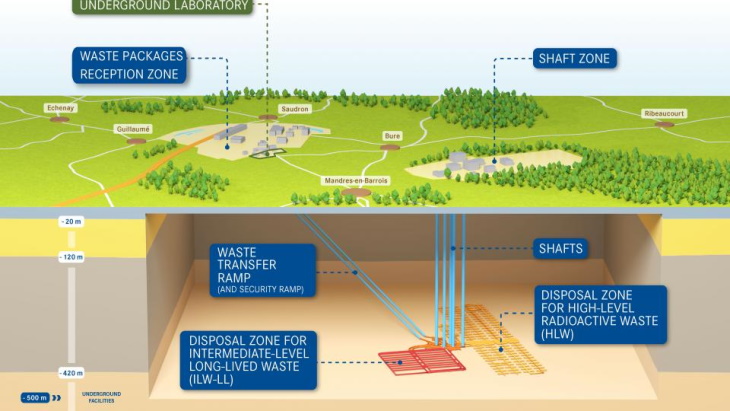
France plans to construct the Centre Industriel de Stockage Géologique (Cigéo) repository - an underground system of disposal tunnels - in a natural layer of clay near Bure, to the east of Paris in the Meuse/Haute Marne area. The plan is to dispose of 10,000 cubic metres of high level waste and 75,000 cubic metres of intermediate-level waste.
Jean-Luc Lachaume, Commissioner of the French Authority for Nuclear Safety and Radiation Protection (ASNR), said that, as with other countries, there had been decades of work already on developing the repository, with parliamentary debates about it beginning in the 1980s, before a decision 20 years ago to go ahead with a deep geological repository.
A diagram of the planned Cigéo repository (Image: Andra)
The milestone of the construction licence application being submitted happened in 2023, since when it has been under review. A technical review was completed in June and ASNR issued a favourable opinion on the application earlier this month.
This will be followed by the consultation phase and public inquiry in 2026 and a potential licence granting in 2027 or 2028, with a target first operation of the pilot phase in 2035.
Sweden
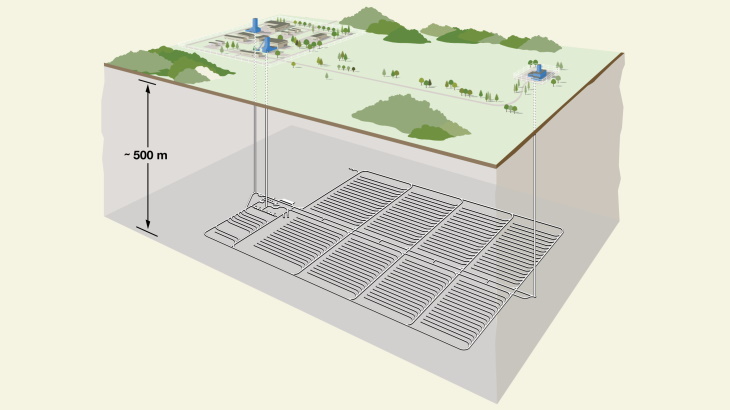
A site has been selected at Fosmark, 150 kilometres north of Stockholm. Surface works have been taking place and the application to start underground excavation was submitted in January 2025 and is currently being considered. The concept for Sweden is the repository to be at a depth of 500 metres, in crystalline rock, with copper canisters each surrounded by bentonite clay to keep groundwater away from the canister and to provide a barrier to any potential leakage of radioactive material.
As with all countries, there has been decades of preparation and discussion, with regulatory licensing reviews and court hearings from 2011 to 2018 prior to government approval being issued in 2022.
A visualisation of the completed repository (Image: SKB)
Michael Knochenhaut, Director General of the Swedish Radiation Safety Authority (SSM), said "it started in the 1970s and 1980s - it has definitely been a journey - there have been quite a lot of technical challenges to demonstrate the protected capacity, both to meet our requirements as a regulator, but also to remain intact for more than 100,000 years".
He noted the importance of gaining public trust and acceptance, which takes time, and said there was also the need to build up knowledge within the regulator and an "important factor during this long journey has been a clear allocation of responsibility, with the ‘polluter pays’ principal".
Above-ground construction work is to continue while the repository construction permit is considered, with the authority’s approval coming in 2026 or 2027, which would allow the start of underground construction, followed by trial operation.
Switzerland
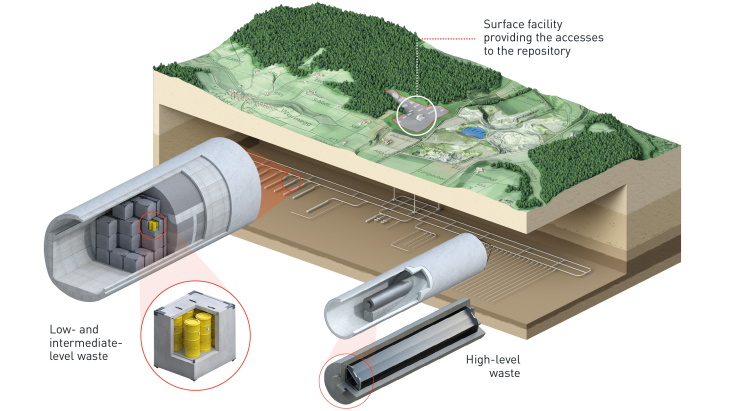
Switzerland is in the final stage of the site selection process, which began in 2008, with national and international participation. The plan is for a combined repository for high- low- and Intermediate-level waste, with a general licence application submitted and due to be considered by 2027 with a government decision targeted for 2029.
Marc Kenzelmann, Director General of the Swiss Federal Nuclear Safety Inspectorate, outlined the background to the site selection, noting that Switzerland was a country about 7% the size of Texas, with two thirds of its area covered in mountains, so unusable for a high-level waste repository because the Alps could rise by a kilometre over the next million years, which is "the time frame that we have set for a safe, deep geological repository. So the Alps have an active geology, but what we need is a boring geology".
This has meant that the location search was focused on the area near to the German border, so "we have involved Germany from the very start of the selection process". He said that one issue was making sure to take the time and effort to build up stakeholder trust. In their case there have also been some unique differences of public opinion, with "Swiss people generally less concerned than German people" about the issue.
In November 2024 Switzerland's national radioactive waste disposal cooperative Nagra applied to the Swiss Federal Office of Energy for a general permit for the construction of the planned deep geological repository for radioactive waste at Nördlich Lägern in northern Switzerland, and a used nuclear fuel encapsulation plant at the existing Zwilag interim storage facility in Würenlingen in the canton of Aargau.
The concept of the Swiss repository(Image: Nagra)
According to current planning, the Federal Council will decide on the application in 2029 and Parliament in 2030. A national referendum is expected to take place in 2031.
Once the general authorisation for the repository comes into force, geological studies will be carried out underground in the area of implantation (through the creation of an underground laboratory), with the aim of acquiring more in-depth knowledge with a view to the construction of the repository. The application for a building permit, then later the application for an operating permit, can then be submitted. According to current planning, the repository could come into operation and the first radioactive waste could be stored there from 2050.
The USA
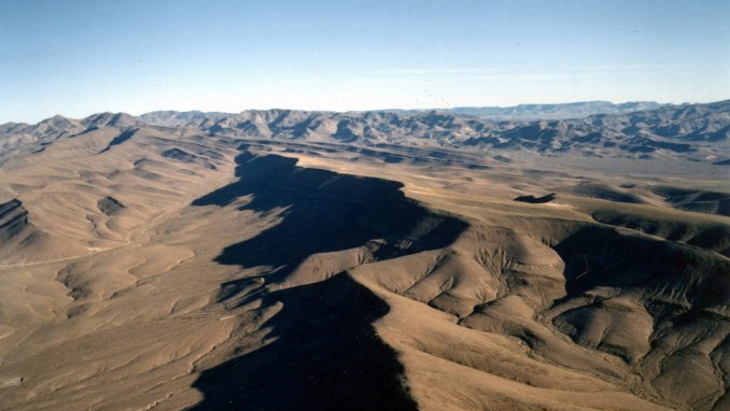
Yucca Mountain has since 1987 been named in the US Nuclear Waste Policy Act as the sole initial repository for disposal of the country's used nuclear fuel and high-level radioactive wastes. The DOE submitted a construction licence application to the Nuclear Regulatory Commission in 2008, but the Obama Administration subsequently decided to abort the project and there have been various twists and turns since then, with the upshot that it has not been built.
Mike King, Executive Director for Operations at the US Nuclear Regulatory Commission, said the current status of its high-level waste disposal programme is that NRC staff had reviewed the US Department of Energy’s application for a repository at Yucca Mountain and staff completed its Safety Evaluation Report more than a decade ago and concluded it met safety standards "however there were two remaining environmental and programmatic pull points that prevented the final authorisation" and since 2016 funding has been halted and there are no activities taking place on it other than record-keeping, and the licensing process is currently suspended.
An aerial view of Yucca Mountain, Nevada (Image: DOE)
King stressed that the NRC continues to participate in a variety of national and international activities related to geologic disposal with lessons to be shared and learned. He said that in the interim there are about 100 different locations where used fuel is being stored in fuel pools or dry cast storage "however we are also keenly interested in what is the ultimate permanent storage" solution.
He said that from a regulator's perspective it was important to be objective and take a very methodical approach and engage with the public. In the Yucca Mountain case there had been 100+ technical exchanges with the the applicant which are open to the public "so they could see that we are addressing the key technical issues".
His other lesson was the technological implications of such a long-term process, and "thinking about that ahead of time and keeping your records in a way that you can retrieve them - we probably started with some microfiche, this was an era before everybody had PCs. And so the software that we used changed so much over time". This had added to the challenge of collecting all the records and putting them in a recoupable format.
And finally
The general thrust of the discussion was that there needs to be a clear delineation of responsibilities for the project, with long-term planning and clear public consultation and decision-making processes to ensure there is community trust in the decision making process. As one speaker put it: "We need to understand what they want to understand and understand what they understand." Another speaker pointed out that the reason some projects have not proceeded in the past has not been because of any technical failings, but because of public opposition/political reasons. The regulators were also urged to be sufficiently flexible to allow for changes in concept development. On site selection those taking part agreed that it should not be fixed on getting the best site, as there may be a few sites which meet all the necessary criteria.
They also agreed on the importance of sharing lessons from the projects so that other countries which may be planning to embark on their own deep geological repository - and the IAEA itself as advisors - can benefit from that experience
Report: Lost Russian Ship Was Carrying Nuclear Submarine Reactor Parts
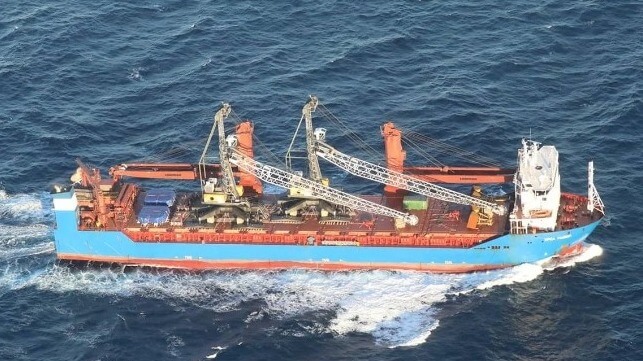
Ursa Major on her final voyage. The mysterious cargo in question is located all the way aft on the weather deck, wrapped in tarps. (Oliver Alexander / X)
The special cargo aboard the Russian arms ship that went down off Cartagena last year was not what its crew initially reported, according to Spanish outlet La Verdad. The blue-tarped objects on the vessel's stern were likely naval reactor components, unfueled and potentially headed for North Korea, national authorities determined.
In December 2024, Ursa Major was under way in an eastbound convoy through the Strait of Gibraltar, a trip she had made many times before. The vessel was well-known to shipwatchers as a Russian arms ship, and many suggested that she was on another "Syria Express" run to the Russian base at Tartus.
On December 21, Spanish maritime SAR authorities noticed that the vessel was making unusual course changes. On the 22nd, Ursa Major veered to port and slowed to bare steerageway, then drifted. A distress call came at last on the 23rd, and Spanish authorities dispatched search and rescue units. On arrival, they found that the ship was listing, two engineering crewmembers were missing, the engine room was shut tight, and the survivors were ready to abandon ship. 14 surviving crewmembers were evacuated to shore, and the vessel went down soon after.
The circumstances of the vessel's sudden sinking were suspicious, and the maritime captaincy began asking questions. Ursa Major's master, Capt. Igor Vladimirovich Anisimov, initially told investigators that the cargo consisted of more than 100 empty containers, two giant crawler cranes on deck, and two large components for a Russian icebreaker project (the tarped objects located near the stern). All this was headed to Vladivostok, he said.
The two "icebreaker components" were shipped as deck cargo and were visible to spotting planes during the ship's earlier transit (top). Based on aerial surveillance, they were each approximately 20-25 feet square, including any crating material, dunnage and tarping.
Spanish authorities estimated their weight at about 65 tonnes each, suggesting unusual density. La Verdad reports that after the master was pressed on the matter, he asked for time to think, then told investigators that the items were "manhole covers."
Documents seen by La Verdad show that Spanish investigators identified the cargo as a pair of casings for nuclear-submarine reactors - specifically, for a pair of Soviet-era VM-4SG reactors. This model was the final iteration of the VM-series, the naval reactors that powered Russia's nuclear ballistic missile sub fleet through the Cold War. The VM-4SG variant was installed aboard the Delta IV-class submarine, and is still in active service aboard half a dozen of these ballistic missile subs in the Russian Navy.
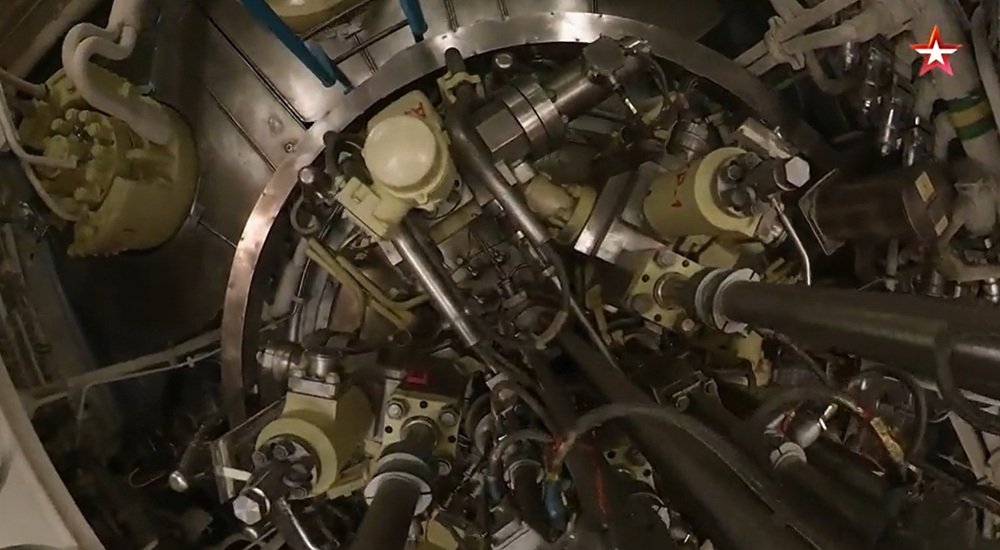
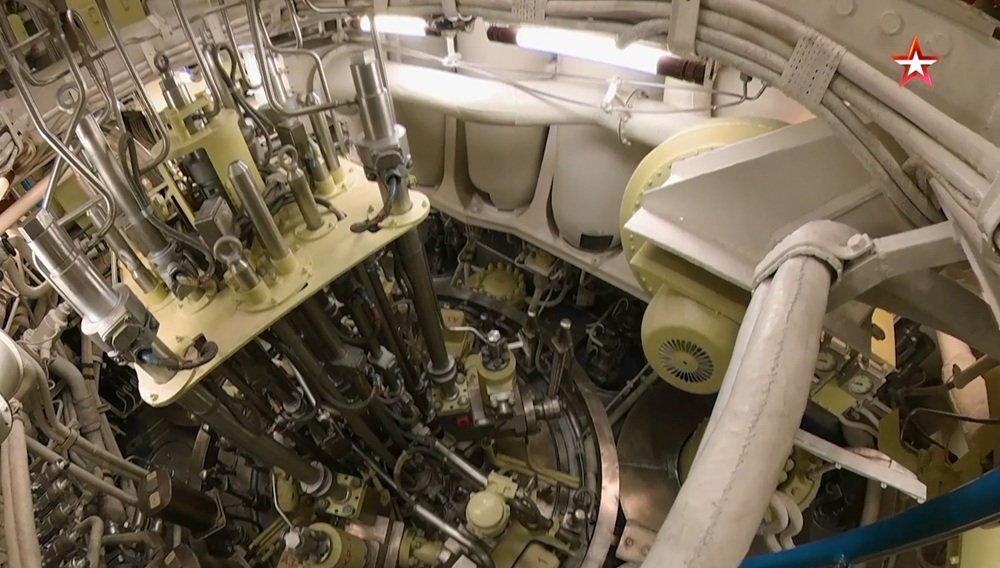
Public audiences have more access to information about the VM-4SG than they do about most naval reactors. Virtually every parameter and component of a naval reactor is secret: knowledge of its design could help an opponent to target the sub, or to improve their own equipment. Luckily, in 2023 Russia's defense ministry shared rare footage of the inside of a 4M-4SG reactor compartment on a Delta IV, including a detailed video exploration of the control rod system and the visible top of the "lid," which is bolted to the top of the barrel-shaped containment vessel.
Top of the VM-4SG's lid as viewed from above (TV Zvezda)
Top of the VM-4SG reactor as viewed from above, including control rods (TV Zvezda)
The lid of this reactor is about three feet thick, and it is made of solid steel to protect the sub's crew from ionizing radiation, propulsion division commander Andrei Leonov told the Russian Ministry of Defense's TV Zvezda channel. This thickness suggests exceptional weight, in line with the suspected mass of the Ursa Major's cargo.
As for the destination, Spanish authorities speculated that the reactor parts may have been destined for the North Korean nuclear submarine program, which just launched its first ballistic-missile sub. Multiple analysts have suggested that the newbuild North Korean vessel likely benefited from Russian technical assistance for its reactor design, and could potentially have incorporated a fully built Russian reactor. Russia owes North Korea a special debt for vast transfers of artillery shells and other munitions, which have helped the Russian Army to reverse losses and begin gaining ground in Eastern Ukraine.
The cause of the Ursa Major's sinking appears to be kinetic. The shipowner told media that there were three explosions and a 20-inch hole in the shell plating, and the captain confirmed that the hole's ragged edges were bent inwards. This is consistent with an explosion on the outside of the hull.
No comments:
Post a Comment