‘Throwback to McCarthyism’: Trump DOJ Moves to Treat Leftist Dissent as Criminal
A former official from Trump’s first term said the FBI will be able to throw the full might of the surveillance state at “Americans whose primary ‘offense’ may be ideological dissent.”
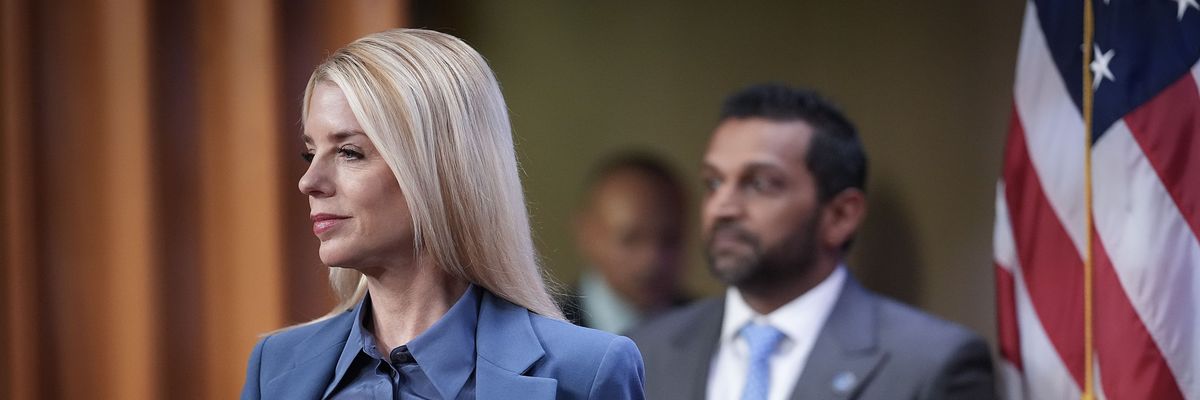
Attorney General Pam Bondi and FBI Director Kash Patel arrive for a news conference at the Department of Justice on December 4, 2025, in Washington, DC.
(Photo by Andrew Harnik/Getty Images)
Stephen Prager
Dec 18, 2025
COMMON DREAMS
The Trump administration is about to embark on a massive crackdown on what it describes as a scourge of rampant left-wing “terrorism.”
But the US Department of Justice (DOJ) memo ordering the crackdown has critics fearing it will go far beyond punishing those who plan criminal acts and will instead be used to criminalize anyone who expresses opposition to President Donald Trump and his agenda.

Earlier this month, independent journalist Ken Klippenstein reported that Attorney General Pam Bondi had sent out a memo ordering the FBI to “compile a list of groups or entities engaging in acts that may constitute domestic terrorism.”
As part of this effort, Bondi set Thursday as a deadline for all law enforcement agencies to “coordinate delivery” of intelligence files related to “antifa” or “antifa-related activities” to the FBI.
The memo identifies those who express “opposition to law and immigration enforcement; extreme views in favor of mass migration and open borders; adherence to radical gender ideology,” as well as “anti-Americanism,” “anti-capitalism,” and “anti-Christianity,” as potential targets for investigation.
This language references National Security Presidential Memorandum-7, or NSPM-7, a memo issued by Trump in September, which identified this slate of left-wing beliefs as potential “indicators” of terrorism following the assassination of right-wing activist Charlie Kirk in September.
In comments made before the alleged shooter’s identity was revealed, Trump attributed the murder to “those on the radical left [who] have compared wonderful Americans like Charlie to Nazis,” adding that “this kind of rhetoric is directly responsible for the terrorism that we’re seeing in our country and must stop right now.”
Weeks after Kirk’s shooting, Trump designated “antifa” as a “domestic terrorism organization,” a move that alarmed critics because “antifa,” short for “anti-fascist,” is a loosely defined ideology rather than an organized political group.
Senior Trump adviser Stephen Miller, meanwhile, promised that the Trump administration would use law enforcement to “dismantle” left-wing groups he said were “fomenting violence.” He suggested that merely using heated rhetoric—including calling Trump and his supporters “fascist” or “authoritarian”—“incites violence and terrorism.”
Klippenstein said that “where NSPM-7 was a declaration of war on just about anyone who isn’t MAGA,” the memo that went into effect Thursday “is the war plan for how the government will wage it on a tactical level.”
In comments to the Washington Post, former FBI agent Michael Feinberg, who is now a senior editor at Lawfare, said it was “a pretty damn dangerous document,” in part because “it is directed at a specific ideology, namely the left, without offering much evidence as to why that is necessary.”
Studies have repeatedly shown that while all political factions contain violent actors, those who commit acts of political violence are vastly more likely to identify with right-wing causes.
Miles Taylor, who served as chief of staff for the Department of Homeland Security under the first Trump administration, pointed out in a blog post the extraordinary surveillance capability that the FBI will have at its disposal to use against those it targets.
He said it “includes the FBI’s ability to marshal facial recognition, phone-tracking databases, license-plate readers, financial records review, undercover operations, and intelligence-sharing tools against Americans whose primary ‘offense’ may be ideological dissent.”
“Unfortunately, once you are fed into that system, there is no real ‘due process’ until charges are brought,” Taylor said. “It’s not like you get a text-message notification when the FBI begins investigating you for terrorism offenses, and there’s certainly no ‘opt-out’ feature. For this to happen, you don’t need to commit violence. You don’t even need to plan it. Under the administration’s new guidelines, you merely need to be flagged for association with the anti-fascist movement to become a potential target.”
Sen. Ron Wyden (D-Wash.), a member of the Senate Intelligence Committee, told the Post, “It is a throwback to McCarthyism and the worst abuses of [Former FBI Director J. Edgar] Hoover’s FBI to use federal law enforcement against Americans purely because of their political beliefs or because they disagree with the current president’s politics.”
Taylor argued: “He’s right, but it’s actually more dangerous than that. Joseph McCarthy had subpoenas and hearings and created his blacklists of ‘communist’ Americans from Capitol Hill. And while controversial FBI Director J. Edgar Hoover may have had old-school wiretaps and informants, Donald Trump’s team has algorithmic surveillance, bulk data collection, and a post-9/11 security state designed for permanent emergency. It’s like comparing a snowflake with a refrigerator.”
A former official from Trump’s first term said the FBI will be able to throw the full might of the surveillance state at “Americans whose primary ‘offense’ may be ideological dissent.”
Attorney General Pam Bondi and FBI Director Kash Patel arrive for a news conference at the Department of Justice on December 4, 2025, in Washington, DC.
(Photo by Andrew Harnik/Getty Images)
Stephen Prager
Dec 18, 2025
COMMON DREAMS
The Trump administration is about to embark on a massive crackdown on what it describes as a scourge of rampant left-wing “terrorism.”
But the US Department of Justice (DOJ) memo ordering the crackdown has critics fearing it will go far beyond punishing those who plan criminal acts and will instead be used to criminalize anyone who expresses opposition to President Donald Trump and his agenda.
Earlier this month, independent journalist Ken Klippenstein reported that Attorney General Pam Bondi had sent out a memo ordering the FBI to “compile a list of groups or entities engaging in acts that may constitute domestic terrorism.”
As part of this effort, Bondi set Thursday as a deadline for all law enforcement agencies to “coordinate delivery” of intelligence files related to “antifa” or “antifa-related activities” to the FBI.
The memo identifies those who express “opposition to law and immigration enforcement; extreme views in favor of mass migration and open borders; adherence to radical gender ideology,” as well as “anti-Americanism,” “anti-capitalism,” and “anti-Christianity,” as potential targets for investigation.
This language references National Security Presidential Memorandum-7, or NSPM-7, a memo issued by Trump in September, which identified this slate of left-wing beliefs as potential “indicators” of terrorism following the assassination of right-wing activist Charlie Kirk in September.
In comments made before the alleged shooter’s identity was revealed, Trump attributed the murder to “those on the radical left [who] have compared wonderful Americans like Charlie to Nazis,” adding that “this kind of rhetoric is directly responsible for the terrorism that we’re seeing in our country and must stop right now.”
Weeks after Kirk’s shooting, Trump designated “antifa” as a “domestic terrorism organization,” a move that alarmed critics because “antifa,” short for “anti-fascist,” is a loosely defined ideology rather than an organized political group.
Senior Trump adviser Stephen Miller, meanwhile, promised that the Trump administration would use law enforcement to “dismantle” left-wing groups he said were “fomenting violence.” He suggested that merely using heated rhetoric—including calling Trump and his supporters “fascist” or “authoritarian”—“incites violence and terrorism.”
Klippenstein said that “where NSPM-7 was a declaration of war on just about anyone who isn’t MAGA,” the memo that went into effect Thursday “is the war plan for how the government will wage it on a tactical level.”
In comments to the Washington Post, former FBI agent Michael Feinberg, who is now a senior editor at Lawfare, said it was “a pretty damn dangerous document,” in part because “it is directed at a specific ideology, namely the left, without offering much evidence as to why that is necessary.”
Studies have repeatedly shown that while all political factions contain violent actors, those who commit acts of political violence are vastly more likely to identify with right-wing causes.
Miles Taylor, who served as chief of staff for the Department of Homeland Security under the first Trump administration, pointed out in a blog post the extraordinary surveillance capability that the FBI will have at its disposal to use against those it targets.
He said it “includes the FBI’s ability to marshal facial recognition, phone-tracking databases, license-plate readers, financial records review, undercover operations, and intelligence-sharing tools against Americans whose primary ‘offense’ may be ideological dissent.”
“Unfortunately, once you are fed into that system, there is no real ‘due process’ until charges are brought,” Taylor said. “It’s not like you get a text-message notification when the FBI begins investigating you for terrorism offenses, and there’s certainly no ‘opt-out’ feature. For this to happen, you don’t need to commit violence. You don’t even need to plan it. Under the administration’s new guidelines, you merely need to be flagged for association with the anti-fascist movement to become a potential target.”
Sen. Ron Wyden (D-Wash.), a member of the Senate Intelligence Committee, told the Post, “It is a throwback to McCarthyism and the worst abuses of [Former FBI Director J. Edgar] Hoover’s FBI to use federal law enforcement against Americans purely because of their political beliefs or because they disagree with the current president’s politics.”
Taylor argued: “He’s right, but it’s actually more dangerous than that. Joseph McCarthy had subpoenas and hearings and created his blacklists of ‘communist’ Americans from Capitol Hill. And while controversial FBI Director J. Edgar Hoover may have had old-school wiretaps and informants, Donald Trump’s team has algorithmic surveillance, bulk data collection, and a post-9/11 security state designed for permanent emergency. It’s like comparing a snowflake with a refrigerator.”
Rights Groups Warn FBI Probe of Anti-ICE Activity Portends New Crackdown on Lawful Dissent
“People who are entirely innocent of any wrongdoing can be subjected to surveillance or investigation,” said one critic of the FBI memo. “That imposes stigma.”
“People who are entirely innocent of any wrongdoing can be subjected to surveillance or investigation,” said one critic of the FBI memo. “That imposes stigma.”
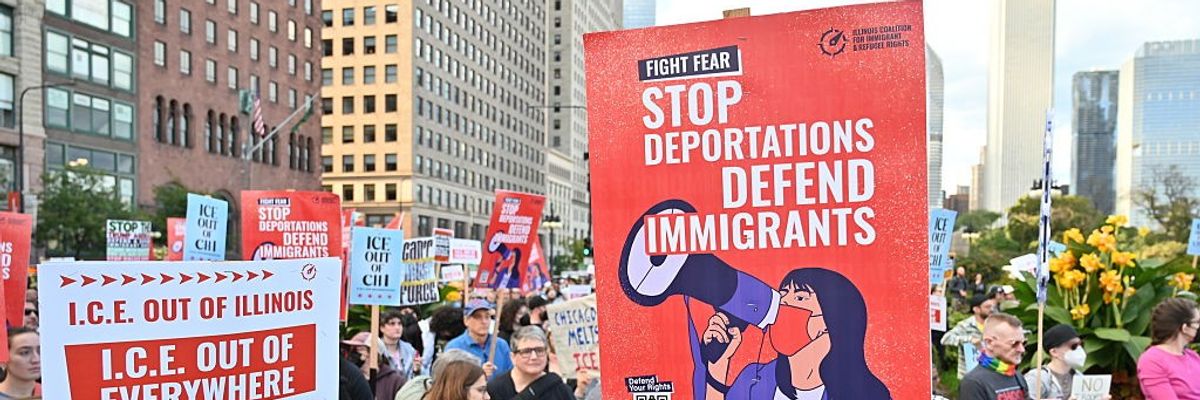
Demonstrators rally at Congress Plaza Garden in Chicago on September 6, 2025, to protest President Donald Trump’s immigration policies.
(Photo by Jacek Boczarski/Anadolu via Getty Images)
Brad Reed
Dec 19, 2025
COMMON DREAMS
Rights groups are expressing alarm over new reporting about the FBI carrying out nationwide anti-terrorism probes against activists protesting against federal immigration enforcement officers.
The Guardian on Friday published a report detailing an internal FBI document that outlines “criminal and domestic terrorism investigations” into “threats against immigration enforcement activity” in 23 regions across the US.
RECOMMENDED...
‘Throwback to McCarthyism’: Trump DOJ Moves to Treat Leftist Dissent as Criminal
The FBI document, which was dated November 14, is a response to National Security Presidential Memorandum-7 (NSPM-7), a directive signed by President Donald Trump in late September that demanded a “national strategy to investigate and disrupt networks, entities, and organizations that foment political violence so that law enforcement can intervene in criminal conspiracies before they result in violent political acts.”
The FBI report cites two violent attacks against Immigration and Customs Enforcement (ICE) facilities in Texas to argue that there has been “an escalation in violence compared to past attacks, which primarily resulted in property damage.”
Additionally, the FBI report directs agents to look for “indicators” that an anti-ICE activist may be planning to carry out an attack on immigration enforcement officials, including “stockpiling or distributing firearms,” as well as using encrypted messaging apps and “conducting online research” about immigration agents’ movements and locations.
The last two of these three “indicators” are raising red flags for rights groups, which are warning that they could be used as the pretext for mass infringement of constitutional rights to speak freely and protest peacefully.
Rachel Levinson-Waldman, director of the Liberty and National Security Program at the Brennan Center for Justice, told the Guardian that the FBI appeared to be treating US citizens with suspicion for engaging in activities protected by the First Amendment.
“It is not illegal to do online research about the publicly available movements of government officers or to communicate through encrypted apps like Signal or WhatsApp,” she said. “While the document refers to using encrypted communications to ‘discuss operational planning’, that term is undefined and ambiguous, leaving it open what kinds of conversations might draw FBI scrutiny.”
Hina Shamsi, director of the ACLU National Security Project, expressed concern to the Guardian that the FBI document is “infused with vague and over-broad language, which was exactly our concern about NSPM-7 in the first place.”
“It invites law enforcement suspicion and investigation based on purely First Amendment-protected beliefs and activities,” Shamsi explained. “People who are entirely innocent of any wrongdoing can be subjected to surveillance or investigation. That imposes stigma. It can wrongly immesh people in the criminal legal system.”
Adam Goldstein, vice president of strategic initiatives at the Foundation for Individual Rights and Expression (FIRE), published an analysis on Thursday that criticized a recently unearthed memo from Attorney General Pam Bondi that fleshed out the concepts laid out in NSPM-7.
In particular, Goldstein argued that Bondi’s memo risks using law enforcement to investigate people based on their political ideologies rather than on suspicion that they are engaging in criminal activity.
“People who conspire to engage in actual criminal behavior should be investigated, arrested, and prosecuted,” Goldstein wrote. “But these memos aren’t narrowly focused on groups that exist for the purpose of ideologically motivated violence, which act to bring about violence; they broadly condemn particular viewpoints and lay a foundation for a government watchlist of American groups which share those viewpoints.”


No comments:
Post a Comment