The new data comes as Tesla is removing human safety monitors from its driverless taxi fleet.
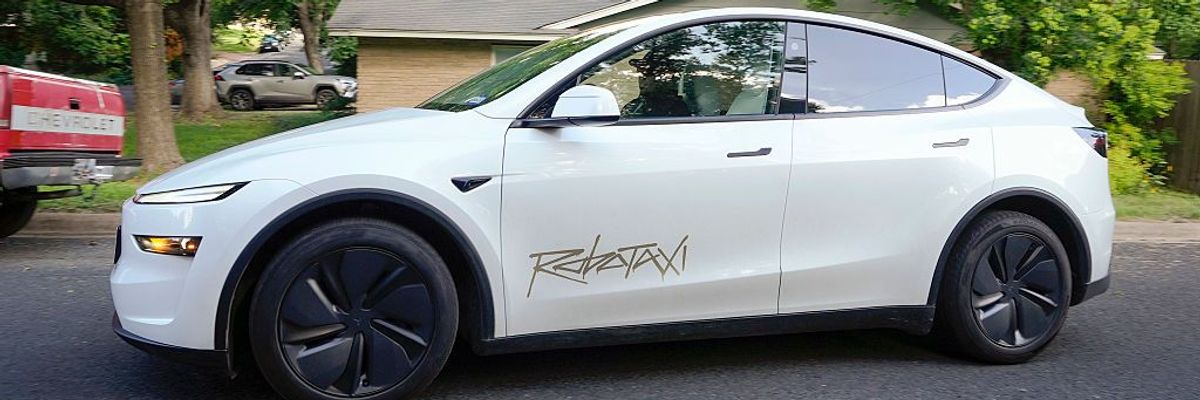
A driverless Tesla Robotaxi, with a man serving as a safety monitor in the front passenger seat, rolls along Laguna Drive in Southeast Austin, Friday, June 27, 2025.
(Photo by Jay Janner/Austin American-Statesman via Getty Images)
Brad Reed
Dec 16, 2025
COMMON DREAMS
Proponents of driverless cars often tout them as a safer alternative to cars with human drivers—but such claims don’t appear to be holding up so far in the case of Tesla’s Robotaxis.
A Monday report from Elektrek found that Tesla Robotaxis are crashing much more frequently than cars driven by humans, as the company has now reported eight crashes of its driverless taxi fleet in Austin, Texas to the National Highway Traffic Safety Administration since July.
Elektrek also crunched some numbers based on data released by Tesla last month and estimated that the Tesla Robotaxis are involved in a crash for every 40,000 miles they drive. For comparison, the publication reported, cars driven by humans crash about once every 500,000 miles, meaning the Robotaxis so far have crashed 12.5 times more frequently than human-driven cars.
All of the Robotaxi crashes so far have occurred with human safety monitors—who have been trained to take control of the car in the event of a software error—present in the vehicles.
This is significant because, as TechCrunch reported on Monday, Tesla is starting to send out its Robotaxi fleet without safety monitors.
TechCrunch noted that “the removal of the human safety monitors brings the company a critical step closer to its goal of launching a real commercial Robotaxi service,” but also said it “will most likely ramp up the scrutiny on Tesla’s ongoing testing in Austin, doubly so when the company starts offering rides in the empty cars.”
Tesla’s bet on Robotaxis has grown more important given that its vehicle sales in the US and around the world have been dropping significantly so far this year, in part due to a boycott campaign inspired by outrage over CEO Elon Musk’s support for far-right political parties.
According to a report from Reuters, the most recent data from car software company Cox Automotive shows that US Tesla sales dropped to a four-year low last month. The news agency also pointed out that Tesla now “is offering financing deals as low as 0% on the Standard Model Y,” which is “a sign of weak demand.”
Dec 16, 2025
COMMON DREAMS
Proponents of driverless cars often tout them as a safer alternative to cars with human drivers—but such claims don’t appear to be holding up so far in the case of Tesla’s Robotaxis.
A Monday report from Elektrek found that Tesla Robotaxis are crashing much more frequently than cars driven by humans, as the company has now reported eight crashes of its driverless taxi fleet in Austin, Texas to the National Highway Traffic Safety Administration since July.
Elektrek also crunched some numbers based on data released by Tesla last month and estimated that the Tesla Robotaxis are involved in a crash for every 40,000 miles they drive. For comparison, the publication reported, cars driven by humans crash about once every 500,000 miles, meaning the Robotaxis so far have crashed 12.5 times more frequently than human-driven cars.
All of the Robotaxi crashes so far have occurred with human safety monitors—who have been trained to take control of the car in the event of a software error—present in the vehicles.
This is significant because, as TechCrunch reported on Monday, Tesla is starting to send out its Robotaxi fleet without safety monitors.
TechCrunch noted that “the removal of the human safety monitors brings the company a critical step closer to its goal of launching a real commercial Robotaxi service,” but also said it “will most likely ramp up the scrutiny on Tesla’s ongoing testing in Austin, doubly so when the company starts offering rides in the empty cars.”
Tesla’s bet on Robotaxis has grown more important given that its vehicle sales in the US and around the world have been dropping significantly so far this year, in part due to a boycott campaign inspired by outrage over CEO Elon Musk’s support for far-right political parties.
According to a report from Reuters, the most recent data from car software company Cox Automotive shows that US Tesla sales dropped to a four-year low last month. The news agency also pointed out that Tesla now “is offering financing deals as low as 0% on the Standard Model Y,” which is “a sign of weak demand.”
No comments:
Post a Comment