Robert Davis
December 30, 2025
RAW STORY

President Donald Trump appeared to get his birds mixed up on Tuesday when he made a snide social media post about wind energy.
On Truth Social, Trump posted a picture of a dead bird in a field of wind turbines. "Windmills are killing all of our beautiful Bald Eagles!" the caption reads. It was amplified by the White House and viewed millions of times on X.
However, the bird in the picture isn't a bald eagle, as the president claims. It's an Israeli falcon.
"Unfortunately for Trump’s effort to sow outrage among American patriots at what he proclaimed to be an image of the national bird laid low, closer inspection reveals the photograph does not show a bald eagle and was not taken in the United States," The Guardian reported after Trump posted the image. "The image actually shows a falcon that was killed at a wind farm in Israel eight years ago."
The Guardian also noted there were clues as to what kind of bird was in the picture that Trump seemingly overlooked "in a rush."
"The first is that the bird is missing the distinctive markings of a bald eagle. The second is that the turbine blamed for its death appears to have Hebrew writing on it," according to the report.
Trump has consistently bashed wind energy, and his second administration has rolled back several Biden-era clean energy programs. In December, Trump halted permits on thousands of new wind energy projects, citing reasons stretching from national security risks to the number of birds that die in wind farms each year.
Judge Delays Dominion’s Offshore Wind Suit Awaiting U.S. Data
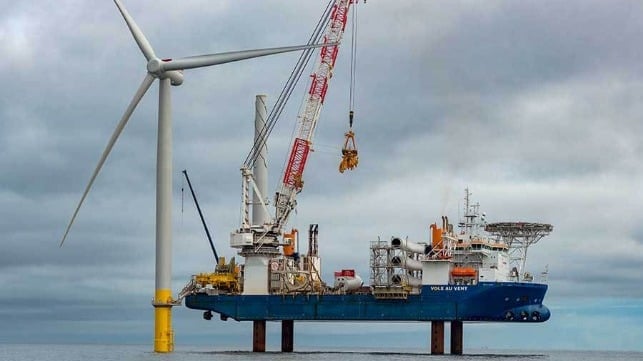
The first showdown over the U.S. Department of the Interior’s efforts to stop the construction of five offshore wind farms is being delayed as a U.S. District Court in Virginia waits for data from the government. Dominion Energy’s efforts to gain a temporary restraining order to permit it to restart work were delayed, with the next hearing set for January 16.
Dominion Energy and its Coastal Virginia Offshore Wind project is one of five that were ordered to stop offshore work by the Department of the Interior, which made vague claims about national security concerns due to radar clutter caused by the turbine blades and towers. The government cited new confidential data from studies by the Pentagon as the justification for the orders.
The five projects are all under construction, and in the case of Coastal Virginia and Vineyard Wind 1 in Massachusetts nearing completion. Dominion asserted in its court filing that the stop-work order is costing the company $5 million a day and said it could jeopardize completion of the wind farm on time in 2026 and the stability of the power grid, which needs more electricity. Coastal Virginia was expected to generate its first power in early 2026.
Offshore work on the five projects was stopped, but the Bureau of Ocean Energy Management did permit them to take steps to protect safety. The Vineyard Gazette newspaper reported yesterday, December 29, that the Massachusetts project was also permitted to continue power generation from the partially installed project. It began sending its first power in January, and as of the summer, reports said it had more than 20 of its 62 turbines commissioned. The State of Massachusetts, in a recent filing, said the project was capable of producing 572 MW of its planned 800 MW capacity. Vineyard Wind 1, which the newspaper says was expected to finish construction by the end of the year, is the second commercial-scale project generating power, following South Fork Wind in New York, which completed its commissioning in 2024.
Dominion Energy was the first of the developers to file suit, calling the actions to stop the work unconstitutional and a violation of BOEM rules. Judge Jamar Walker did not rule on the merits of the motion for a temporary restraining order, but converted the case to a motion for a preliminary injunction. If granted, the injunction would permit offshore work to resume while the legal case proceeded.
The government responded to the suit, telling the District Court that it estimated it could provide the classified information on which the stop-work order relies during the week of January 5. The court said that the information it “critical to evaluating” the request. It further directed the government to inform it by December 31 if it would supply the confidential information to Dominion Energy’s representatives.
The government is directed to supply the information to the court by January 9, along with a response from Dominion. A hearing in Norfolk on January 16 will consider the converted motion for the preliminary injunction.

No comments:
Post a Comment