
“The illegal use of force, and threats to use further force at sea and on land, gravely endanger the human right to life and other rights in Venezuela and the region.”
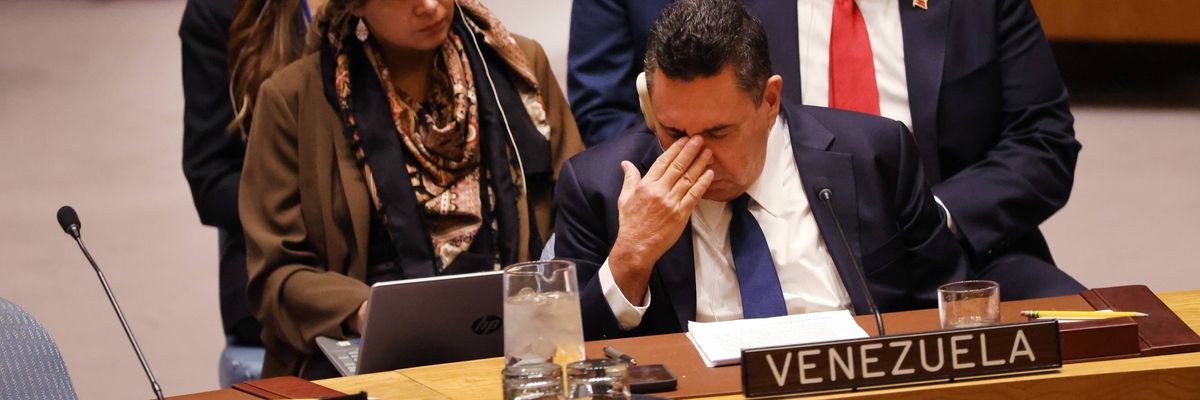
Samuel Reinaldo Moncada Acosta, the Permanent Representative of Venezuela to the United Nations, reacts during an emergency United Nations (U.N.) Security Council meeting regarding the situation in Venezuela on December 23, 2025 at UN headquarters in New York City. Venezuelan officials formally requested the meeting last week, pointing to U.S. maritime actions and oil sanctions.
(Photo by Spencer Platt/Getty Images)
Jon Queally
Dec 24, 2025
COMMON DREAMS
Experts at the United Nations on Wednesday issued a scathing rebuke to US President Donald Trump’s aggression toward Venezuela, saying attempts to impose an oil blockade based on US-imposed sanctions and a series of bombings of alleged drug-trafficking vessels at sea are clear violations of international law.
“There is no right to enforce unilateral sanctions through an armed blockade,” said the UN experts.
According to their statement:
A blockade is a prohibited use of military force against another country under article 2(4) of the UN Charter. “It is such a serious use of force that it is also expressly recognized as illegal armed aggression under the General Assembly’s 1974 Definition of Aggression,” the experts said.
“As such, it is an armed attack under article 51 of the Charter – in principle giving the victim State a right of self-defence,” they said.
“The illegal use of force, and threats to use further force at sea and on land, gravely endanger the human right to life and other rights in Venezuela and the region,” the experts said.
Aggression is a crime attracting universal jurisdiction under international law, which gives all countries the power to prosecute it, although the most senior government leaders retain immunity from foreign prosecution while still in office.
The experts behind the joint statement were: Ben Saul, Special Rapporteur on the promotion and protection of human rights and fundamental freedoms while countering terrorism; George Katrougalos, Independent Expert on the promotion of a democratic and equitable international order; Surya Deva, Special Rapporteur on the right to development; and Gina Romero, Special Rapporteur on the rights to freedom of peaceful assembly and of association.
Their statement notes that the US sanctions imposed on Venezuela may be “unlawful” because they are “disproportionate and punitive” under international statute. The Trump administration has used alleged violations of US sanctions to justify its blockade and the seizure of vessels.
“The threat is not Venezuela. The threat is the US government.” —Venezuela UN Ambassador Samuel Moncada
The aggression of the US government toward Venezuela was also rebuked at an emergency meeting of the UN Security Council on Tuesday, with China, Russia, Cuba, Colombia, and others backing Venezuela’s call for an end to the series of criminal boat bombings against alleged drug traffickers in the Caribbean and eastern Pacific and the unlawful seizure of oil tankers as a way to coerce the government of President Nicolas Maduro.
Venezuela’s UN Ambassador Samuel Moncada equated Trump’s Dec. 16 order that the US was establishing a “total and complete blockade of all sanctioned oil tankers” coming into or out of Venezuela an admission of “a crime of aggression” by the US president, who Moncada said wants to “turn back the clock of history 200 years to establish a colony” in the Latin American country.
Moncada characterized the recent US seizure of two oil tankers in international waters as “worse than piracy” and “robbery carried out by military force,” warning that such brazen acts set “an extremely serious precedent for the security and navigation of international trade” in the region and worldwide.
“We are in the presence of a power that acts outside of international law,” he said of the US delegation, “demanding that Venezuelans vacate our country and hand it over. We are talking about pillaging, looting, and recolonization of Venezuela.”
During his comments to the council, Mike Waltz, the US Representative to the UN, defended Trump’s policies by calling the threat of “transnational terrorist and criminal groups” the “single most serious threat” in the hemisphere. Waltz repeatedly claimed, without providing evidence, that Maduro’s government is part of a criminal gang called “Cartel de Los Soles,” which Moncada said was “ridiculous” as the group is “non-existent,” an invention of the Trump administration.
Human rights groups, UN experts, and scholars of international have all stated that Trump’s extrajudicial targeting of alleged drug boats—which have now left over 100 people killed—are nothing short of “murder” on the high seas.
In their Wednesday statement, the four UN experts said the killings at sea ordered by Trump “amount to violations of the right to life,” citing the International Covenant on Civil and Political Rights, which the US government ratified in 1992.
The experts called on all UN member states “to urgently take all feasible measures to stop the blockade and illegal killings” by the US government, “including through diplomatic protest, General Assembly resolutions, and peaceful counter-measures—and bring perpetrators justice.”
“Collective action by States is essential to uphold international law,” they said. “Respect for the rule of law, sovereignty, non-use of force, non-intervention, and the peaceful settlement of disputes are essential to preserving peace and stability worldwide.”
In his remarks, Moncada said Venezuela would defend itself against aggression but did not consider itself at war with the United States.
“Let it be clear once and for all that there is no war in the Caribbean, there is no international armed conflict, nor is there a non-international one, which is why it is absurd for the US government to seek to justify its actions by applying the rules of war,” Moncada told the council.
“The threat is not Venezuela,” he said. “The threat is the US government.”
Sanctioned Ships Still Loading Venezuelan Oil Despite U.S. Blockade
At least half a dozen sanctioned tankers have loaded oil from Venezuela since December 11, when the U.S. escalated the pressure on Venezuelan oil exports, Bloomberg reported on Tuesday, quoting data from Kpler.
Loadings of oil from Venezuelan ports appear to have been happening in recent weeks at a more or less typical pace despite the U.S. crackdown on vessels involved in illicit oil trade, according to Kpler’s data.
Earlier this month, the Trump Administration intensified pressure on Venezuela’s Nicolas Maduro by designating his regime as a “foreign terrorist organization”.
U.S. President Donald Trump has also ordered a naval blockade offshore Venezuela to intercept sanctioned vessels trying to travel to and from the South American country.
This weekend, the United States seized a second oil tanker offshore Venezuela.
Commenting on the seizure, U.S. Homeland Security Secretary Kristi Noem posted on X that “The United States will continue to pursue the illicit movement of sanctioned oil that is used to fund narco terrorism in the region. We will find you, and we will stop you.”
In an interview with Fox & Friends on Monday, Secretary Noem said that
“We’re not just interdicting these ships, but we’re also sending a message around the world that the illegal activity that Maduro is participating in cannot stand, he needs to be gone, and that we will stand up for our people.”
Most of Venezuela’s crude is being shipped on shadow-fleet tankers to China. The U.S. blockade is paralyzing this lifeline for Nicolas Maduro’s regime in Caracas. At the same time, the Trump Administration allows Venezuelan crude to flow to the U.S. Gulf Coast via shipments chartered by U.S. supermajor Chevron, which has a special license to operate in Venezuela and export to the U.S. part of the crude it pumps through its joint ventures there.
President Trump’s military campaign against Venezuela is threatening an $8-billion market of shadow-fleet oil trade as the U.S. pressure on Venezuela is disrupting oil exports, with tankers diverting, crude piling up at sea, and Venezuelan state oil firm PDVSA facing imminent well shut-ins due to shrinking storage capacity.
By Tsvetana Paraskova for Oilprice.com
One Killed in U.S. Attack on Suspected Drug Smuggling Boat
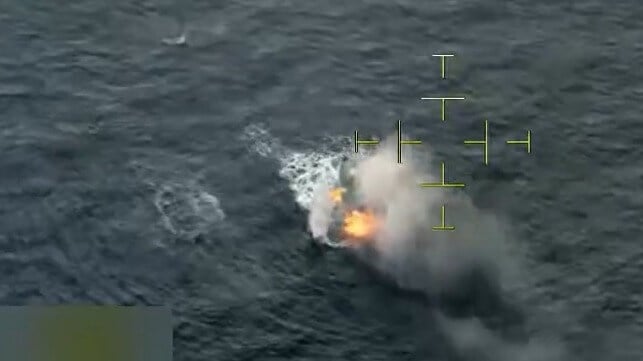
On Monday, U.S. Southern Command announced the destruction of another suspected smuggling boat in the waters of the Eastern Pacific, the 29th such strike since the new campaign of lethal-force interdictions began on September 2. This instance marked a new turn: video released by the military appears to show the use of cannonfire and machine gun fire to destroy the target vessel, indicating the possible involvement of an AC-130J gunship previously seen in the region.
The first 28 interdictions appeared to be carried out at a distance using small guided missiles. In the initial Caribbean phase of the operation, U.S. officials told The Intercept that the strikes were being carried out by Air Force drone units attached to U.S. Special Operations Command. The attacks were conducted with single missile strikes, with a notable and much-debated exception - a follow-up strike conducted in early September. The video of that "double tap" strike has not been released, and the Pentagon asserts that it is classified.
The video released Monday is different from prior compilations: it shows repeated and frequent small impacts interspersed with explosions, and has visual similarities to prior exercises pitting an AC-130J Ghostrider gunship against small wooden fishing vessels.
Monday's suspected drug boat strike (U.S. Southern Command)
A 2024 live fire exercise in the Philippines centered on the use of the AC-130J (USAF)
At least one AC-130J is known to be operating in the Southern Command area of operations. Since mid-October, one airframe has been observed along with a P-8A maritime surveillance aircraft at Comalapa Air Base in El Salvador, a nation that enjoys friendly relations with Washington.
The aircraft can carry Hellfire guided missiles on wing pylons, but its characteristic armaments protrude from the port side of the fuselage: a 105mm howitzer mounted on a recoil carriage and a 30mm chain gun. If accurate, the 29th drug-boat strike would appear to be the first time that these weapons have been employed in the new counternarcotics effort, and the first involving visual-range gunfire by U.S. servicemembers on scene.
The legality of the strike program has been questioned by political critics, legal experts and even the United Nations' top human rights official. The program occurs outside of a declared war and targets criminal suspects in the smuggling trade, who have been historically viewed as civilians rather than combatants, even if their activities have lethal effects on U.S. citizens.
In October, former International Criminal Court prosecutor Luis Moreno Ocampo advised that the strikes could be considered planned attacks on civilian criminals, and as such, could be viewed as crimes against humanity under international law - opening the possibility of legal hazards for participating servicemembers. The Pentagon asserts that the strikes are fully lawful.
China Protests U.S. Seizures of Venezuela-Linked Tankers
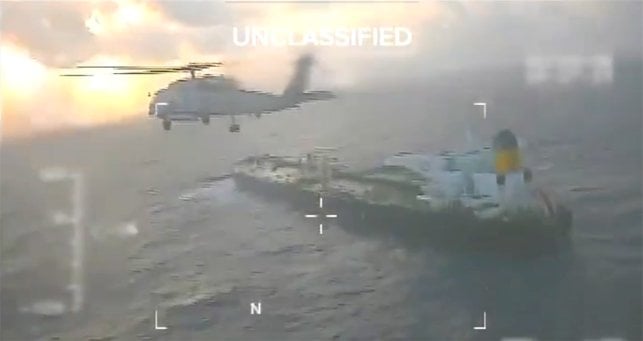
China's government is voicing its opposition to the Trump administration's campaign of tanker seizures off the coast of Venezuela. The U.S. Coast Guard has captured two China-bound tankers full of Venezuelan oil this month, and on Monday, President Donald Trump said that the U.S. government will be keeping both vessels and their cargoes.
The first tanker seized, Skipper, was a stateless and sanctioned vessel. It was carrying about 1.85 million barrels of oil, according to TankerTrackers.com, and was headed to deliver the cargo to a Chinese buyer. The second, the VLCC Centuries, was also headed for China with about 1.8 million barrels on board. The U.S. sought and obtained permission from Centuries' flag state, Panama, before conducting a boarding. In an interview with local media on Monday, Panamanian foreign minister Javier Martinez-Acha said that Centuries had disabled its AIS transponder, changed its name and failed to respect Panama's regulations during its loading in Venezuela.
China, which is the top buyer for Venezuelan oil, believes that Washington's recent tanker seizures in the Caribbean are out of line. At a press conference Monday, Chinese foreign ministry spokesman Lin Jian said that the boardings infringe on other countries' sovereignty and constitute "unilateralism and bullying."
"By arbitrarily seizing other countries’ vessels, the U.S. has seriously violated international law. China stands against unilateral illicit sanctions that lack basis in international law or authorization of the UN Security Council, and against any move that violates the purposes and principles of the UN Charter," Lin said.
China routinely uses force in asserting its claims to sovereignty in the South China Sea, including areas inside of its neighbors' internationally-recognized exclusive economic zones. Earlier this month, China Coast Guard personnel injured several Filipino fishermen and damaged their vessel while attempting to drive them away from Sabina Shoal, a reef located well within the Philippine EEZ. The Philippine Coast Guard called the Chinese actions “unprofessional and unlawful.”
Report: U.S. Coast Guard Awaits Specialized Team to Board Third Tanker
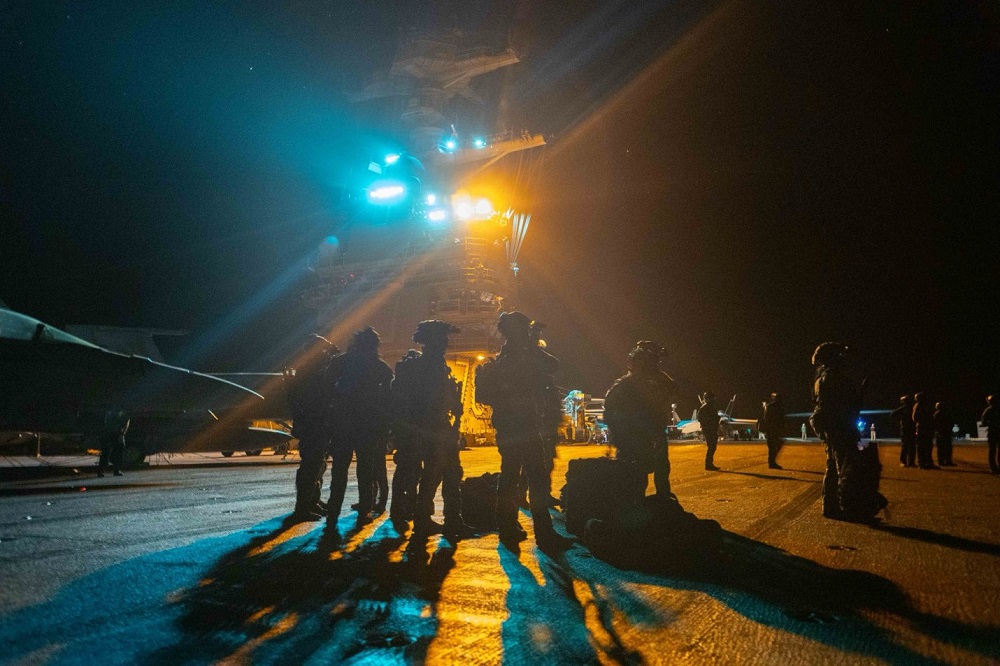
U.S. officials say that the U.S. Coast Guard's "pursuit" of the sanctioned VLCC Bella 1 will come to a conclusion after a team of boarding specialists arrives on scene. The service's cuttermen and law enforcement detachments (LEDETs) are skilled at interdicting small craft, but boarding a noncompliant vessel on the high seas requires the specialized skills of a Maritime Security Response Team (MSRT), the counterterrorism SWAT units that the service created after the 9/11 attacks.
On Saturday, American forces began chasing a tanker linked to Venezuela's oil exports, the third attempt at an interdiction this month. The vessel has been identified as the Bella 1, a stateless, sanctioned tanker with a past in the Iranian oil trade. Bella 1 was in ballast and approaching Venezuela, and it was the first ship that the U.S. targeted before it loaded a cargo.
Bella 1 declined to submit to a boarding and reversed course, U.S. officials told the New York Times on Sunday. The Coast Guard continued its pursuit of the ship, according to the Times, and on Monday President Donald confirmed that a chase was ongoing.
The Bella 1 is a VLCC with a deadweight in excess of 300,000 tonnes, and has a sea speed commensurate with her design. AIS data provided by Pole Star shows that over the past year, the tanker has rarely exceeded 12 knots. This is less than half of the speed required to outrun a U.S. Coast Guard cutter or a U.S. Navy surface combatant, and more than a few analysts have suggested that American forces should be able to conclude the "pursuit" in short order.
The delay in boarding is not the result of difficulty in catching up to the tanker, two officials told Reuters. The service only has two active MSRTs, and those personnel are otherwise occupied. They have already captured two shadow fleet tankers this month, and the arrested vessels require onboard oversight and possible crew augmentation for their journeys to U.S. waters. The first tanker has already arrived off Galveston.
Specialized Marine Corps and Navy units (like U.S. Navy SEAL teams) have world-class skills for boarding, search and seizure missions, but they lack the Coast Guard's legally-authorized law enforcement capabilities. Meanwile, standard Coast Guard units lack the SEALs' fast-roping skills for opposed boardings, officials said.
So far, the services have not employed a pure Navy or Marine Corps unit to secure the vessel, followed later by a Coast Guard officer who could conduct legal procedures in a noncombat environment. Instead, the "pursuit" elements are waiting for an MSRT to be freed up to board the Bella 1 in international waters of the Atlantic, moving further from Venezuelan shores at a likely rate of 200 nautical miles or more per day.
The shortage of resources is a long-running theme for the Coast Guard. Congress and successive administrations have often viewed the agency's budget as a pay-for, a lower-priority item when compared to other missions - with consequences for readiness. Its eldest oceangoing patrol vessels are passing their 60th anniversaries in service, and it faces a persistent manning shortfall.
"The Service is now stretched thin, with significant workforce shortages and aging, underfunded assets that often cannot meet mission requirements. The Coast Guard’s current organizational structure and reactive posture are no longer adequate to meet current and emerging challenges," commandant Adm. Kevin Lunday told a House committee earlier this year. Recent improvements in recruitment numbers will help going forward, as will a massive cash infusion for fleet recapitalization under the One Big Beautiful Bill Act.
Venezuela's Oil Exports Grind Towards a Halt Under U.S. Pressure
Venezuela is having difficulty in getting its oil to market due to U.S. tanker seizures in the Caribbean, multiple officials told the New York Times and Reuters. Two laden VLCC tankers have been captured by the U.S. Coast Guard; another has been "pursued" back into the Atlantic without capture; at least several more have turned around mid-voyage, according to TankerTrackers.com; multiple tanker owners have declined signing new charters for future Venezuelan loadings, officials said; and about 30 tankers are stranded in the country's territorial seas, stranded by risk of capture and awaiting a safe political forecast for departure.
The oil buyers who pay for state oil company PDVSA's shipments to China are reticent to approve shipments because of the risk of seizure, company sources told Reuters. Chevron's loadings for export to the United States have continued unaffected - the company confirms that it has experienced no disruption - but PDVSA's storage tanks are filling up.
As an interim measure, PDVSA is using stranded foreign-flag tankers as floating storage, filling as many as possible in hopes of delaying the day when it will have to begin shutting in production for lack of a place to put the oil. So far, PDVSA has not declared force majeure to formally suspend loadings and reduce its contractual obligations.
According to Reuters, this strategy has its limits: some customers are pushing to offload their cargoes back to Venezuelan terminals, freeing up their tankers for onward voyages with less risk of interdiction.
To assuage buyers' concerns, Venezuelan dictator Nicolas Maduro has dispatched the country's navy to escort outbound tankers on their way to China. But those escorts are stopping at the boundary of Venezuela's territorial seas, according to the New York Times. So far, all interdictions have occurred in international waters.
Venezuela's national assembly approved legislation to criminalize tanker seizures on Tuesday, and officials told the Times that Maduro is contemplating putting Venezuelan soldiers aboard outbound tankers in order to counter the risk of a U.S. Coast Guard boarding. However, this would raise the odds of a direct military-to-military clash, which could trigger a broader and more forceful U.S. intervention. The Pentagon has built up the most substantial naval task force seen in the region since the Cuban Missile Crisis, including the supercarrier USS Gerald R. Ford and a three-ship Navy-Marine Corps amphibious ready group.
The U.S. pressure campaign is "probably" aimed at removing Maduro from power, President Donald Trump said Monday night at a press conference in Florida.
"Well, I think it probably would. I can't tell him. That's up to him what he wants to do. I think it would be smart for him to do that. But again, we're going to find out," Trump said. "If he plays tough, it'll be the last time he's ever able to play tough. . . . We have a massive armada for him."

No comments:
Post a Comment