“The problems don’t go away when the reporting goes away,” says the Corporate Toxics Information Project’s co-director.
By C.J. Polychroniou ,
Truthout

Trump’s Second Term Dispels Any Notion of CEOs Saving Us From Climate Crisis
Corporate actors have shed any pretense of climate action and now openly back Trump’s doubling down on fossil fuels. By Derek Seidman , Truthout November 28, 2025
In which states do companies emit the most heat-trapping gas that feeds climate change, and which corporations have the highest share of residents of color living close to their polluting facilities?
We have prepared state-specific lists of greenhouse gas releasers. We stay at the company level, because the company is the crucial decision-making unit, but in each state, we rank companies based on the facilities they own in the state. The big petro states, Texas and Louisiana, top the list, by quite a lot. Fossil electricity generation is widespread; so almost everywhere has a share. A petroleum-processing industry can make individual states stand out. For example California is near the top of the state list (at number 7) because of large refineries; the top five greenhouse-gas-releasing facilities in the state are refineries owned by Marathon Petroleum, Chevron, Valero, and PBF energy, even though the electricity sector as a whole is responsible for more greenhouse gas releases in California.
We think that the state listings are particularly important in this era of diminished local news capacity. This is the type of inquiry that local news sources might pursue in the public interest.
In addition to the absolute impact rankings, we also take a look at the share of people of color living near companies’ pollution-emitting facilities. At first glance, it might seem odd to look at local populations when greenhouse gas emissions are a global problem, but almost all the greenhouse gas emissions we examine are from combustion and, hence, coupled with the release of local pollutants. These local pollutants that come with the greenhouse gases are called co-pollutants, including sulfur oxides, nitrous oxides, and particular matter, as well as a host of toxics. In addition to the Puerto Rico Electric Power Authority, some companies among the Top 100 Greenhouse emitters that have a particularly high share of people of color (people categorized as “minorities” in this study) living near their facilities are the chemical company LyondellBasell (72 on the overall greenhouse emissions list, with people of color composing more than 75 percent of the population within 10 miles of their plants) and BP (50 overall, with people of color composing more than 75 percent of the population near their facilities). Marathon Petroleum (14 overall) and Valero Energy (19 overall) are other high emitters with people of color composing more than 70 percent of the population near their facilities. Forty-one of the companies on the top 100 list have their emissions near populations that are more than 50 percent people of color. The country as a whole is around 40 percent people of color; 63 of the top 100 companies exceed that share in their impact.
These local co-pollutants add to the case for reducing greenhouse gas emissions. For those who harbor the view that greenhouse gas emissions are a problem for the future — a shortsighted view in my opinion, but people face a variety of constraints — the health benefits of reducing co-pollutants are local and immediate. We’d see fewer hospitalizations for asthma, less COPD [chronic obstructive pulmonary disease], fewer cases of cancer when we stop burning fossil fuels near vulnerable populations. I’m not necessarily a fan of placing dollar values on human life and health, but by reasonable estimates, the health benefits of the co-pollutant reduction alone are as big as the climate benefits. There’s a potential very large improvement in the quality of the air that we all breathe, with special benefit for the vulnerable, such as children, older people, and communities that are heavily exposed to the burden of cumulative pollution.
Isn’t climate pollution a racial justice issue since communities of color and marginalized groups disproportionately feel the effects of corporate pollution?
Climate pollution is a justice issue for a host of reasons, including the disproportionate impact of the local co-pollutants on marginalized groups, but also because climate vulnerability, for example, to extreme weather events, is higher among marginalized groups.
The Trump administration has canceled billions of dollars in clean energy projects nationwide, seeks to revive the coal industry, and contends that the EPA has no legal authority to regulate greenhouse gas emissions. Under these new government approaches to pollution and climate change, what incentives would U.S. corporations have to reduce greenhouse gas emissions? Indeed, isn’t it most likely to expect an increase in corporate greenhouse gas pollution in the years ahead?
The actual and pending regulatory changes at EPA are deeply troubling.
One sign of hope is that some states have enacted and many are considering state-level Climate Superfund Bills. These bills would hold corporations responsible for climate change accountable for costs of adaptation, remediation, and disaster recovery. The bills are modeled on the Superfund legislation (Comprehensive Environmental Response, Compensation, and Liability Act of 1980) that sought both to recover damages and to finance cleanup from the effects of corporate toxic dumping. New York and Vermont have passed bills, of varying stringency, and legislation has also been introduced in Oregon, California, Maine, New Hampshire, Massachusetts, Rhode Island, Connecticut, New Jersey, Maryland, Illinois, Virginia, and Tennessee. There is plenty of corporate pushback against these Climate Superfund bills, and we should expect to see contentious fights in the coming years. But the main point is that these laws — and the potential for a federal law if there are changes in the control of the federal government — provide significant incentives for corporations to consider future liability in making decisions about greenhouse gas emissions. So we might see efforts to curtail greenhouse gas emissions even in the face of the current administration’s hostility to greenhouse gas regulation.
Ending the EPA’s Greenhouse Gas Reporting Program, which has been tracking the climate emissions of major polluters for the last 15 years, constitutes an unmistakable attack on the right-to-know movement. However, do you think that the Trump administration’s intent to stop collecting greenhouse gas data from thousands of facilities across the United States will have an impact on environmental activism? And what effect in particular would the killing of Greenhouse Gas Reporting Program have on PERI’s efforts to continue to provide the public with valuable information and analysis on U.S. corporate pollution?
As you indicated, the EPA is in the process of eliminating the Greenhouse Gas Reporting Program, the regulatory program that makes these crucial right-to-know data available to the public. This fall EPA carried out a “Reconsideration” of the program which would outright eliminate most of the reporting requirements and suspend the remainder until 2034.
We are still assessing the future of the Greenhouse 100 without the Greenhouse Gas Reporting Program. The Greenhouse Gas Reporting Program was extraordinarily valuable because it was mandatory and uniform – it provided a clear look at greenhouse gas pollution from U.S.-based facilities, and it was hard to cherry pick or to greenwash. The problems don’t go away when the reporting goes away, of course, and I expect that environmental activism will continue. It will simply continue with less information, and this important tool won’t be available to the full set of stakeholders, including socially responsible investors, environmental and community activists, state and local regulators, and even companies themselves as they seek to improve their operations and benchmark against comparison companies. It’s a right-to-know disaster and it means that all of us will be operating in the dark.
This article is licensed under Creative Commons (CC BY-NC-ND 4.0), and you are free to share and republish under the terms of the license.

C.J. Polychroniou
C.J. Polychroniou is a political scientist/political economist, author and journalist who has taught and worked in numerous universities and research centers in Europe and the United States. Currently, his main research interests are in U.S. politics and the political economy of the United States, European economic integration, globalization, climate change and environmental economics, and the deconstruction of neoliberalism’s politico-economic project. He is a columnist for Global Policy Journal and a regular contributor to Truthout. He has published scores of books, including Marxist Perspectives on Imperialism: A Theoretical Analysis; Perspectives and Issues in International Political Economy (ed.); and Socialism: Crisis and Renewal (ed.), and over 1,000 articles which have appeared in a variety of journals, magazines, newspapers and popular news websites. Many of his publications have been translated into a multitude of languages, including Arabic, Chinese, Croatian, Dutch, French, German, Greek, Italian, Japanese, Portuguese, Russian, Spanish and Turkish. His latest books are Climate Crisis and the Global Green New Deal: The Political Economy of Saving the Planet (with Noam Chomsky and Robert Pollin as primary authors, 2020); The Precipice: Neoliberalism, the Pandemic, and the Urgent Need for Radical Change (an anthology of interviews with Noam Chomsky, 2021); Economics and the Left: Interviews with Progressive Economists (2021); Illegitimate Authority: Facing the Challenges of Our Time (an anthology of interviews with Noam Chomsky, 2023); and A Livable Future Is Possible: Confronting the Threats to Our Survival (an anthology of interviews with Noam Chomsky, 2024).
December 20, 2025
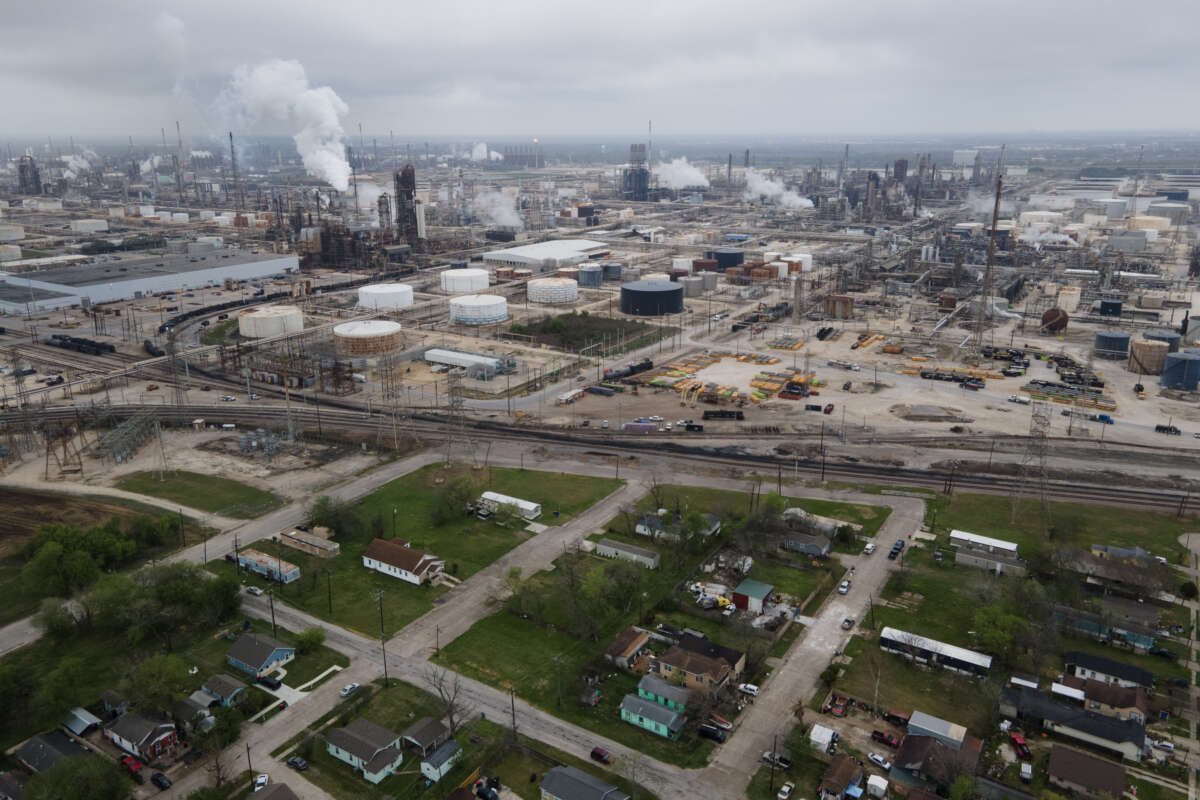
The ExxonMobil Baytown Refinery in Baytown, Texas, on March 2, 2023.Mark Felix for The Washington Post via Getty Images
Since 2010, the Environmental Protection Agency (EPA) has required large industrial facilities to report their greenhouse gas emissions. The data, which the EPA’s Greenhouse Gas Reporting Program has been collecting since 2011, is essential in efforts to reduce emissions and provides vital information to the public about climate pollution from the largest U.S. polluters. However, the Trump EPA has proposed to put an end to greenhouse gas reporting by major polluters. This move is consistent with the Trump administration’s intent to make climate denial an official U.S. policy and restricts the public from the right to know. Subsequently, it will deprive communities from having access to a critical tool for holding pollutants accountable.
Researchers at the Political Economy Research Institute (PERI) at the University of Massachusetts Amherst have been using EPA data for many years now to rank the top U.S. polluters and disseminate vital information to the public. They publish their findings annually and have just released the 2025 edition of Greenhouse Gas Emissions Index. In the interview that follows, Michael Ash, professor of economics and public policy and co-director of PERI’s Corporate Toxics Information Project, shares the latest data on the top U.S. climate pollutants and discusses the consequences of the potential end of EPA’s Greenhouse Gas Reporting Program in the fight against climate change and climate justice.
C.J. Polychroniou: For many years now, the Political Economy Research Institute (PERI) at the University of Massachusetts Amherst has been providing a valuable service to public interest in general and to activists in particular by collecting and releasing information and analysis on corporate pollution and greenhouse gas emissions through its Corporate Toxics Information Project. Last month, the 2025 edition of Greenhouse Gas Emissions Index was published, using the latest data available from the U.S. Environmental Protection Agency’s Greenhouse Gas Reporting Program. The index takes on new significance since the EPA has announced plans to end the program, which amounts to an erosion of the people’s right to know. But before we get to that, what does the new edition of Greenhouse Gas Emissions Index look like? Which corporations are the top climate polluters in the country, and have there been any significant changes in total emissions and rankings from last year
Michael Ash: The top of the list remains similar; the biggest point emitters of greenhouse gases are the electrical power companies that burn fossil fuels to generate electricity. Topping the list are Vistra Energy, Southern Company, and Duke Energy. Their combined 235 million metric tons of CO2 equivalent emissions made up just under 4 percent of all U.S. contributions to climate change that year (including all sources, such as automobiles, airplanes, and home heating, not just industrial emitters). Again, the top of the list are the fossil electricity generators. Next come the major oil refiners and petrochemical processors, such as Exxon Mobil (at the number 7 spot); and that is only accounting for the direct releases from their facilities, not the releases from the fuels that they bring into the economy. (For that, see our companion list of Toxic 100 Suppliers.)
This list has been stable for some years; a company may move up or down by a position or two based on acquisitions or sales of facilities, but the list is entirely recognizable from year to year.
Since 2010, the Environmental Protection Agency (EPA) has required large industrial facilities to report their greenhouse gas emissions. The data, which the EPA’s Greenhouse Gas Reporting Program has been collecting since 2011, is essential in efforts to reduce emissions and provides vital information to the public about climate pollution from the largest U.S. polluters. However, the Trump EPA has proposed to put an end to greenhouse gas reporting by major polluters. This move is consistent with the Trump administration’s intent to make climate denial an official U.S. policy and restricts the public from the right to know. Subsequently, it will deprive communities from having access to a critical tool for holding pollutants accountable.
Researchers at the Political Economy Research Institute (PERI) at the University of Massachusetts Amherst have been using EPA data for many years now to rank the top U.S. polluters and disseminate vital information to the public. They publish their findings annually and have just released the 2025 edition of Greenhouse Gas Emissions Index. In the interview that follows, Michael Ash, professor of economics and public policy and co-director of PERI’s Corporate Toxics Information Project, shares the latest data on the top U.S. climate pollutants and discusses the consequences of the potential end of EPA’s Greenhouse Gas Reporting Program in the fight against climate change and climate justice.
C.J. Polychroniou: For many years now, the Political Economy Research Institute (PERI) at the University of Massachusetts Amherst has been providing a valuable service to public interest in general and to activists in particular by collecting and releasing information and analysis on corporate pollution and greenhouse gas emissions through its Corporate Toxics Information Project. Last month, the 2025 edition of Greenhouse Gas Emissions Index was published, using the latest data available from the U.S. Environmental Protection Agency’s Greenhouse Gas Reporting Program. The index takes on new significance since the EPA has announced plans to end the program, which amounts to an erosion of the people’s right to know. But before we get to that, what does the new edition of Greenhouse Gas Emissions Index look like? Which corporations are the top climate polluters in the country, and have there been any significant changes in total emissions and rankings from last year
Michael Ash: The top of the list remains similar; the biggest point emitters of greenhouse gases are the electrical power companies that burn fossil fuels to generate electricity. Topping the list are Vistra Energy, Southern Company, and Duke Energy. Their combined 235 million metric tons of CO2 equivalent emissions made up just under 4 percent of all U.S. contributions to climate change that year (including all sources, such as automobiles, airplanes, and home heating, not just industrial emitters). Again, the top of the list are the fossil electricity generators. Next come the major oil refiners and petrochemical processors, such as Exxon Mobil (at the number 7 spot); and that is only accounting for the direct releases from their facilities, not the releases from the fuels that they bring into the economy. (For that, see our companion list of Toxic 100 Suppliers.)
This list has been stable for some years; a company may move up or down by a position or two based on acquisitions or sales of facilities, but the list is entirely recognizable from year to year.
Trump’s Second Term Dispels Any Notion of CEOs Saving Us From Climate Crisis
Corporate actors have shed any pretense of climate action and now openly back Trump’s doubling down on fossil fuels. By Derek Seidman , Truthout November 28, 2025
In which states do companies emit the most heat-trapping gas that feeds climate change, and which corporations have the highest share of residents of color living close to their polluting facilities?
We have prepared state-specific lists of greenhouse gas releasers. We stay at the company level, because the company is the crucial decision-making unit, but in each state, we rank companies based on the facilities they own in the state. The big petro states, Texas and Louisiana, top the list, by quite a lot. Fossil electricity generation is widespread; so almost everywhere has a share. A petroleum-processing industry can make individual states stand out. For example California is near the top of the state list (at number 7) because of large refineries; the top five greenhouse-gas-releasing facilities in the state are refineries owned by Marathon Petroleum, Chevron, Valero, and PBF energy, even though the electricity sector as a whole is responsible for more greenhouse gas releases in California.
We think that the state listings are particularly important in this era of diminished local news capacity. This is the type of inquiry that local news sources might pursue in the public interest.
In addition to the absolute impact rankings, we also take a look at the share of people of color living near companies’ pollution-emitting facilities. At first glance, it might seem odd to look at local populations when greenhouse gas emissions are a global problem, but almost all the greenhouse gas emissions we examine are from combustion and, hence, coupled with the release of local pollutants. These local pollutants that come with the greenhouse gases are called co-pollutants, including sulfur oxides, nitrous oxides, and particular matter, as well as a host of toxics. In addition to the Puerto Rico Electric Power Authority, some companies among the Top 100 Greenhouse emitters that have a particularly high share of people of color (people categorized as “minorities” in this study) living near their facilities are the chemical company LyondellBasell (72 on the overall greenhouse emissions list, with people of color composing more than 75 percent of the population within 10 miles of their plants) and BP (50 overall, with people of color composing more than 75 percent of the population near their facilities). Marathon Petroleum (14 overall) and Valero Energy (19 overall) are other high emitters with people of color composing more than 70 percent of the population near their facilities. Forty-one of the companies on the top 100 list have their emissions near populations that are more than 50 percent people of color. The country as a whole is around 40 percent people of color; 63 of the top 100 companies exceed that share in their impact.
These local co-pollutants add to the case for reducing greenhouse gas emissions. For those who harbor the view that greenhouse gas emissions are a problem for the future — a shortsighted view in my opinion, but people face a variety of constraints — the health benefits of reducing co-pollutants are local and immediate. We’d see fewer hospitalizations for asthma, less COPD [chronic obstructive pulmonary disease], fewer cases of cancer when we stop burning fossil fuels near vulnerable populations. I’m not necessarily a fan of placing dollar values on human life and health, but by reasonable estimates, the health benefits of the co-pollutant reduction alone are as big as the climate benefits. There’s a potential very large improvement in the quality of the air that we all breathe, with special benefit for the vulnerable, such as children, older people, and communities that are heavily exposed to the burden of cumulative pollution.
Isn’t climate pollution a racial justice issue since communities of color and marginalized groups disproportionately feel the effects of corporate pollution?
Climate pollution is a justice issue for a host of reasons, including the disproportionate impact of the local co-pollutants on marginalized groups, but also because climate vulnerability, for example, to extreme weather events, is higher among marginalized groups.
The Trump administration has canceled billions of dollars in clean energy projects nationwide, seeks to revive the coal industry, and contends that the EPA has no legal authority to regulate greenhouse gas emissions. Under these new government approaches to pollution and climate change, what incentives would U.S. corporations have to reduce greenhouse gas emissions? Indeed, isn’t it most likely to expect an increase in corporate greenhouse gas pollution in the years ahead?
The actual and pending regulatory changes at EPA are deeply troubling.
One sign of hope is that some states have enacted and many are considering state-level Climate Superfund Bills. These bills would hold corporations responsible for climate change accountable for costs of adaptation, remediation, and disaster recovery. The bills are modeled on the Superfund legislation (Comprehensive Environmental Response, Compensation, and Liability Act of 1980) that sought both to recover damages and to finance cleanup from the effects of corporate toxic dumping. New York and Vermont have passed bills, of varying stringency, and legislation has also been introduced in Oregon, California, Maine, New Hampshire, Massachusetts, Rhode Island, Connecticut, New Jersey, Maryland, Illinois, Virginia, and Tennessee. There is plenty of corporate pushback against these Climate Superfund bills, and we should expect to see contentious fights in the coming years. But the main point is that these laws — and the potential for a federal law if there are changes in the control of the federal government — provide significant incentives for corporations to consider future liability in making decisions about greenhouse gas emissions. So we might see efforts to curtail greenhouse gas emissions even in the face of the current administration’s hostility to greenhouse gas regulation.
Ending the EPA’s Greenhouse Gas Reporting Program, which has been tracking the climate emissions of major polluters for the last 15 years, constitutes an unmistakable attack on the right-to-know movement. However, do you think that the Trump administration’s intent to stop collecting greenhouse gas data from thousands of facilities across the United States will have an impact on environmental activism? And what effect in particular would the killing of Greenhouse Gas Reporting Program have on PERI’s efforts to continue to provide the public with valuable information and analysis on U.S. corporate pollution?
As you indicated, the EPA is in the process of eliminating the Greenhouse Gas Reporting Program, the regulatory program that makes these crucial right-to-know data available to the public. This fall EPA carried out a “Reconsideration” of the program which would outright eliminate most of the reporting requirements and suspend the remainder until 2034.
We are still assessing the future of the Greenhouse 100 without the Greenhouse Gas Reporting Program. The Greenhouse Gas Reporting Program was extraordinarily valuable because it was mandatory and uniform – it provided a clear look at greenhouse gas pollution from U.S.-based facilities, and it was hard to cherry pick or to greenwash. The problems don’t go away when the reporting goes away, of course, and I expect that environmental activism will continue. It will simply continue with less information, and this important tool won’t be available to the full set of stakeholders, including socially responsible investors, environmental and community activists, state and local regulators, and even companies themselves as they seek to improve their operations and benchmark against comparison companies. It’s a right-to-know disaster and it means that all of us will be operating in the dark.
This article is licensed under Creative Commons (CC BY-NC-ND 4.0), and you are free to share and republish under the terms of the license.
C.J. Polychroniou
C.J. Polychroniou is a political scientist/political economist, author and journalist who has taught and worked in numerous universities and research centers in Europe and the United States. Currently, his main research interests are in U.S. politics and the political economy of the United States, European economic integration, globalization, climate change and environmental economics, and the deconstruction of neoliberalism’s politico-economic project. He is a columnist for Global Policy Journal and a regular contributor to Truthout. He has published scores of books, including Marxist Perspectives on Imperialism: A Theoretical Analysis; Perspectives and Issues in International Political Economy (ed.); and Socialism: Crisis and Renewal (ed.), and over 1,000 articles which have appeared in a variety of journals, magazines, newspapers and popular news websites. Many of his publications have been translated into a multitude of languages, including Arabic, Chinese, Croatian, Dutch, French, German, Greek, Italian, Japanese, Portuguese, Russian, Spanish and Turkish. His latest books are Climate Crisis and the Global Green New Deal: The Political Economy of Saving the Planet (with Noam Chomsky and Robert Pollin as primary authors, 2020); The Precipice: Neoliberalism, the Pandemic, and the Urgent Need for Radical Change (an anthology of interviews with Noam Chomsky, 2021); Economics and the Left: Interviews with Progressive Economists (2021); Illegitimate Authority: Facing the Challenges of Our Time (an anthology of interviews with Noam Chomsky, 2023); and A Livable Future Is Possible: Confronting the Threats to Our Survival (an anthology of interviews with Noam Chomsky, 2024).
No comments:
Post a Comment