Trump, Infantino, and the FIFA Peace Prize
Perfectly Appropriate
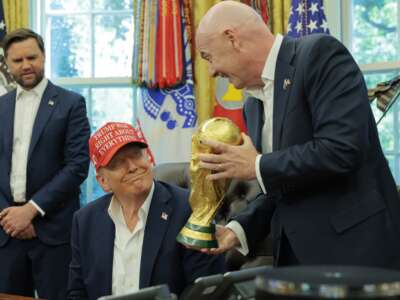
He craves it, and, to some extent, his desire was satisfied. President Donald Trump did get a peace prize. Not the peace prize picked out by self-important Norwegian non-entities, but the inaugural curiosity of FIFA, an organisation famed for opacity, corruption and graft. What the critics missed in all of this was its sheer appositeness.
In a two-hour ceremony held on December 5 at Washington’s Kennedy Center, which included the World Cup draw for participants at next year’s games, Trump was presented with a prize few FIFA officials seem to know existed. Last month, FIFA president Gianni Infantino announced the award, expressing the view that Trump also deserved that other coveted gong, the Nobel Peace Prize. One senior FIFA official boldly told BBC Sport that the football organisation’s prize deserved serious attention: “Why can’t this be bigger than the Nobel Peace Prize? Football has huge global support, so it’s right that it recognises extraordinary efforts to bring about peace every year.”
That football – grand sport of sublimated aggression, contest and rivalries – is an agent of peace, is one of those shibboleths sporting administrators feed. Go through the records of any famous club rivalry, and peace is found wanting. Violence and politics, however, can be found in abundance. But Infantino did not become FIFA President on his mastery of such details. His formula was simple if hypocritical: athletes should play and shut up about politics, leaving it to the administrative class to do the rest.
With fawning relish, he heaped high praise on the winner. “This is what we want from a leader; a leader who cares about the people. We want to live in a safe world, in a safe environment. We want to unite – that’s what we do here today, that’s what we’ll do at the (FIFA) World Cup, Mr President.” Trump, in deserving the inaugural award, could count on Infantino’s support and that “of the entire football community – or ‘soccer’ community – to help you make peace and make sure the world prospers all over the world.”
Infantino has never been a strict observer of the dusty ethics clause stating that the organisation maintains neutrality “in matters of politics and religion” and that “all persons bound by the code remain politically neutral … in dealings with government institutions.” He has hobnobbed with the leaders of Qatar, Saudi Arabia and Russia, ostensibly pursuing the footballing cause. He was the only sports leader present at the Egyptian “Summit for Peace” held in October, when a clutch of significant figures, marshalled by Trump and Egyptian President Abdel Fatah El-Sisi, agreed to implement the first phase of the Gaza peace plan. (There was much personal gratitude for Trump, praised as “absolutely fundamental and crucial in the [peace] process.) He has gathered a swag of awards and accolades from governments, hardly an affirmation of neutrality in any strict sense.
In keeping with the mood, Trump spoke about everything other than football. He was in the business of saving lives, and peace prizes did not matter much. (You need to get one in order to dismiss its merits.) For good measure, he had also “saved a lot [of lives], millions even.”
In keeping with the absurd occasion was the furious criticism of the choice, when its absurdity was most apt. Infantino, derided over his stance on not suspending Israel over its military operations in Gaza, was now receiving rebukes for eschewing neutrality. “Not satisfied with two years of FIFA complicity in genocide in Palestine, Infantino and his cronies have now invented a ‘peace prize’ in order to curry favour with Donald Trump,” fumed former UN official Craig Mokhiber and campaigner against Israeli’s membership of FIFA.
Andrea Florence, Executive Director of the Sports & Rights Alliance, acknowledged that the World Cup had been the political plaything of states in rinsing stained human rights records. “But FIFA is now doing the sportswashing itself. Giving this so-called FIFA ‘Peace Prize’ to US President Donald Trump with no clear criteria or process – and despite his administration’s violent detentions of immigrants, crackdowns on freedom of expression, and militarization of US cities – it’s sportswashing on steroids.”
This grumbling was bound to take a more formal shape, and it came in the form of an eight-page letter of complaint from the non-profit advocacy organisation, FairSquare. Unfortunately for the organisation, it was sent to FIFA. In the letter, the organisation demands that the ethics committee (the joke keeps giving) “investigate the circumstances surrounding the decision to introduce and award a FIFA Peace Prize and their conformity with FIFA’s procedural rules.” It makes reference to various remarks of Infantino’s, including those in an Instagram post from Trump’s inauguration on January 20 declaring that, “Together we will make not only America great again, but also the entire world”.
Studiously referencing FIFA statutes – not that this will get them far – the group goes on to state that awarding such a prize “to a sitting political leader is in and of itself a clear breach of Fifa’s duty of neutrality”. Infantino lacked the power to unilaterally determine “the organisation’s mission, strategic direction, policies and values”.
As with most things relevant to that organisation, the complaint is unlikely to get far. Politics and sport do mix, as they have always done. Infantino, chief of the world’s foremost unchallenged sporting mafia, may claim otherwise, but his tenure shows that he knows that crude reality all too well.
Trump’s Draconian Border Policies Are Menacing the 2026 World Cup
World Cup athletes, fans, and personnel fear Trump’s anti-immigration policies may disrupt the tournament’s operation.
By Nora Loreto ,

On Saturday, December 6, soccer fans around the world will find out where their favorite teams will be playing in the 2026 FIFA World Cup. Players and staff from 48 countries and territories will play 104 games across North America — and for the first time in history, Canada is hosting some of the games. Together, Toronto and Vancouver will host 13 matches.
In addition to the matches, 84 training sites and 178 practice fields will be spread across Canada, the U.S., and Mexico. Plus, tens of thousands of broadcasters from around the world will cover the games for their home countries.
Holding the games in three countries means that ease of crossing borders is a fundamental part of the World Cup going smoothly. Hundreds of thousands of players, staff, and fans will need to move across the U.S.-Mexico border and the Canada-U.S. border multiple times in order to attend the matches over the course of six weeks in June and July 2026. But already, months before the games begin, concerns are mounting over whether attendees will be able to enter the host countries at all
“Trump has made clear that U.S. restrictions on immigration visas, travel bans, and ongoing ICE kidnappings apply to World Cup fans and, in several cases, to athletes’ delegations as well,” Harsha Walia — the author of Border and Rule: Global Migration, Capitalism, and the Rise of Racist Nationalism — told Truthout.
“The fact that FIFA is continuing to host the World Cup as planned and has not at all leveraged their business relationship to advocate for human rights commitments signals FIFA’s capitulation to growing authoritarianism and protection of capitalist interests,” added Walia, who lives in Vancouver.
Related Story
FIFA Announces New “Peace Prize,” Weeks After Trump Fails to Win Nobel Award
The award comes as FIFA is under fire for refusing to sanction Israel and Saudi Arabia for their human rights abuses. By Chris Walker , Truthout November 6, 2025
It isn’t exactly easy to cross the Canada-U.S. border under the Trump administration. Cross-border travel has dropped as Canadians seek out other destinations for travel, scared off by images and stories of people being caught up in immigration enforcement, or even disappeared. ICE has been given a green light to continue its worst practices, Truthout has previously reported. With 20 new Canadian-built armored vehicles on their way into ICE’s possession, oppression from ICE will continue and likely get even worse.
Earlier this year, several countries issued travel warnings to their citizens, telling people to be careful in the United States due to immigration enforcement agents’ increasingly brazen tactics. Some refugees who have crossed into Canada have been turned away by Canadian border agents only to then be placed into ICE custody and face deportation. Sixty thousand people are currently in ICE detention, the highest number in many years, and the number of fatalities in ICE custody is the highest it has been in 20 years.
On November 28, 2025, Donald Trump announced on Truth Social that he would prevent migration to the United States by people who are from, in his words, from “the Third World.” One month earlier, he announced that the United States would only accept 7,500 refugees per year, a shockingly low number given that the United Nations High Commissioner for Refugees estimates there are 117.3 million forcibly displaced people on the planet.
The U.S. administration has signaled that staff from Iranian and Haitian teams, like player analysts, kinesiologists and other technical staff, won’t be allowed to enter the U.S. for the games.
These conditions have the potential to make crossing borders for the World Cup more dangerous for personnel and fans. Errors in documents or visa delays could each put someone at risk of detention, deportation, or disappearance.
To facilitate entry to the United States to watch the games, the U.S. has created a special FIFA visa for World Cup ticket holders, the U.S. State Department announced in November, which will give fans priority appointments for their visa requirements, or give fans from certain countries access to visa waivers.
Even so, athletes and fans may find it difficult to move across borders to attend the event. In October, a star of the international mountain biking world, Jolanda Neff, arrived at the Lake Placid World Cup just 45 minutes before her race started due to visa issues. Coach and veteran of the sport Steve Peat was denied entry entirely. In Canadian MTB magazine, Terry McCall wrote, “to be very clear, both Peaty and Neff are very experienced professionals with solid team backing. This isn’t a couple juniors winging it on their first trip overseas,” warning that fans, athletes, and team staff may face similar struggles at future U.S.-based sporting events.
Foot Africa reports that already, the U.S. administration has signaled that staff from Iranian and Haitian teams, like player analysts, kinesiologists, and other technical staff, won’t be allowed to enter the U.S. for the games. Iranian citizens who are part of that support staff, for example, will likely be rejected.
Meanwhile, Canada has not announced a special program for the World Cup. FIFA ticket holders have been asked to apply for their visas as soon as possible, as there are no guarantees that they will be allowed entry into Canada. Of the 48 teams playing in the tournament, more than half represent countries where Canada requires a visa for its travelers to be allowed to enter the country. Documents can range from CA$7 for a visa waiver to CA$100 for a visa. The Government of Canada advises applicants to mention that they’re coming to Canada for the World Cup in their application.
Toronto Star sports columnist Bruce Arthur notes that while Brazil required ticket holders from some countries to hold visas at the 2014 World Cup, they waived the fees. Ticket holders didn’t need visas to attend the World Cup in Russia in 2018 or Qatar in 2022.
Simon Black, professor of labor studies at Brock University, says that by increasing the number of teams at the World Cup from the usual 32 teams to 48, there are many more teams from small countries in the Global South where, “under ‘normal’ circumstances, it would probably be difficult to get in [to Canada] regardless.”
Entering Canada is difficult for people from countries outside of Europe or the United States. Processing times vary wildly: the Government of Canada website posts an estimated 469 days for Côte d’Ivoire, 162 days for Iran, 37 days for Colombia, 23 days for Jamaica, and no time estimate at all for Cabo Verde — all countries that have teams in the World Cup.
A spokesperson from the Department of Immigration, Refugees and Citizenship Canada said in an email statement: “Canada is excited to welcome hundreds of thousands of visitors for the FIFA World Cup 2026, including athletes, coaches, officials, medical staff, media, corporate sponsors and fans from around the world. Immigration, Refugees and Citizenship Canada (IRCC) is working closely with FIFA and federal partners to make travel to Canada as simple and smooth as possible without compromising security.”
To head off some of these issues, the Canadian government issued a temporary policy to exempt people who carry a FIFA invitation from work authorization requirements.
Canada’s visa problems might be overshadowed by an erratic U.S. president who has made immigration enforcement and deportations a key part of his administration’s work, but they have increasingly plagued large-scale international events. When the International Symposium on High-Performance Computer Architecture was held in Montreal in 2023, a quarter of conference attendees had their visas denied. In a joint letter signed by 76 computer scientists, they wrote “In order to advocate for the best interests of our academic communities, we can only recommend a moratorium in selecting Canada as a destination for such events.” In July 2024, the International Health Economics Association decided to relocate their 2025 conference to Indonesia, asserting they could not process the visas fast enough. Conference organizers had anticipated 1500 people would attend from all over the world.
To head off some of these issues, on November 14, 2025, the Canadian government issued a temporary policy to exempt people who carry a FIFA invitation from work authorization requirements that usually apply to foreign nationals who enter Canada.
The exemption started on December 1 and will expire on the last day of July, or just after the World Cup ends. To be eligible, individuals must apply for a visa and have a letter of invitation from FIFA. It will cover athletes and team staff, as well as some vendors, but not fans.
Vancouver city councilor Sean Orr lived in Vancouver during the 2010 Vancouver Olympics. In advance of the World Cup, his attention has been on how the city’s most vulnerable will be treated while the matches are played in his city. The city council hasn’t considered immigration or refugee issues; generally, they fall within the jurisdiction of the federal government. But he points to the detention of Democracy Now!’s Amy Goodman when she crossed the border for an event just before the 2010 Olympics as a warning sign that things might get more difficult for critics of the Canadian or U.S. governments who cross the border closer to the World Cup.
In an ideal world, Orr would like to see FIFA place personnel needs at the center of planning the World Cup. “I expect that there be a robust human rights framework attached to FIFA, and I know the city is working on it, but what does that mean when it comes to enforcement? What does that mean, on the ground, to protect people, sex workers, fans and residents? FIFA is in control of so much,” Orr told Truthout.
Black says that given the problems that so many people have had with immigration enforcement in the United States, “I can’t not see there being some sort of issue,” during the games. Ultimately, he believes that all governments hosting the World Cup need to center the rights and freedoms of the people whose jobs rely on their freedom to travel to matches. What’s needed most is “free movement of labor, which is what this is, across borders … without fear of harassment from immigration authorities, without fear of deportation, without fear of detention.”
Walia echoed this sentiment, calling on FIFA to take responsibility to protect human rights.
“FIFA should firmly require all host countries to safeguard migrant rights, end unlawful immigration enforcement at least during the tournament, end the displacement of unhoused communities in the lead up to and during the games, and protect journalists, activists and workers,” Walia said.
Truthout’s December fundraiser is our most important of the year and will determine the scale of work we will be able to do in 2026. Please support us with a tax-deductible donation today.
This article is licensed under Creative Commons (CC BY-NC-ND 4.0), and you are free to share and republish under the terms of the license.

Nora Loreto is a writer and activist based in Quebec City. She is also the president of the Canadian Freelance Union.
No comments:
Post a Comment