UN ambassadors condemn Israel's recognition of Somaliland
UN ambassadors criticised Israel during an emergency Security Council meeting on Monday, condemning its unilateral recognition of Somaliland as a violation of sovereignty and international law. Several delegates called the move morally reprehensible and rejected any proposal to relocate Palestinians from Gaza to Somaliland. The US was the only member state to defend Israel's recognition of the breakaway region.
Issued on: 30/12/2025 -
By: FRANCE 24
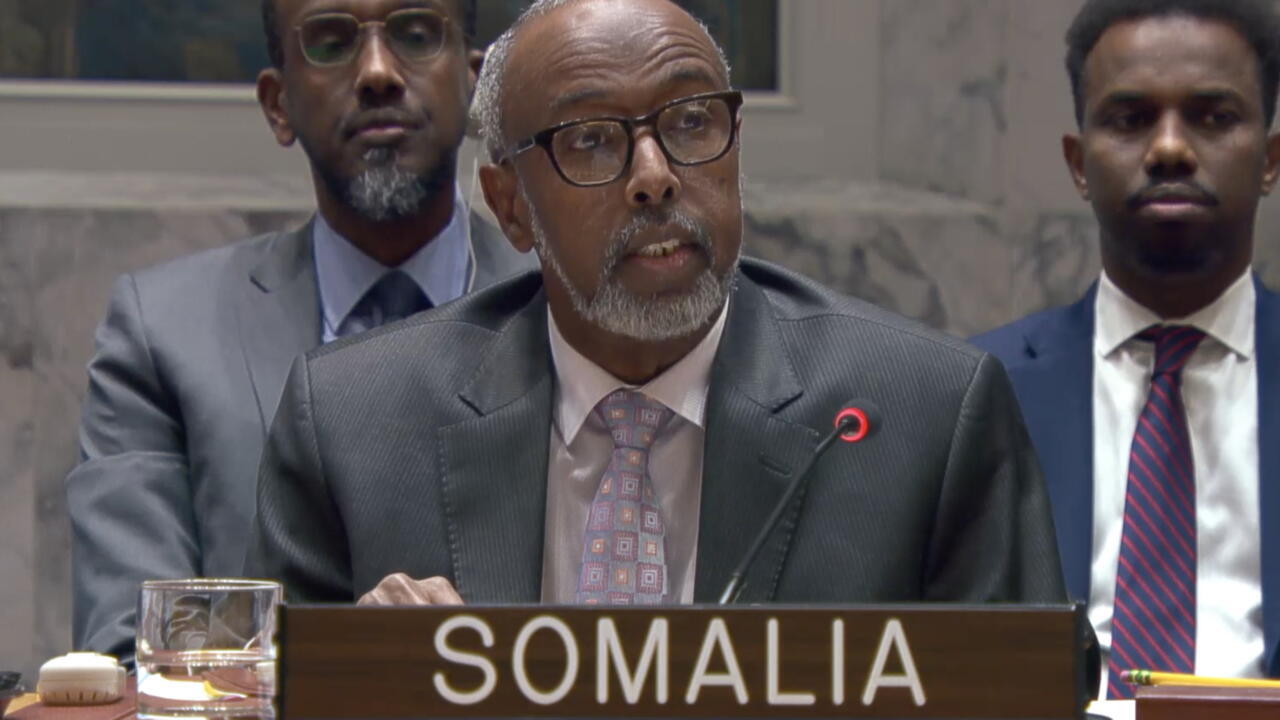 Somalia’s UN Ambassador Abukar Dahir Osman during a UN Security Council meeting on December 29, 2025 at the UN Headquarters in New York City. © France 24
Israel defended on Monday its formal recognition of the self-declared Republic of Somaliland, but several countries at the United Nations questioned whether the move aimed to relocate Palestinians from Gaza or to establish military bases.
Israel became the first country to recognise Somaliland as an independent and sovereign state on Friday.
The 22-member Arab League, a regional organisation of Arab states in the Middle East and parts of Africa, rejects "any measures arising from this illegitimate recognition aimed at facilitating forced displacement of the Palestinian people or exploiting northern Somali ports to establish military bases," Arab League UN Ambassador Maged Abdelfattah Abdelaziz told the UN Security Council.
"Against the backdrop of Israel's previous references to Somaliland of the Federal Republic of Somalia as a destination for the deportation of Palestinian people, especially from Gaza, its unlawful recognition of Somaliland region of Somalia is deeply troubling," Pakistan's Deputy UN Ambassador Muhammad Usman Iqbal Jadoon told the council.
Israel's UN mission did not immediately respond to a request for comment on the remarks or address any of them in its statement at the council meeting. In March, the foreign ministers of Somalia and Somaliland said they had not received any proposal to resettle Palestinians from Gaza.
US President Donald Trump's peace plan for Gaza states: "No one will be forced to leave Gaza, and those who wish to leave will be free to do so and free to return."
Israel's coalition government, the most right-wing and religiously conservative in its history, includes far-right politicians who advocate the annexation of both Gaza and the West Bank and encouraging Palestinians to leave their homeland.
Somalia’s UN Ambassador Abukar Dahir Osman said council members Algeria, Guyana, Sierra Leone and Somalia "unequivocally reject any steps aimed at advancing this objective, including any attempt by Israel to relocate the Palestinian population from Gaza to the northwestern region of Somalia."
Somaliland vs Palestinian state
Somaliland has enjoyed effective autonomy - and relative peace and stability - since 1991 when Somalia descended into civil war, but the breakaway region has failed to receive recognition from any other country.
"It is not a hostile step toward Somalia, nor does it preclude future dialogue between the parties. Recognition is not an act of defiance. It is an opportunity,” Israel’s Deputy UN Ambassador Jonathan Miller told the council.
In September, several Western states, including France, Britain, Canada and Australia announced they would recognise a Palestinian state, joining more than three-quarters of the 193 UN members who already do so.
Deputy US Ambassador to the UN Tammy Bruce said: "This council’s persistent double standards and misdirection of focus distract from its mission of maintaining international peace and security."
Slovenia's UN Ambassador Samuel Zbogar disputed her argument, saying: "Palestine is not part of any state. It is illegally occupied territory ... Palestine is also an observer state in this organisation."
He added: "Somaliland, on the other hand, is a part of a UN member state and recognising it goes against ... the UN Charter."
Israel said last week that it would seek immediate cooperation with Somaliland in agriculture, health, technology and the economy. The former British protectorate hopes Israeli recognition will encourage other nations to follow suit, increasing its diplomatic heft and access to global markets.
UN ambassadors criticised Israel during an emergency Security Council meeting on Monday, condemning its unilateral recognition of Somaliland as a violation of sovereignty and international law. Several delegates called the move morally reprehensible and rejected any proposal to relocate Palestinians from Gaza to Somaliland. The US was the only member state to defend Israel's recognition of the breakaway region.
Issued on: 30/12/2025 -
By: FRANCE 24
Somalia’s UN Ambassador Abukar Dahir Osman during a UN Security Council meeting on December 29, 2025 at the UN Headquarters in New York City. © France 24Israel defended on Monday its formal recognition of the self-declared Republic of Somaliland, but several countries at the United Nations questioned whether the move aimed to relocate Palestinians from Gaza or to establish military bases.
Israel became the first country to recognise Somaliland as an independent and sovereign state on Friday.
The 22-member Arab League, a regional organisation of Arab states in the Middle East and parts of Africa, rejects "any measures arising from this illegitimate recognition aimed at facilitating forced displacement of the Palestinian people or exploiting northern Somali ports to establish military bases," Arab League UN Ambassador Maged Abdelfattah Abdelaziz told the UN Security Council.
"Against the backdrop of Israel's previous references to Somaliland of the Federal Republic of Somalia as a destination for the deportation of Palestinian people, especially from Gaza, its unlawful recognition of Somaliland region of Somalia is deeply troubling," Pakistan's Deputy UN Ambassador Muhammad Usman Iqbal Jadoon told the council.
Israel's UN mission did not immediately respond to a request for comment on the remarks or address any of them in its statement at the council meeting. In March, the foreign ministers of Somalia and Somaliland said they had not received any proposal to resettle Palestinians from Gaza.
US President Donald Trump's peace plan for Gaza states: "No one will be forced to leave Gaza, and those who wish to leave will be free to do so and free to return."
Israel's coalition government, the most right-wing and religiously conservative in its history, includes far-right politicians who advocate the annexation of both Gaza and the West Bank and encouraging Palestinians to leave their homeland.
Somalia’s UN Ambassador Abukar Dahir Osman said council members Algeria, Guyana, Sierra Leone and Somalia "unequivocally reject any steps aimed at advancing this objective, including any attempt by Israel to relocate the Palestinian population from Gaza to the northwestern region of Somalia."
Somaliland vs Palestinian state
Somaliland has enjoyed effective autonomy - and relative peace and stability - since 1991 when Somalia descended into civil war, but the breakaway region has failed to receive recognition from any other country.
"It is not a hostile step toward Somalia, nor does it preclude future dialogue between the parties. Recognition is not an act of defiance. It is an opportunity,” Israel’s Deputy UN Ambassador Jonathan Miller told the council.
In September, several Western states, including France, Britain, Canada and Australia announced they would recognise a Palestinian state, joining more than three-quarters of the 193 UN members who already do so.
Deputy US Ambassador to the UN Tammy Bruce said: "This council’s persistent double standards and misdirection of focus distract from its mission of maintaining international peace and security."
Slovenia's UN Ambassador Samuel Zbogar disputed her argument, saying: "Palestine is not part of any state. It is illegally occupied territory ... Palestine is also an observer state in this organisation."
He added: "Somaliland, on the other hand, is a part of a UN member state and recognising it goes against ... the UN Charter."
Israel said last week that it would seek immediate cooperation with Somaliland in agriculture, health, technology and the economy. The former British protectorate hopes Israeli recognition will encourage other nations to follow suit, increasing its diplomatic heft and access to global markets.
INTERVIEW
Israel's recognition of Somaliland ‘is not an isolated initiative': expert
For the first time, the secessionist state of Somaliland has been officially recognised by another state, namely Israel. It's a blow for the President of the Federal Republic of Somalia, Hassan Sheikh Mohamud, who managed to organise local elections despite growing pressure from the Islamist group al-Shabaab. RFI spoke to Matt Bryden, a strategic advisor at the Sahan Research centre in Nairobi, about the state of play and what's behind Israel's recognition of Somaliland.
Issued on: 29/12/2025 - RFI

Israel's recognition of Somaliland ‘is not an isolated initiative': expert
For the first time, the secessionist state of Somaliland has been officially recognised by another state, namely Israel. It's a blow for the President of the Federal Republic of Somalia, Hassan Sheikh Mohamud, who managed to organise local elections despite growing pressure from the Islamist group al-Shabaab. RFI spoke to Matt Bryden, a strategic advisor at the Sahan Research centre in Nairobi, about the state of play and what's behind Israel's recognition of Somaliland.
Issued on: 29/12/2025 - RFI
People walk next to a destroyed house and the wreckage of a car following a deadly explosion provoked by Al-Shabaab militants on the outskirts of Mogadishu, 16 February 2022. AFP - HASSAN ALI ELMI
Al-Shabaab ("The Youth") rose to prominence in Somalia in the early 2000s and aims to establish a "Greater Somalia", joining ethnic Somalis across East Africa under strict Islamic rule.
It has allegedly become one of al-Qaeda’s strongest and most successful affiliates.
A joint United Nations and African Union peacekeeping force known as the African Union Transitional Mission to Somalia (ATMIS), along with the United States and several East African nations, have been actively trying to combat the movement, but it has proven resilient against numerous counterinsurgency campaigns.
RFI: Why have Shabaab militants been able to regain the ground they lost over the past three years?
Matt Bryden: Three years ago, the offensive against the Shabaab was led by clan militias that wanted to free themselves from Al-Shabaab. They received support from the federal government and from the Americans. But clan militias can only fight on their own clan territory. Once they had liberated their own areas, they could not advance any further. So the offensive was really a series of small, local operations by different clan militias, not a coherent, coordinated campaign.
RFI: And today, have these clan militias allied themselves with the Shabaab against the government?
MB: No. Most of them are still opposed to the Shabaab, especially in the areas where they fought them. But they are not necessarily allied with the government either. That is another major problem for the federal government: it is not just fighting the Shabaab, but also some of the provinces and regions of Somalia, which are themselves fighting Al-Shabaab. In reality, the government in Mogadishu controls at most 15 per cent of Somalia’s territory – and that's a generous estimate.
RFI: Still, these are the first elections without attacks. Isn’t that a success for President Hassan Sheikh Mohamud?
MB: Absolutely. There were voters at some polling stations, that’s true. But Somalia is a clan-based society. Members of clans that support the government turned out to vote, while other clans – those that support the opposition – did not. So the election risks deepening divisions between Somalia’s clans and regions: those that back the government, who are currently a minority, and those clans and regions that oppose it.
US launches air strikes against Islamic State targets in Somalia
RFI: President Hassan Sheikh Mohammed was beaming on Thursday during the elections. But the next day, Friday, he received very bad news. For the first time, the secessionist state of Somaliland was officially recognised by another country – Israel. Did that surprise you?
MB: For Somalia, certainly. It's a very unwelcome surprise. Somaliland now risks receiving not only Israel’s recognition, but that of other countries as well. What Israel has done is clearly not an isolated initiative; it was coordinated with other states in Africa, with some Arab countries, and probably with the United States too.
RFI: You say other countries could follow. Two years ago, Ethiopia nearly recognised Somaliland’s independence, but eventually backed down under pressure from Somalia and Turkey.
MB: Yes, but Ethiopia’s move was not coordinated with other states and amounted to a declaration rather than formal recognition. This time, Israel has officially recognised Somaliland. From what I hear from diplomats in the region, Israel and other countries have been coordinating this decision for months, perhaps more than a year, so that Israel would not be alone. There are likely to be further recognitions in the weeks and months ahead.
With a new president, Somaliland seeks international recognition
RFI: The Israelis suggest that this recognition of Somaliland is in the spirit of the [2020] Abraham Accords, under which Israel normalised relations with countries including the United Arab Emirates and Morocco. Are the Americans perhaps behind this?
MB: Yes, absolutely. The Americans, especially since President Trump’s election, have signalled deep frustration with the situation in Somalia. They have spent billions of dollars on the country’s security, yet the situation is worse than before. As a result, the US has begun working directly with the regions of Jubaland and Puntland to fight Al-Shabaab and also Islamic State, which has been very active in north-eastern Puntland.
Relations with Somaliland are also deepening. The head of Africom, General Anderson, visited a few months ago. So it is fairly clear that the Americans see Somaliland as a potential partner, both to secure maritime routes in the Gulf of Aden and the Red Sea, and to combat extremist movements in the Horn of Africa.
This interview was adapted from the original in French and has been lightly edited for clarity.
Al-Shabaab ("The Youth") rose to prominence in Somalia in the early 2000s and aims to establish a "Greater Somalia", joining ethnic Somalis across East Africa under strict Islamic rule.
It has allegedly become one of al-Qaeda’s strongest and most successful affiliates.
A joint United Nations and African Union peacekeeping force known as the African Union Transitional Mission to Somalia (ATMIS), along with the United States and several East African nations, have been actively trying to combat the movement, but it has proven resilient against numerous counterinsurgency campaigns.
RFI: Why have Shabaab militants been able to regain the ground they lost over the past three years?
Matt Bryden: Three years ago, the offensive against the Shabaab was led by clan militias that wanted to free themselves from Al-Shabaab. They received support from the federal government and from the Americans. But clan militias can only fight on their own clan territory. Once they had liberated their own areas, they could not advance any further. So the offensive was really a series of small, local operations by different clan militias, not a coherent, coordinated campaign.
RFI: And today, have these clan militias allied themselves with the Shabaab against the government?
MB: No. Most of them are still opposed to the Shabaab, especially in the areas where they fought them. But they are not necessarily allied with the government either. That is another major problem for the federal government: it is not just fighting the Shabaab, but also some of the provinces and regions of Somalia, which are themselves fighting Al-Shabaab. In reality, the government in Mogadishu controls at most 15 per cent of Somalia’s territory – and that's a generous estimate.
RFI: Still, these are the first elections without attacks. Isn’t that a success for President Hassan Sheikh Mohamud?
MB: Absolutely. There were voters at some polling stations, that’s true. But Somalia is a clan-based society. Members of clans that support the government turned out to vote, while other clans – those that support the opposition – did not. So the election risks deepening divisions between Somalia’s clans and regions: those that back the government, who are currently a minority, and those clans and regions that oppose it.
US launches air strikes against Islamic State targets in Somalia
RFI: President Hassan Sheikh Mohammed was beaming on Thursday during the elections. But the next day, Friday, he received very bad news. For the first time, the secessionist state of Somaliland was officially recognised by another country – Israel. Did that surprise you?
MB: For Somalia, certainly. It's a very unwelcome surprise. Somaliland now risks receiving not only Israel’s recognition, but that of other countries as well. What Israel has done is clearly not an isolated initiative; it was coordinated with other states in Africa, with some Arab countries, and probably with the United States too.
RFI: You say other countries could follow. Two years ago, Ethiopia nearly recognised Somaliland’s independence, but eventually backed down under pressure from Somalia and Turkey.
MB: Yes, but Ethiopia’s move was not coordinated with other states and amounted to a declaration rather than formal recognition. This time, Israel has officially recognised Somaliland. From what I hear from diplomats in the region, Israel and other countries have been coordinating this decision for months, perhaps more than a year, so that Israel would not be alone. There are likely to be further recognitions in the weeks and months ahead.
With a new president, Somaliland seeks international recognition
RFI: The Israelis suggest that this recognition of Somaliland is in the spirit of the [2020] Abraham Accords, under which Israel normalised relations with countries including the United Arab Emirates and Morocco. Are the Americans perhaps behind this?
MB: Yes, absolutely. The Americans, especially since President Trump’s election, have signalled deep frustration with the situation in Somalia. They have spent billions of dollars on the country’s security, yet the situation is worse than before. As a result, the US has begun working directly with the regions of Jubaland and Puntland to fight Al-Shabaab and also Islamic State, which has been very active in north-eastern Puntland.
Relations with Somaliland are also deepening. The head of Africom, General Anderson, visited a few months ago. So it is fairly clear that the Americans see Somaliland as a potential partner, both to secure maritime routes in the Gulf of Aden and the Red Sea, and to combat extremist movements in the Horn of Africa.
This interview was adapted from the original in French and has been lightly edited for clarity.
Israel’s Somaliland Gambit: What’s At Risk For The Region? – Analysis
 Somaliland's President Abdirahman Mohamed Abdullahi holds virtual meeting with Israel's Prime Minister Benjamin Netanyahu. Photo Credit: @Presidencysl_, X

December 29, 2025
By Arab News
It perhaps comes as no surprise to seasoned regional observers that Israel has become the first and only UN member state to formally recognize the Republic of Somaliland as an independent and sovereign nation.
On Dec. 26, Israel’s Prime Minister Benjamin Netanyahu and Foreign Minister Gideon Sa’ar signed a joint declaration of mutual recognition alongside Somaliland’s President Abdirahman Mohamed Abdullahi.
For a region that has existed in a state of diplomatic limbo since declaring independence from Somalia in 1991, this development is, as Abdullahi described it, “a historic moment.” But beneath the surface lies a calculated and high-stakes geopolitical gamble.
While several nations, including the UK, Ethiopia, Turkiye, and the UAE, have maintained liaison offices in the capital of Hargeisa, none had been willing to cross the Rubicon of formal state recognition.
Israel’s decision to break this decades-long international consensus is a deliberate departure from the status quo.
By taking this step, Israel has positioned itself as the primary benefactor of a state that has long sought a seat at the international table. As Dya-Eddine Said Bamakhrama, the ambassador of Djibouti to Saudi Arabia, told Arab News, such a move is deeply disruptive.
“A unilateral declaration of separation is neither a purely legal nor an isolated political act. Rather, it carries profound structural consequences, foremost among them the deepening of internal divisions and rivalries among citizens of the same nation, the erosion of the social and political fabric of the state, and the opening of the door to protracted conflicts,” he said.
Critics argue that Israel has long lobbied for the further carving up of the region under various guises.
This recognition of Somaliland is seen by many in the Arab world as a continuation of a strategy aimed at weakening centralized Arab and Muslim states by encouraging peripheral secessionist movements.
In the Somali context, this path is perceived not as a humanitarian gesture, but as a method to undermine the national understandings reached within the framework of a federal Somalia.
According to Ambassador Bamakhrama, the international community has historically resisted such moves to prioritize regional stability over “separatist tendencies whose dangers and high costs history has repeatedly demonstrated.”
By ignoring this precedent, Israel is accused of using recognition as a tool to fragment regional cohesion.
In the past, Israel has often framed its support for non-state actors or separatist groups under the pretext of protecting vulnerable minorities — such as the Druze in the Levant or Maronites in Lebanon.
This “Periphery Doctrine” served a dual purpose: it created regional allies and supported Israel’s own claim of being a Jewish state by validating the idea of ethnic or religious self-determination.
However, in the case of Somaliland, the gloves are off completely. The argument here is not about protecting a religious minority, as Somaliland is a staunchly Muslim-majority territory. Instead, the rationale is nakedly geopolitical.
Israel appears to be seeking strategic depth in a region where it has historically been isolated. Netanyahu explicitly linked the move to “the spirit of the Abraham Accords,” signaling that the pimary drivers are security, maritime control, and intelligence gathering rather than the internal demographicsof the Horn of Africa.
The first major win for Israel in this maneuver is the expansion of its diplomatic orbit. It could be argued that the refusal of the federal government in Mogadishu to join the Abraham Accords was an artificial barrier.
The evidence for this claim, from the Israeli perspective, is that Somaliland — a territory with a population of nearly six million and its own functioning democratic institutions — was eager to join.
Abdullahi said Somaliland would join the Abraham Accords as a “step toward regional and global peace.” Yet, this peace comes with a clear quid pro quo — formal recognition.
Israel can now argue that the “Somaliland model” proves that many other Arab and Muslim entities are willing to normalize relations if their specific political or territorial interests are met.
This challenges the unified stance of the Arab League and the Organization of Islamic Cooperation, which maintain that normalization must be tied to the resolution of the Palestinian conflict.
The second major gain for Israel is the potential for a military presence in the Horn of Africa. Somaliland’s strategic position on the Gulf of Aden, near the Bab Al-Mandab Strait, makes it a prime location for monitoring maritime traffic.
This is a ticking time bomb given that just across the narrow sea lies Yemen, where the Houthi movement — whose slogan includes “Death to Israel” — controls significant territory.
Israel may claim that a military or intelligence presence in Somaliland will boost regional security by countering Houthi threats to shipping. However, regional neighbors fear it will likely inflame tensions.
Ambassador Bamakhrama warned that an Israeli military presence would “effectively turn the region into a powder keg.”
“Should Israel proceed with establishing a military base in a geopolitically sensitive location… such a move would be perceived in Tel Aviv as a strategic gain directed against the Arab states bordering the Red Sea — namely Egypt, Saudi Arabia, Somalia, Yemen, Sudan, and Djibouti,” he said.
The Red Sea is a “vital international maritime corridor,” and any shift in its geopolitical balance would have “repercussions extending far beyond the region,” he added.
The recognition is also a clear violation of international law and the principle of territorial integrity as enshrined in the UN Charter.
While proponents point to exceptions like South Sudan or Kosovo, those cases involved vastly different circumstances, including prolonged genocidal conflicts and extensive UN-led transitions.
In contrast, the African Union has been firm that Somaliland remains an integral part of Somalia.
The backlash has been swift and severe. The Arab League, the Gulf Cooperation Council, and the OIC have all decried the move. Even US President Donald Trump, despite his role in the original Abraham Accords, has not endorsed Israel’s decision.
When asked whether Washington would follow suit, Trump replied with a blunt “no,” adding, “Does anyone know what Somaliland is, really?”
This lack of support from Washington highlights the isolation of Israel’s position. The OIC and the foreign ministers of 21 countries have issued a joint statement warning of “serious repercussions” and rejecting any potential link between this recognition and reported plans to displace Palestinians from Gaza to the African region.
Israel’s recognition of Somaliland appears to be a calculated gamble to trade diplomatic norms for strategic advantage.
While Hargeisa celebrates a long-awaited milestone, the rest of the world sees a dangerous precedent that threatens to destabilize one of the world’s most volatile corridors.
As Ambassador Bamakhrama says, the establishment of such ties “would render (Israel) the first and only state to break with the international consensus” — a move that prioritizes “narrow strategic calculations” over the stability of the international system.
By Arab News
It perhaps comes as no surprise to seasoned regional observers that Israel has become the first and only UN member state to formally recognize the Republic of Somaliland as an independent and sovereign nation.
On Dec. 26, Israel’s Prime Minister Benjamin Netanyahu and Foreign Minister Gideon Sa’ar signed a joint declaration of mutual recognition alongside Somaliland’s President Abdirahman Mohamed Abdullahi.
For a region that has existed in a state of diplomatic limbo since declaring independence from Somalia in 1991, this development is, as Abdullahi described it, “a historic moment.” But beneath the surface lies a calculated and high-stakes geopolitical gamble.
While several nations, including the UK, Ethiopia, Turkiye, and the UAE, have maintained liaison offices in the capital of Hargeisa, none had been willing to cross the Rubicon of formal state recognition.
Israel’s decision to break this decades-long international consensus is a deliberate departure from the status quo.
By taking this step, Israel has positioned itself as the primary benefactor of a state that has long sought a seat at the international table. As Dya-Eddine Said Bamakhrama, the ambassador of Djibouti to Saudi Arabia, told Arab News, such a move is deeply disruptive.
“A unilateral declaration of separation is neither a purely legal nor an isolated political act. Rather, it carries profound structural consequences, foremost among them the deepening of internal divisions and rivalries among citizens of the same nation, the erosion of the social and political fabric of the state, and the opening of the door to protracted conflicts,” he said.
Critics argue that Israel has long lobbied for the further carving up of the region under various guises.
This recognition of Somaliland is seen by many in the Arab world as a continuation of a strategy aimed at weakening centralized Arab and Muslim states by encouraging peripheral secessionist movements.
In the Somali context, this path is perceived not as a humanitarian gesture, but as a method to undermine the national understandings reached within the framework of a federal Somalia.
According to Ambassador Bamakhrama, the international community has historically resisted such moves to prioritize regional stability over “separatist tendencies whose dangers and high costs history has repeatedly demonstrated.”
By ignoring this precedent, Israel is accused of using recognition as a tool to fragment regional cohesion.
In the past, Israel has often framed its support for non-state actors or separatist groups under the pretext of protecting vulnerable minorities — such as the Druze in the Levant or Maronites in Lebanon.
This “Periphery Doctrine” served a dual purpose: it created regional allies and supported Israel’s own claim of being a Jewish state by validating the idea of ethnic or religious self-determination.
However, in the case of Somaliland, the gloves are off completely. The argument here is not about protecting a religious minority, as Somaliland is a staunchly Muslim-majority territory. Instead, the rationale is nakedly geopolitical.
Israel appears to be seeking strategic depth in a region where it has historically been isolated. Netanyahu explicitly linked the move to “the spirit of the Abraham Accords,” signaling that the pimary drivers are security, maritime control, and intelligence gathering rather than the internal demographicsof the Horn of Africa.
The first major win for Israel in this maneuver is the expansion of its diplomatic orbit. It could be argued that the refusal of the federal government in Mogadishu to join the Abraham Accords was an artificial barrier.
The evidence for this claim, from the Israeli perspective, is that Somaliland — a territory with a population of nearly six million and its own functioning democratic institutions — was eager to join.
Abdullahi said Somaliland would join the Abraham Accords as a “step toward regional and global peace.” Yet, this peace comes with a clear quid pro quo — formal recognition.
Israel can now argue that the “Somaliland model” proves that many other Arab and Muslim entities are willing to normalize relations if their specific political or territorial interests are met.
This challenges the unified stance of the Arab League and the Organization of Islamic Cooperation, which maintain that normalization must be tied to the resolution of the Palestinian conflict.
The second major gain for Israel is the potential for a military presence in the Horn of Africa. Somaliland’s strategic position on the Gulf of Aden, near the Bab Al-Mandab Strait, makes it a prime location for monitoring maritime traffic.
This is a ticking time bomb given that just across the narrow sea lies Yemen, where the Houthi movement — whose slogan includes “Death to Israel” — controls significant territory.
Israel may claim that a military or intelligence presence in Somaliland will boost regional security by countering Houthi threats to shipping. However, regional neighbors fear it will likely inflame tensions.
Ambassador Bamakhrama warned that an Israeli military presence would “effectively turn the region into a powder keg.”
“Should Israel proceed with establishing a military base in a geopolitically sensitive location… such a move would be perceived in Tel Aviv as a strategic gain directed against the Arab states bordering the Red Sea — namely Egypt, Saudi Arabia, Somalia, Yemen, Sudan, and Djibouti,” he said.
The Red Sea is a “vital international maritime corridor,” and any shift in its geopolitical balance would have “repercussions extending far beyond the region,” he added.
The recognition is also a clear violation of international law and the principle of territorial integrity as enshrined in the UN Charter.
While proponents point to exceptions like South Sudan or Kosovo, those cases involved vastly different circumstances, including prolonged genocidal conflicts and extensive UN-led transitions.
In contrast, the African Union has been firm that Somaliland remains an integral part of Somalia.
The backlash has been swift and severe. The Arab League, the Gulf Cooperation Council, and the OIC have all decried the move. Even US President Donald Trump, despite his role in the original Abraham Accords, has not endorsed Israel’s decision.
When asked whether Washington would follow suit, Trump replied with a blunt “no,” adding, “Does anyone know what Somaliland is, really?”
This lack of support from Washington highlights the isolation of Israel’s position. The OIC and the foreign ministers of 21 countries have issued a joint statement warning of “serious repercussions” and rejecting any potential link between this recognition and reported plans to displace Palestinians from Gaza to the African region.
Israel’s recognition of Somaliland appears to be a calculated gamble to trade diplomatic norms for strategic advantage.
While Hargeisa celebrates a long-awaited milestone, the rest of the world sees a dangerous precedent that threatens to destabilize one of the world’s most volatile corridors.
As Ambassador Bamakhrama says, the establishment of such ties “would render (Israel) the first and only state to break with the international consensus” — a move that prioritizes “narrow strategic calculations” over the stability of the international system.
No comments:
Post a Comment