
A Possible Strategy for Stopping War on Venezuela
Critics of state violence become most dangerous when they directly jeopardize the state’s capacity to inflict violence. The most common and tangible way that happens is when soldiers refuse to kill.
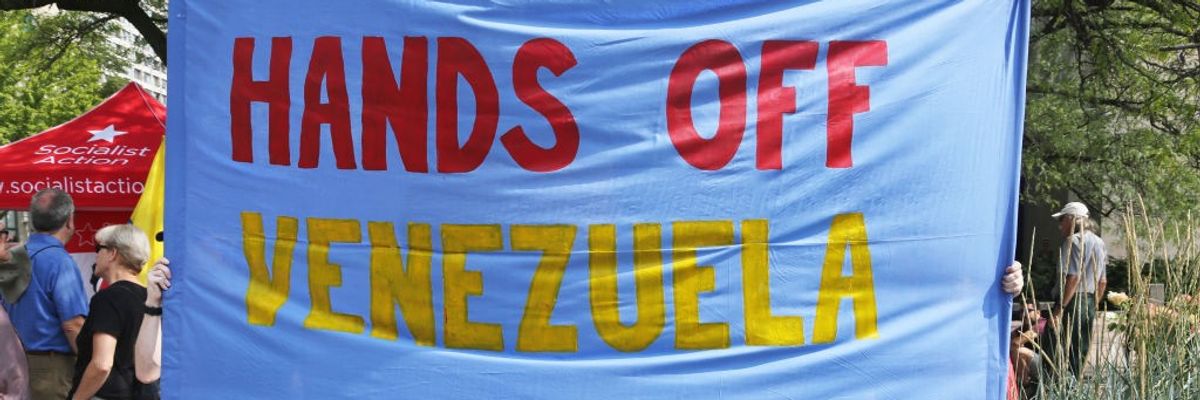
Canadians rally to demand an end to American attempts at a “regime change” in Venezuela and to denounce Canada’s complicity to overthrow the government of Venezuela in Toronto, Canada, on September, 16 2017.
(Photo by Creative Touch Imaging Ltd./NurPhoto via Getty Images)
Kevin Young
Dec 20, 2025Common Dreams
Few believe the justifications for the ongoing US murder campaign, and now military blockade, off the coast of Venezuela. Even US officials seem halfheartedly committed to their claims about stopping drugs. They now concede that the real goal is overthrowing the Venezuelan government and recovering “our oil,” which was mistakenly buried under Venezuelan soil.
If they succeed there, they will surely escalate violence against Cuba and perhaps other noncompliant governments. The larger goal, proclaims the US secretary of defense, is the “restoration of our power and prerogatives in this hemisphere.” That entails reasserting “US military dominance in the Western Hemisphere” and with it the “access to key terrain throughout the region”—that is, markets and resources like our oil. In the meantime, if blowing up boats can also divert attention from domestic scandals, that’s a bonus.
Progressives Urge Passage of Bills to Stop Trump From Launching ‘Forever War’ in Venezuela
Though US actions are indisputably illegal under both international and domestic law, the administration is confident it will enjoy impunity. More assurance came on December 17 when the House of Representatives rejected a War Powers Resolution brought by Rep. Jim McGovern (D-Mass.).
To stop US aggression against Venezuela we must look beyond Congress and the courts to other possible sources of constraint. The strength of the Venezuelan military and its loyalty to Nicolás Maduro is one source. Resistance from powerful Latin American governments like Mexico, Brazil, and Colombia, along with China, may be another. But what can those of us in the United States do?
Pressure campaigns directed at members of Congress should not only repeat all the usual demands—war powers resolutions, bills to cut off funding, impeachment—but also focus on getting them to publicly amplify the message of the November 18 video.
Our people-powered journalism cannot survive without you
Your support allows Common Dreams to continue covering the stories and amplifying the voices that the corporate media never will. Make a tax-deductible year-end gift to ensure we can sustain the reporting needed to meet the challenges of 2026.
In this country, only one thing so far seems to have threatened the administration’s confidence: the threat of disobedience within the military. On November 18 six members of Congress released a video calling on all military servicemembers to “refuse illegal orders.” Doing so is not just a right but a legal duty, they said: Soldiers “must refuse” such orders. As Rep. Mark Kelly (D-Ariz.) reiterated publicly, “You are not allowed to follow illegal orders.”
In response, President Donald Trump called publicly for the execution of those who made the video. That reaction was not just an outburst from a fascist blowhard. It reflected the realistic concern that faltering military loyalty could undermine the administration’s agenda in Venezuela and beyond, including here in the United States.
Critics of state violence become most dangerous when they directly jeopardize the state’s capacity to inflict violence. The most common and tangible way that happens is when soldiers refuse to kill.
Some of the 20th century’s leading voices for peace and justice have been tolerated by the state until they began encouraging disobedience to illegal and immoral orders. The government’s harshest reaction to longtime socialist and labor organizer Eugene Debs came in 1918 when he condemned World War I as an imperialist war for the rich, which the government plausibly interpreted as a call for soldiers to disobey orders (Debs said forthrightly that he was “obstructing the war”). Debs had been organizing workers and preaching socialism for the past quarter century, but his 10-year prison sentence in 1918 was by far the harshest punishment he received.
Martin Luther King Jr. also became his most dangerous when he threatened the Johnson administration’s ability to wage war against Vietnam. In 1967 he began calling the US “the greatest purveyor of violence in the world.” His analysis of the “triple evils” of capitalism, racism, and empire gained a mass audience at the very moment that the Vietnamese resistance—alongside growing disobedience by US soldiers—was imperiling the slaughter in Vietnam. King had been a public figure since the mid-1950s, but only in 1968 was he killed.
The martyred archbishop of San Salvador, Oscar Romero, was likewise killed at the very moment that he urged soldiers of the country’s US-backed military regime to disobey orders. Romero had been criticizing state violence since 1977, but only on March 23, 1980 did he make “a special appeal to the men of the army” to stop killing their own people. The following evening he was killed by a sniper while saying mass.
In all three cases—Debs, King, Romero—the critics were most intolerable to the state when they incited disobedience in the armed forces. Given the extent of mass mobilization and politicization at each of those moments, their incitements were particularly likely to impede military discipline.
We lack that level of mobilization in the US today, but Trump’s actions against Venezuela are drawing growing public attention and condemnation. US residents are also witnessing the administration’s escalating militarization inside their own country. In this context, high-profile calls to “refuse illegal orders” become very dangerous, particularly in relation to military personnel. Unlike US police, the armed forces have a substantial history of internal dissent and disobedience.
Soldier resistance may or may not be morally driven. The statement that soldiers and officers must refuse illegal orders also raises the prospect of prosecution. That is rare and especially hard to imagine at this moment, but not entirely implausible at a later date. And future defendants can’t necessarily assume a future president will pardon them.
The lawmakers who released the November 18 video may have stumbled onto a viable strategy for undermining Trump’s war plans. This is a real break from the Democrats’ normal fecklessness. It’s easy to see why Democratic leaders would be queasy about continuing this approach, since so many of former Presidents Barack Obama and Joe Biden’s foreign policies were also illegal. They don’t want to destroy the US government’s capacity to engage in illegal warfare.
But the November 18 video, and the willingness of Mark Kelly and others to stand behind it amid persecution, suggest an opening. Pressure campaigns directed at members of Congress should not only repeat all the usual demands—war powers resolutions, bills to cut off funding, impeachment—but also focus on getting them to publicly amplify the message of the November 18 video.
Organizing soldiers and countering military recruitment must be priorities for those interested in stopping future US violence. Those are long-term projects though. Right now, we should demand of our politicians (and celebrities, online influencers, whoever) that they amplify the message: Military personnel can and must refuse illegal and immoral orders.
Our work is licensed under Creative Commons (CC BY-NC-ND 3.0). Feel free to republish and share widely.
Kevin Young
Kevin Young teaches history at the University of Massachusetts, Amherst. His most recent book is Abolishing Fossil Fuels: Lessons from Movements That Won.
Full Bio >
Canadians rally to demand an end to American attempts at a “regime change” in Venezuela and to denounce Canada’s complicity to overthrow the government of Venezuela in Toronto, Canada, on September, 16 2017.
(Photo by Creative Touch Imaging Ltd./NurPhoto via Getty Images)
Kevin Young
Dec 20, 2025
Few believe the justifications for the ongoing US murder campaign, and now military blockade, off the coast of Venezuela. Even US officials seem halfheartedly committed to their claims about stopping drugs. They now concede that the real goal is overthrowing the Venezuelan government and recovering “our oil,” which was mistakenly buried under Venezuelan soil.
If they succeed there, they will surely escalate violence against Cuba and perhaps other noncompliant governments. The larger goal, proclaims the US secretary of defense, is the “restoration of our power and prerogatives in this hemisphere.” That entails reasserting “US military dominance in the Western Hemisphere” and with it the “access to key terrain throughout the region”—that is, markets and resources like our oil. In the meantime, if blowing up boats can also divert attention from domestic scandals, that’s a bonus.
Progressives Urge Passage of Bills to Stop Trump From Launching ‘Forever War’ in Venezuela
Though US actions are indisputably illegal under both international and domestic law, the administration is confident it will enjoy impunity. More assurance came on December 17 when the House of Representatives rejected a War Powers Resolution brought by Rep. Jim McGovern (D-Mass.).
To stop US aggression against Venezuela we must look beyond Congress and the courts to other possible sources of constraint. The strength of the Venezuelan military and its loyalty to Nicolás Maduro is one source. Resistance from powerful Latin American governments like Mexico, Brazil, and Colombia, along with China, may be another. But what can those of us in the United States do?
Pressure campaigns directed at members of Congress should not only repeat all the usual demands—war powers resolutions, bills to cut off funding, impeachment—but also focus on getting them to publicly amplify the message of the November 18 video.
Our people-powered journalism cannot survive without you
Your support allows Common Dreams to continue covering the stories and amplifying the voices that the corporate media never will. Make a tax-deductible year-end gift to ensure we can sustain the reporting needed to meet the challenges of 2026.
In this country, only one thing so far seems to have threatened the administration’s confidence: the threat of disobedience within the military. On November 18 six members of Congress released a video calling on all military servicemembers to “refuse illegal orders.” Doing so is not just a right but a legal duty, they said: Soldiers “must refuse” such orders. As Rep. Mark Kelly (D-Ariz.) reiterated publicly, “You are not allowed to follow illegal orders.”
In response, President Donald Trump called publicly for the execution of those who made the video. That reaction was not just an outburst from a fascist blowhard. It reflected the realistic concern that faltering military loyalty could undermine the administration’s agenda in Venezuela and beyond, including here in the United States.
Critics of state violence become most dangerous when they directly jeopardize the state’s capacity to inflict violence. The most common and tangible way that happens is when soldiers refuse to kill.
Some of the 20th century’s leading voices for peace and justice have been tolerated by the state until they began encouraging disobedience to illegal and immoral orders. The government’s harshest reaction to longtime socialist and labor organizer Eugene Debs came in 1918 when he condemned World War I as an imperialist war for the rich, which the government plausibly interpreted as a call for soldiers to disobey orders (Debs said forthrightly that he was “obstructing the war”). Debs had been organizing workers and preaching socialism for the past quarter century, but his 10-year prison sentence in 1918 was by far the harshest punishment he received.
Martin Luther King Jr. also became his most dangerous when he threatened the Johnson administration’s ability to wage war against Vietnam. In 1967 he began calling the US “the greatest purveyor of violence in the world.” His analysis of the “triple evils” of capitalism, racism, and empire gained a mass audience at the very moment that the Vietnamese resistance—alongside growing disobedience by US soldiers—was imperiling the slaughter in Vietnam. King had been a public figure since the mid-1950s, but only in 1968 was he killed.
The martyred archbishop of San Salvador, Oscar Romero, was likewise killed at the very moment that he urged soldiers of the country’s US-backed military regime to disobey orders. Romero had been criticizing state violence since 1977, but only on March 23, 1980 did he make “a special appeal to the men of the army” to stop killing their own people. The following evening he was killed by a sniper while saying mass.
In all three cases—Debs, King, Romero—the critics were most intolerable to the state when they incited disobedience in the armed forces. Given the extent of mass mobilization and politicization at each of those moments, their incitements were particularly likely to impede military discipline.
We lack that level of mobilization in the US today, but Trump’s actions against Venezuela are drawing growing public attention and condemnation. US residents are also witnessing the administration’s escalating militarization inside their own country. In this context, high-profile calls to “refuse illegal orders” become very dangerous, particularly in relation to military personnel. Unlike US police, the armed forces have a substantial history of internal dissent and disobedience.
Soldier resistance may or may not be morally driven. The statement that soldiers and officers must refuse illegal orders also raises the prospect of prosecution. That is rare and especially hard to imagine at this moment, but not entirely implausible at a later date. And future defendants can’t necessarily assume a future president will pardon them.
The lawmakers who released the November 18 video may have stumbled onto a viable strategy for undermining Trump’s war plans. This is a real break from the Democrats’ normal fecklessness. It’s easy to see why Democratic leaders would be queasy about continuing this approach, since so many of former Presidents Barack Obama and Joe Biden’s foreign policies were also illegal. They don’t want to destroy the US government’s capacity to engage in illegal warfare.
But the November 18 video, and the willingness of Mark Kelly and others to stand behind it amid persecution, suggest an opening. Pressure campaigns directed at members of Congress should not only repeat all the usual demands—war powers resolutions, bills to cut off funding, impeachment—but also focus on getting them to publicly amplify the message of the November 18 video.
Organizing soldiers and countering military recruitment must be priorities for those interested in stopping future US violence. Those are long-term projects though. Right now, we should demand of our politicians (and celebrities, online influencers, whoever) that they amplify the message: Military personnel can and must refuse illegal and immoral orders.
Our work is licensed under Creative Commons (CC BY-NC-ND 3.0). Feel free to republish and share widely.
Kevin Young
Kevin Young teaches history at the University of Massachusetts, Amherst. His most recent book is Abolishing Fossil Fuels: Lessons from Movements That Won.
Full Bio >
Unchecked Waters: The Constitutional Crisis
of Trump’s Venezuela Oil Blockade
A naval blockade—regardless of whether it is met with armed resistance qualifies under both domestic and international law as a use of force.
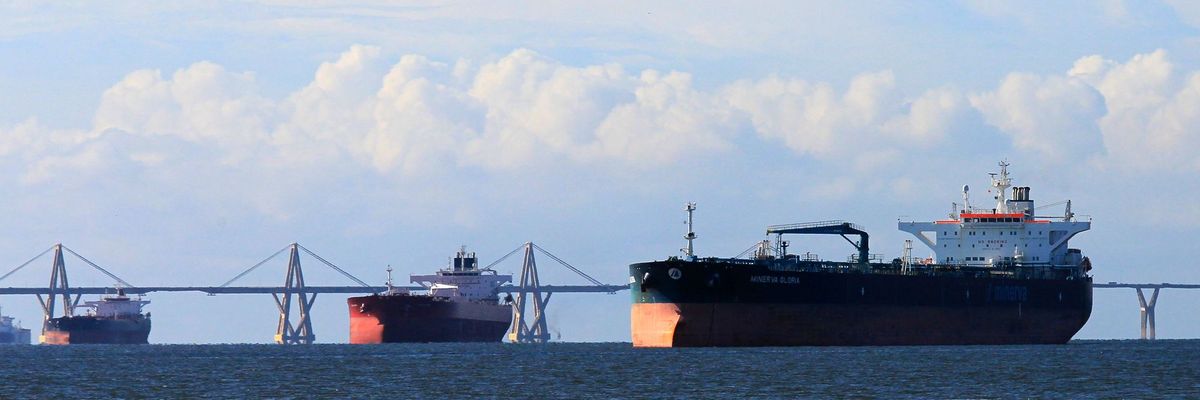
Oil tankers are seen anchored in Lake Maracaibo after loading crude oil at the Bajo Grande Refinery port. The Trump administration seized an oil tanker off the coast of Venezuela, which was on the Treasury Department’s sanctions list and was sailing under the Guyanese flag. The US president threatened to confiscate all hydrocarbon-laden vessels in the Venezuelan oil-producing nation.
(Photo by: Jose Bula Urrutia/UCG/Universal Images Group via Getty Images)
Angel Gomez
Dec 20, 2025Common Dreams
On 16 December, 2025, President Donald Trump announced what he called a “total and complete blockade” of oil tankers entering or leaving Venezuela. Delivered via his personal media platform, the statement was sweeping in its implications. Trump declared that Venezuela was “completely surrounded by the largest Armada ever assembled in the History of South America,” and he made clear this would not end until all Venezuelan “oil, land, and other assets” were returned to the United States. But beneath the dramatic language lies a far more dangerous truth: this action marks a breach of US constitutional limits, a perilous expansion of executive authority, and a break with both legal precedent and historical norms of dispute resolution.
At its core, this naval blockade—undeclared, unauthorized, and now operational—poses a direct challenge to the War Powers Resolution, a congressional statute designed specifically to prevent precisely this kind of unilateral military escalation. While prior administrations have used sanctions, diplomatic pressure, and limited enforcement actions to manage foreign resource disputes, President Trump’s move replaces law with coercion, and diplomacy with force.
..
‘Unquestionably an Act of War’: Trump Declares Naval Blockade Against Venezuela
The Constitutional Line That Has Been Crossed
Under Article I of the US Constitution, the power to declare war, or to authorize acts tantamount to war, lies exclusively with Congress. While Article II grants the President authority as Commander-in-Chief, it does not permit sustained, coercive military operations absent legislative consent. The War Powers Resolution of 1973 was enacted to enforce this distinction, requiring the President to seek congressional authorization for any use of armed forces likely to involve hostilities or imminent risk thereof.
The blockade announced by President Trump is not merely a foreign policy maneuver; it is a constitutional violation in motion.
Our people-powered journalism cannot survive without you
Your support allows Common Dreams to continue covering the stories and amplifying the voices that the corporate media never will. Make a tax-deductible year-end gift to ensure we can sustain the reporting needed to meet the challenges of 2026.
A naval blockade—regardless of whether it is met with armed resistance—qualifies under both domestic and international law as a use of force. It is, by nature, confrontational, involving the assertion of control over international waters and the denial of access to maritime commerce by a sovereign state. As such, the blockade announced by President Trump is not merely a foreign policy maneuver; it is a constitutional violation in motion.
The Fallacy of “Stolen Oil”: A Historical and Legal Fiction
Trump’s central justification for the blockade—that Venezuela “stole” American oil—is not supported by historical fact or legal doctrine. Venezuela’s oil sector was nationalized in 1976, with the creation of the state company Petróleos de Venezuela, S.A. (PDVSA). Over the years, foreign firms—including US giants like ExxonMobil and ConocoPhillips—were permitted to operate under negotiated terms. In the early 2000s, Venezuela reasserted control over key assets, converting foreign-controlled projects into joint ventures in which the state held majority ownership.
These actions were not acts of piracy, but sovereign decisions—ones that fall well within Venezuela’s rights under international law. The resulting disputes were not settled by force, but through arbitration and negotiation. Indeed, many of the affected companies sought recourse through investor-state arbitration mechanisms, challenging compensation levels or contract terms—not the fundamental legality of nationalization itself.
Even as tensions grew, the United States relied on sanctions, licensing restrictions, and diplomatic tools. Not once, in decades of resource disputes throughout Latin America—including in Mexico, Bolivia, and El Salvador—did the US resort to blockades or military coercion to assert commercial claims. The shift to force in the Venezuelan context is therefore not only unprecedented but also deeply destabilizing to the established order.
Sanctions Are Not a Blank Check
The distinction between sanctions enforcement and military action is not academic. Sanctions, as administered by the Office of Foreign Assets Control (OFAC), regulate economic conduct—typically prohibiting certain transactions by US persons. They do not authorize armed interdiction of foreign-flagged vessels on the high seas. While isolated tanker seizures have been justified through civil forfeiture statutes—sometimes involving alleged ties to terrorism or sanctions evasion—the transition to a systematic maritime blockade is an escalation into armed coercion.
This is not simply a technical legal issue. It is a constitutional crisis in real time.
Under the War Powers Resolution and the 1980 Office of Legal Counsel opinion, even emergency military deployments must terminate within 60 days without congressional approval. The blockade’s indefinite duration, announced expansion, and linkage to political demands—such as the return of assets—place it well outside the legal bounds of executive discretion.
This is not simply a technical legal issue. It is a constitutional crisis in real time.
A Dangerous Precedent
If a President can declare and execute a naval blockade without congressional approval—based on economic grievances, political claims, or allegations of foreign misconduct—then the separation of powers itself is under siege. Today, it is Venezuela. Tomorrow, it could be any other state or region where American commercial or political interests are challenged.
Even more alarming is the potential precedent this sets for private claims to become triggers for military action. By framing a dispute over oil contracts as a matter of theft, the administration recasts a regulatory disagreement as grounds for warlike engagement. This upends international norms, threatens global maritime order, and encourages future executives to substitute force for law in matters of foreign commerce.
The Legal and Diplomatic Path Forward
It is not too late to reverse course. The solutions are neither exotic nor novel. They are grounded in law, history, and precedent:
Congress must reassert its constitutional role. Whether through resolutions like House Concurrent Resolution 64 or emergency oversight hearings, the legislative branch must enforce the War Powers Resolution and prohibit unauthorized hostilities.
The Executive must return to lawful enforcement mechanisms. This includes relying on civil forfeiture, targeted sanctions, and international arbitration—not coercive naval operations.
When the President crosses a constitutional red line and no one pushes back, it is not just a policy failure—it is a signal that the balance of powers has tilted dangerously toward autocracy.
Diplomatic engagement must be restored as the core modality. Disputes over Venezuela’s resource management must be addressed through negotiation, licensing frameworks, and international claims processes—not unilateral blockade.
For decades, the United States has held itself as a champion of a rule-based international order. That order cannot be maintained abroad if it is being subverted at home.
The High Cost of Erosion
The blockade of Venezuelan oil tankers may appear to some as a show of strength or a necessary escalation. But in truth, it is a dangerous erosion—of law, of precedent, and of constitutional governance. It represents not the defense of American interests, but the abandonment of the constitutional boundaries that define the Republic.
When the President crosses a constitutional red line and no one pushes back, it is not just a policy failure—it is a signal that the balance of powers has tilted dangerously toward autocracy. Congress must act, the courts must scrutinize, and the public must demand that power be wielded not in anger or impulse, but in accordance with the law.
Because once the executive can blockade without approval, the Constitution becomes not a safeguard, but a suggestion.
Our work is licensed under Creative Commons (CC BY-NC-ND 3.0). Feel free to republish and share widely.
Angel Gomez
Mr. Angel Gomez is a researcher specializing in the societal impact of government policies. He has a background in psychoanalytical anthropology and general sciences.
Full Bio >
Oil tankers are seen anchored in Lake Maracaibo after loading crude oil at the Bajo Grande Refinery port. The Trump administration seized an oil tanker off the coast of Venezuela, which was on the Treasury Department’s sanctions list and was sailing under the Guyanese flag. The US president threatened to confiscate all hydrocarbon-laden vessels in the Venezuelan oil-producing nation.
(Photo by: Jose Bula Urrutia/UCG/Universal Images Group via Getty Images)
Angel Gomez
Dec 20, 2025
On 16 December, 2025, President Donald Trump announced what he called a “total and complete blockade” of oil tankers entering or leaving Venezuela. Delivered via his personal media platform, the statement was sweeping in its implications. Trump declared that Venezuela was “completely surrounded by the largest Armada ever assembled in the History of South America,” and he made clear this would not end until all Venezuelan “oil, land, and other assets” were returned to the United States. But beneath the dramatic language lies a far more dangerous truth: this action marks a breach of US constitutional limits, a perilous expansion of executive authority, and a break with both legal precedent and historical norms of dispute resolution.
At its core, this naval blockade—undeclared, unauthorized, and now operational—poses a direct challenge to the War Powers Resolution, a congressional statute designed specifically to prevent precisely this kind of unilateral military escalation. While prior administrations have used sanctions, diplomatic pressure, and limited enforcement actions to manage foreign resource disputes, President Trump’s move replaces law with coercion, and diplomacy with force.
..
‘Unquestionably an Act of War’: Trump Declares Naval Blockade Against Venezuela
The Constitutional Line That Has Been Crossed
Under Article I of the US Constitution, the power to declare war, or to authorize acts tantamount to war, lies exclusively with Congress. While Article II grants the President authority as Commander-in-Chief, it does not permit sustained, coercive military operations absent legislative consent. The War Powers Resolution of 1973 was enacted to enforce this distinction, requiring the President to seek congressional authorization for any use of armed forces likely to involve hostilities or imminent risk thereof.
The blockade announced by President Trump is not merely a foreign policy maneuver; it is a constitutional violation in motion.
Our people-powered journalism cannot survive without you
Your support allows Common Dreams to continue covering the stories and amplifying the voices that the corporate media never will. Make a tax-deductible year-end gift to ensure we can sustain the reporting needed to meet the challenges of 2026.
A naval blockade—regardless of whether it is met with armed resistance—qualifies under both domestic and international law as a use of force. It is, by nature, confrontational, involving the assertion of control over international waters and the denial of access to maritime commerce by a sovereign state. As such, the blockade announced by President Trump is not merely a foreign policy maneuver; it is a constitutional violation in motion.
The Fallacy of “Stolen Oil”: A Historical and Legal Fiction
Trump’s central justification for the blockade—that Venezuela “stole” American oil—is not supported by historical fact or legal doctrine. Venezuela’s oil sector was nationalized in 1976, with the creation of the state company Petróleos de Venezuela, S.A. (PDVSA). Over the years, foreign firms—including US giants like ExxonMobil and ConocoPhillips—were permitted to operate under negotiated terms. In the early 2000s, Venezuela reasserted control over key assets, converting foreign-controlled projects into joint ventures in which the state held majority ownership.
These actions were not acts of piracy, but sovereign decisions—ones that fall well within Venezuela’s rights under international law. The resulting disputes were not settled by force, but through arbitration and negotiation. Indeed, many of the affected companies sought recourse through investor-state arbitration mechanisms, challenging compensation levels or contract terms—not the fundamental legality of nationalization itself.
Even as tensions grew, the United States relied on sanctions, licensing restrictions, and diplomatic tools. Not once, in decades of resource disputes throughout Latin America—including in Mexico, Bolivia, and El Salvador—did the US resort to blockades or military coercion to assert commercial claims. The shift to force in the Venezuelan context is therefore not only unprecedented but also deeply destabilizing to the established order.
Sanctions Are Not a Blank Check
The distinction between sanctions enforcement and military action is not academic. Sanctions, as administered by the Office of Foreign Assets Control (OFAC), regulate economic conduct—typically prohibiting certain transactions by US persons. They do not authorize armed interdiction of foreign-flagged vessels on the high seas. While isolated tanker seizures have been justified through civil forfeiture statutes—sometimes involving alleged ties to terrorism or sanctions evasion—the transition to a systematic maritime blockade is an escalation into armed coercion.
This is not simply a technical legal issue. It is a constitutional crisis in real time.
Under the War Powers Resolution and the 1980 Office of Legal Counsel opinion, even emergency military deployments must terminate within 60 days without congressional approval. The blockade’s indefinite duration, announced expansion, and linkage to political demands—such as the return of assets—place it well outside the legal bounds of executive discretion.
This is not simply a technical legal issue. It is a constitutional crisis in real time.
A Dangerous Precedent
If a President can declare and execute a naval blockade without congressional approval—based on economic grievances, political claims, or allegations of foreign misconduct—then the separation of powers itself is under siege. Today, it is Venezuela. Tomorrow, it could be any other state or region where American commercial or political interests are challenged.
Even more alarming is the potential precedent this sets for private claims to become triggers for military action. By framing a dispute over oil contracts as a matter of theft, the administration recasts a regulatory disagreement as grounds for warlike engagement. This upends international norms, threatens global maritime order, and encourages future executives to substitute force for law in matters of foreign commerce.
The Legal and Diplomatic Path Forward
It is not too late to reverse course. The solutions are neither exotic nor novel. They are grounded in law, history, and precedent:
Congress must reassert its constitutional role. Whether through resolutions like House Concurrent Resolution 64 or emergency oversight hearings, the legislative branch must enforce the War Powers Resolution and prohibit unauthorized hostilities.
The Executive must return to lawful enforcement mechanisms. This includes relying on civil forfeiture, targeted sanctions, and international arbitration—not coercive naval operations.
When the President crosses a constitutional red line and no one pushes back, it is not just a policy failure—it is a signal that the balance of powers has tilted dangerously toward autocracy.
Diplomatic engagement must be restored as the core modality. Disputes over Venezuela’s resource management must be addressed through negotiation, licensing frameworks, and international claims processes—not unilateral blockade.
For decades, the United States has held itself as a champion of a rule-based international order. That order cannot be maintained abroad if it is being subverted at home.
The High Cost of Erosion
The blockade of Venezuelan oil tankers may appear to some as a show of strength or a necessary escalation. But in truth, it is a dangerous erosion—of law, of precedent, and of constitutional governance. It represents not the defense of American interests, but the abandonment of the constitutional boundaries that define the Republic.
When the President crosses a constitutional red line and no one pushes back, it is not just a policy failure—it is a signal that the balance of powers has tilted dangerously toward autocracy. Congress must act, the courts must scrutinize, and the public must demand that power be wielded not in anger or impulse, but in accordance with the law.
Because once the executive can blockade without approval, the Constitution becomes not a safeguard, but a suggestion.
Our work is licensed under Creative Commons (CC BY-NC-ND 3.0). Feel free to republish and share widely.
Angel Gomez
Mr. Angel Gomez is a researcher specializing in the societal impact of government policies. He has a background in psychoanalytical anthropology and general sciences.
Full Bio >
US Blockades Venezuela in a War
Still Searching for an Official Rationale
In our Donald-in-Wonderland world, the US is at war with Venezuela while still grasping for a public rationale. The horrific human toll is real – over a 100,000 fatalities from illegal sanctions and over a hundred from more recent “kinetic strikes.” Yet the officially stated justification for the US empire’s escalating offensive remains elusive.
The empire once spun its domination as “democracy promotion.” Accordingly, State Department stenographers such as The Washington Post framed the US-backed coup in Venezuela, which temporarily overthrew President Hugo Chávez, as an attempt to “restore a legitimate democracy.” The ink had barely dried on The New York Times editorial of April 13, 2002 – which legitimized that imperial “democratic” restoration – before the Venezuelan people spontaneously rose up and reinstated their elected president.
When the America Firsters captured the White House, Washington’s worn-out excuse of the “responsibility to protect,” so beloved by the Democrats, was banished from the realm along with any pretense of altruism. Not that the hegemon’s actions were ever driven by anything other than self-interest. The differences between the two wings of the imperial bird have always been more rhetorical than substantive.
Confronted by Venezuela’s continued resistance, the new Trump administration retained the policy of regime change but switched the pretext to narcotics interdiction. The Caribbean was cast as a battlefield in a renewed “war on drugs.” Yet with Trump’s pardon of convicted narco-trafficker and former Honduran President Juan Orlando Hernández – among many other contradictions – the alibi was wearing thin.
Venezuelan oil tankers blockaded
The ever-mercurial US president flipped the narrative on December 16, announcing on Truth Social that the US would blockade Venezuelan oil tankers. He justified this straight-up act of war with the striking claim that Venezuela had stolen “our oil, our land, and other assets.”
For the record, Venezuela had nationalized its petroleum industry half a century ago. Foreign companies were compensated.
This presidential social media post followed an earlier one, issued two weeks prior, ordering the airspace above and surrounding Venezuela “closed in its entirety.” The US had also seized an oil tanker departing Venezuela, struck several alleged drug boats, and continued to build up naval forces in the region.
In response to the maritime threat, President Nicolás Maduro ordered the Venezuelan Navy to escort the tankers. The Pentagon was reportedly caught by surprise. China, Mexico, Brazil, BRICS, Turkey, along with international civil society, condemned the escalation. Russia warned the US not to make a “fatal mistake.”
The New York Times reported a “backfire” of nationalist resistance to US aggression among the opposition in Venezuela. Popular demonstrations in support of Venezuela erupted throughout the Americas in Argentina, Panama, Ecuador, Peru, Mexico, Brazil, Colombia, Honduras, and the US.
Trump’s phrasing about Venezuela’s resources is not incidental. It reveals an assumption that precedes and structures the policy itself: that Venezuelan sovereignty is conditional, subordinate to US claims, and revocable whenever it conflicts with Yankee economic or strategic interests. This marks a shift in emphasis, not in substance; drugs have receded from center stage, replaced by oil as the explicit casus belli.
The change is revealing. When Trump speaks of “our” oil and land, he collapses the distinction between corporate access, geopolitical leverage, and national entitlement. Venezuelan resources are no longer considered merely mismanaged or criminally exploited; they are portrayed as property wrongfully withheld from its rightful owner.
The day after his Truth Social post, Trump’s “most pointless prime-time presidential address ever delivered in American history” (in the words of rightwing blogger Matt Walsh) did not even mention the war on Venezuela. Earlier that same day, however, two House resolutions narrowly failed that would have restrained Trump from continuing strikes on small boats and from exercising war powers without congressional approval.
Speaking against the restraining resolutions, Rep. María Elvira Salazar – the equivalent of Lewis Carroll’s Red Queen and one of the far-right self-described “Crazy Cubans” in Congress – hailed the 1983 Grenada and 1989 Panama invasions as models. She approvingly noted that both were perpetrated without congressional authorization and suggested that Venezuela should be treated the same way.
The votes showed that nearly half of Congress is critical – compared to 70% of the general public – but their failure also allows Trump to claim that Congress reviewed his warlike actions and effectively granted him a mandate to continue.
Non-international armed conflict
In this Trumpian Wonderland, a naval blockade with combat troops rappelling from helicopters to seize ships becomes merely a “non-international armed conflict” not involving an actual country. The enemy is not even an actual flesh-and-blood entity, but a tactic – narco-terrorism.
Trump posted: “Venezuelan Regime has been designated a FOREIGN TERRORIST ORGANIZATION.” Yet FTOs are non-state actors lacking sovereign immunities conferred by either treaties or UN membership. Such terrorist labels are not descriptive instruments but strategic ones, designed to foreclose alternatives short of war.
In a feat of rhetorical alchemy, the White House designated fentanyl a “weapon of mass destruction.” Trump accused Venezuela of flooding the US with the deadly synthetic narcotic, when his own Drug Enforcement Administration says the source is Mexico. This recalls a previous disastrous regime-change operation in Iraq, also predicated on lies about WMDs.
Like the Cheshire Cat, presidential chief of staff Susie Wiles emerges as the closest to a reliable narrator in a “we’re all mad here” regime. She reportedly said Trump “wants to keep on blowing boats up until Maduro cries uncle,” openly acknowledging that US policy has always been about imperial domination.
The oil is a bonus for the hegemon. But even if Venezuela were resource-poor like Cuba and Nicaragua, it still would be targeted for exercising independent sovereignty.
Seen in that light, Trump’s claim that Venezuela stole “our” oil and land is less an error than a confession. It articulates a worldview in which US power defines legitimacy and resources located elsewhere are treated as imperial property by default. The blockade is not an aberration; it is the logical extension of a twisted belief that sovereignty belongs to whoever is strong enough to seize it. Trump is, in effect, demanding reparations for imperialists for the hardship of living in a world where other countries insist their resources belong to them.
A War No American Needs: Confrontation with Venezuela Brings Neither Security nor Benefit
The United States finds itself at a moment when the gap between power and prudence has rarely been more visible. As American society grapples with structural inflation, deep social fragmentation, a crisis of institutional credibility, and the steady erosion of public trust, renewed talk of military confrontation with Venezuela is once again circulating within Washington’s political and security circles. In recent months, this rhetoric has intensified, driven in part by President Donald Trump and influential figures around him – most notably Senator Marco Rubio – who have pushed an increasingly confrontational line toward Caracas, bringing the country closer to the threshold of conflict. These developments are not the product of a genuine threat, but rather reflect a dangerous habit in U.S. foreign policy: transforming domestic deadlock into external military adventure. The central question is both simple and decisive: who exactly is this war for, and what purpose is it meant to serve?
The first reality that must be acknowledged is that Venezuela, despite its profound economic, political, and governance crises, does not constitute an imminent or existential threat to U.S. national security. Neither its military capabilities nor its regional position – and not even its relations with America’s strategic rivals – place it in the same category as real systemic challenges such as China, or even complex transnational threats like cyber warfare and the collapse of global supply chains. Venezuela is neither capable of striking the U.S. homeland nor of disrupting the global balance of power. The inflation of the Venezuelan threat rests less on sober security analysis than on Washington’s recurring political need to manufacture a “manageable enemy.”
Within this framework, a war with Venezuela offers no direct benefit to American citizens. It does not enhance job security for workers, reduce healthcare costs, rebuild decaying infrastructure, or provide lasting stabilization to domestic energy prices. The experiences of Iraq, Afghanistan, Libya, and Syria demonstrate that early promises of “economic gain” or “market stability” tend to be short-lived illusions, quickly replaced by prolonged instability, rising public debt, and the erosion of social capital. At best, the American public becomes a spectator to a war that yields no dividends; at worst, it becomes the entity that pays for it.
The costs of such a war, by contrast, would be immediate and tangible. Direct military expenditures – at a time when the U.S. defense budget already exceeds the combined military spending of several major powers – would mean funneling tens of billions of additional dollars into an industry that thrives on conflict, not peace. Beyond this, potential shocks to global energy markets, particularly in oil and gas, would translate directly into higher fuel and consumer prices at home. Despite reduced production capacity, Venezuela remains a consequential actor in energy geopolitics, and any significant instability there would reverberate across global markets. The result would be renewed economic pressure on American households still struggling to recover from previous crises.
Migration represents another cost routinely underestimated in early calculations. Any escalation of violence or security collapse in Venezuela would generate new waves of displacement across Latin America and eventually toward the U.S. southern border. This would not only produce humanitarian and ethical challenges, but also inflame domestic political tensions and deepen partisan divides. A war launched under the banner of “threat control” could, in practice, import instability directly into the United States.
If this war is neither about security nor public welfare, where do its real motivations lie? The answer must be found in the intersection of politics, power projection, and the satisfaction of security elites. In a system where foreign policy is heavily shaped by the military–industrial complex and entrenched security networks, war is not an anomaly but a tool for sustaining the existing power cycle. Confrontation with Venezuela – precisely because of the country’s relative weakness – offers the opportunity for a low-risk display of force, one that may benefit politicians, generals, and defense contractors even as it imposes costs on society at large. The recent advocacy by Trump-aligned hawks, including Rubio, fits squarely within this pattern.
This logic is fundamentally diversionary. When governments fail to resolve structural domestic problems, the temptation grows to mobilize public opinion around an external threat, redirecting attention away from internal crises. In this narrative, Venezuela is not treated as a country with real people and complex realities, but as a simplified symbol of “the enemy” – one that appears easy to defeat and whose human costs are often erased from political calculations.
History, however, shows that “symbolic” wars rarely remain contained. Interventions expand, objectives shift, and costs escalate. What begins as “deterrence” can quickly harden into a long-term and expensive commitment that proves difficult to unwind. Along the way, public trust erodes further, and the distance between the state and society deepens.
From an ethical standpoint, the question remains unavoidable: can a war be justified when the majority of citizens derive no benefit from it, yet bear its costs? Is a demonstration of power – especially against a country that poses no existential threat – worth the loss of life and the destabilization of an entire region? How the United States answers these questions will serve as a measure of its political and strategic maturity.
Military confrontation with Venezuela stands as a clear example of a war no American needs. It strengthens neither national security nor public prosperity, nor does it sustainably enhance America’s global standing. Instead, it wastes resources, generates instability, and exacerbates internal divisions. The choice between war and restraint is ultimately a choice between perpetuating a cycle of exhaustion and rethinking what genuine national interest means. If foreign policy is meant to serve the public rather than the performance of power, then the conclusion is unmistakable: this is not America’s war.
Greg Pence is an international studies graduate of University of San Francisco and my articles have been published on websites like Middle East Monitor.
Trump doesn’t rule out war with Venezuela
By AFP
December 19, 2025
The deployment of the USS Gerald R Ford will add to concerns in Venezuela that Washington's ultimate goal is the overthrow of President Nicolas Maduro - Copyright AFP/File Jonathan KLEIN
Shaun TANDON
US President Donald Trump left open the possibility of war with Venezuela, as his top diplomat Marco Rubio vowed Friday to enforce a blockade on the country’s oil wealth.
Asked in an interview with NBC News conducted Thursday about a war with Venezuela, Trump said, “I don’t rule it out, no.”
Trump declined to say whether he wants to oust President Nicolas Maduro, after saying in an earlier interview that the leftist firebrand’s “days are numbered.”
“He knows exactly what I want,” Trump replied. “He knows better than anybody.”
Rubio, who was repeatedly asked about Venezuela during a two-hour news conference at the State Department which he addressed both in English and Spanish, also declined to answer explicitly if the United States was aiming to overthrow Maduro, but he promised to press on.
“It is clear that the current status quo with the Venezuelan regime is intolerable for the United States,” Rubio said.
“So yes, our goal is to change that dynamic, and that’s why the president is doing what he’s doing,” he said of Trump.
Rubio, a Cuban American and vociferous critic of the communist government in Havana, has pressed for a hard line on Venezuela after Trump initially appeared open to a transactional relationship with Maduro. Rubio did not rule out talks with Maduro.
Trump earlier this week declared that Venezuela is “completely surrounded by the largest Armada ever assembled in the History of South America.”
Trump vowed that the United States would stop Venezuela’s shipments of oil, in what he described as enforcement of sanctions imposed unilaterally by the United States.
“There’s nothing that’s going to impede our ability to enforce US law when it comes to sanctions,” Rubio said.
Hardline Trump aide Stephen Miller has accused Venezuela of “expropriation” as US companies were involved in early oil exploration on sovereign Venezuelan territory.
– No declaration of war –
Venezuela, which has the world’s largest proven oil reserves, has promised security to keep its ships sailing. The oil is critical to Venezuela’s budget and offers a key lifeline for Cuba.
In its latest pressure, the Trump administration on Friday imposed sanctions on several more family members or associates of Maduro’s family.
But the administration has stopped short of seeking formal approval by Congress, which constitutionally is in charge of declarations of war.
“I’m not going to speculate about things that, you know, haven’t happened and may never happen,” Rubio said.
“I can tell you that to this point, nothing has happened that requires us to notify Congress or get congressional approval or cross the threshold in the war,” he said.
The House of Representatives, narrowly controlled by Trump’s Republicans, on Wednesday rejected a bid to restrict Trump from attacking Venezuela without congressional approval.
A Quinnipiac poll taken this month found that 63 percent of US voters opposed military action in Venezuela, with only 25 percent in favor.
Trump has long criticized US interventionism overseas and promised to keep the country out of wars, although he has also insisted on US supremacy in the Western Hemisphere.
The administration previously argued that its military deployment was in response to drug trafficking, with the United States sinking boats to kill people it alleges were smugglers.
Some lawmakers have alleged a war crime on September 2 when the United States carried out a second strike to kill survivors of an initial hit on a boat.
Behind Trump’s assault on the Caribbean
First published in French at L’Anticapitaliste. Translation by Adam Novak for Europe Solidaire Sans Frontières.
The deployment of over 14,000 US troops in the Caribbean, including the aircraft carrier USS Gerald R. Ford, marks the largest US military presence in the region since the 1989 Panama invasion. Yoletty Bracho, a specialist on Venezuela, and Franck Gaudichaud of the New Anticapitalist Party (NPA) international commission, analyse this imperialist escalation and its implications for the Venezuelan people. They argue for an anti-imperialist solidarity that supports popular movements rather than the authoritarian Maduro regime.
What are the reasons for recent changes in Caribbean geopolitics?
Since Trump came to power, we have observed a geopolitical shift in the Caribbean: massive reinforcement of the military fleet, bombing of boats presented as transporting drugs to the United States, record deployment of soldiers and armaments — aircraft carriers, nuclear submarines, destroyers — perhaps 14,000 soldiers in total.1 There have never been so many military personnel in the Caribbean since the invasion of Panama against Noriega2 or the intervention in Haiti in the 1990s.3
This is part of Trump’s imperialist policy, but represents a qualitative leap. Latin America has always been considered the backyard of the United States since the end of the 19th century, but Trump’s circle — including Marco Rubio,4 who is extremely virulent — seeks to regain control of Latin American space in the name of “hemispheric security”. These are continuities observable under Obama or Biden, but Trump 2 crosses a new threshold, applying maximum pressure on Maduro, threatening the entire Caribbean Sea and Colombia, and also targeting natural resources.
This military activism is part of inter-imperial competition.5 US imperialism is in decline, even if it remains dominant. Some speak of “domination without hegemony” where brute force is put to the fore by the Trump administration. Since the 2000s, China has taken on a considerable role in Latin America: it is the primary trading partner of South America and the second largest for Mexico. The admiral of the US Southern Command6 stated that Chinese presence had to be countered with reinforced military presence. The “imperial MAGA strategy” described by John Bellamy Foster7 is contradictory: a protectionist social base hostile to military deployments, but an American bourgeoisie demanding control of its backyard.
Is Trump trying to overthrow the Venezuelan regime?
These military pressures clearly target Venezuela.8 Since Chávez came to power, tensions between the United States and Venezuela have been structural, linked to the emergence of a government that presented itself as left-wing, revolutionary, and that offered the continent an alternative to American leadership. The confrontation was immediate: the ousting of Chávez, then the 2002 coup d’état openly supported by Washington,9 and constant support for the traditional opposition — sometimes through electoral means, sometimes engaged in extra-institutional overthrow attempts.
After Chávez’s death, Maduro came to power in 2013 and American pressure intensified: sanctions against those close to the regime, sanctions against the national oil company, then sanctions prohibiting the State from acquiring debt, aggravating an already existing economic crisis. The crisis is not solely due to sanctions: it also stems from the economic choices of Chavismo in power, but the sanctions make it much harder.
During this phase, an authoritarian turn by the Maduro government occurred, marked by a break with the democratic values initially championed by the Bolivarian Revolution, as well as increased repression against the population, against opponents, and very specifically against left-wing forces.10 This real authoritarianism is used by the United States to present itself as a defender of democracy: support for opposition figure María Corina Machado11 — Nobel Peace Prize laureate — and adoption of a “fight against narco-terrorism” discourse. According to this narrative, the Maduro government deliberately sends drugs and migrants to destabilise the United States. Of course, the United States has never had the wellbeing of Latin American populations as its objective: it is not by killing more than 80 people in the Caribbean Sea that one builds a democratic quest.
Trump often blows hot and cold: occasional discussions with Maduro, threats of interventions, maximum pressure, mentions of CIA actions, without direct ground intervention. However, the presence of the aircraft carrier Ford marks a clear military escalation. The strikes do not only concern Venezuela: attacks in the Pacific have targeted Colombian boats, and people arrested were from Ecuador, which shows the broadening of pressure to the entire region. There is also a domestic dimension, notably in US Latino communities hostile to Maduro, which constitutes a mobilisable electoral base, particularly for Marco Rubio.
Is Trump only targeting the Venezuelan regime or is this a more general project for the region?
Trump also supports Latin American far-right forces: support for Milei in Argentina12 with threats regarding bilateral relations, pressure on Brazil following Bolsonaro’s imprisonment,13 immediate congratulations after Bolivia’s shift to the right, and a possible similar dynamic in Chile.
This imperialist offensive does not mechanically reproduce the policies of the 1970s, even if some authors speak of a “new cold war”. The context is more complex, mixing external pressures and discreet negotiations. The example is telling: whilst the United States asks aircraft to avoid Venezuelan airspace due to military activities, a flight arrives from the United States with twelve deportees, demonstrating the existence of bilateral agreements. Behind a displayed diplomatic break, oil concessions and prisoner exchanges continue.
What is Maduro’s response to the situation?
Faced with the first strikes, the Maduro government’s initial reaction was to deny the facts, claiming that the images were produced by artificial intelligence. This left the families of those executed without recourse, unable to demand justice from either the Maduro government or the United States government. Subsequently, Maduro displays a posture of strength and mobilises the population, whilst seeking spaces for diplomatic negotiation, invoking peace and presenting Trump as a possible interlocutor. The Maduro government is aware that it is absolutely not capable of militarily confronting the world’s greatest military power. This tension also serves him domestically to close ranks, neutralise dissent and repress critical left forces.
On the regional side, an important position is that of the Petro government14 in Colombia: explicit denunciation of US military presence, refusal to support Maduro, call for a negotiated solution, and opposition to any military intervention, because Colombia is also threatened and accused of being a narco-state. The question is one of regional solidarity between popular movements and progressive governments — which does not exist today.
What kind of solidarity should we build then?
For us, here, it is first and foremost a clear anti-imperialist solidarity, which denounces Trump’s strategy in the Caribbean Sea and this new imperialist aggression. For the NPA,15 this means reflecting on a unitary strategy in France, as the situation risks continuing to worsen in the coming weeks.
At the same time, our solidarity is not an alignment with the Maduro regime, which is clearly authoritarian. Within the European and French left, there is sometimes a very simplified view where anti-imperialism would mean aligning behind any government as soon as it is targeted by Washington. This is absolutely not our perspective. Our solidarity must be with peoples, social movements, autonomous progressive forces, and not with authoritarian regimes.
Binary views of the situation prevent us from seeing the internal struggles in Venezuela. Venezuelan revolutionary lefts, sometimes originating from Chavismo, denounce Maduro’s authoritarianism and become targets: disappearances, arrests, accusations of terrorism or incitement to hatred. This also affects journalists, social science researchers, and environmental activists. Understanding these struggles requires going beyond a binary view where the government’s façade anti-imperialism would automatically justify support.
To understand this, and to make these connections, we must go beyond a binary view: one that would have Maduro’s anti-imperialist discourse — denounced as a façade discourse by Venezuelan lefts — automatically justify solidarity with his government. It is precisely by making our view more complex that we can see reality as it is.
Interview conducted by Martin Noda, synthesis proposed by the editorial team of L’Anticapitaliste. Yoletty Bracho, teacher-researcher and specialist on Venezuela. Franck Gaudichaud, professor of Latin American contemporary history and studies at Université Toulouse-Jean-Jaurès, member of the NPA international commission.
- 1
The USS Gerald R. Ford, the world’s largest aircraft carrier, was deployed to the region in late October 2025 along with five destroyers, a cruiser and a submarine. See Dan La Botz, “The United States Prepares for War on Venezuela”, Europe Solidaire Sans Frontières. Available at: http://www.europe-solidaire.org/spip.php?article76818
- 2
Manuel Noriega (1934–2017) was the military dictator of Panama from 1983 to 1989. The United States invaded Panama in December 1989 in Operation Just Cause, ostensibly to protect American citizens and combat drug trafficking, but primarily to remove Noriega from power.
- 3
The United States led a military intervention in Haiti in 1994 (Operation Uphold Democracy) to restore President Jean-Bertrand Aristide, who had been ousted in a coup in 1991.
- 4
Marco Rubio (born 1971) is a Cuban-American Republican politician and former Florida Senator who became US Secretary of State under Trump’s second administration. He is closely associated with Florida’s neoconservative movement and has long advocated for aggressive policies towards Cuba and Venezuela.
- 5
On the concept of “imperial MAGA strategy” and its contradictions, see United Left Platform, “USA/Venezuela - Trump’s looming ’Forever War’: Hands off Latin America and Venezuela!”, https://links.org.au/updated-statements-us-hands-venezuela-colombia-and-latin-america
- 6
United States Southern Command (SOUTHCOM) is one of eleven unified combatant commands in the US Department of Defense, responsible for military operations in Central and South America and the Caribbean.
- 7
John Bellamy Foster (born 1953) is a US sociologist and editor of Monthly Review, known for his work on Marxist ecology and political economy.
- 8
On the situation in Venezuela and the dual pressures from US imperialism and domestic authoritarianism, see Y.B. and F.G., “Venezuela: Between Trump’s imperialist offensive and Maduro’s repression”, Europe Solidaire Sans Frontières. Available at: http://www.europe-solidaire.org/spip.php?article77109
- 9
In April 2002, a coup briefly removed Hugo Chávez from power for 47 hours before he was restored by a combination of loyal military officers and mass popular mobilisation. The Bush administration was quick to recognise the coup government before Chávez’s restoration.
- 10
On the repression of the Venezuelan left and social movements, see Anti*Capitalist Resistance, “Hands off Venezuela – No to Trump’s war”, Europe Solidaire Sans Frontières. Available at: http://www.europe-solidaire.org/spip.php?article77204
- 11
María Corina Machado (born 1967) is a Venezuelan right-wing opposition leader who received the Nobel Peace Prize in 2025. She has openly supported Trump’s policies towards Venezuela and called for international intervention.
- 12
Javier Milei (born 1970) is the far-right libertarian President of Argentina, elected in 2023, known for his radical free-market policies and close alignment with Trump.
- 13
Jair Bolsonaro (born 1955), former far-right President of Brazil (2019–2022), was imprisoned in 2025 following his conviction for attempting to overturn the 2022 election results.
- 14
Gustavo Petro (born 1960) is the President of Colombia, elected in 2022 as the country’s first left-wing head of state. A former guerrilla member of the M-19 movement, he has pursued progressive social and environmental policies whilst navigating complex relations with both the US and Venezuela.
- 15
Nouveau Parti Anticapitaliste (New Anticapitalist Party) is a French far-left political party founded in 2009, affiliated with the Fourth International. It advocates revolutionary socialism, feminism, ecosocialism and anti-imperialism.
Joint statement: Stop the US military aggression in the Caribbean! Hands off Venezuela!
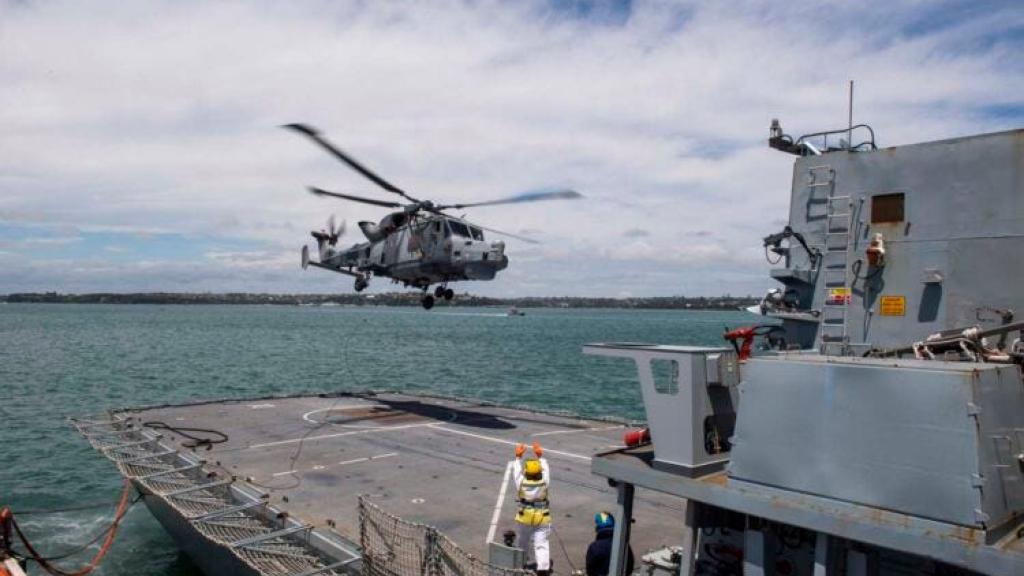
We, the undersigned organisations, are deeply concerned over the recent military escalation in the Caribbean and the aggression against Venezuela by the imperialist US.
We strongly condemn the US military deployment in the Caribbean and its military build-up and operations in the Caribbean Sea, blowing up boats and resulting in extrajudicial killings. The military build-up in the Caribbean under the pretext of combating drug trafficking and “narcoterrorists” since August 2025, is the latest attempt of the imperialist US to conduct a regime change operation in Venezuela. The intention of the imperialist US is clear, which is to remove the current Venezuelan government led by Nicolás Maduro, to reverse the gains of the Bolivarian Revolution, and to restore the pro-US oligarchical rule in the country, in order to serve the geopolitical interest of the imperialist US. Seizing Venezuela’s oil deposits, one of the largest in the world, is a critical consideration, demonstrated by the recent US seizure of a Venezuelan oil tanker.
The Venezuelan people already suffer dire economic conditions due to the sweeping sanctions imposed by the US in 2019.
The people of Venezuela have every right to defend their sovereignty and to determine their own path of development, without any intervention from foreign imperialist powers.
Hence, we call for:
- Stop US attacks on Venezuela!
- Stop the US military operations in the Caribbean.
- Stop all US interference and interventions in Latin American domestic politics.
- Shut down all US military bases overseas.
We stand in solidarity with the people of Venezuela in defending their sovereignty, free from imperialist intervention.
Initiated by:
- Parti Sosialis Malaysia (PSM), Malaysia
- Partido Lakas ng Masa (PLM), Philippines
Endorsed by:
- Organisasi Kaum Muda Sosialis, Indonesia
- Partai Pembebasan Rakyat, Indonesia
- Perempuan Mahardhika, Indonesia
- Perserikatan Sosialis, Indonesia
- Pusat Perjuangan Mahasiswa untuk Pembebasan Nasional (PEMBEBASAN), Indonesia
- Safety Indonesia, Indonesia
- Aliran, Malaysia
- Gabungan Marhaen, Malaysia
- GEGAR (Gerakan Gabungan Anti-Imperialis), Malaysia
- Islamic Renaissance Front, Malaysia
- Malaysian Consultative Council of Islamic Organizations (MAPIM), Malaysia
- MANDIRI, Malaysia
- Parti Rakyat Malaysia (PRM), Malaysia
- Pemuda Sosialis, Malaysia
- Saya Anak Bangsa Malaysia (SABM), Malaysia
- Bukluran ng Manggagawang Pilipino, Philippines
- Philippines Venezuela Solidarity Network (Phil-Ven-Sol), Philippines
- SANLAKAS, Philippines
- WomanHealth Philippines, Philippines
- People's Democracy Movement of Thailand (PDMT), Thailand
- Socialist Worker Thailand, Thailand
- Southern Peasant Federation of Thailand (SPFT), Thailand
- Socialist Alliance, Australia
- Communist Party of India (Marxist-Leninist) Liberation, India
- Haqooq Khalq Party, Pakistan
- International Strategy Center, Republic of Korea
- Dindeng, Southeast Asia
Add your organisation's name to the statement by filling out this form.
(Updated) Statements: US hands off Venezuela, Colombia and Latin America
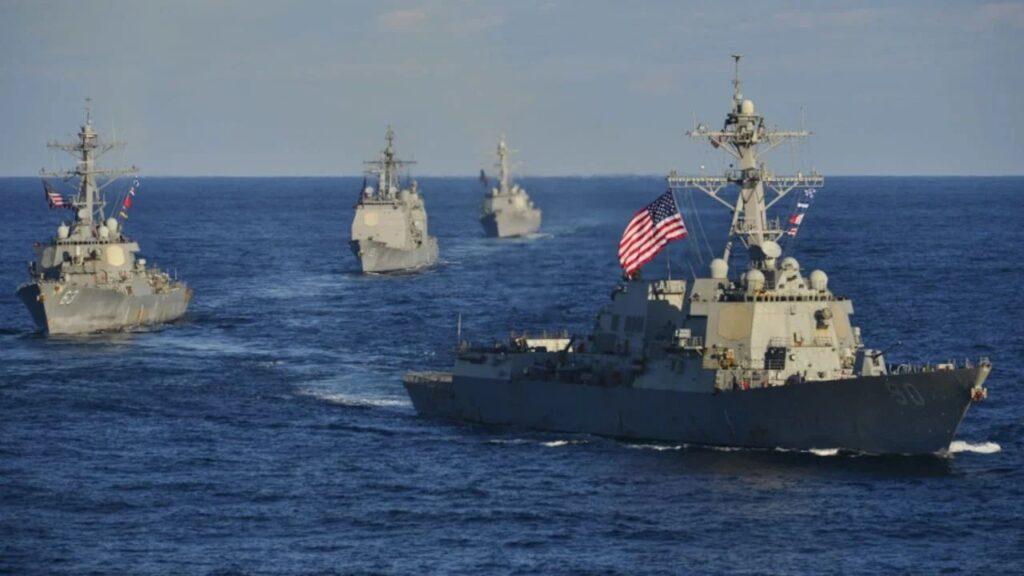
Socialist Alliance: Labor must condemn US aggression in Latin America
The Socialist Alliance National Executive adopted the following statement on November 20.
Supporters of peace, democracy and justice must demand that the Australian government call on the United States to stop its military intimidation and threats of intervention in Venezuela, Colombia and Mexico, and immediately withdraw its military deployment throughout the region.
The maverick United States President Donald Trump has floated a number of illegal intervention plans, as well as saying he may also talk with Venezuelan President Nicolás Maduro.
For more than two months, the US Southern Command has been targeting and killing predominantly Venezuelan and Colombian civilians in the Caribbean and Eastern Pacific Ocean.
The US alleges it is engaged in an anti-drug trafficking operation in international waters, by going after small ships. On November 17, it killed three more people in the Eastern Pacific Ocean, bringing the number of deadly attacks since early September to 21. More than 80 civilians have been killed.
No US agency or international body has produced evidence of drug production and distribution being concentrated in Venezuela or linked to Maduro. And even if boats were carrying drugs, summary executions are still illegal.
The US state department announced on November 17 it will designate Cartel de los Soles as a terrorist organisation on November 24.
It accused Maduro of leading the cartel, which it said supplies drugs to the US and Europe. It added that such a designation will give it the right to strike inside the country, and it has given its military immunity from prosecution.
Trump has also threatened Colombia and Mexico with the same treatment.
The Venezuelan, Colombian and Mexican governments have rejected the US’ accusations, with the former saying it is winning the war against drug trafficking, especially since 2005 when it expelled the US Drug Enforcement Agency.
This week the US moved its most lethal aircraft carrier, the USS Gerald R Ford, into the Caribbean Sea under the pretext of stopping the narcotics trade. “Operation Southern Spear” includes about 12,000 people on about 12 ships, the largest build-up of US firepower in the region in some time.
Maduro has publicly urged Trump to address his own country’s myriad social and economic problems and stop intervening in Venezuela’s internal affairs. Mexican President Claudia Sheinbaum has condemned Trump’s threats, as has Colombian President Gustavo Petro.
For decades, Washington has considered it has the right to intervene in Latin American countries’ affairs. Venezuela has been a particular target ever since revolutionary leader Hugo Chávez became president in 1998; the US imposed crippling sanctions on the country in more recent years.
Meanwhile, the Australian Labor Party has said nothing about the US’ illegal strikes or cautioned its ally about respecting countries’ national sovereignty, including those with which it disagrees.
Socialist Alliance calls on federal Labor to stand with the people of Venezuela, Colombia, Mexico and the Latin American and Caribbean region. This requires demanding the US respect international law, lift the sanctions on Venezuela and end its military deployment intimidation campaign in the region.
Trump’s Looming “Forever War:” Hands off Latin America and Venezuela!
This statement is by the United Left Platform. We are an initiative of a group of revolutionary and independent socialist organizations to actively seek opportunities for joint work given the unprecedented authoritarian assaults facing the left, oppressed communities, and the working class as a whole, in the U.S. and internationally. We are united by a commitment to political independence, a strategic focus on social struggle and mass action, and democratic organizing in all our efforts. The organizations of the ULP are: International Marxist Humanist Organization (https://imhojournal.org), Socialist Horizon (https://socialisthorizon.org), Solidarity (https://solidarity-us.org), Speak Out Socialists (https://speakoutsocialists.org) , Tempest Collective (https://tempestmag.org) , and Workers Voice (https://workersvoiceus.org).
The present moment is exceptionally dangerous for the nations and peoples of Latin America — and for communities across the United States. The actions of the U.S. government put us all at risk.
While the Trump regime’s murderous bombing of small boats in the Caribbean and Pacific Ocean are world-class crimes in their own right, they are not happening in isolation. They openly signal Trump’s and his administration’s intention to wage war on Venezuela, in order to install a pro-U.S. puppet regime in that country — or to compel the existing government to surrender Venezuela’s oil resources to U.S. corporate exploitation.
The pretext for the boat bombings is a transparent lie. Venezuela does not produce fentanyl, which is responsible for most U.S. drug-related deaths, and less than 10% of the illegal drugs that enter the U.S. go through Venezuela. These murders are not about “stopping narco-terrorism,” they’re about displaying imperial power to assassinate at will without even the appearance of arrest or trial.
They’re also intimately connected to the same contempt for judicial process or “rule of law” happening in U.S. cities and towns, where masked terrorist gangs called Immigration and Customs Enforcement (ICE) snatch and disappear people off the streets, work sites, stores and day care centers in immigrant communities, treating their people as subhumans without rights or recourse.
The racism of this campaign is undisguised. At the same time that Trump is assaulting Venezuelan asylum seekers and reducing refugee admissions to zero for 2026, he’s making an exception to bring seven thousand white Afrikaners into the USA on the absurd pretense of “white genocide” in South Africa.
The big, beautiful resistance rising up against ICE raids in our communities needs to be joined by antiwar mobilizations to stop Trump’s assault on Venezuela and Latin America. Trump ran for president deceptively promising his MAGA base that he would end the United States’ “forever wars.” In office, he’s not only continued a Israeli-U.S. genocide in Gaza, he’s now pursuing a course that would produce continental chaos in Latin America.
The Trump gang’s goal is not only crushing whatever hopes remain from the early 2000s “Bolivarian Revolution.” It aims to isolate Colombia’s moderately progressive government, strengthen Trump’s alliance with the far-right regime of Argentina, and embolden the military forces hoping to restore neo-fascist rule in Brazil under Trump’s friend Jair Bolsonaro.
The Maduro government in Venezuela is repressive and unpopular. Despite its claims, it does not sustain a socialist economy. We are not supporters of this regime. Along with the crippling criminal sanctions imposed by U.S. imperialism on Venezuela, Maduro shares some responsibility for the catastrophic economic situation and social calamity which has driven millions of Venezuelans to leave the country.
Any regime change imposed by imperialism would only worsen this catastrophe. We demand “Hands Off Venezuela,” “End All U.S. Sanctions,” and we speak out in solidarity with the people of Venezuela and their right to national sovereignty and to organize for democratic rights in their country.
We understand that for the militarist-neocon wing of the Republican cult, notably Trump’s Secretary of State and National Security Advisor Marco Rubio, Venezuela is an initial target toward the longtime fantasy of regime change in Cuba, to complete the restoration of U.S. capitalist hegemony in Latin America.
How far will any of this go? In essence, as far as Trump and the far right are allowed before popular resistance stops them. Only mass mobilization of antiwar action in the form of protests, strikes, and direct action can stop the imperial war machine and Trump’s illegal and unconstitutional ICE terror and monstrous deportations.
These are not separate struggles. Blowing up boats in Caribbean and Pacific waters is not a sideshow, but a display of imperial-presidential arrogance and impunity with appalling implications for the hemisphere and the world. We call on all social movement and labor activists, unions, community and your organizations in the United States to oppose all U.S. aggressions against Venezuela, and be ready to take the streets in mass to defend the right of self-determination of the Venezuelan people.
From Venezuela to Gaza to US: Trump’s wars against the people
Solidarity National Committee, November 4, 2025
The serial murders committed by the Trump regime in blowing up small boats in the Caribbean and Pacific Ocean, on the untested and almost certainly false claim that these are “drug smuggling vessels,” are world-class crimes in their own right. At this writing the victims of these assaults number over 60, with no accountability and no end in sight.
It is an astonishing sign of our times that these atrocities receive so little outrage, blending into the background noise of the daily crimes against humanity perpetrated by this administration both globally and at home. We need to look more closely at the extreme menace they represent.
First, Trump’s intention to wage war on Venezuela, in order to install a pro-U.S. puppet regime in that country, is out in the open. This scheme is supposed to be accomplished through some combination of CIA operations that Trump boasts he’s authorized inside Venezuela, economic strangulation, and possibly direct military action if it’s not feasible to organize an internal coup. (Alternatively, though less likely, U.S. imperialist goals might be achieved through massive economic and political concessions by the Maduro regime, particularly regarding access to Venezuela’s oil resources.)
Second, the goal is not only crushing whatever hopes remain from the early 2000s “Bolivarian Revolution.” More strategically important, it aims to isolate Colombia’s moderately leftwing government, strengthen Trump’s alliance with the far-right regime of Argentina, and embolden the military forces hoping to bring back the days of neo-fascist rule in Brazil under Trump’s friend Jair Bolsonaro — whose pardon he’s demanding as a price for lifting punitive tariffs on Brazil’s exports to the United States.
No doubt the U.S. temptation to intervene is strengthened by the fact that the Maduro government is repressive and unpopular. This kind of gunboat-diplomacy scenario is not so attractive to Trump’s MAGA base, to which he deceptively promised no more “endless wars” and Iraq-scale chaos that would likely ensue. It does represent, however, the perspective of the militarist-neocon wing of the Republican cult, notably Trump’s Secretary of State and National Security Advisor Marco Rubio.
For Rubio, Venezuela is only the initial target. He has long fantasized of bringing about regime change in Cuba to complete the project of restoring the order of U.S. capitalist hegemony in Latin America.
Trump’s terror bombing of the boats not only satisfies his well-known personal insecure masculinity. It serves more importantly as a test of how far he might be able to go – bombing Venezuelan targets, assassinating officials, kidnappings? – before finally meeting Congressional or court resistance which so far is largely absent.
Third, we have to understand Trump’s crimes in the Caribbean in a much broader global scenario.
After boastfully campaigning for the Nobel Peace Prize, Trump like his wretched predecessor Biden is enabling Israel’s genocide in Gaza to carry on under the thin veil of the ceasefire agreement, which the Netanyahu government, of course, never had any intention to respect.
Trump dispatched his acolytes Kushner, Witkoff and vice-president Vance as “Bibi-sitters” to keep Netanyahu within the boundaries of behavior that prohibit his outright cancellation of the ceasefire – something the Gulf kingdoms can’t tolerate in the face of popular anger in the Arab world. But so long as the ceasefire remains formally in place, the Israeli state can use any pretext for daily bombings that often kill as many Gazans as during the full-scale war.
Israel blatantly holds back essential food, medicine and essential supplies from the population of the utterly destroyed Gaza Strip, with cold weather soon setting in. The brutal military-settler destruction of Palestinian life in the West Bank continues without interruption, unconstrained by Trump’s pronouncements that Israel will not officially annex the territory, at least not yet.
So Trump’s imperialist crimes in the Caribbean are not to be considered separate from Washington’s total indifference to the genocide of the Palestinian people. And this is not the total picture either. The dismantling of USAID, for example, means that desperately needed assistance is not available for the survivors of the climate-change Hurricane Melissa catastrophe in Jamaica, Haiti, the Dominican Republic and Bermuda, or mass starvation in Sudan.
On the surface, the United States may seem not to be responsible for the carnage in Sudan. In reality, however, it’s a major U.S. strategic Middle East ally — the United Arab Emirates — that funds the Rapid Support Forces perpetrating the full-scale genocide in Darfur.
Fourth, Trump’s war on the world’s people is very much part of the same brutal assault his regime is waging against the U.S. population. Can blowing up boats in international waters be a test not only for the possibility of bombing Venezuela, but perhaps also lethal force against U.S. dissident populations?
Masked and unaccountable ICE and Border Patrol gangs roam the streets of U.S. cities, kidnapping and disappearing non-citizen and sometimes citizen residents as well, manhandling protesters, pepper-spraying bystanders and indeed police officers. If that doesn’t produce mass deportations on a sufficient scale, as it probably is not, Trump says he will deploy the National Guard and the military itself to carry out deportations and crush protests.
There must be immediate demands, obviously, for “ICE Off Our Streets” and, in particular, to stop the horrendous deportation of refugees from Venezuela’s collapsing economy and the desperate situation in Haiti (while Trump says he’ll gladly welcome seven thousand white Afrikaners from South Africa and eliminate all other refugee admissions).
At the same time, the right wing with astonishing speed is wiping out many central victories of the U.S. civil rights revolution, including voting rights and protections from job and housing discrimination as well as police brutality.
Under cover of the government shutdown, millions of people are about to lose access to essential food support and health care. And the federal government itself is being stripped of precisely those functions that provide actual services that people really need, while enhancing the military and the apparatus of repression.
How far will any of this go? In essence, as far as Trump and the far right are allowed before popular resistance stops them. How that can be accomplished is an entire set of strategic challenges — for the immigrant defense and Palestine solidarity movements, for mobilizations against the war on Latin America, for defense of democratic rights and, crucially, for the labor movement that must ultimately play a central role.
What must be clear from the outset is that these are not separate struggles. Blowing up boats in Caribbean and Pacific waters is not a sideshow. It is a display of imperial-presidential arrogance and impunity with appalling implications for us all.
Trump: hands off Venezuela and Latin America!
Executive Bureau of the Fourth International, October 17, 2025
Economic blackmail and threats against Brazil, Colombia, Mexico, and Argentina are part of a new phase in US policy toward Latin America. But the greatest danger falls on Venezuela, whose government Trump is determined to overthrow. The deployment of 10,000 soldiers, a massive arsenal in the Caribbean, and attacks that have already killed more than 60 rafters threaten not only Venezuela but the entire region. It is the urgent duty of activists around the world to raise their voices and mobilize against US interventionism under Trump.
Unprecedented military deployment in the Caribbean
The central target of the US offensive is undoubtedly Venezuela. With unprecedented stridency and brazenness, the imperialist leader and his secretaries of state and war, Marco Rubio and Peter Hegseth, have already decreed that criminal drug cartels are "terrorist organizations", considered Maduro as the head of a cartel that does not exist (the Soles cartel), and offered a $50 million reward for information leading to the capture of the Venezuelan.
Most threateningly, they have deployed around 10,000 marines to the Caribbean, with aircraft carriers (the largest in their navy), torpedo boats and nuclear submarines, warships equipped with medium-range missiles, B-52 bombers, and the technological capacity for large-scale data analysis, in a maneuver defined by geopolitical experts as a "seismic realignment." Puerto Rico has been remilitarized, and military cooperation agreements with Caribbean countries have been used to build an army infrastructure that appears to precede a large-scale attack on the country that was the scene of the great Bolivarian revolution. Over the past two months, these forces have carried out seven attacks on rafters (alleged traffickers), resulting in 46 deaths and two arrests.
On October 15, in a move unprecedented even during the Cold War (CIA operations were secret), Trump announced that he had authorized the Central Intelligence Agency to carry out operations in Venezuela. According to the Washington Post, the president signed a document authorizing the CIA to carry out covert operations in foreign countries, ranging from clandestine information gathering to training opposition guerrilla forces and carrying out lethal attacks.
On Sunday, October 19, in a further escalation, US forces carried out a deadly attack against what was supposedly a ship belonging to Colombia's ELN group in the waters of the Pacific Ocean. In response to Gustavo Petro's justified protest, Trump insulted the Colombian president as a “drug trafficker" and head of "a weak and very bad government," threatening, as usual, with tariffs and funding cuts, while at the same time revoking the US visas of Petro, his family, and his advisors. While Petro recalled the Colombian ambassador to Washington, Trump said at a press conference — in response to a journalist — that he does not need a declaration of war for his operations against trafficking in what he considers his waters. "We go there and we kill them."
Trump's top advisers are reportedly urging him to invade Venezuela to overthrow Maduro, according to open speculation in the US. Of course, the awarding of the Nobel Peace Prize to the far-right Venezuelan leader María Corina Machado — which, if it weren't serious, would be one of the worst jokes of our time – is part of a deliberate plan to reinforce what the hawks see as the alternative to Maduro. The Trump administration appears to be forcing a transition to a far-right government led by Edmundo González Urrutia and María Corina, who has already called for sanctions against Venezuela, without any concern for their effects on the impoverished population and is now handing over the fate of the nation to the boots of Yankee soldiers.
It may seem unlikely that the US would invade by land countries whose governments it accuses of complicity in drug trafficking, such as Venezuela, Colombia, or Mexico itself. A prolonged ground invasion would meet with strong resistance from the armed forces under Maduro's command, possibly with widespread support and sympathy in the region, meaning a new and closer Iraq. Entering a war of this magnitude contradicts Trump's rhetoric to his domestic audience, to whom he has promised to "end the wars." Furthermore, there are signs of opposition to such a solution from sectors of the US military high command, as evidenced by the early resignation of the head of the Southern Military Command, Admiral Alvin Hosley, on October 16.
In any case, prudence dictates that we should not rule out the possibility of any warmongering "madness" on the part of the neo-fascist leader. At the very least, based on his rhetoric, he may opt for drone or aircraft attacks against specific targets in Venezuela in a continued attempt to weaken the government.
A return to the past
Since the first days of his return to the Oval Office of the White House, Donald Trump, emboldened by his neo-fascist hawks, has kept Mexico under heavy tariff and police-military pressure (so that the Sheinbaum government will stop the flow of migrants at the border and combat local drug cartels). CIA drones fly over Mexican territory in the supposed search for cocaine and other drug laboratories.
Trump has meddled in Brazil's internal politics to defend his friend Bolsonaro, convicted of attempted coup (imposing 50% tariffs on Brazilian exports to the US and opening a trade investigation against Brazil's timid policies to restrict US big tech companies). Not even Argentina, governed by his compadre Javier Milei, escapes threats and blackmail: in mid-October, commenting on a new US$20 billion loan from the IMF to the country, Trump conditioned his continued support for the Southern neo-fascist libertarian on a victory for Milei's party in the October 26 parliamentary elections, in which the possibility of the president's neo-fascist coalition finally controlling Congress is at stake (with low chances). "If [Milei] loses, we are not going to be generous with Argentina," Trump said. The episode points to the normalization of the rhetoric and practice of the US government's direct interference in the internal political affairs of sovereign states. (It seems that Trump's move was one of the factors explaining the Milei administration's victory in the elections.)
The combination of gestures, punitive rhetoric, and enormous military deployment constitutes an attack on Latin American neighbors not seen since the invasion of Grenada in 1982. In the context of the substantive change that Trump's White House is imposing on the global power relations that have been in place for the last eight decades, US policy toward Latin America is taking a turn toward the interventionist past of military aggression and open political interference that had already marked the imperialist power's treatment of the entire South during the Cold War.
A call for international anti-imperialist solidarity
The accusation that Maduro and senior Venezuelan government officials are members of cartels, stupid as it is, seeks to justify the violation of the principle of self-determination of peoples and the territorial sovereignty of Venezuela. There is an unprecedented warmongering offensive in the region, which must be forcefully rejected by socialists, social activists, and progressive sectors, regardless of what they or we think about the government of Nicolás Maduro, its anti-worker, anti-popular policies, and its anti-democratic drift.
It is time to call on the democratic, anticolonial, progressive, and revolutionary forces of the world, and of the region in particular, to defend the territorial integrity of Venezuela, the Caribbean countries, and all of Latin America in the face of attempts at military or political intervention, that is, attempts to define "from above and outside" (read: in the Oval Office) the political course of sovereign countries. It is the Venezuelan people who must decide on their government, without any interference. It is the sovereign peoples of Latin America and all corners of the globe who must decide on their tyrants, their parliaments, and the trials in their judicial systems.
We must demand that the governments of Lula, Petro, Boric, and Sheinbaum do their utmost to prevent any possibility of military aggression and political intervention in Venezuela. It is positive that Lula offers himself as a “mediator,” as he did in his meeting with Trump, but all these governments must be vehement and even repetitive in rejecting any US initiative against Venezuela.
The Fourth International's solidarity with Venezuela includes demanding that Maduro restore political freedoms for the social movement, the left, and the workers of Venezuela. This is the path, together with legitimate popular military mobilization, to build genuine national and regional unity against imperialist aggression. Only the broadest unity of action can contain, resist, and defeat the ongoing aggression.
US troops and weapons out of the Caribbean Sea!
No more bomb attacks!
Demilitarize Puerto Rico now!
US hand off Venezuela and Latin America.
Oppose Trump’s Attacks on Venezuela!
International Marxist-Humanist Organization, October 27, 2025
The latest chapter in the U.S.’s effort to impose regime change on a sovereign country may unfold any day now, as the Trump administration prepares for a military intervention against Venezuela.
In the Caribbean, the U.S. Navy has deployed a fleet of destroyers, amphibious ships, a nuclear submarine, Tomahawk missiles, and advanced radar and 10 F-35 fighter jets, the most advanced in the U.S. military aircraft. And on October 24, the administration sent the USS Gerald Ford aircraft carrier toward Venezuela, supported by 27 other vessels, all this in preparation for launching a direct attack.
The stage began to be set for this on September 2, when Trump ordered the U.S. military to destroy a boat off the coast of Venezuela, killing all 11 on board, on the grounds that it was trafficking drugs destined for the U.S. No effort was made to stop, board, or search the vessel—this was shoot first and ask no questions later. The same is true of the 10 additional boats destroyed (as of this writing) that have killed 43 people in total.
The Trump administration has not supplied a shred of evidence that drugs were on board or that the ships were commanded by drug gangs. Nor would there be much reason to bomb them even if that were not the case: Venezuela does not produce fentanyl, which is responsible for most drug-related deaths in the U.S., and the vast majority of drugs that enter the U.S. are shipped through the Pacific Coast, not the Caribbean (less than 10% of the illegal drugs that enter the U.S. go through Venezuela).
In fact, these attacks have nothing to do with stopping the drug trade. They are aimed at providing a pretense for removing President Nicolas Maduro from power in Venezuela and imposing a far-rightwing government upon it. Trump aims to do by using the same mechanism the U.S. has utilized for two centuries in Latin America — overt as well as covert military intervention.
As we have argued elsewhere, Trump is not an isolationist. Faced with the U.S.’s setback in the 2003 Gulf war and the failure of its 20-year war in Afghanistan, he — like his counterpart Vladimir Putin when it comes to Russia — is seeking to solidify control over the U.S.’s “spheres of interest” in what has become an increasingly multipolar world. And there is no sphere of interest that is more important to the U.S. than Latin America.
Trump already wanted to overthrow Maduro’s regime during his first administration. Instead, he did something that was no less egregious — in 2017 he cut off all oil imports from Venezuela (at the time a major source of U.S. oil) and imposed sanctions which blocked Venezuela’s access to U.S. and international financial markets. Since oil (like most major commodities) is traded on the world market in dollars, this effectively prevented Venezuela from exporting the bulk of its oil — which made up 94% of its foreign exchange. As a result, Venezuela’s already weakening economy fractured, plunging millions of Venezuelans into dire poverty.
It was this fact, more than any other, that explains the massive numbers of Venezuelans who have fled the country since 2017, with close to a million immigrating (or attempting to immigrate) to the U.S.
Trump’s saber-rattling against Maduro’s regime — which until recently was involved in negotiations with the U.S. to resolve their differences — is directly related to his war against immigrants at home. He has unleased ICE and the Department of Homeland Security against documented as well as undocumented immigrants under the blatantly false charge that they are engaged in “criminal” activity. Thousands of working-class and poor Venezuelans have been deported in recent months, and he plans to evict 700,000 more (many of whom were granted residency in the U.S. through the Temporary Protective Status program). Several hundred have been deported to the U.S. concentration camp at Guantanamo Bay and the notorious “Terrorism Confinement Center” in El Salvador.
Here is the madness embodied in Trump’s policies: he creates the conditions that compel many to leave Venezuela and then he punishes the victims of his policies by deporting them to other places to suffer further degradation and torture.
Yet in the eyes of Trump, Secretary of War Hegseth, and fascist White House counselor Stephen Miller, what better way is there to get support for deporting as many immigrants as possible than by tarnishing them with being connected to the drug-dealing Tren de Aragua gang from Venezuela—and on the grounds that the gang is controlled by the Venezuelan government.
In fact, there are no more than a few hundred members of Tren de Aragua in the U.S. InSight Crime, which has tracked the gang for years, has found no evidence that it has organized cells in the U.S. that cooperate with one another or that it receives instructions from abroad. Nor is there evidence that Maduro sent members of Tren de Aragua and other Venezuelan gangs to the U.S., as Trump claims. Tren de Aragua is a horrible group, responsible for violent crimes in Venezuela and elsewhere in South America. But since the Venezuelan military stormed the prison in 2023 that Tren de Aragua controlled, the gang is greatly weakened, not centrally organized, and has no clear political goals.
To dehumanize people in practice, one first must label them as somehow less than human in words. This is what Trump is trying to do by tying Venezuelan (as well as other) immigrants to violent gangs. And a major reason he is going after Maduro is to further bolster this very claim.
Make no mistake about it: it is total hypocrisy to oppose Trump’s war against immigrants at home while not opposing his effort to attack and overthrow the Venezuelan government. The two policies are inseparable.
Trump is not hiding the fact that he is aiming for regime change in Venezuela. His preferred replacement is Maria Corina Machado, a far Rightist who sought to run against Maduro in the most recent presidential election but was prevented by him from doing so. She is a long-time supporter and advocate of Trump who has been calling for the U.S. military to violently overthrow its government for years. Not only that; she supports Trump’s deportation of Venezuelan immigrants and defends his decision to send some of them to Guantanamo Bay and El Salvador. This has alienated her from many former supporters of hers in Venezuela.
How ironic then that the committee that decides the Nobel Peace Prize picks this as the moment to give her the award. Machado is no friend of peace. She is a product of the oligarchy that ran Venezuela for decades prior to the ascent of Hugo Chavez to the presidency, and she has allied herself with some of the most reactionary political forces in the Americas. Her getting the Nobel Prize for Peace only makes Trump’s work easier.
We must say loud and clear — NO to U.S. intervention in Venezuela! NO to any effort to overthrow of the Venezuelan government! NO to the deportations of immigrants, whether from Venezuela or anywhere else! And NO to the dehumanization of those victimized by past and present U.S. foreign and domestic policies!
Our firm support for these demands does not imply political support for the present-day policies of the Venezuelan government.
But whatever one thinks of them, they are NOT the reason for the U.S.’s effort to take military action for the sake of regime change. It is instead about promoting its reactionary drive to dismantle what is left of U.S. democracy, accelerate its war on immigrants, and violently impose U.S. imperial control over Latin America.
There is a long history of U.S. military interventions in Latin America — from William Walker’s effort to conquer Nicaragua in the 1850s to Theodore Roosevelt's seizure of the area that became the Panama Canal from Colombia, and from JFK’s Bay of Pigs invasion of Cuba in the early 1960s to Nixon’s complicity in overthrowing Allende’s government in Chile a decade later. U.S. imperialist interventions never end well, and neither will this one, if allowed to go forward.
Against U.S. military aggression on Venezuela and all imperialist presence in Latin America!
Various
A US fleet has been deployed in the Caribbean Sea off the coast of Venezuela. With Trump’s unilateral declaration of “war on drug trafficking”, his administration has claimed the “imperialist right” to intervene militarily.
A direct political-military objective is regime change in Venezuela. He has declared President Maduro a “narco-terrorist” and put a $50 million bounty on his head. Trump considers himself the “sheriff” of the Caribbean and Latin America. In a matter of weeks, he has established a semi-naval blockade off Venezuela and sunk three boats, killing more than 30 crew members, accusing them of being drug traffickers. He has just sunk two more boats off Colombia and Trinidad, where survivors and relatives have proven that they are artisanal fishermen.
Trump wants to assert U.S. “rights” over what he considers its “backyard” in Latin America. To this end, he is resorting to the —never entirely abandoned — policy of the “big stick” and the diplomacy of “gunboats” (and nuclear submarines, and the “authorization” of direct attack operations on Venezuelan territory).
This is part of the struggle between capitalist monopolies, particularly against China, which in recent years has made advances in international trade with Latin America. The United States remains the main direct “investor” in Latin America (38%), followed by the European Union (16%) and, quite a bit further behind, China, which is even in decline. But commercially, China is the main destination for many Latin American exports (such as Brazil, Chile, and Peru). Latin America has become increasingly dependent on agricultural and raw material exports (Chile and Peru on copper, Brazil and Argentina on soybeans, Venezuela on oil, etc.) and imports of manufactured goods. But the money it receives from its exports is not invested in industrialization or economic development or in solving the acute social problems of the working masses. It goes directly into the pockets of the oligarchies and to pay the “external debts” to the IMF and US and European imperialist finance capital.
Trump uses the ongoing economic war against China (and Russia) to tighten the screws throughout Latin America and dictate his policies. He wants to gain economic advantages and advance greater military dominance. This militaristic and fascist-oriented offensive also scapegoats poor Latino immigrants in the US who are expelled militarily. His plan of militarism and economic warfare is accompanied by growing internal militarization, which does not stop at mass arrests of migrants, but includes the deployment of troops in most of the country’s major cities. The working class of the US itself is a central military target of Trump’s offensive.
The US AFL-CIO trade union leadership has also been involved in supporting US military interventions in Venezuela, Latin America and throughout the world through the government funded AFL-CIO “Solidarity Center”. We call on US workers to reject the pro-imperialist policies of the AFL-CIO leadership who have also supported the trillion dollar military budget of the US government. US workers and unionists must link up directly with workers in Venezuela, Latin America and around the world in opposition to their own capitalist ruling class who are threatening the working class of the world.
We are against US imperialist action. We reject its military threats and demand the immediate withdrawal of the US fleet from Latin American waters. The US has some 800 bases around the world: 9 in Colombia, 8 in Peru, 3 in Mexico, 3 in Honduras, and 12 in Puerto Rico! The people of Puerto Rico have responded to the announcements with growing mobilizations that are a resurgence of the questioning of their status as a direct US colony. The US has reinstalled troops in the Panama Canal and is pushing for the installation of bases in new countries such as Brazil and Argentina.
In its hybrid war of economic and military measures, it has promoted a plebiscite for November 11 in Ecuador to “legalize” the reinstallation of military bases that had been closed years ago. The U.S. has lent $600 million to the Noboa government, which is facing a general strike against fuel price increases and other anti-popular measures, and has announced that it will lend it another $5 billion if the YES vote wins in the referendum.
The same is true in Argentina, where Trump is lending money to Milei’s government (increasing public debt and defending the interests of bondholders) on the explicit condition that his far-right ally wins the elections against growing popular opposition. The US ambassador and other Trump envoys are meeting directly with governors, bourgeois opponents, and union bureaucrats to uphold their economic interests in the country, particularly to advance on lithium and rare earth deposits. Milei has just decreed the entry of US troops into Argentina to participate in joint military exercises with an eye toward “consolidating regional stability,” according to the military in charge.
The US government has pushed through the OAS the formation of a military force, a new Minustah, to intervene in Haiti. It wants Latin American governments to provide soldiers so that it can withdraw its own and carry out adventures against Venezuela and other places.
The Latin American bourgeoisie and a large part of the bourgeois nationalist movements act in a cowardly fashion. Maduro has proposed negotiating with Trump for US free access to concessions, such as those already held by Chevron, on Venezuelan oil (the world’s largest reserve). Trump has rejected this because he wants regime change. He is working to divide the regime and its armed forces. He has launched a global propaganda campaign that culminated in the appointment of his ally, the right-wing Venezuelan leader Corina Machado, as a Nobel Peace Prize laureate. Corina Machado participated in the coup attempt against Chávez in 2002 and has always called for economic sanctions against Venezuela and even direct US military intervention.
We oppose imperialist intervention and militaristic aggression aimed at regime change, but we do not give political support to Maduro and his corrupt, repressive circles against the working people. It is necessary to arm the workers, nationalize Yankee and imperialist companies, banking, and foreign trade, under workers’ control.
The BRICS allow the development of this imperialist military threat against Venezuela, just as they allowed Trump and Netanyahu’s genocide against Gaza. Brazil has positioned an army on the borders of Venezuela. The Latin American bourgeoisies remain silent. At best, they try to explain to Trump that he is “wrong,” as Petro of Colombia has done.
It is young people and workers who are mobilizing against the imperial powers and their policies of austerity and imperialist war in Peru, Paraguay, Uruguay, and Argentina. More than 7 million Americans (from all communities) demonstrated on October 18th in 2,000 cities across the US against Trump’s fascist actions. Let us unite our strength.
U.S. imperialism out of Venezuela, Panama, Ecuador, and all of Latin America! Immediate withdrawal of all naval and air forces from the Caribbean!
End the persecution of Latinos living in the US; no more persecution of immigrants!
Out with the IMF. No to the payment of usurious foreign debts!
No more imperialist interference in Latin American nations!
¡Fuera Yankis de Venezuela y de América Latina!
Independence for Puerto Rico. UK out of Islas Malvinas.
Workers of Latin America and the World unite, for the Socialist Unity of Latin America and the World!
First signatories:
KA – Communist Liberation (Greece)
PO – Workers Party (Argentina)
SEP – Socialist Workers Party (Turkey)
SWP – Socialist Workers Party (Great Britain)
TIR – Revolutionary Internationalist Tendency (Italy)
UFCLP – United Front Committee for a Labor Party (United States)
WCP-H – Workers Communist Party of Iran- Hekmatist (Iran)
Tribuna Classista (Brazil)
Comunistas (Cuba)
Fuerza 18 de Octubre (Chile)
Revolutionary Left Current (Syria)
Internationale Socialister (Denmark)
DSIP – Revolutionary Socialist Workers Party (Turkey)
GAR – Revolutionary Action Group (Mexico)
Workers Solidarity (South Korea)
SEK – Socialist Workers Party (Greece)
Linkswende (Austria)
Marx21 (Spanish State)
Marx21 (USA)
Pracownicza Demokracja -Workers Democracy (Poland)
Solidarity (Australia)
Internasjonale Sosialister (Norway)
International Socialists (Botswana)
Movimiento Anticapitalista (Peru)
International Socialists (Canada)
Sozialismus von Unten (Germany)
Revolutionäre Linke ( Germany)
Socialistická Solidarita (Czech Republic)
Crvena Akcija/Crvena Inicijativa – Red Dawn/ Red Initiative (CA/CI), Croatia/Serbia
Socialist Workers League (Nigeria)
Socialist Workers Network (Ireland)
Joint socialist statement on U.S. attacks on boats in Latin America
Socialist Workers Unity (Venezuela), Socialist Workers Party (Colombia) & Workers’ Voice (USA), October 30
We, revolutionary socialist workers’ organizations from Venezuela, Colombia, and the United States, completely condemn the unjustifiable murders of sailors and fishermen from Venezuela, Colombia, and Trinidad by the U.S. Navy. Likewise, we condemn the disgusting, deadly threats and provocations by the Trump administration against the peoples of Venezuela and Colombia, which constitute an imperialist attack and a mortal danger to the entire Latin American region. The Trump administration has acknowledged 14 attacks on vessels suspected of drug smuggling from South America, in which, according to The New York Times, at least 57 people have died, including the attacks on Monday, Oct. 27, 2025, which left 14 people dead.
The claims that this is a “war on drugs” are just an excuse for a morally bankrupt imperialist maneuver. There has been no evidence that those killed by the U.S. in recent weeks were drug traffickers — and even if they were drug traffickers, it does not justify their random killing by a military fleet. The history of U.S. interventions shows that its policy has no intention of combating drug trafficking. On the contrary, U.S. federal agencies have collaborated with drug cartels in Mexico and Colombia, and their interventions have not served to stop trafficking, but to reorganize it under US control.
By accusing Nicolás Maduro, and more recently Gustavo Petro, of being involved in the drug trade without providing any evidence, Trump is clearly preparing an excuse for military intervention against Venezuela, and possibly also against Colombia. For his part, Trump’s attempt to portray Maduro and Petro as immoral and illegal “drug leaders” ignores his own government’s and previous U.S. administrations’ involvement in drug trafficking, as well as their personal connections to the notorious sex trafficker Jeffrey Epstein.
Neither Trump nor any other U.S. president has the moral authority to denounce presidents or even entire countries in Latin America as traffickers of any kind. The U.S. government’s intent is to use “gunboat diplomacy” — which can lead to full-scale invasion — to advance an imperialist policy of plunder and oppression against all the peoples of the Americas.
In the United States, we recognize how these imperialist attacks are directly linked to the Trump administration’s attacks on the American working class, as well as to the long history of U.S. interventions against Latin America and the working class in general. We need mass mobilization to stop it in its tracks, and to cancel without compensation all the neocolonial debts controlled by the U.S.
As socialists organizing in the United States, Venezuela, and Colombia, we recognize that we need to mobilize to confront the imperialist war machine with the power of the organized working class. We owe no loyalty to the bourgeois governments of Maduro and Petro.
In Venezuela, we know that Maduro is not a socialist, that he keeps his people mired in poverty, and that he is even willing to hand over all of the country’s natural wealth to satisfy Trump’s demands. In Colombia, despite his correct denunciations of imperialist hypocrisy and interference, Petro remains committed to paying the foreign debt and being a global partner of NATO, bound by commitments that keep Colombia under the yoke of imperialism.
Our commitment is to the working classes of Venezuela and Colombia, recognizing that attempts to overthrow Maduro with imperialist military pressure will do nothing to improve the living conditions of the Venezuelan people; any sanctions by Trump against Colombia will affect workers; imperialist interference will only leave countries more impoverished and dominated by imperialism. This is demonstrated by the long history of U.S. military interventions on our continent and around the world.
A military intervention in Venezuela, Colombia, or any other country on the continent ultimately seeks to bring back “big stick” politics, normalizing direct military incursions to overrule our countries’ policies according to the whims of U.S. imperialism and to reinforce the protection of its political, economic, and military interests in a region that is historically strategic for U.S. imperialism, and which it considers its backyard.
For these reasons, in Venezuela, we call for unified political action to defeat the threat of imperialist attacks. The working people need to mobilize in this struggle, and from there move forward and organize to defeat the anti-worker austerity measures of the Maduro government. Meanwhile, in Colombia, we call for the non-payment of the imperialist foreign debt, withdrawal from NATO, and the rejection of any imperialist threats. Throughout Latin America and around the world, we reject imperialist military intervention and demand the withdrawal of the U.S. military presence in the Caribbean Sea and the Pacific Ocean.
We call for the broadest international unity of action, of the working class, the oppressed, and the masses in general, to defeat the imperialist offensive. It is a fact that in the U.S. people are already mobilizing against their government, with 7 million people taking to the streets on Oct. 18, and this popular sentiment needs to be deepened and organized so that it has the strength of the working class to bring about a general strike. In Latin American countries it is necessary to mobilize widely in the same way to defend ourselves both from Yankee attacks and from the masters of our countries who hand us over to these same imperialists. These struggles of our class must also be linked to the struggle of immigrants for the right to live in peace, to join a global struggle against imperialist plunder in general.
Yankee hands off Latin America!
Down with the foreign debt!
Trump must pay for all those killed!
The struggle against imperialism is won through the mobilization and leadership of the international working class!
Latin America under Attack by Yankee Imperialism: For the second national and social liberation!
Revolutionary Communist International Tendency
1. The Trump Administration has declared war against the peoples of Latin America. It has started to deport thousands of migrants in the U.S., it threatens to impose high tariffs on every country which does not subordinate to its wishes, it threatens to invade Panama and to take over the Canal and it threatens to violate the national sovereignty of Mexico by waging cross-border military raids against “drug cartels”.
2. The purpose of the new foreign policy of the White House is to whip up U.S. chauvinism and to intensify the imperialist subjugation and super-exploitation of Latin America — a continent of capitalist semi-colonies.
3. While bourgeois governments — like those of Claudia Sheinbaum in Mexico, of Gustavo Petro in Colombia or José Raúl Mulino in Panama — verbally protest against this imperialist aggression, they fail to organise any serious resistance. They humbly accept to receive the deportation flights from the U.S. or agree to mobilise 10,000 soldiers to the Mexican-U.S. border in order to “combat drug trafficking”. When there was an attempt to have a summit of Latin American states in order to organise a joint response to Trump, the meeting was cancelled soon after its announcement.
4. The Latin American bourgeoisie is divided between those sectors which are servile lackeys of U.S. imperialism (like the right-wing governments of Argentina, Paraguay or Ecuador), those which serve Chinese and Russian imperialism (like Venezuela, Cuba, Nicaragua or Bolivia) and those which try to do business with the Western as well as Eastern Great Powers without annoying one or the other. All of these governments serve the interests of their bourgeoisie resp. their imperialist allies but are enemies of their own people.
5. The Revolutionary Communist International Tendency (RCIT) and its Latin American sections denounce these pro-imperialist governments. We call workers and popular organisations to organise support for migrants in the U.S., to pressurize their governments to resist the Yankees and to prepare their country against a potential U.S. invasion. Furthermore, they should call for the expropriation of U.S. corporations and their nationalisation under workers control. They should also demand a rupture with the IMF, the cancellation of debt payments to imperialist financial institutions and the end of security agreements with the United States that militarize Mexico and Central America under the pretext of the War on Drugs (e.g. the Security and Prosperity Partnership of North America, the U.S.-Mexico Bicentennial Framework for Security (better known as the Merida Initiative) and the Central American Regional Security Initiative).
6. Workers and popular organisations should demand from governments which pretend to resist the pressure of the U.S. to put their words into deeds. While we unconditionally oppose all forms of imperialist tariffs as an instrument of Great Power aggressions, we defend the right of semi-colonial countries to impose tariffs against imports from imperialist countries as a (limited) instrument of anti-imperialist resistance.
Latin America for the Latin American peoples — not for Yankee imperialism!
For the second national and social liberation!
For a socialist federation of Latin America!
No comments:
Post a Comment