Coal Fire Doused on Bulker Loading in India
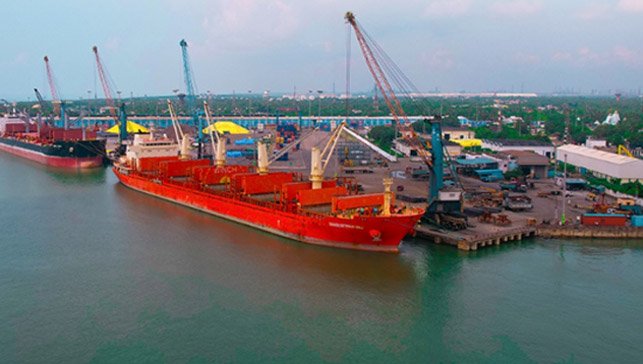
Fire services responded quickly to reports of smoke billowing from a bulker that was loading in the Paradip, India, port over the weekend. They were able to successfully douse the fire without injuries to the crew, but it again raised questions about the handling of the dangerous cargo.
The Greek-owned bulker Eco Colonel, registered in Liberia, had arrived at Paradip on November 27. Over the weekend, the vessel was loading a cargo of nearly 30,000 metric tons of coal for shipment in India. According to the local media reports, smoke was observed coming from one of the vessel’s holds as the coal was being loaded by conveyor belt.
As the smoke grew thicker and more intense, the decision was made to move the vessel, which is 82,000 dwt and 229 meters (751 feet), to another berth within the port to gain better access to the hold. Fire crews began offloading and watering the coal. Port operations were also suspended.
The Paradip Fire Department at the port said that after about two hours, it believed the fire had been contained. They said it was safe to reopen the port. There was minor damage reported to both the vessel and the coal loading conveyor belt.
The Eco Colonel, which was built in 2012, remains at the port as the investigation is ongoing. The authorities are thankful that a port worker quickly alerted the teams to the potential danger and that it could be controlled quickly. They have yet to confirm what caused the fire.
Media reports cite the high flammability of the coal and the danger of spontaneous combustion. Port officials are reportedly looking at the watering of the coal and whether there had been insufficient amounts of water sprayed before the loading. A lack of ventilation in the hold or in the stockpile could also have contributed to the fire.
The dangers of handling and shipping coal were demonstrated in August at the Port of Baltimore when an explosion tore a 30-ton hatch cover off a bulker. The vessel W Sapphire had completed loading and just departed the terminal when a massive explosion shook the ship, followed by a small fire. The force of the explosion hurled a portion of the number two hatch cover into the air and over the side of the ship. Luckily, no one was injured, and the local fire departments and Coast Guard were quickly able to stabilize the situation.
X-Press Pearl Compensation Dispute with Sri Lanka Intensifies
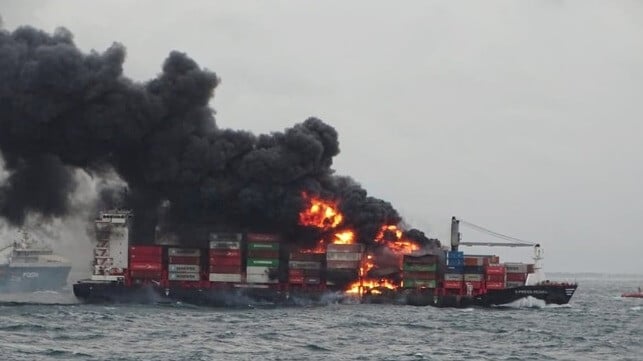
The London P&I Club, acting as assurer to the owners of the MV X-Press Pearl, is intensifying its approaches to the authorities in Sri Lanka over the compensation awarded to cover damage caused by the shipwreck of the vessel off Colombo.
The X-Press Pearl, a newly built containership with a capacity of 2,750 TEU, was owned by Singapore's X-Press Feeders. It was on a voyage eastward bound in May 2021 when at least one container began leaking onto the deck shortly after leaving Jebel Ali. The cargo is believed to have included 25 tons of Iranian-manufactured nitric acid, among multiple classes of other dangerous cargo. The master sought and was denied refuge first in Port Hamad, Qatar, and at its next scheduled port of call in Hazira, India, before sailing on to anchor off Colombo, Sri Lanka, its next scheduled port of call. Off Colombo, a fire broke in Number 2 Hold of the ship, but given the mix of dangerous cargo on board, it has still not been established exactly what the cause of the fire or where the seat of the fire was located.
Reports assert that there were some delays in initially providing the ship with firefighting services and later in permitting the ship to be moved to deeper waters, by which time it was already sinking. The situation was unrecoverable by the time specialist firefighting and anti-pollution vessels and aircraft arrived on the scene, both from Sri Lanka and India. Acids, caustic soda, epoxy resin, plastic pellets, and bunker oil on board were either released or sank in containers when the ship went down, potentially creating a very large plastics spill. Officials indicate that 1,075 tons of debris have been collected from Sri Lankan beaches, along with dead turtles, whales, large numbers of fish, and at least six dolphins. But it is unclear whether what was recovered from the beaches was linked either directly or indirectly to the X-Press Pearl. As a precautionary measure, the Sri Lankan authorities halted local fishing due to fears of acid contamination and also to allow salvage operations to continue safely.
In July 2025, Sri Lanka's Supreme Court ruled in favor of local fishermen in a human rights claim. The finding criticized both X-Press Feeders for not sharing information and the government for not responding effectively enough. Without hearing expert evidence on the quantum, the court set the value of the loss at an arbitrary figure $1 billion, to be paid by the owner as the polluter, with further sums to be calculated by a committee.
X-Press Feeders have financed the clean-up efforts made so far, covering fisheries and beach clean-up, as well as salvage, wreck and debris removal. But, along with the London P&I Club, they have declined to make further payments, asserting that jurisdiction for environmental damage in this case lies in Singapore. Further, they contend that the cost calculations in other areas are largely based on theoretical estimates of damage using unapproved methodologies, which diverge from recorded evidence on the ground. They have referenced impartial technical advice issued by the International Tanker Owners Pollution Federation (ITOPF), which recommends internationally-accepted methodologies for assessing Oil Spill Damage, Nitrogen Added to Ocean, Human Health Air Pollution Impacts, Turtle Damage, Impacts on Whales, Microplastic Related Damages - Fisheries, Microplastic and Chemical Related Damages - Fish Consumers and Beach Users, Fisher Livelihoods, Incurred Costs and Future Monitoring.
The London P&I Club is now seeking the UK government's support to help with opening a dialogue with the Sri Lankan government, which is standing by its judiciary's finding, and is not responding to approaches. Neither the British nor the Sri Lankan government appears to be communicating with the other over the matter.
James Bean, CEO of the London P&I Club told The Maritime Executive that the London P&I Club's position is that a negotiated settlement is in the best interests of the Sri Lankan government and the international maritime community. They report that they are working with X-Press Feeders to achieve a rules-based outcome compliant with the norms of international trade.
No comments:
Post a Comment