ABP and University of Hull Partner to Research Port Safety
[By: ABP]
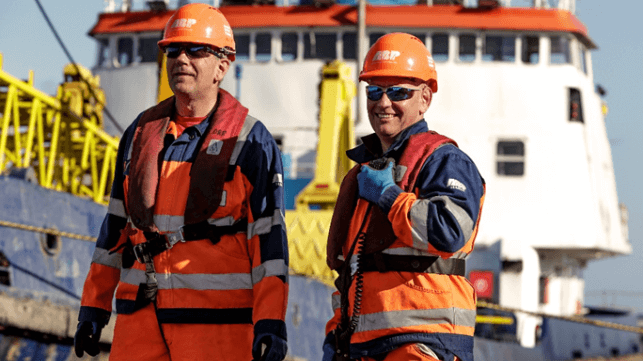
Associated British Ports (ABP), the UK’s leading ports group, has partnered with the University of Hull to delve deeper into the context and drivers impacting safety performance on ABP’s ports.
ABP is working with the team of psychologists at The Centre for Human Factors based in Lampada Digital Solutions, a University of Hull subsidiary, to deliver a survey across all ABP’s 21 ports plus the group’s other locations utilising a diagnostic safety climate tool designed to help organisations assess and improve their safety culture. It measures employees' perceptions of safety in the workplace, focusing on areas such as organisational commitment and usability of procedures. The survey adopts the best practice approach from the Health and Safety Executive (HSE).
Sally Ford, Group Head of Health Safety and Environment for ABP, said “Safety is a core value for ABP. We are committed to doing all we can to make sure each of our colleagues goes home safe every day. We’ve made good progress over recent years but we know our focus must be relentless. That’s why we’ve partnered with the Centre for Human Factors – to bring a new perspective firmly grounded in rigour and evidence.
“We’re also particularly pleased to be working with a University in one of our port locations, Hull. Working with a local university in Hull is about more than research, it’s about investing in our community, developing lasting partnerships and supporting the local innovation ecosystem.”
Professor Fiona Earle, Chartered Occupational Psychologist & Director of the Centre for Human Factors said “Our focus at the Centre is on creating healthier and safer working environments. Over the past two decades, we have developed extensive expertise in translating research into practical, industry-relevant solutions. We understand that effective safety goes far beyond policies and formal processes—it requires a deep understanding of the unique context within each organisation.
“We’re delighted to be working with ABP, a major employer in a key industrial sector across the Humber region. Our collaboration is already well underway as we analyse survey results from 21 UK ports and explore emerging issues facing the business. Drawing on our in-depth expertise in human factors, we will work with ABP to develop interventions that drive positive shifts in safety culture.”
Fiona and Dr Léa Fréour will also be undertaking a series of deep dives into key outcomes from the survey, designed to give detail on attitudes and behaviour and drive towards actionable insights that ABP can adopt to drive safety performance improvements.
The Centre for Human Factors delivers sector?leading, evidence?based approaches to health, safety and wellbeing in the workplace, with long established experience in the field of human factors. This considers how people interact with their working environment and its systems.
As part of its sector leading network of 21 ports, ABP operates three other ports in the Humber region in addition to Hull – Immingham, Grimsby and Goole. Collectively they make up the UK’s largest gateway for trade with the world by volume, handling more than 50 million tonnes of freight each year. ABP’s Humber ports also provide a crucial foundation for the region’s contribution to the UK’s energy system today and tomorrow – enabling, for example, refining and energy generation activities and hosting major wind turbine manufacturing facilities.
The products and services herein described in this press release are not endorsed by The Maritime Executive.
Port of LA Displays Resilience, Achieving Third Best Year in 2025
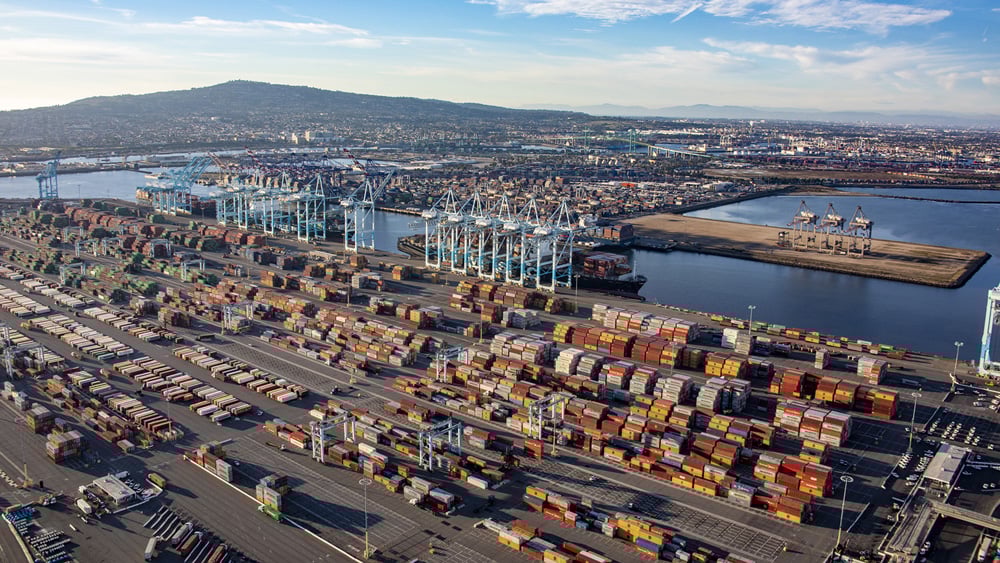
The busiest port in the U.S., Los Angeles, is feeling the pressures of a redrawn global trade map due to shifting policies. While recording flat growth in container throughput in 2025, a year the port contends was characterized by uncertainty and volatility, it still achieved its third-best year in history in its 118-year history.
Despite maintaining its position as the top U.S. port for the 26th consecutive year and the only North American port to exceed 10 million TEU in a year, Los Angeles saw its container throughput take a one percent dip to 10.2 million TEU.
For Los Angeles, which commands about 17 percent of the total containerized waterborne international trade in the U.S., 2025 presented a mixed bag. While June saw the port record an eight percent increase in throughput to handle 892,340 TEUs and go down in history as one of the busiest months, December was a rather bleak month, posting a 14 percent decline to 791,587 TEU.
While presenting the 11th annual State of the Port status report, Port of Los Angeles Executive Director Gene Seroka admitted that 2025 was a rollercoaster year characterized by accelerated dips in volumes to record highs, specifically due to the uncertainties caused by Donald Trump’s erratic tariff wars. In July, for instance, Los Angeles recorded another busy month after handling one million TEUs, 8.5 percent more than the same month in 2024, but it was largely because retailers and manufacturers rushed to bring in goods at an elevated pace due to concerns of higher tariffs.
“Shifting trade policies are creating uncertainty and volatility, and the maritime supply chain is at the center of it all,” said Seroka, adding that the positive takeaway from the year is that fact that cargo remains the lifeblood of the U.S. economy. “American farmers, manufacturers, retailers, and consumers all depend on how well we move that cargo.”
Seroka went on to outline his vision for the future, which he believes will be anchored on “Build Bigger and Build Smarter” investment priorities in line with anticipated future cargo demand. The port will focus on infrastructure, technology, community, and the environment.
Part of the infrastructure projects includes the proposed expansion of Pier 500 marine container terminal that is expected to significantly increase the port’s overall cargo capacity. The terminal will be constructed on a 200-acre site with two new berths and approximately 3,000 linear feet of new available wharf. It is designed to increase cargo efficiency in addition to allowing for bigger, next-generation containerships to call at the port.
“Pier 500 would be the first new container terminal to be developed at the port in a generation,” noted Seroka. “We envision it to be the greenest, cleanest terminal in the world. It will be an investment in our workforce, sustainability, resilience, and innovation—keeping us ready for the opportunities of tomorrow.”
Los Angeles also intends to implement other infrastructure projects, including a dedicated hub for chassis parking and container pick-up and drop-off, and expansion at Fenix Marine Services terminal on Pier 300. It also proposes wharf and rail upgrades at the LA TiL Container terminal.
Another key focus in 2026 will be on expanding the port’s growing cruise business. Having handled a record 1.6 million passengers and 241 cruise calls last year, Los Angeles is anticipating growth in its cruise business in the future. Pacific Cruise Terminals, a joint venture between Carrix and JLC Infrastructure, has been selected to develop a massive new cruise terminal to be located at the outer harbor.
Though Los Angeles remains focused on future growth, the plans are intertwined with environmental goals. The latest emissions report shows that the port had achieved the lowest emissions ever on a per-TEU basis of any port in the world. The port contends that upcoming projects are expected to help further those gains.
Report: Hutchison Explores New Structure to Sell Port Terminals
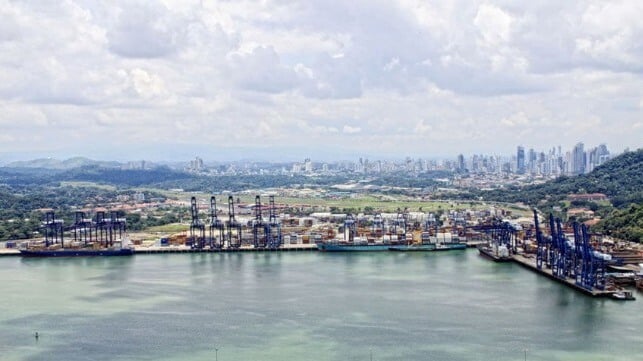
CK Hutchison is reported to be exploring a new path to structure the deal for the company to sell its interest in terminal operations at 43 ports in 23 countries, including the controversial terminals at each terminus of the Panama Canal. The company announced in March 2025 that it had reached terms to sell the terminal portfolio in a deal valued at $22.8 billion, but it slowly unraveled as China said the company owned by billionaire Li Ka-shing was betraying national interests.
The latest structure, according to a report from Bloomberg, would break the sale of the portfolio into smaller parcels. Previously, Hutchison had agreed to a two-part deal where U.S. investment group, BlackRock, would have had the largest share of the two Panama terminal operations, with MSC’s Terminal Investment Limited (TiL) as a minority investor. TiL was to be the lead investor in the terminals beyond Panama, while Hutchison would have retained the operations in China. The deal was built on BlackRock’s long-term investment in TiL and the two companies' joint efforts at other ports.
China immediately objected to the proposed sale, linking it to political pressure from the Trump administration. Initial reports said China was demanding participation in the deal, and later Bloomberg reported China insisted that the state-owned COSCO have a majority position and veto rights. Hutchison had initially said it expected to complete terms for the two Panama terminals by April 2025. As the negotiations dragged on, the lock-up granted to the BlackRock-TiL consortium expired in July, and by December, Bloomberg was reporting the negotiations were at an impasse.
It says discussions on the new structure are preliminary, and details are yet to be finalized. Bloomberg, however, quotes sources saying China has signalled that the Chinese government “would find such a structure acceptable.” Bloomberg writes that China, through COSCO, would take control of the terminals in ports and regions both more friendly to China and critical to the country’s trade strategy.
COSCO is a logical company to lead the Chinese portion, as its COSCO Shipping Ports, as of December 31, 2024, reported that it operated and managed 375 berths at 39 ports globally. It said 226 were for containers, with an annual handling capacity of approximately 124 million TEU.
Bloomberg reports that China and the other companies have noted the “mounting geopolitical headwinds” facing the deal as Donald Trump presses U.S. interests in Latin America and continues to seek to challenge China. The Panama Canal was the original sticking point, with BlackRock positioned as the lead to satisfy the White House and Trump’s assertion that China was running the Panama Canal.
AD Ports Buys Spanish Shipyard Astilleros Balenciaga
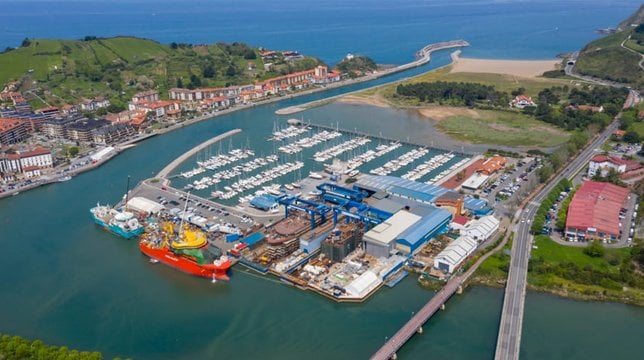
The Abu Dhabi-based AD Ports acquired a Spanish shipyard as part of its effort to expand in the Mediterranean and serve the offshore operations sector. The reports indicate that it paid €11.2 million ($13.1 million) for 100 percent ownership of Astilleros Balenciaga, based on the northern coast of Spain near Bilbao.
The shipyard, which traces its origins to 1921, will now be known as Balenciaga Shipyard. AD Ports acquired the yard for its Safeen Drydocks subsidiary, which is part of its Noatum Maritime group. The yard has both shipbuilding and repair facilities.
For AD Ports, the acquisition is an opportunity to further expand its presence in the offshore services sector and specifically offshore wind. The company recently announced a partnership with Masdar, the state-owned renewable energy company that is investing in the European offshore wind sector. Safeen will develop and deliver offshore wind projects for the partnership with Masdar.
Safeen Drydocks was launched in June 2023 as a joint venture 51 percent owned by AD Ports and working with Premier Marine Engineering Services, which was developing a shipyard at the Khalifa Port. It is a 45,000 square meter facility with a 350-meter (1,150-foot) berth for vessel repairs. The yard also has a floating dry dock.
The Balenciaga Shipyard has two dry docks, a 105-meter slipway, and a fabrication factory, as well as a cutting plant. The company recently invested in an expansion of its facilities.
The Spanish shipyard works with tug boats, offshore support vessels, fishing vessels, cargo vessels, and product carriers. Safeen highlights its capabilities in structural prefabrication of large modules for offshore projects, which it looks to leverage to further develop its presence in the offshore market. The shipyard is one of the few yards in Spain specializing in the construction of Service Operation Vessels (SOVs) as well as research vessels, offshore support vessels, and specialized tugs.
AD Ports Group highlights that it will further consolidate its operations in Spain and the Mediterranean region.
No comments:
Post a Comment