It’s possible that I shall make an ass of myself. But in that case one can always get out of it with a little dialectic. I have, of course, so worded my proposition as to be right either way (K.Marx, Letter to F.Engels on the Indian Mutiny)
Monday, January 12, 2026
AU
Gold overtakes US bonds as largest foreign reserve asset
Gold has surpassed US Treasuries as the world’s largest reserve asset globally for the first time in 30 years amid rising prices and aggressive buying by central banks.
According to new data from the World Gold Council, the value of gold held by foreign central banks is now approaching the $4 trillion mark, more than their approximate $3.9 trillion holding in US Treasuries. The last time that foreign institutions held more gold than US bonds was 1996.
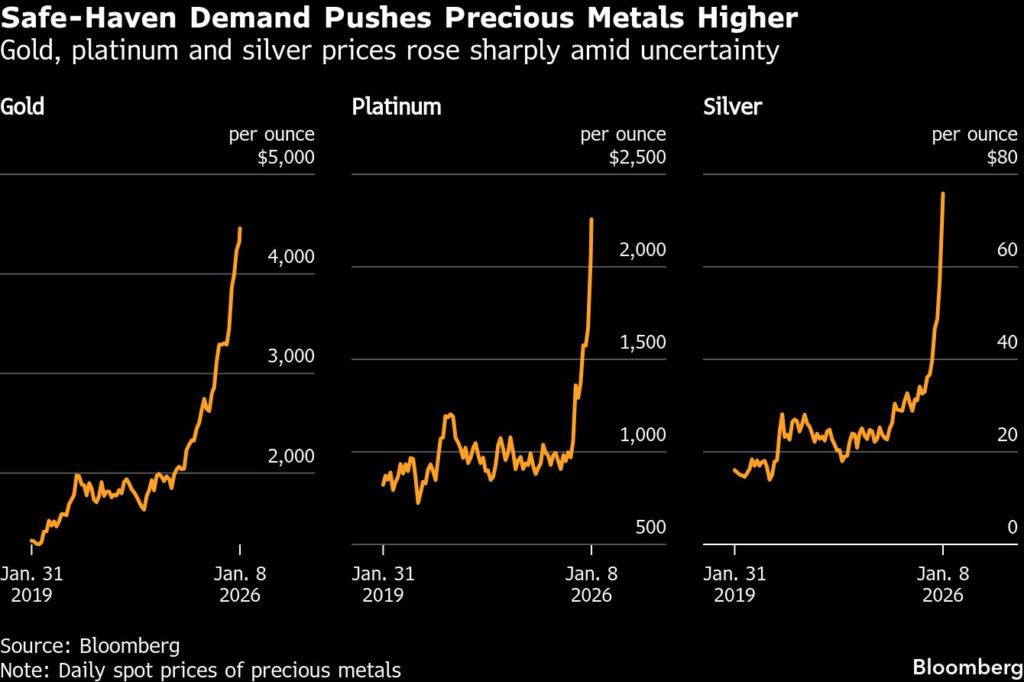
The shift coincides with rising gold prices, which recently crossed over the $4,500-an-ounce milestone during an end-of-year rally. The precious metal ended 2025 with a gain of nearly 70%, as geopolitical tensions and concerns over fiscal sustainability boosted its safe-haven appeal.
On Wednesday, gold prices briefly touched $4,500 an ounce again before paring gains to near the $4,500 level. In the first week of 2026, the yellow metal rose by 3.6%, extending last year’s scorching rally.
De-dollarization movement
Central banks, undeterred by high gold prices, have been accumulating bullion, with the WGC forecasting another 1,000 tonnes in net purchases for 2025. To analysts, this marked a structural shift in global reserve holdings, as foreign governments pivot away from dollar-denominated assets and into gold.
This shift — what they call de-dollarization — stems from the United States’ overall standing as the world’s leading economic, political and military power, said JP Morgan in a note last year. “Increased polarization in the US could jeopardize its governance, which underpins its role as a global safe haven,” it wrote.
Meanwhile, gold — traditionally seen as a much safer alternative to fiat currencies with no counterparty risk — has risen up the ranks. Over the last four years, foreign central banks have been buying the metal at a fast pace to safeguard themselves from any US geopolitical fallout.
Gold exports mask weakness in Canada’s broader trade picture
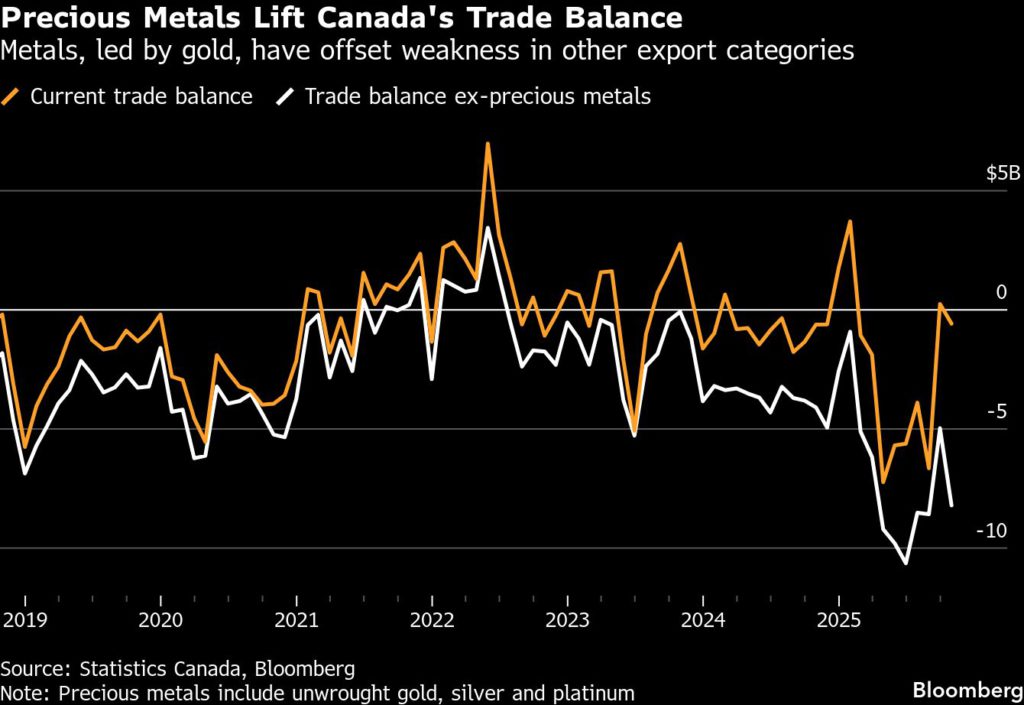
Canada posted a C$583 million ($421 million) trade deficit in October, but surging precious metal exports — mostly gold — are doing a lot of heavy lifting. Strip those out, and Canada would have a C$8.2 billion shortfall.
The gap underscores how the country’s trade fortunes have become more dependent on global demand for bullion.
Gold prices have jumped as investors flock to safe‑haven assets due to rising geopolitical uncertainty. The rally is boosting the value of Canada’s precious metal exports, with shipment volumes growing too — just more slowly than prices. That’s helping steady Canada’s export performance even as US tariffs squeeze Canadian industries and weigh on global growth.
Strong gold shipments to the UK pushed Canada’s overall exports to non‑US countries to new heights in October. The share of Canada’s exports bound for the US fell to a record low, outside of the pandemic period.
“As of October, precious metals (unwrought + alloys) made up roughly 13% of Canadian exports,” Bank of Montreal economist Shelly Kaushik said in a note.
“For the first time on record (or 1997), that’s more than exports of oil or autos. Those two traditional heavyweights have, of course, been under pressure from lower prices and higher trade tensions, respectively. While Canada’s trade flows will continue to face headwinds amid geopolitical uncertainty, gold will remain a stalwart as long as prices hold up.”
(By Mario Baker Ramirez)
GNOMES OF ZURICH
Gold price surge boosts Swiss National Bank’s profit
The Swiss National Bank made a profit of around 26 billion Swiss francs ($33 billion) in 2025, the central bank said on Friday, thanks to a sharp increase in gold prices as investors headed for safe-haven assets last year.
The provisional figure was down from the record 80.7-billion-franc profit in 2024, but still ranked among the top five in the SNB’s 119-year history.
The 2025 result was driven by a 36.3-billion-franc valuation gain on its gold holdings, as investors piled into the precious metal to shield against global economic turmoil triggered by US President Donald Trump’s tariffs.
The SNB’s gold profit was its biggest ever, helped by a 64% rise in the metal’s price last year, lifting the value of its 1,040 metric tons of reserves.
Foreign currency losses
The central bank’s profits were capped by a 9-billion-franc loss on foreign currency positions as the franc’s strength erased valuation gains on equities and dividends.
The SNB, which holds 37% of its 764 billion francs in foreign currency investments in US dollar assets, was hit by the dollar’s 13% slide against the franc in 2025, analysts said.
“The flight to safety had a mixed effect for the SNB in 2025,” said UBS economist Alessandro Bee.
“On one hand it was helped by a big increase in the price of gold, but on the other hand the Swiss franc – another safe haven – gained in value which turned the gains on foreign equity markets into losses when converted back into francs.”
Bee estimated that foreign exchange moves ultimately cost the SNB around 55 billion francs last year.
The bank also booked a 900-million-franc loss on its Swiss franc positions, mainly due to interest payments to commercial banks with sight deposits.
The overall profit was in line with UBS’ forecast of 23.5 billion to 28.5 billion francs.
($1 = 0.7996 Swiss francs)
(By John Revill; Editing by Miranda Murray and Mark Potter)
Philippine central bank gold holdings jump 70% in 2025 to record
The value of the Philippine central bank’s gold holdings surged almost 70% last year to a record high as the metal jumped.
Gold holdings rose to an all-time high of $18.6 billion at end-2025, according to central bank data released late Wednesday. They accounted for about 17% of its foreign-exchange reserves – a ratio officials had said exceed the ideal.
The rise in the central bank’s gold holdings reflects the surge in the metal, which jumped more than 60% last year. Bangko Sentral ng Pilipinas does not report the volume of its gold holdings.
Ideally, the precious metal should be anywhere between 8%-12% of the total reserves, Monetary Board member Benjamin Diokno said in October.
China’s central bank buys gold for 14th consecutive month
China’s central bank continued gold purchases for a 14th straight month, with gold holdings amounting to 74.15 million fine troy ounces at the end of December, from 74.12 million in the previous month.
The value of China’s gold reserves increased to $319.45 billion at the end of last month, from $310.65 billion a month earlier, data from the People’s Bank of China showed on Wednesday.
(By Qiaoyi Li and Ryan Woo; Editing by Bernadette Baum)


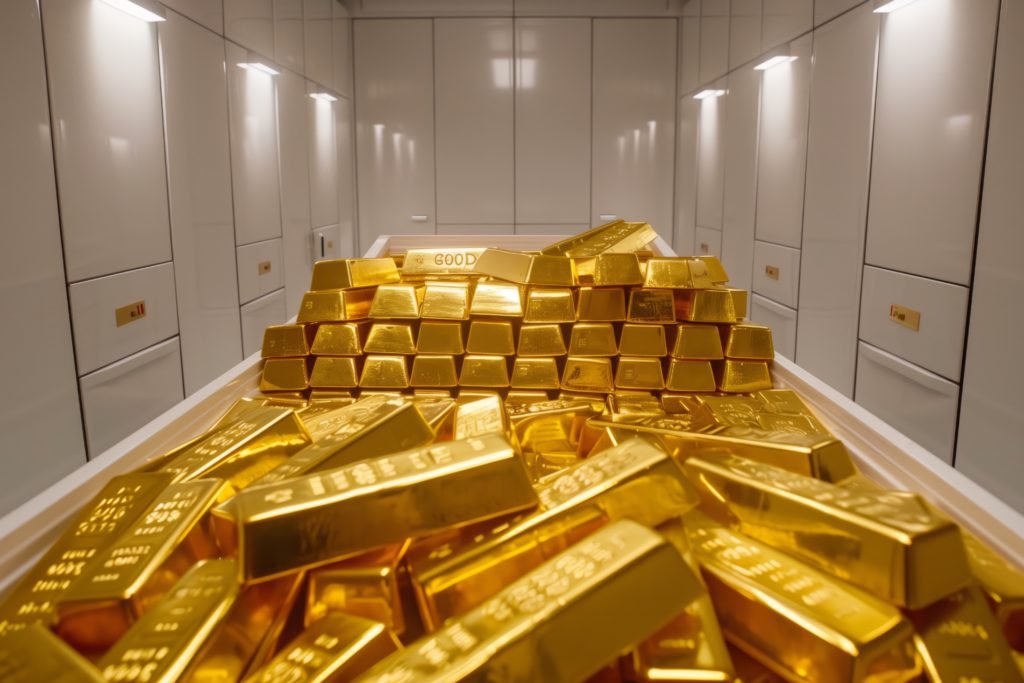 Stock image.
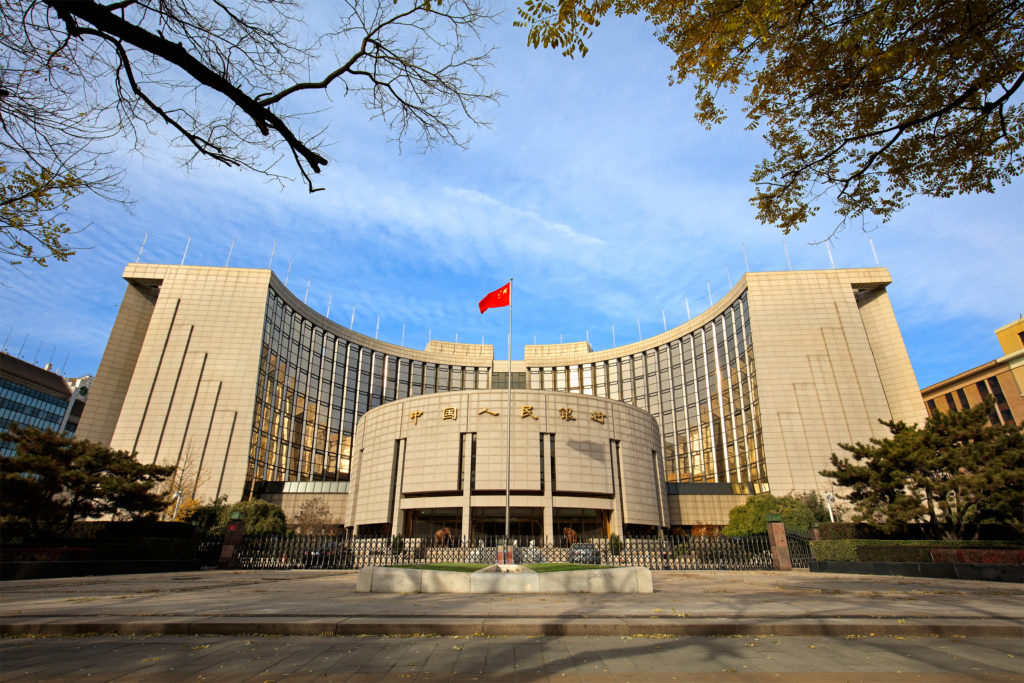 China’s central bank. Credit: Adobe Stock
No comments:
Post a Comment