The United States announced on Wednesday that it had “seized” the Marinera, an oil tanker with links to Venezuela, in the North Atlantic. During the US pursuit of this boat, the Marinera changed its name (from the Bella 1) and swapped out its former flag for the Russian flag. Turns out, this isn’t a first: experts say that Moscow has agreed to lend its flag and its protection to other so-called “dark fleet” ships attempting to circumnavigate the US blockade.
Issued on: 09/01/2026 -
By: The FRANCE 24 Observers/Lise KIENNEMANN
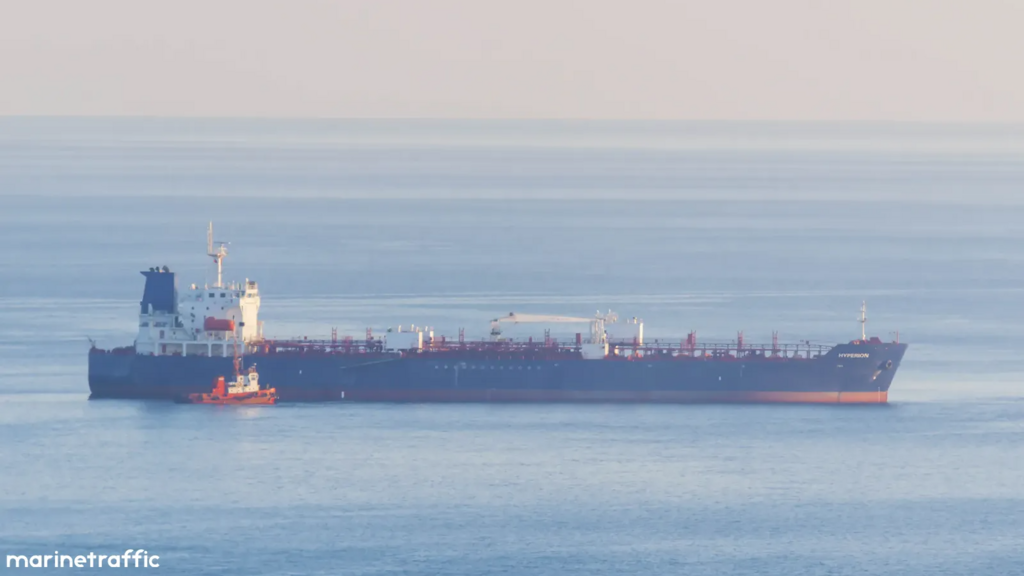
Just like the Marinera, the oil tanker Hyperion recently adopted the Russian flag. © MarineTraffic / Sergei Skriabin
The United States announced on January 7 that it had “seized” a Russian oil tanker with links to Venezuela as it sailed across the North Atlantic. This news is the latest twist in a drama that began late in December in the Caribbean.
The United States announced on December 21 that it would pursue the oil tanker, then known as the Bella 1, for trying to get around the blockade they imposed in mid-December on oil tankers under sanctions entering or leaving Venezuela.
The Bella 1 has been subject to US sanctions since June 2024 because of its apparent links to Iran and the Lebanese Shiite group Hezbollah. Maritime company Windward reported that the tanker had been participating in trading with Iran and Venezuela since 2021. Windward also tracked multiple instances of deceptive shipping practices.
TankerTrackers, a site specialised in maritime transport, reported that the tanker was not carrying oil when the United States began its pursuit. Analysts say that it was likely going to Venezuela to pick up oil.
The United States announced on January 7 that it had “seized” a Russian oil tanker with links to Venezuela as it sailed across the North Atlantic. This news is the latest twist in a drama that began late in December in the Caribbean.
The United States announced on December 21 that it would pursue the oil tanker, then known as the Bella 1, for trying to get around the blockade they imposed in mid-December on oil tankers under sanctions entering or leaving Venezuela.
The Bella 1 has been subject to US sanctions since June 2024 because of its apparent links to Iran and the Lebanese Shiite group Hezbollah. Maritime company Windward reported that the tanker had been participating in trading with Iran and Venezuela since 2021. Windward also tracked multiple instances of deceptive shipping practices.
TankerTrackers, a site specialised in maritime transport, reported that the tanker was not carrying oil when the United States began its pursuit. Analysts say that it was likely going to Venezuela to pick up oil.
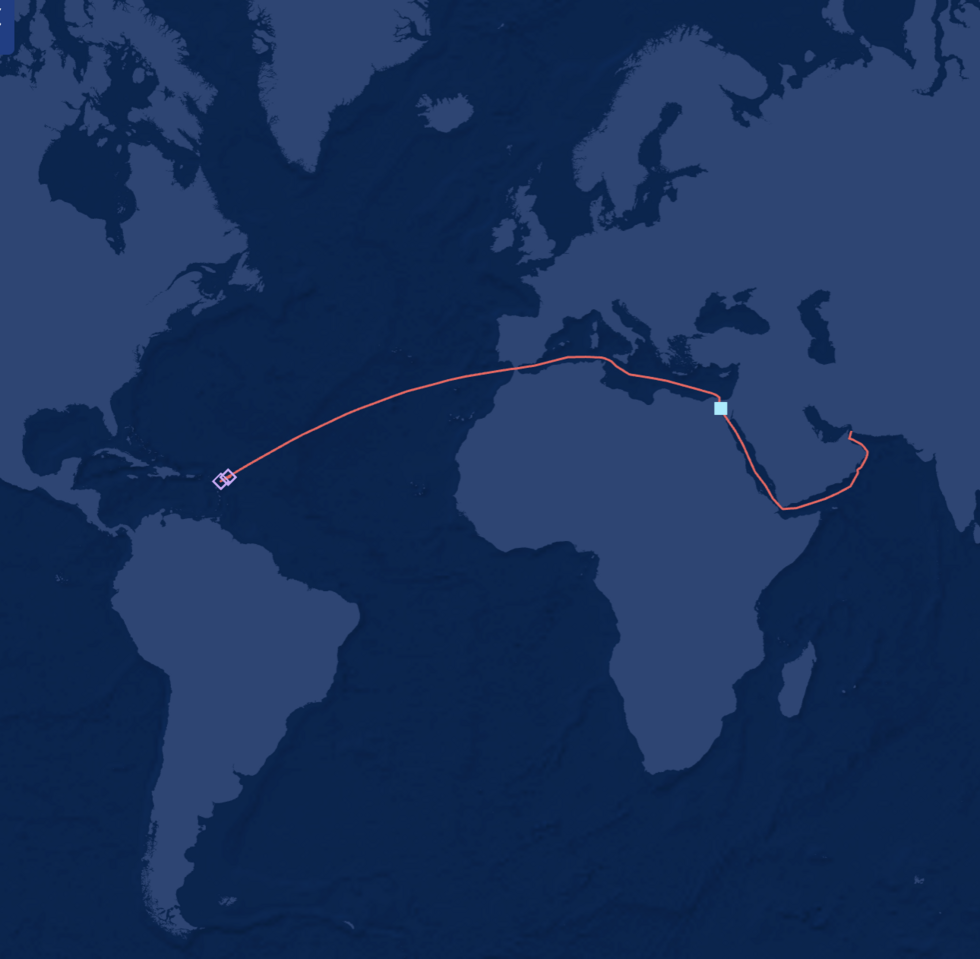
This is the path taken by the Marinera (formerly known as the Bella 1) between November 13 and December 17, 2025, when the ship stopped transmitting its location. © Global Fishing Watch
From 'false' flag to Russian flag
The US suspected the Marinera of being part of what’s called a dark or shadow fleet. These are fraudulent or unregistered vessels that smuggle goods that are illegal or subject to sanctions.
American authorities claimed that the tanker, which was flagged to Guyana, was “falsely flagged”. If a boat is stateless or flying under a false flag, then it is not protected under international law and can be boarded. The United States used this legal argument to seize two oil tankers in mid-December as well as the oil tanker M/T Sophia on Wednesday.
The Coast Guard said that they initially attempted to intercept the Bella 1, but it continued on its path.
American authorities interviewed by the New York Times said that the crew of the recently christened Marinera had painted a crude Russian flag on the side of the ship. An officer on the ship also made contact with the Coast Guard via radio to say that the ship was now flagged to Russia.
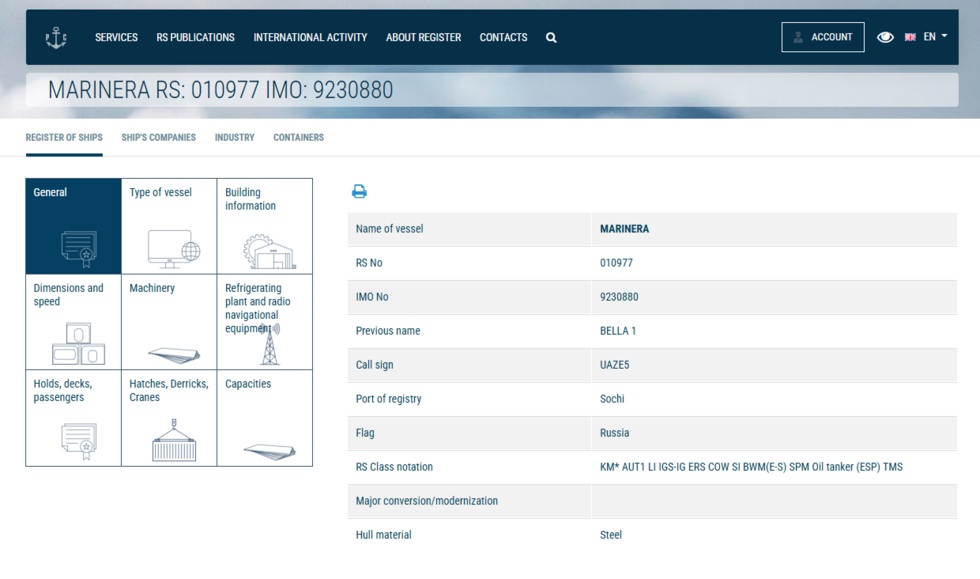
The oil tanker also now appears in the Russian maritime registry, under the name Marinera, with its home port listed as the Russian city of Sochi. The database Equasis also indicates that the ship’s owner and manager live in Russia.
From 'false' flag to Russian flag
The US suspected the Marinera of being part of what’s called a dark or shadow fleet. These are fraudulent or unregistered vessels that smuggle goods that are illegal or subject to sanctions.
American authorities claimed that the tanker, which was flagged to Guyana, was “falsely flagged”. If a boat is stateless or flying under a false flag, then it is not protected under international law and can be boarded. The United States used this legal argument to seize two oil tankers in mid-December as well as the oil tanker M/T Sophia on Wednesday.
The Coast Guard said that they initially attempted to intercept the Bella 1, but it continued on its path.
American authorities interviewed by the New York Times said that the crew of the recently christened Marinera had painted a crude Russian flag on the side of the ship. An officer on the ship also made contact with the Coast Guard via radio to say that the ship was now flagged to Russia.
The oil tanker also now appears in the Russian maritime registry, under the name Marinera, with its home port listed as the Russian city of Sochi. The database Equasis also indicates that the ship’s owner and manager live in Russia.
The Marinera appears in the Russian maritime registry. © Russian maritime registry
The Russian government then sent a formal demand for the United States to end their pursuit of the ship, according to the New York Times.
An American official told the New York Times that the United States still considered the ship “stateless” because it was not flying a valid flag when it was approached for the first time by the Coast Guard.
The Russian government then sent a formal demand for the United States to end their pursuit of the ship, according to the New York Times.
An American official told the New York Times that the United States still considered the ship “stateless” because it was not flying a valid flag when it was approached for the first time by the Coast Guard.
Chase across the Atlantic Ocean
The oil tanker then headed northeast, setting out across the Atlantic Ocean. On January 7, it was located to the south of Iceland, according to information provided by Lloyd’s List Intelligence. A number of analysts interviewed by our team said they believed that the boat was heading towards a Russian port.
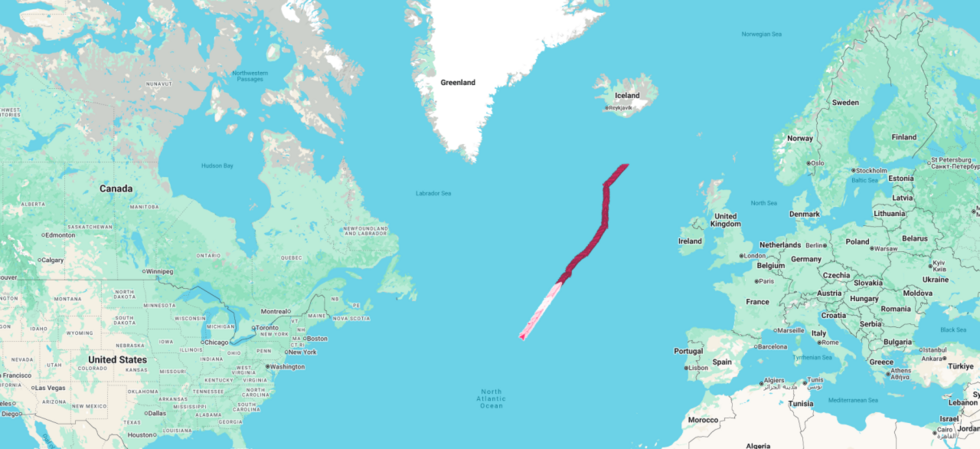
This map shows the Marinera’s trajectory between January 1 and 7, 2025. © Lloyd’s List Intelligence
In recent days, aviation data seemed to indicate that the Marinera was being closely surveilled by two American P-8 spy planes, who took off from Mildenhall air base in the United Kingdom.
“The vessel is being shadowed by a United States Coast Guard cutter, with supporting surveillance including an RAF Rivet Joint mission and RFA Tideforce operating in the area,” Martin Kelly, head of advisory at the British security company EOS Risk Group, told our team a few hours before the operation took place.
The RAF is an abbreviation for the Royal Air Force, the British Air Force. A Rivet Joint is a spy plane. And the RFA Tideforce is a refuelling ship that belongs to the RAF.
A video posted on January 6, 2026 by Russia Today, which was said to have been filmed by the crew of the Marinera, shows a US Coast Guard Patroller following them. It is impossible to know when and where this video was filmed.
In recent days, aviation data seemed to indicate that the Marinera was being closely surveilled by two American P-8 spy planes, who took off from Mildenhall air base in the United Kingdom.
“The vessel is being shadowed by a United States Coast Guard cutter, with supporting surveillance including an RAF Rivet Joint mission and RFA Tideforce operating in the area,” Martin Kelly, head of advisory at the British security company EOS Risk Group, told our team a few hours before the operation took place.
The RAF is an abbreviation for the Royal Air Force, the British Air Force. A Rivet Joint is a spy plane. And the RFA Tideforce is a refuelling ship that belongs to the RAF.
A video posted on January 6, 2026 by Russia Today, which was said to have been filmed by the crew of the Marinera, shows a US Coast Guard Patroller following them. It is impossible to know when and where this video was filmed.
'The United States cannot allow this to become a template for dozens of other sanctioned tankers'
The Bella 1 is not the only ship operating in Venezuela that has reflagged to Russia in recent days.
“Reflagging to Russia is increasingly being used by these tankers to allow them to continue operating and gain some sort of legitimacy and protection,” said Mark Douglas, a maritime analyst with Starboard Maritime Intelligence.
After having dropped off its cargo of Russian naphtha – used to refine crude oil – in Venezuela, the Hyperion oil tanker, which is also under sanction, dropped the false Gambian flag that it was operating under on December 25 and announced that it was now flagged to Russia, according to the publication gCaptain. It then managed to travel into the Atlantic Ocean, making it seem as if it had escaped American seizure.
The oil tanker the Premier also indicated that it had reflagged in late December, going from the Gambian flag to the Russian flag, according to Windward. On Wednesday, it was located in the Caribbean.
According to the New York Times, three other boats under sanction that were recently located in Venezuelan waters have reflagged to Russia in recent days. They are all now also listed in the Russian maritime registry.
“Over the past six months, a dozen or more of the darkest tankers operating globally have switched from open registries to Russia. This trend accelerated in December as the flag state emerged as a critical shield against drone strikes and vessel seizures,” Windward wrote.
Vessels also began to reflag to Russia in the Black Sea after Ukrainian drone attacks on oil tankers carrying false flags.
“This is ultimately about principle,” says Kelly. “The United States cannot allow this to become a template for dozens of other sanctioned tankers off Venezuela to evade enforcement by simply changing flags.”
After Venezuelan President Nicolas Maduro was arrested, US Secretary of State Marco Rubio said that the blockade on sanctioned oil tankers would remain in place.
The risk is also that other boats in the so-called dark or ghost fleet, operating in other regions, will also adopt this strategy.
“If the vessel doesn't get seized, then the remaining near 1,500 dark fleet tankers worldwide will resort to keeping a Russian flag handy in their closet,” said Samir Madani, co-founder of the site TankerTrackers.com, ahead of the US operation.
'The presence of Russian warships… significantly increases the risk of miscalculation and escalation'
However, an operation like the seizure of the Marinera is not without risk. The New York Times said Wednesday that Russia had sent a warship to escort the oil tanker.
Kelly explains:
“The presence of Russian warships ‘defending’ a vessel that now declares itself Russian-flagged significantly increases the risk of miscalculation and escalation.
The Russian warship will have specific rules of engagement and is unlikely to use force to oppose any boarding, but it may seek to disrupt or obstruct boarding operations, potentially through unsafe manoeuvring or using laser devices to target aircraft. Any Russian submarine nearby will highly likely conduct surveillance without playing an active part in the incident.”
'Russia has an interest in maintaining the shadow fleet in activity'
But why is Russia getting so involved? We spoke to Eric Orsini, global head of compliance at Lloyd's List Intelligence:
What you're seeing is sanctioned actors working together. They're forming their own little ecosystem.
Russia has been providing Venezuela with condensate or diluents [Editor’s note: like naphtha]. Venezuela's oil is heavy crude and it needs to be mixed or blended with diluents in order for it to be refined. So it’s in Russia's interest to continue the flow of their diluents to Venezuela, because Venezuela is buying it.
Russia has an interest in also keeping the shadow fleet on the water. The Marinera is a VLCC – a very large crude carrier, which has a lot of capacity to move oil. The more vessels that come out of the shadow fleet, the less capacity the sanctioned actors have to continue moving the oil and storing it.
It remains to be seen how Western countries will adapt to this new world.
“The reflagging will likely lead to an evolution of the approach taken to these vessels by the likes of Ukraine and the US as they consider what additional actions Russia might be willing to take to protect the tankers and the oil they carry,” concludes Douglas.
No comments:
Post a Comment