CANADA
Carney at Davos: Removing that Sign in the Window

“It seems that every day we’re reminded that we live in an era of great power rivalry – that the rules-based order is fading, that the strong can do what they can, and the weak must suffer what they must.” These were the grave reflections of Canada’s Prime Minister, Mark Carney, delivered in his January 22 speech at the World Economic Forum in Davos, Switzerland.
With such Thucydidean tendences in international relations bothering the PM, Carney feared that “strong tendency of countries to go along, get along to accommodate, to avoid trouble, to hope that compliance will buy safety.” In abjuring this tendency, options beyond accommodation and grudging acceptance had to be considered. Who better to inspire than the meditations of Czech dissident author Václav Havel, whose 1978 essay “The Power of the Powerless” had conspicuously moved Carney?
Carney homes in on Havel’s reference to the greengrocer who places a sign in his window each morning with the slogan “Workers of the world unite.” Neither he, nor anyone else believes it. “But he places the sign anyway to avoid trouble, to signal compliance, to get along.” (Havel argues that such formulations help “the greengrocer to conceal from himself the low foundations of his obedience, at the same time concealing the low foundations of power. It hides behind the façade of something high. And that something is ideology.”)
As every shopkeeper on the street follows the ritual “the system persists – not through violence alone, but through the participation of ordinary people in rituals they privately know to be false.” Such a performance bolsters the lie, nourishes it, and sustains the system. Its strength is also its signal weakness. “When even one person stops performing, when the greengrocer removes his sign, the illusion begins to crack.”
The time had come, exhorted Carney, for the shopkeepers of the world to remove those slogans extolling the full, normative veracity of “what we called the rules-based international order.” Canada and other countries had prospered from it, joining its institutions, praising its values, profiting from predictability and conducting policy under its protection. To Carney’s credit, he acknowledged its duplicity, that such an order “was partially false, that the strongest would exempt themselves when convenient, that trade rules were enforced asymmetrically, and we knew that international law applied with varied rigour, depending on the identity of the accused or the victim.”
Behind this order was its own lie or useful fiction: the guarantees offered by American hegemony, including “public goods, open sea lanes, a stable financial system, collective security and support for frameworks for resolving disputes” that led to Canada and likeminded powers to place the sign in the window, participate in the rituals and generally avoid “calling out the gaps between rhetoric and reality.”
With great powers now “using economic integration as weapons, tariffs as leverage, financial infrastructure as coercion, supply chains as vulnerabilities”, exploitation was inevitable. “You cannot live within the lie of mutual benefit through integration when integration becomes the source of your subordination.”
These sentiments, voiced more in sorrow than anger, could only come from an ally and power long aligned with Washington. There were previous occasions when the ubiquitously displayed sign regarding fidelity to international rules could have been removed. There was the cynicism of US efforts in Indochina during the Cold War, most aptly captured by the conduct of former national security advisor and Secretary of State Henry Kissinger. The administration of George W. Bush supplied the crude template for post-Cold War power politics in sneering at the United Nations, mocking the tempering dictates of international law, and launching the illegal invasion of Iraq in 2003 to destroy weapons of mass destruction it did not have.
Ivo H. Daalder and James M. Lindsay, writing in May 2003, offered a description that, with the slightest tinkering, could be equally applicable in January 2025: “With terrorists, tyrants, and technologies of mass destruction posing a grave and growing danger, [Bush] believes that the best – if not the only way – to ensure America’s security is to jettison the constraints imposed by friends, allies and international institutions. The United States will act as it sees fit to protect itself and its interests. Other countries will either follow or get out of the way.”
Given the menacing musings by US President Donald Trump about acquiring Canada as a potential 51st state, his attempt to seize and control Venezuelan oil and his aggressive yearning for annexing the Danish island territory of Greenland, Canada has begun its own modest efforts to follow the Havál recipe. For the first time in over a century, its military is considering scenarios involving the seizure by US troops of vital land and sea points in over a two day to a week’s period. As with previous countries or opponents attacked by a power superior in numbers and arms, the suggested response, as reported by The Globe and Mail, is one for the ages: guerilla warfare.
The modelling for the insurgency envisages using tactics adopted by the Afghan mujahideen against the Soviet intervention between 1979 and 1989 and, ironically, those used by the Taliban in their two-decade campaign against the US and its allies, including Canada, during their presence in the country. (Between 2001 and 2014, 158 Canadians died in that graveyard of empires, many perishing to improvised explosive devices.)
Given that the United States has tried twice, and failed on both occasions, to successfully invade their northern neighbour, contingency planning is only prudent. All alliances in international affairs, however praised and revered at the podium, are mutable off it.
Carney Speech: The Rupture is a Necessary
Part of the Transition
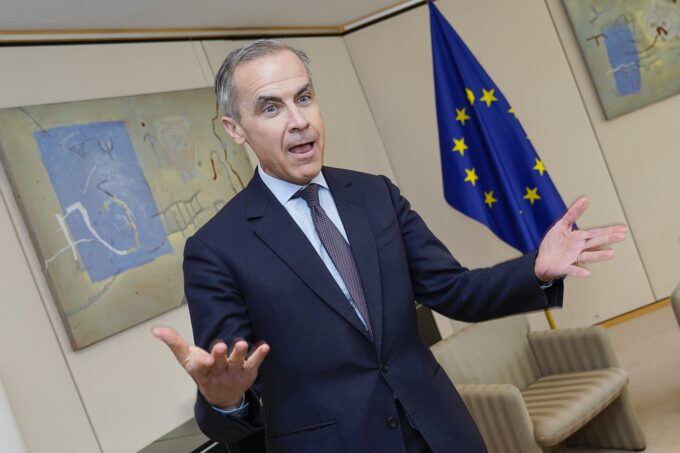
Photograph Source: © European Union 2020
“We are in the midst of a rupture, not a transition,” Canadian prime minister Mark Carney told the world’s self-designated elite in a January 21 speech. “[G]reat powers have begun using economic integration as weapons. Tariffs as leverage. Financial infrastructure as coercion. Supply chains as vulnerabilities to be exploited. You cannot ‘live within the lie’ of mutual benefit through integration when integration becomes the source of your subordination.”
Carney delivered his musings to the World Economic Forum in Switzerland, days after visiting China and striking a major trade deal with its regime. That deal represents both a “rupture” with Canada’s former first-line trade partner, the United States, and a “transition” to something else.
Why the rupture? Why the transition?
Under US president Donald Trump (and, to some degree, Joe Biden), we’ve seen all the things Carney complained about in his speech.
When your main buyer (or, rather, the lord and master of your main buyers) becomes reluctant to buy from you — even if it means he (or, rather, his serfs) have trouble selling to you — you eventually start looking for other buyers and sellers. That’s the transition.
And, eventually, you find those new buyers and sellers and, to at least some degree, swear off coddling the old ones. That’s the rupture.
Writ large, Canada’s move away from the US and toward China is just the latter part of Mike’s answer, in Ernest Hemingway’s The Sun Also Rises — “Two ways. Gradually, then suddenly” — to the question of how he went bankrupt.
Which, in turn, is just a waypoint in another transition. In Mike’s case, it was all downhill from the bankruptcy. In America’s case, who knows?
It’s easy to just blame Trump for all this craziness, but it’s also a little bit lazy.
Yes, Trump’s trade and economic policies seem purpose-built for the task of dismantling American prosperity at home and power (“soft” and “hard”) abroad.
In reality, though, the American empire and the supposed global “rules-based order” have been in continual decline pretty much since that happy accident 80 years ago, when World War 2 ended with most of the world’s industry wrecked, but America’s untouched.
It’s all been downhill from there … gradually.
We may have finally reached the “suddenly” point.
We were always going to.
It may be that with Trump, as William Lowndes Yancey said of Jefferson Davis upon his arrival in Montgomery, Alabama in 1861, “the man and the hour have met.” You may remember how that turned out. In both cases, the man’s identity was unimportant. There was going to be a man, there was going to be an hour, there was going to be a rupture, and there was going to be a transition.
I consider myself lucky, in many ways, to have lived the bulk of my likely lifespan during the “gradually” phase. Americans, including myself, have had it fat and happy for a very long time. That time is nearing its end.
I just hope America can find its way to a better transition than Mike managed.
“The Weak Must Suffer”
The Eternal Fiction of the "International Rules-Based Order"

Trump managed to dismiss Greenland’s status as part of Denmark with typical chutzpah:
‘I’m a big fan [of Denmark], but the fact that they had a boat land there five hundred years ago doesn’t mean that they own the land’.
It was a tragicomic remark, displaying Trump’s apparent ignorance of his own country’s history. As many pointed out on social media, the indigenous peoples of North America made the same point about the White settlers from Europe who came by boat and stole the natives’ land and committed genocide.
Like a disgruntled toddler, Trump even linked his threat to seize control of Greenland to his failure to win the Nobel Peace Prize, which, ludicrously, had just been ‘gifted’ to him by the winner, Venezuelan opposition leader María Corina Machado (the Norwegian Nobel Committee later stated that the prize itself is non-transferable).
On 18 January, Trump sent an infantile text message to the Norwegian prime minister, Jonas Gahr Støre:
‘Considering your Country decided not to give me the Nobel Peace Prize for having stopped 8 Wars PLUS, I no longer feel an obligation to think purely of Peace’.
Ursula von der Leyen, President of the EU Commission, responded to Trump’s threat to take Greenland:
‘Territorial integrity and sovereignty are fundamental principles of international law.
‘They are essential for Europe and for the international community as a whole.’
Her ostensible concern for international law was absent when it came to the recent outrageous and illegal US kidnapping of the Venezuelan president, Nicolás Maduro. Even worse, her concern for international law has been conspicuously lacking during Israel’s ongoing genocidal assault on the Palestinians in Gaza.
In fact, Mark Carney, the Canadian prime minister, strongly alluded to the fact that the supposed framework of international law, territorial law, and sovereignty had been a sham all along. In a remarkable speech to the global elite at Davos, Switzerland, he began with an aphorism by the ancient Greek historian and general Thucydides that:
‘the strong can do what they can, and the weak must suffer what they must.’
It is notable that Noam Chomsky has often cited this quote to highlight the gap between the stated lofty aims of great powers and the brutal reality for those on the receiving end of imperial force. We are not claiming that Carney has suddenly become an acolyte of Chomsky. But perhaps Canada’s leader has been emboldened to speak out by recent world events and feels honour-bound to give an impression of someone being at least minimally honest to his domestic Canadian audience and the wider public.
Carney went on to say that:
‘We knew the story of the international rules-based order was partially false. That the strongest would exempt themselves when convenient. That trade rules were enforced asymmetrically. And we knew that international law applied with varying rigour depending on the identity of the accused or the victim.’
A glaring example, which he did not voice, is the Western condemnation of Russia’s invasion of Ukraine, while the West has refused to condemn or even acknowledge Israel’s genocide in Gaza. Indeed, the US and its allies, including the UK, have been complicit or even participants in the genocide, having armed Israel, provided military training, intelligence support, and diplomatic cover.
Carney continued to expand on the myth of the global ‘rules-based order’:
‘This fiction was useful. And American hegemony, in particular, helped provide public goods: open sea lanes, a stable financial system, collective security and support for frameworks for resolving disputes.’
No mention, however, of the appalling costs of that American hegemony to much of the world’s population.
Carney then added:
‘We participated in the rituals. And we largely avoided calling out the gaps between rhetoric and reality.
‘This bargain no longer works.’
A ‘bargain’ for the comfortable in privileged parts of the world, perhaps; but not for those who have suffered US-inflicted wars, regime changes, ‘humanitarian interventions’ and much else besides.
The admission that ‘we’, a term which really means Western leaders and their media cheerleaders, have ‘largely avoided calling out the gaps between rhetoric and reality’ is significant. Obviously, any reasonably well-informed person has known this all along. But the media preferred to skip merrily past this crucial aspect of Carney’s speech, as we will see below.
Unwelcome Truths About US Imperialism
The rise of US imperialism, especially since the end of the Second World War, has been accompanied and promoted by grandiose assertions about spreading democracy, peace, and prosperity. The self-serving ideology has underpinned all of the following horrors and many more:
· The dropping of the atomic bombs on Hiroshima and Nagasaki in order ‘to bring about the surrender of Japan and end WW2’: a demonstrably false narrative.
· The overthrow of Mohammad Mosaddegh, the democratically-elected leader of Iran to be replaced by the dictatorial, US-compliant Shah in 1953.
· The Indonesian coup in 1965, killing up to one million people, to install the brutal, Washington-friendly General Suharto.
· The invasion and bombing of Vietnam (and Laos and Cambodia) ‘to stop the spread of Communism’ in the 1960 and 1970s.
· Extensive support in the 1980s for right-wing governments and paramilitary groups in Latin America, utilising death squads to suppress leftist movements.
· The Persian Gulf war in 1990-91, with an estimated 30,000 to 100,000 Iraqi military deaths, and up to 5,000 civilian deaths.
· Sanctions on Iraq in the 1990s which led to the deaths of as many as 1.5 million Iraqi civilians, including around 500,000 children under the age of five.
· The 2001 invasion-occupation of Afghanistan: the first of the US post-9/11 wars which have led to an estimated total death toll of around five million people in Iraq, Afghanistan, Syria, Yemen, and Pakistan.
· The 2003 invasion-occupation of Iraq, leading to the deaths of over one million Iraqis.
· The 2011 bombing of Libya and the destruction of much its infrastructure, acting as a catalyst for a massive surge in jihadist activity across north Africa and the Middle East.
· The 2014 coup in Ukraine to impose US-backed regime change, fuelling dangerous tensions with Russia.
· Crippling economic sanctions and military threats against Iran, including joint air strikes with Israel on Iranian nuclear facilities; together with the fomenting of violence inside Iran by CIA-backed NGOs and Mossad, Israel’s spy agency.
· The strangling of the Venezuelan economy through sanctions, and the kidnapping of the Venezuelan leader, Nicolás Maduro, on 3 January 2026.
All of the above is but a fraction of the crimes committed by the US empire over many decades. For more information, read any number of books by Noam Chomsky, Edward Herman, William Blum, Howard Zinn, Michael Parenti, Naomi Klein, John Pilger, Seymour Hersh, Media Lens, and others.
The British state-corporate media response was telling. The crucial segment of his speech about the longstanding ‘fiction’ of the ‘international rules-based order’ and ‘the gaps between rhetoric and reality’ was almost entirely buried. If we had responsible, public-service news media in this country, they would have quoted that vital section, word-for-word, and provided relevant context and substantive analysis as to what it meant.
Predictably, the BBC’s online report simply omitted that part of Carney’s speech. BBC News at Ten devoted all of twenty seconds to the speech. The short snippet showed Carney saying that ‘the rules-based order is fading’, followed by his citing of the Thucydides quote. But BBC North America editor Sarah Smith merely said in her voiceover that his speech ‘echoed Greenland’s right to sovereignty’. The rest of Carney’s comments disappeared down the proverbial BBC black hole.
The Guardian had a live feed which quoted Carney saying that ‘the rules-based order is fading’ and that the world faces ‘“the end of a pleasant fiction and the dawn of a harsh reality of geopolitics” in which the great powers are unconstrained.’ But there was no elucidation to help readers understand the magnitude of Carney’s comments.
Worse, a dedicated ‘analysis’ piece in the Guardian made no mention of Carney’s remarks about the ‘fiction’ of the rules-based order, or ‘the gaps between rhetoric and reality’. It did, however, cite his quoting of Thucydides that:
‘the strong can do what they can, and the weak must suffer what they must.’
The following day, Julian Borger, the Guardian’s senior international correspondent, had a comment piece focusing on ‘Trump’s rambling Davos speech’ that briefly quoted Carney’s observation about ‘the end of a pleasant fiction’, without exploring what that meant. Patrick Wintour, the paper’s diplomatic editor, took a similar approach in his comment piece, noting that Carney had ‘vowed he would no longer live in a state of nostalgia, waiting for an old world to return’. A deeper insight and explanation of the speech was almost comically absent.
It was safe territory for journalists to refer to ‘nostalgia’ for ‘an old world’ that would never ‘return’. But it was verboten to point out that the nostalgia was misplaced; that there never was an old world that adhered to an international order upholding peace, stability, and democracy. As ever, the Guardian’s ability to steer clear of dangerous waters is testament to its establishment credentials.
The Independent had a short article briefly mentioning Carney’s observation that ‘the world order based on rules has become “fiction”’. The article also included the Canadian prime minister’s warning that:
‘If great powers abandon even the pretense of rules and values for the unhindered pursuit of their power and interests, the gains from transactionalism will become harder to replicate.’
But the extensive, brutal reality and sordid history behind the phrase, ‘the pretense of rules and values for the unhindered pursuit of their power and interests,” was left unmentioned and unexplored. To the Independent’s credit, however, the following day it published the full text of Carney’s speech. The Financial Times also published a transcript of the speech.
From our Nexis newspaper database searches, the above was the sum total of media mentions in the UK national press of the most vital passages from Carney’s speech. Judging by other people’s observations on social media, such as the responses to our viral post on X about BBC reporting of the speech, this pattern was repeated in other Western countries.
US political analyst Glenn Greenwald made an important point:
‘It’s amazing to watch mainstream western media outlets completely and brazenly distort what Mark Carney said.
‘They’re pretending he was just attacking Trump: as if Carney was claiming we had a nice “rules-based international order” until Trump came along.
‘No. Carney said that this “rules-based international order” has long been a fraud that western nations pretended was true because it was in their interests to maintain this lie.’
Greenwald added:
‘But establishment outlets like the NYT, CBC, The Atlantic, The Economist, etc. etc. can’t grapple with or even acknowledge Carney’s confession, because those outlets have been central to embracing and ratifying and spreading this precise fiction.’
These are crucial observations about the media’s unwillingness or inability to honestly appraise and dissect Carney’s remarks. Although to what extent Carney’s speech was really a ‘confession’, or whether there was an element of performative politics to assuage the public and maintain a semblance of credibility, is up for debate.
But, as always, for the ‘mainstream’ media, crucial truths about imperial Western power are not deemed worthy of significant broadcast, far less explanation.
Carney’s Hot Air at Davos as Cover for Western Barbarism
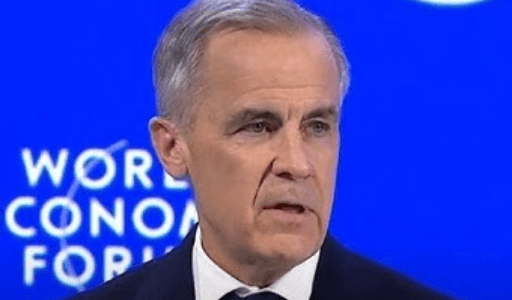
YouTube screenshot.
On January 20, 2026, at the World Economic Forum in Davos, Switzerland, Canadian Prime Minister Mark Carney called time of death on the so-called rules-based international order. In a speech lauded by many, Carney urged countries to stop complying with regimes seeking hegemony, to stop hoping for a return to the past, and to instead build new coalitions to survive what’s coming next.
But missing from the Prime Minister’s speech was an honest reflection of the contribution of Canada and other “middle powers” to the destruction of international law, violation of human rights, and global inequality. These governments fucked around and now they’re finding out. They emboldened the United States to get where it is today, supporting and enabling it for so long because it suited their interests. Many “middle powers” also colonized other countries, extracted wealth, resources, and labour from the Global South, and overthrew democatically elected leaders in those countries in favour of those willing to serve the imperial core.
Now these same “middle powers” are finding out what it might mean to be on the other side of this equation. To be the ones under threat of having economic integration weaponized against them, of having tariffs imposed on them, of having their governments overthrown and their countries invaded and occupied.
Acknowledging their own crimes and privileges is essential if the governments of these countries are going to build meaningful, lasting coalitions that actually protect people and the planet, and not just serve their own short-term self-interests. If the “middle powers” don’t want to experience what they have done to others, these countries need to get serious about building alternatives with the leadership of the Global South and the populations who have been harmed by their past actions.
Acknowledging reality as a “radical act”
The core admission of Carney’s speech, highlighting the sham of the rules-based order, is a good place to start. “We knew the story of the international rules-based order was partially false,” he said. “That the strongest would exempt themselves when convenient. That trade rules were enforced asymmetrically. And we knew that international law applied with varying rigour depending on the identity of the accused or the victim.”
He said this fiction was useful (he left out for whom—it was useful for imperialist countries like Canada), but that it no longer works. Instead of pretending the rules-based order functions as advertised, Carney urged states to “call it what it is: a system of intensifying great power rivalry where the most powerful pursue their interests using economic integration as a weapon of coercion.”
Proclaiming that the world is facing a rupture, he pointed out that the “great powers” are using economic integration as weapons and tools of subordination. In banker-speak, he urged countries to “diversify” their alliances, make “collective investments in resilience,” and to embrace “values-based realism”. He announced that Canada will be pursuing “different coalitions for different issues based on common values and interests.” He specifically urged so-called middle power countries to band together, noting that “if we’re not at the table, we’re on the menu.” Most importantly, he said these states must act consistently, “applying the same standards to allies and rivals.”
As important as this admission and the calls for coalition building are, underneath the jargon is a pitch for countries to double down on capitalism, resource extraction, free trade, artificial intelligence, and militarism. This is a call to fortify neoliberalism under the guise of countering fascism—even though these choices are what has led to the imperialist international order Carney is claiming to oppose.
Embedded militarism
Let’s start with militarism. Carney affirmed at Davos that he will be doubling Canada’s military spending by the end of the decade. Last year, he announced a military budget of $81.8 billion CAD (~59.1 billion USD) over the next five years. While advising countries at Davos against “building fortresses,” it seems his government is investing in just that. Not that doubling the military budget would be enough to deter a US invasion; the Canadian military recently modeled a response to the US attack on Canada, in which it predicted that US forces would overwhelm “strategic assets” with “lightning speed”. The Canadian military said it would have to rely on unconventional warfare modelled after the Muhajideen in Afghanistan, as well as guerrilla fighting from armed civilians. It assumes the fighting would last for decades.
What Carney also didn’t mention at Davos is the fact that the Canadian military and intelligence services are deeply entwined with the United States. There are US troops stationed in Canada at North American Aerospace Defense Command (NORAD) bases. Canada is part of the Five Eyes alliance, an intelligence-sharing coalition made up of Australia, Canada, New Zealand, the United Kingdom, and the United States. Then of course there is the North Atlantic Treaty Organization (NATO), which the Trump regime has been overtly hostile towards but which in the past has done plenty of US bidding in terms of bombing other countries, hosting US nuclear weapons, engaging in war games, ratcheting up tensions with Russia, and spending more and more taxpayer dollars on weapons and war (all members but Spain recently agreed to spend 5% of their gross domestic product on militarism).
Like Canada, the rest of NATO has been throughly militarised by the United States. The US has troops stationed in at least 38 military bases across Europe. It has about 100 nuclear weapons stationed across five of these. This makes European posturing around not wanting to cede European territory to the US a bit ironic, as large swaths of European land already belongs to the United States.
Canada and European NATO members are also deeply invested in US weapon companies. Canada hosts manufacturing plants for Boeing, General Dynamics, Lockheed Martin, and more. Canada’s military buys billions of dollars’ worth of weapons from the United States and continues to do so. Canada is a key partner in the US F-35 joint strike fighter jet program, which is one of the weapon systems that Canada has been supplying Israel with parts and components for its genocide of Palestinians. The same is true of many European NATO members and other “middle powers”.
Canada’s complicity and crimes
All of this entanglement brings us to the importance of acknowledging one’s role in bringing the current situation to bear. If Carney is serious about building new alliances based on trust and equality, he should acknowledge that Canada, under his leadership and past administrations, was not a passive observer in the fiction of the rules-based order. Canada did not just “hang a sign in the window,” as suggested in his speech. Canada was an active participant in breaking international law for economic gain, for enforcing rules asymmetrically to privilege itself and allies.
For example, the Canadian government helped the United States invade and occupy Afghanistan; it pretended not to support the invasion of Iraq while aiding and abetting it; it helped launch a coup in Haiti; and it has helped overthrow governments and destabilise societies in Latin America in locations where its companies own mines.
The destruction of international law didn’t just come from Russia’s invasion of Ukraine, the US invasion of Venezuela, or threats about Greenland. Canada has been a full and active partner in refusing to play by the rules in helped established. No more so than in its continued arming of Israel. Canada has been a consistent partner for Israel in its genocide of Palestinians, in violation of the Genocide Convention, the Geneva Conventions, the Arms Trade Treaty, and more.
The Canadian government has also violently repressed any opposition to its complicity in genocide. Police cleared student encampments at universities, arrested activists for criticising Israel online, criminalised solidarity actions and marches, executed no-knock nighttime raids on the homes of activists accused of property damage of complicit institutions, and pre-dawn raids on others who allegedly organised blockades of weapon factories.
At Davos, Carney talked a big game of Canada being “a pluralistic society that works,” where its “public square is loud, diverse and free.” In reality, the public square is becoming smaller and more criminalised. It’s not just anti-genocide activists that are under threat. The Canadian government has repeatedly sent its most militarized police force, the Royal Canadian Mounted Police (RCMP), onto unceaded Indigenous lands to violently arrest First Nations organizers and activists for protecting land, water, and forests from fossil fuel extraction. The RCMP, whose precurser was formed to commit genocide in the early days of the settler state’s expansion, is now deployed by the federal government to protect the interests of fossil fuel companies.
This makes Carney’s bragging about Canada’s energy resources and critical minerals particularly concerning. Canada already extracts oil from the tar sands in Alberta—the dirtiest form of oil extraction in the world, for which Carney recently granted the far-right Alberta premier permission to build a new pipeline in what activists have called the “sellout of the century” and a “stunning betrayal of federal commitments on climate change and Indigenous rights.” Canada also extracts gas and coal from British Columbia, uranium from Saskatchewan, and much more. Carney’s celebration of environmentally devastating artificial intelligence, and of Canada’s status as an “energy superpower” and holder of “vast reserves of critical minerals,” is a dire warning about the future Carney envisons for Canadians, and for the planet. More extraction and mining, more use of energy, more human rights violations.
Canadian companies have a horrific human rights record at mining sites around the world. And Mining Watch Canada warns that “the manner in which the metal-intensive energy transition is advancing is fundamentally at odds with respect for global human rights.” It points out, “The critical minerals rush is rapidly encroaching on sensitive environments, imposing on Indigenous territories without consent, further endangering the lives of human rights and environmental defenders, and violating basic rights to health, clean air and water, and safety and security for local communities.”
If Carney is counting on more mining to save the Canadian economy, that will inevitably lead to more human rights violations, including in relation to freedom of speech. In addition to the violent repression of First Nations organizing, the Canadian government has also deported non-citizens for their climate activism. On that note, Canada is in the midst of an immigration crackdown. It has been deporting more than 400 people a week, mostly people seeking refugee and asylum status. The government says it intends to deport more people in 2026, even though it costs millions of dollars to do so. So much for Canada’s pluralistic society.
Building a new world order
All of this is to say, the “solutions” that Carney posits to aggressive US imperialism will still harm people, will still destroy ecology and exacerbate the climate crisis, will still maintain a rigid hierarchy in international relations that privileges some at the expense of others, and will still violate the human rights of activists, Indigenous Peoples, migrants, and more. This is not standing up to a bully; this is being one yourself.
Carney is right that the world needs global coalitions to prevent the Trump regime from crushing everyone it decides it dislikes or wants to own. Carney is also right that countries need to “diversify” their allies. But we need to go much further than his capitalist, extractivist imagination allows.
For one thing, Carney imagines the United States and other so-called great powers will go it alone. But this isn’t the plan, according to Trump’s own National Security Strategy. His regime is interested in teaming up with other authoritarian states to control “spheres of influence” and rule the world together. His preferred partners in crime are the gangster capitalists and the despotic megalomaniacs who are afraid of women and queer people, and think the world owes them. These partners don’t even need to all be white, which is particularly incredible when you realise that part of the reason he’s trashing his European allies is that their countries are no longer white enough for him. His new friends just have to have enough money and be repressive enough to play the game he wants to play.
These alliances of the worst of the worst are already forming, and anyone wanting to stand up to them needs to realize this. Because that also changes the calculation that Carney seems to be making that the “middle powers” just need to stick together, or form alliances with other economically powerful fascist states like China or India. In reality, the “middle powers” need to get over themselves, own up to their contributions to the destruction of international rules, norms, and law, and build coalitions with those they have harmed in the past. Not colonial relationships or patronizing, extractivist arrangements, but real partnerships.
There is no more time for Western domination. The “middle powers” need to learn from the countries that have experience with being oppressed by bully states. They need to figure out how to form equitable, reciprocal economic and security relationships that don’t rely on extraction, imperialism, militarism, and violence. Relationships that prioritize the well-being of all people, not just those in the imperial core, and that ensure the survival and health of the planet.
If Carney is willing to admit that the rules-based order was a sham, he need not seek to replicate it with other Western states, but to build real solidarity with the rest of the world. He needs to disentangle Canada from the US not just economically, but also militarily. And he needs to uphold the international law that he’s acknowledged the “middle powers” have only upheld partially.
Shifting language
He also needs to stop calling countries “great powers” and “middle powers”. We all do. These terms bestow upon certain governments a status they do not deserve. The US, Russia, Saudi Arabia, and others that the Trump regime wants to build an alliance of autocrats with are not great powers. They are heavily militarized states seeking global dominance through violence. They are bullies.
Canada, European countries, and other settler colonial states that claim Western status regardless of geography, like Australia and New Zealand, are not middle powers. They are countries that pillaged and plundered the Global South to build and maintain their economies at the expense of the vast majority of people and the planet. They are not in the middle; they are on the top, only now experiencing the full weight of what it means to be subordinated to a hierarchy imposed by those more violent than you.
Equality means getting rid of “great” and “middle” and the idea of “powers” at all, and telling things like they are. Power shouldn’t be about economic or military strength but about what people can do together in solidarity to better us all. Let this rupture be one that brings the world not to its knees at the boot of the violent bullies, but to build something that actually helps us all survive and thrive.

No comments:
Post a Comment