Son of Last Iranian Shah Asks Trump to Back Military Coup as Protests Rage
“What is clear is that President Trump does not now have Congress’ authorization for the use of military force in Iran,” said one expert.
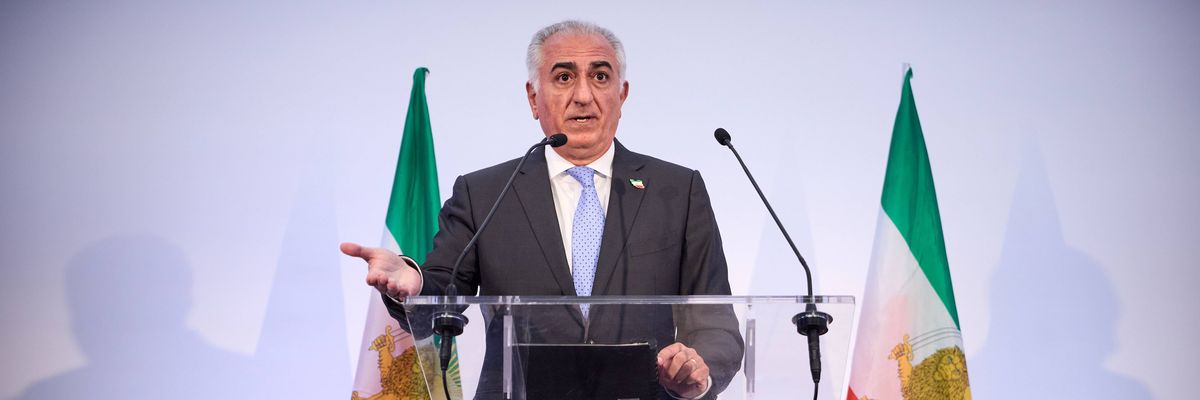
Reza Pahlavi, the eldest son of the last Shah of Iran, addresses the media during a press conference on June 23, 2025 in Paris, France.
(Photo by Kiran Ridley/Getty Images)
Jake Johnson
Jan 12, 2026
COMMON DREAMS
The son of Mohammad Reza Pahlavi, who brutally ruled Iran for decades with backing from the United States and other Western powers, has urged US President Donald Trump to intervene militarily and support the overthrow of the Iranian government amid an escalating protest movement that has faced violent repression.
“The people of Iran have responded and reacted positively to a promise of intervention,” Reza Pahlavi, who has lived in exile since the 1979 revolution and ouster of his father, said in a Fox News appearance on Sunday when asked if he wants US forces to “take out” Ali Khamenei, Iran’s supreme leader.
“We need to cut the snake’s head off for good so it can no longer be a threat to Iranian interests, to American interests, to regional interests,” said Pahlavi, who has been accused of opportunistically coopting the protest movement, which began late last month over the collapse of the nation’s currency. “The only solution is to make sure this regime goes down for good and the Iranian people can liberate themselves.”
Hours after Pahlavi’s comments, Trump told reporters that the US military is looking at “some very strong options” to intervene in Iran, a country whose nuclear facilities the Trump administration bombed last year.
The Wall Street Journal reported Sunday that Trump, fresh off his unlawful and deadly attack on Venezuela, is set to receive a briefing on Iran from top administration officials on Tuesday. According to the newspaper, the meeting “will be a discussion about the next steps, which could include boosting anti-government sources online, deploying secretive cyber weapons against Iranian military and civilian sites, placing more sanctions on the regime, and military strikes.”
“One option under discussion is the possibility of the US sending terminals of Starlink, a satellite-based internet service owned by Elon Musk, into Iran for the first time during the Trump administration, officials said, which could help protesters skirt a recent internet shutdown in the country,” the Journal reported. “Trump said he would speak with Musk about sending Starlink satellite-internet terminals into Iran.”
“Reports that the United States and Israel may be considering military strikes in Iran are deeply concerning.”
Iran’s foreign minister, Abbas Araghchi, said Monday that Iranian leaders are willing to negotiate with the US.
“We are not looking for war, but we are prepared for war—even more prepared than the previous war,” said Araghchi. “We are also ready for negotiations, but negotiations that are fair, with equal rights and mutual respect.”
Expert observers expressed horror at the Iranian government’s treatment of demonstrators while also warning against military intervention by outside powers, including the United States.
Matt Duss, executive vice president of the US-based Center for International Policy, said in a statement Monday that “indications that widespread demonstrations by brave Iranians are being met with a brutal, deadly crackdown by the Iranian government are horrific.”
“This violence should be unequivocally condemned,” said Duss. “It is important for other countries and multilateral bodies to vocally stand for the right of Iranians to protest. It is also critical that no country attempts to intervene inside Iran in a manner that could further endanger or undermine the protestors.”
“Reports that the United States and Israel may be considering military strikes in Iran are deeply concerning,” Duss continued. “It is difficult to know what the impact of such attacks would be on the plight of the Iranian protestors, and even less clear what the follow-on consequences would be for the Iranian people and security in the region. Israeli and US strikes against Iranian government targets last year were broadly opposed by Iran’s people and diaspora across almost the entire political spectrum.”
“What is clear is that President Trump does not now have Congress’ authorization for the use of military force in Iran,” he added. “Any US strikes would be illegal under both US and international law. The administration should instead focus its efforts on working multilaterally to press Iran’s government to end the killing and other abuse of its own citizens.”
Who is Reza Pahlavi — and what are his links to Iran?
News Desk Reza Pahlavi, the exiled son of the last Shah of Iran, attends a press conference about the situation in Iran, in Paris, France on June 23, 2025. — Reuters/File
While Iran has grappled with widespread deadly protests for the past two weeks, Reza Pahlavi, the US-based son of Iran’s ousted shah, Mohammad Reza Pahlavi, has once again emerged as an anti-government figurehead.
The protests began on December 28 in response to soaring prices, before turning against the authorities in Iran, who have governed since the 1979 Islamic Revolution. However, Supreme Leader Ayatollah Ali Khamenei has expressed defiance and blamed the United States.
Pahlavi has urged Iranian government workers and security forces to join the swelling protest movement. He has also hinted at his plans to return to Iran at a time that he believed was “very near”.
He has even requested US President Donald Trump, who has repeatedly threatened to get involved if force is used on protesters, to “be ready to intervene to help the people of Iran”.
So what links does Pahlavi have to Iran’s history, and what are the stakes for him in establishing a role in the ongoing crisis?

News Desk
January 12, 2026
DAWN

While Iran has grappled with widespread deadly protests for the past two weeks, Reza Pahlavi, the US-based son of Iran’s ousted shah, Mohammad Reza Pahlavi, has once again emerged as an anti-government figurehead.
The protests began on December 28 in response to soaring prices, before turning against the authorities in Iran, who have governed since the 1979 Islamic Revolution. However, Supreme Leader Ayatollah Ali Khamenei has expressed defiance and blamed the United States.
Pahlavi has urged Iranian government workers and security forces to join the swelling protest movement. He has also hinted at his plans to return to Iran at a time that he believed was “very near”.
He has even requested US President Donald Trump, who has repeatedly threatened to get involved if force is used on protesters, to “be ready to intervene to help the people of Iran”.
So what links does Pahlavi have to Iran’s history, and what are the stakes for him in establishing a role in the ongoing crisis?

Born in Tehran on Oct 31, 1960, as the heir to the late Shah of Iran Mohammad Reza and Empress Farah Pahlavi, Reza Pahlavi was officially named crown prince at the age of seven.
He has lived in exile since his father was ousted by the 1979 revolution, a year before he died.Iran’s ousted late shah Mohammad Reza Pahlavi. — photo courtesy Pahlavi Centenary
As per his website, Pahlavi left Iran for jet fighter training in the United States Air Force in 1978. “During this same period, the building unrest in Iran led to the royal family’s departure in January 1979,” his website says about his father’s ouster.
Pahlavi completed his higher education with a degree in political science from the University of Southern California. He volunteered to serve Iran’s military as a fighter pilot during the Iran-Iraq War in the 1980s, but was declined by the Islamic regime.
Pahlavi married Yasmine Etemad-Amini on June 12, 1986. They have three daughters (all of whom he has named as his heirs successively): Noor Pahlavi (born April 3, 1992), Iman Pahlavi (born Sept 12, 1993), and Farah Pahlavi (born Jan 17, 2004).
The late shah’s heir has also authored three books: Gozashteh va Ayandeh (Kayhan Publishing, 2000); Winds of Change: The Future of Democracy in Iran (Regnery, 2002); and Iran: L’Heure du Choix [Iran: The Deciding Hour] (Denoël, 2009).
He has lived in exile since his father was ousted by the 1979 revolution, a year before he died.Iran’s ousted late shah Mohammad Reza Pahlavi. — photo courtesy Pahlavi Centenary
As per his website, Pahlavi left Iran for jet fighter training in the United States Air Force in 1978. “During this same period, the building unrest in Iran led to the royal family’s departure in January 1979,” his website says about his father’s ouster.
Pahlavi completed his higher education with a degree in political science from the University of Southern California. He volunteered to serve Iran’s military as a fighter pilot during the Iran-Iraq War in the 1980s, but was declined by the Islamic regime.
Pahlavi married Yasmine Etemad-Amini on June 12, 1986. They have three daughters (all of whom he has named as his heirs successively): Noor Pahlavi (born April 3, 1992), Iman Pahlavi (born Sept 12, 1993), and Farah Pahlavi (born Jan 17, 2004).
The late shah’s heir has also authored three books: Gozashteh va Ayandeh (Kayhan Publishing, 2000); Winds of Change: The Future of Democracy in Iran (Regnery, 2002); and Iran: L’Heure du Choix [Iran: The Deciding Hour] (Denoël, 2009).
Ties outside Iran
Pahlavi’s website highlights that he remains in touch with “opposition groups, both inside and outside” Iran, and advocates for the establishment of a secular democracy in the country.
“He calls for regime change through non-violent civil disobedience, and for a free and open referendum on a new government of Iran,” the website reads.
While Iran and Israel are arch-enemies under the current regime, they both enjoyed warmer ties under Pahlavi’s father.
In October last year, Israeli-funded online campaigns in the Persian language used fake social media personas and AI to boost Pahlavi’s image and destabilise the Iranian regime, parallel investigations by Israeli newspapers and the University of Toronto’s Citizen Lab found.
During the 12-day Iran-Israel war last year, Pahlavi urged Khamenei to step down “for the sake of the Iranian people”.
In a similar fashion, during the ongoing protests, the late shah’s son called for replacing the flags outside of Iranian embassies with the pre-Islamic revolution flag, which protesters briefly succeeded in doing so in London.
Pahlavi’s website highlights that he remains in touch with “opposition groups, both inside and outside” Iran, and advocates for the establishment of a secular democracy in the country.
“He calls for regime change through non-violent civil disobedience, and for a free and open referendum on a new government of Iran,” the website reads.
While Iran and Israel are arch-enemies under the current regime, they both enjoyed warmer ties under Pahlavi’s father.
In October last year, Israeli-funded online campaigns in the Persian language used fake social media personas and AI to boost Pahlavi’s image and destabilise the Iranian regime, parallel investigations by Israeli newspapers and the University of Toronto’s Citizen Lab found.
During the 12-day Iran-Israel war last year, Pahlavi urged Khamenei to step down “for the sake of the Iranian people”.
In a similar fashion, during the ongoing protests, the late shah’s son called for replacing the flags outside of Iranian embassies with the pre-Islamic revolution flag, which protesters briefly succeeded in doing so in London.

No comments:
Post a Comment