Indian shares slide as Trump backs 500% tariff on New Delhi
THIS IS HOW HE TREATS FRIENDS

Indian equities closed lower on January 9 2025 as investors pared risk amid global uncertainty, renewed concern over trade frictions with the US and caution ahead of key inflation data due in the week starting January 12.
The Indian markets also severely corrected based on the potential implications of comments by US President Donald Trump and a proposed US bill that would impose a 500% tariff on Indian goods over New Delhi’s purchases of Russian oil, developments that added to geopolitical and policy risk premiums.
The Trump administration’s intermittent signals and statements about intervention on the side of the protestors in Iran where widespread protests against the ruling islamic regime are reaching a critical point, as well as the US’s continued insistence on acquiring Greenland from Denmark for its own national security needs contributed to the crashing sentiment.
According to a report by state owned DD News, the BSE Sensex fell 604.72 points, or 0.72%, to close at 83,576.24, while the NSE Nifty 50 declined 193.55 points, or 0.75%, to 25,683.30. Losses accelerated as the session progressed after a flat opening, reflecting late-day selling by institutional investors. Sectoral performance showed broad-based weakness.
Real estate and automobile stocks led declines, with the Nifty Realty index down 2.26% and the Nifty Auto index lower by 1.15%. Consumer-linked segments also underperformed, as the Nifty Consumer Durables slipped 1.14%, the Nifty FMCG index fell 1.08% and the Nifty Consumption index dropped 1.06%, signalling caution on discretionary demand. A handful of sectors bucked the trend.
The Nifty Oil & Gas index rose 0.40%, supported by selective buying in energy names, while the Nifty IT index added 0.28% on expectations of stable overseas demand. Public sector lenders also saw modest gains, with the Nifty PSU Bank index up 0.18%.
Heavyweights dragged the benchmark indices lower. Shares of NTPC Ltd (NSE:NTPC), ICICI Bank Ltd (NSE:ICICIBANK), Bharti Airtel Ltd (NSE:BHARTIARTL), Sun Pharmaceutical Industries Ltd (NSE:SUNPHARMA), InterGlobe Aviation Ltd (NSE:INDIGO), Mahindra & Mahindra Ltd (NSE:M&M), Bajaj Finance Ltd (NSE:BAJFINANCE), Titan Co Ltd (NSE:TITAN), Axis Bank Ltd (NSE:AXISBANK), ITC Ltd (NSE:ITC), Tata Steel Ltd (NSE:TATASTEEL), Maruti Suzuki India Ltd (NSE:MARUTI), UltraTech Cement Ltd (NSE:ULTRACEMCO), HDFC Bank Ltd (NSE:HDFCBANK), Bajaj Finserv Ltd (NSE:BAJAJFINSV), Hindustan Unilever Ltd (NSE:HINDUNILVR) and Power Grid Corp of India Ltd (NSE:POWERGRID) were among the main laggards.
Gains were limited to select counters. Asian Paints Ltd (NSE:ASIANPAINT), HCL Technologies Ltd (NSE:HCLTECH), Bharat Electronics Ltd (NSE:BEL), Eternal Ltd (NSE:ETERNAL), Tech Mahindra Ltd (NSE:TECHM), State Bank of India (NSE:SBIN), Tata Consultancy Services Ltd (NSE:TCS) and Infosys Ltd (NSE:INFY) ended higher. Broader markets also weakened.
The Nifty Midcap 100 index fell 474.40 points, or 0.79%, to 59,748.15, while the Nifty Smallcap 100 index slid 318.40 points, or 1.81%, to 17,282.65, indicating risk aversion beyond frontline stocks.
Profit taking intensified amid global volatility and uncertainty over trade negotiations after the US Commerce Secretary signalled delays in an India-US trade deal. Trump’s recent statements on trade and the proposed punitive tariff bill targeting India’s Russian oil imports further clouded the outlook.
Attention is now also on India’s own inflation data due on January 12, which investors see as critical for assessing the policy stance of India’s central bank, the Reserve Bank of India, and the near-term direction of equities.
EU-India trade deal could be agreed by February, Merz says
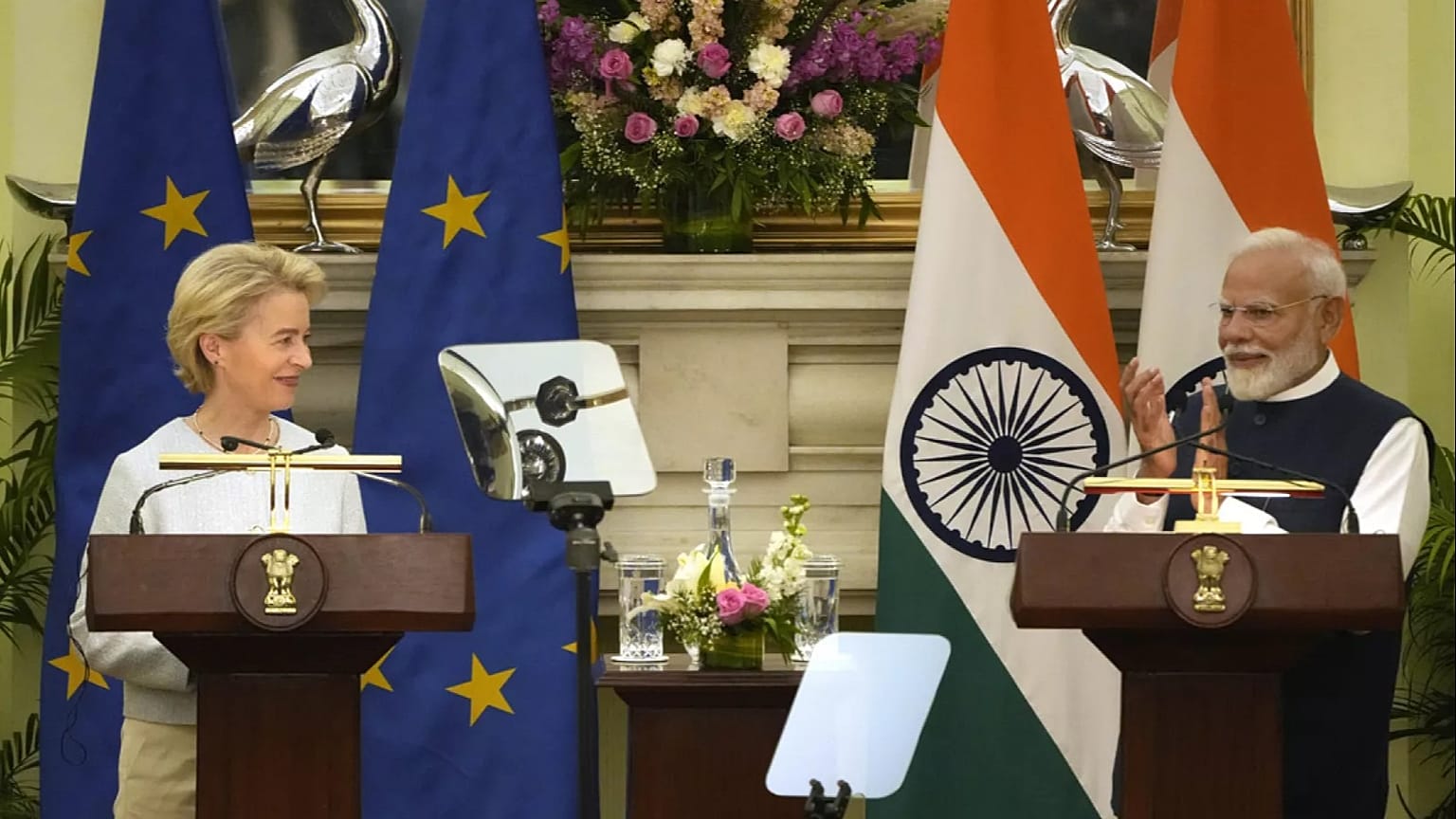
The German chancellor is already a strong supporter of the contentious Mercosur agreement adopted by EU countries last Friday.
Speaking on Monday during a trip to India, German Chancellor Friedrich Merz said European Commission President Ursula von der Leyen and European Council President Antonio Costa could sign a free trade agreement with New Delhi by the end of the month.
Merz's comments came days after a majority of EU member states backed the Mercosur free trade pact, a deal strongly supported by Germany as part of the bloc’s strategy to diversify trade ties beyond the US and China – two countries that have pursued strongly nationalist trade policies over the past year.
“Unfortunately we are seeing a renaissance of protectionism. It is directed against the principles of free trade and open markets,” Merz said at a press conference, adding that EU leaders could travel to India “towards the end of this month” to sign a free-trade agreement.
“In any case, they will take another major step forward to ensure that this free trade agreement comes into being,” he said.
The idea of holding an EU-India summit by the end of January was floated in Brussels as negotiations intensified late last year, though the original aim of sealing a deal by the end of 2025 ultimately came to nothing.
In his remarks encouraging a timely deal, Merz called India “the fastest growing economy of the G20” and described it as a “pivotal partner in the Indo-Pacific.”
EU trade agenda fuels turmoil in France
Last week, India’s Minister of Commerce and Industry Piyush Goyal travelled to Brussels for further high-level negotiations with EU trade chief Maroš Šefčovič, who last year described Indian negotiators as “tough”.
Both India and the EU are facing escalating trade problems with the US, which has raised tariffs on its trade partners, and China, which is increasingly attempting to weaponise other countries' dependencies on raw materials and technology.
But negotiations over the sustainability chapter have proven difficult, the Commission told EU lawmakers last September, particularly regarding the introduction of a dispute settlement mechanism tied to green standards.
The EU’s Carbon Border Adjustment Mechanism, adopted in 2023, has been also a particular sticking point for India.
Merz nonetheless said he was confident the talks have entered their final stretch, remarking that the signing of the deal would be “an encouraging sign on the path to continue down the road of forging and concluding free trade agreements”.
The EU’s diversification agenda is fuelling political turmoil in France, the bloc’s second-largest economy after Germany, which opposed the Mercosur agreement over concerns that French farmers' livelihoods could be endangered by a flood of Latin American imports.
While von der Leyen is set to travel to Paraguay to sign the Mercosur deal on 17 January, as first reported by Euronews, tensions have escalated between French President Emmanuel Macron and the political opposition, with both far-right and far-left parties calling to subject his government to a vote of no confidence.
No comments:
Post a Comment