INTERVIEW
A Tehran resident who took part in the protests that have roiled Iran before fleeing the country has described a deadly crackdown – with security forces firing indiscriminately at protesters with machine guns and assault rifles – in an exclusive interview with FRANCE 24.
Issued on: 16/01/2026
FRANCE24
By: Mariam PIRZADEH
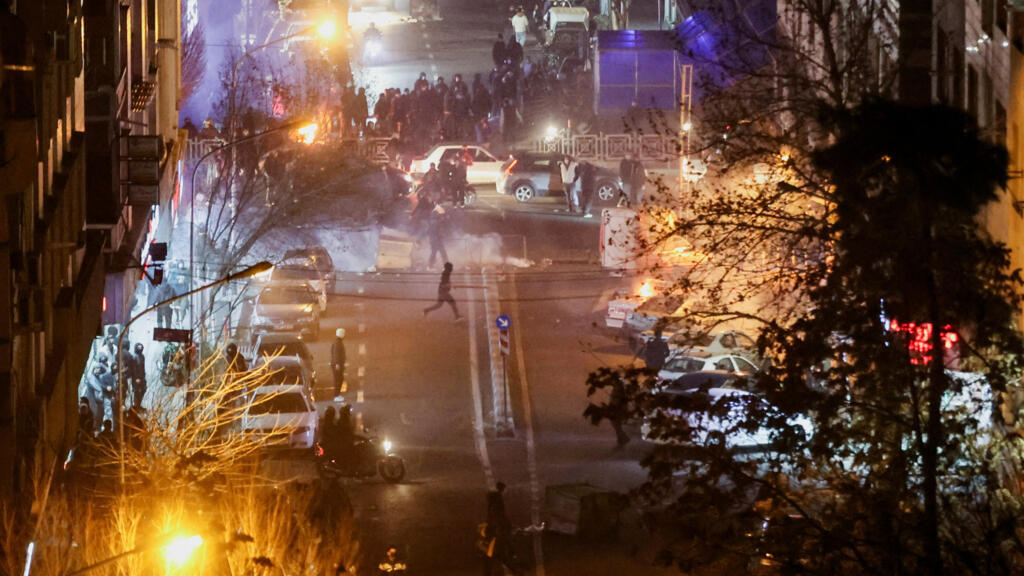
Iran has been largely shut off from the outside world since the authorities cut internet access last week in an attempt to smother massive nationwide protests against the country’s theocratic regime.
Activists say at least 2,637 people have been killed in a brutal crackdown on the protest movement, which kicked off in late December with demonstrations against crippling price rises before escalating into a broader challenge to Iran’s Islamist rulers.
FRANCE 24’s Mariam Pirzadeh spoke to a Tehran resident who took part in some of the largest protests between January 8-10, when the regime dramatically stepped up its deadly riposte.
The eyewitness, who spoke on condition of anonymity and has now sought refuge in Europe, described seeing paramilitary forces fire indiscriminately into the crowds of protesters, seemingly aiming to kill.
He also said he witnessed demonstrators call for the return of the shah, Iran’s pre-revolution monarch, and spoke of their hopes that US President Donald Trump would make good on his promise to come to the “rescue” of protesting Iranians.
Read his account below.
“I went out to protest on Thursday, January 8. There were so many people, I had never seen anything like it. There were millions of us in Tehran. I set off from a northern neighbourhood of the capital; there were people in every street, every thoroughfare. It was extraordinary.
There were mothers with strollers, lots of women, some in chadors (full-body garments that cover the head) shouting “Javid Shah!” (“Long live the shah!”), which was unimaginable for me to see. We were all shouting: “Death to the dictator, death to (Iran’s Supreme Leader Ali) Khamenei!”
There was obviously a lot of anger, but we were all peaceful protesters. We felt safe because there were so many of us, united. We told ourselves that they couldn't shoot us. The security forces were there, watching us.”
‘They aimed for the head and torso’
“I later learned that the security forces had assembled outside Tehran, in Karaj (a town northwest of the capital) in particular. At the end of the march, they opened fire.
The next day, on Friday, even more of us turned out to protest. And there were a lot of them (security forces) on the other side. They began by firing tear gas and flash-balls (a handheld projectile launcher) using metal pellets.
They rode motorcycles in pairs, one driving, the other shooting indiscriminately into the crowd. They aimed for the head and torso, to hit the protesters’ eyes and lungs. Everyone ran away, trying to regroup elsewhere.
05:22
The next day, there were more gatherings, with lots of young people. They were ready to fight, with stones in their hands, but the other side had machine guns.
The security forces changed their strategy on Saturday (January 10), riding their motorcycles into smaller streets where people gathered, shooting and then moving on to the next street. I was in a shop when I saw them firing machine guns and assault rifles at a group of people. Twelve people collapsed before my eyes, in a pool of blood.
A friend of mine lost his three children, ages 17, 20 and 23. He found the bodies of his two sons first, and later that of his daughter. She had been shot three times.
The Basij (pro-regime paramilitary force) demanded 400 million tomans per bullet, the equivalent of €2,700 (to recover her body). They said they would declare that she was a Basij, to inflate casualty numbers among the regime's forces, if he couldn't afford to pay.”
‘We are all thirsty for revenge’
“My friend refused. His relatives raised the money to recover the bodies of his three children. Everyone refuses, there is a real spirit of mutual aid.
The dead are so numerous they arrive in dozens of tipper trucks at the morgues and cemeteries. Everyone knows someone who has lost a loved one.
There is no turning back, we want to put an end to the Islamic Republic. I feel once again the atmosphere of the Islamic Revolution in 1979 (which toppled the previous regime).
At the airport, I saw families of regime officials leaving the country. It's impossible to quantify, but some are afraid. We’re living a revolution: We are all thirsty for revenge, we are filled with burning anger.
The only solution for Iranians I talk to, and myself, is Donald Trump: we are waiting for him, like the Messiah.”
This article was translated from the French original by Benjamin Dodman.
The Iranian authorities' crackdown on nationwide protests has largely quieted the movement for now, residents said, as US President Donand Trump appears to have backed down from his threats of attacking Iran's leadership. Trump claimed on Friday that Iran had called off mass executions, while state media said that protesters were still being arrested.
Issued on: 16/01/2026
FRANCE 24
Video by: Siavosh GHAZI
Iran's deadly crackdown appears to have broadly quelled protests for now, residents said on Friday, as state media reported more arrests in the shadow of repeated US threats to intervene if the killing continues.
US President Donald Trump, whose repeated threats to act had included a vow to "take very strong action" if Iran executed protesters, said Tehran's leaders had called off mass hangings.
"I greatly respect the fact that all scheduled hangings, which were to take place yesterday (Over 800 of them), have been cancelled by the leadership of Iran. Thank you!" he posted on social media.
Iran has not publicly announced plans for such executions or said it had cancelled them.
Iran protest movement subsides amid intense crackdown
01:12
The protests erupted on December 28 over economic hardship and swelled into widespread demonstrations calling for the end of clerical rule, culminating in mass violence at the end of last week.
According to opposition groups and an Iranian official, more than 2,000 people were killed in the worst domestic unrest since Iran's 1979 Islamic Revolution.
But several residents of Tehran reached by Reuters said the capital had now been comparatively quiet for four days.
Drones were flying over the city, but there had been no sign of major protests on Thursday or Friday. Another resident in a northern city on the Caspian Sea said the streets there also appeared calm. The residents declined to be identified for their safety.
Prospect of US attack retreats
The prospect of a US attack has retreated since Wednesday, when Trump said he had been told killings in Iran were easing. But more US military assets were expected to arrive in the region, showing the continued tensions.
US allies, including Saudi Arabia and Qatar, conducted intense diplomacy with Washington this week to prevent a US strike, warning of repercussions for the wider region that would ultimately impact the United States, a Gulf official said.
Israel's intelligence chief David Barnea was also in the US on Friday for talks on Iran, according to a source familiar with the matter, and an Israeli military official said the country's forces were on "peak readiness".
As an internet blackout eased this week, more accounts of the violence have trickled out.
The US is expected to send additional offensive and defensive capabilities to the region, but the exact makeup of those forces and the timing of their arrival was still unclear, a US official said speaking on condition of anonymity.
The US military's Central Command declined to comment, saying it does not discuss ship movements.
Pahlavi calls for increased pressure
Reza Pahlavi, the US-based son of Iran's last shah who has gained increasing prominence as an opposition figure, on Friday urged the international community to ramp up pressure on Tehran to help protesters overthrow clerical rule.
"The Iranian people are taking decisive action on the ground. It is now time for the international community to join them fully," said Pahlavi, whose level of support inside Iran is hard to gauge.
Trump this week appeared to downplay the idea of US backing for Pahlavi, voicing uncertainty that the exiled royal heir who has courted support among Western countries could muster significant backing inside Iran. Pahlavi met US envoy Steve Witkoff last weekend, Axios reported.
Iranian-Kurdish rights group Hengaw said that there had been no protest gatherings since Sunday, but "the security environment remains highly restrictive".
"Our independent sources confirm a heavy military and security presence in cities and towns where protests previously took place, as well as in several locations that did not experience major demonstrations," Norway-based Hengaw said in comments to Reuters.
Reports of sporadic unrest
There were, however, still indications of unrest in some areas. Hengaw reported that a female nurse was killed by direct gunfire from government forces during protests in Karaj, west of Tehran. Reuters was not able to independently verify the report.
The state-affiliated Tasnim news outlet reported that rioters had set fire to a local education office in Falavarjan County, in central Isfahan Province, on Thursday.
An elderly resident of a town in Iran's northwestern region, where many Kurdish Iranians live and which has been the focus for many of the biggest flare-ups, said sporadic protests had continued, though not as intensely.
Describing violence earlier in the protests, she said: "I have not seen scenes like that before."
Video circulating online, which Reuters was able to verify as having been recorded in a forensic medical center in Tehran, showed dozens of bodies lying on floors and stretchers, most in bags but some uncovered. Reuters could not verify the date of the video.
The state-owned Press TV cited Iran's police chief as saying calm had been restored across the country.
A death toll reported by U.S.-based rights group HRANA has increased little since Wednesday, now at 2,677 people, including 2,478 protesters and 163 people identified as affiliated with the government.
Reuters has not been able to independently verify the HRANA death toll. An Iranian official told the news agency earlier this week that about 2,000 people had been killed.
The casualty numbers dwarf the death toll from previous bouts of unrest that have been suppressed by the state, including in 2009 and 2022.
(FRANCE 24 with Reuters)
By AFP
January 16, 2026

Iranians outside of the counry have also protested against the government as it cracked down on rallies - Copyright AFP KAREN MINASYAN
Stuart Williams
The protest movement in Iran has subsided after a crackdown that has killed thousands under an internet blackout, monitors said Friday, one week after the start of the biggest protests in years challenging the Islamic republic’s theocratic system.
The threat of new military action by the United States against Iran has also appeared to have receded for the time being, with a Saudi official saying Gulf allies have persuaded President Donald Trump to give the Iranian leadership a “chance”.
Protests sparked by economic grievances started with a shutdown in the Tehran bazaar on December 28 but turned into a mass movement demanding the removal of the clerical system that has ruled Iran since the 1979 revolution.
People started pouring into the streets in big cities from January 8 but authorities immediately enforced a shutdown of the internet that has lasted over a week and activists say is aimed at masking the scale of the crackdown.
The repression has “likely suppressed the protest movement for now”, said the US-based Institute for the Study of War, which has monitored the protest activity.
But it added: “The regime’s widespread mobilisation of security forces is unsustainable, however, which makes it possible that protests could resume.”
Norway-based rights group Iran Human Rights (IHR) says 3,428 protesters have been verified to have been killed by security forces, but warns this could be a fraction of the actual toll.
Its director Mahmood Amiry-Moghaddam said authorities under supreme leader Ayatollah Ali Khamenei have “committed one of the gravest crimes of our time”.
He cited “horrifying eyewitness accounts” received by IHR of “protesters being shot dead while trying to flee, the use of military-grade weapons and the street execution of wounded protesters”.
Lama Fakih, programme director at Human Rights Watch, said the killings since last week “are unprecedented in the country”.
Monitor Netblocks said that the “total internet blackout” in Iran had now lasted over 180 hours, longer than a similar measure that was imposed during 2019 protests.
– ‘Give Iran a chance’ –
Trump, who backed and joined Israel’s 12-day war against Iran in June, had not ruled out new military action against Tehran and made clear he was keeping a close eye on if any protesters were executed.
But with the belligerent rhetoric on all sides appearing to tone down for now, a senior Saudi official told AFP on Thursday that Saudi Arabia, Qatar and Oman led “a long, frantic, diplomatic last-minute effort to convince President Trump to give Iran a chance to show good intention”.
While Washington appeared to have stepped back, the White House said Thursday that “all options remain on the table for the president”.
White House Press Secretary Karoline Leavitt told reporters Thursday that “the president understands today that 800 executions that were scheduled and supposed to take place yesterday were halted”.
Iran is the most prolific user of capital punishment after China. But there has been no suggestion from Iranian authorities — or rights activists who have repeatedly condemned a recent surge in hangings before the protest wave — that so many people were due to be executed in a single day.
Attention had focused on the fate of a single protester, Erfan Soltani, a 26-year-old who rights activists and Washington said was set to be executed as early as Wednesday.
The Iranian judiciary confirmed Soltani was under arrest but said he had not been sentenced to death and his charges meant he did not risk capital punishment.
– ‘All Iranians united’ –
Asked about a New York Times report that Israeli Prime Minister Benjamin Netanyahu warned Trump against strikes, Leavitt said: “Look, it’s true that the president spoke with (him), but I would never give details about their conversation without… the express approval by the president himself.”
The US Treasury also announced new sanctions targeting Iranian officials on Thursday including Ali Larijani, secretary of Iran’s Supreme Council for National Security.
Despite the internet shutdown, new videos from the height of the protests, with locations verified by AFP, showed bodies lined up in the Kahrizak morgue south of Tehran, as distraught relatives searched for loved ones.
At the UN Security Council in New York, Iranian-American journalist Masih Alinejad, invited to address the body by Washington, said “all Iranians are united” against the clerical system in Iran.
Iran’s representative at the meeting Gholamhossein Darzi accused Washington of “exploitation of peaceful protests for geopolitical purposes.”
Iran's internet shutdown inflicts $60mn daily economic losses

Iran's nationwide internet blackout is costing the country potentially $60mn daily as the shutdown enters its second week, with the cumulative damage already exceeding $700mn-$840mn, according to calculations based on macroeconomic data reported on January 16.
The nationwide connectivity cut commenced on January 8, following twelve days of nationwide protests. Following the government’s internet crackdown, protests continued to swell across major cities, including Astara, Shiraz, Isfahan, and the capital of Tehran.
The disruption has severed access to e-commerce platforms, online banking services and global trade networks as authorities maintain restrictions amid ongoing demonstrations. Iran's digital economy contributes between 6% and 6.5% of gross domestic product, valued at $27bn-$29bn annually from a projected 2026 GDP of $452bn, according to Emerging Markets intelligence research shared with bne IntelliNews.
With internet penetration at more than 80% across 92mn people, representing 73mn active users, the shutdown has eliminated digital sector output entirely, with those who use social media platforms particularly affected in recent days.
E-commerce platforms valued at $107bn in 2024 are facing significant disruption, with forecasts for 2025 projecting growth to $180bn by March 2026.
The sudden shutdown at the beginning of January forced people to use regular telephone lines inside the country to conduct business, which has dramatically damaged all sectors of the economy, the report noted.
Social media platforms including Instagram, Telegram and WhatsApp, which handle 83% of small business sales, remain blocked alongside broader internet access.
Payment processing volumes have declined between 50% and 90% during the outage, with limited offline alternatives available for small and medium enterprises, according to internal data.
Previous internet disruptions provide context for the current damage. A 2019 blackout cost Iran $1.5bn over one week, whilst restrictions between 2022 and 2023 tallied $1.6bn across 17 months.
Recent disruptions during a 2025 conflict with Israel resulted in $170mn losses over one month, Bloomberg reported in July.
The shutdown occurs as Iran confronts currency devaluation, trade challenges and protest-related capital flight wit the rial trading near an historic low of IRR1.42mn against the US dollar and above IRR1.65mn against the euro, the latest available data shows.
According to the EMI report, the technology sector is under pressure as startups close operations, undermining the government's ambitions to expand the digital economy's contribution to national output.
Protesters have had limited connectivity via Elon Musk's Starlink satellite services, though these appear to be few and far between and not used as part of a commercial connection for most businesses.
Two weeks of restrictions already represent 0.2% of projected annual GDP, according to monitoring data from Cloudflare.
Iran's ongoing internet blackout has exceeded 190 hours of continuous disruption, surpassing the core duration of the 2019 shutdown, according to NetBlocks' monitoring data earlier on January 16.
Most Iranian government websites still exist and function over the "National Information Network" or local intranet, but foreign networks, users will only reliably see stubs or gated front pages for a handful of top‑level portals and state media mirrors, with the bulk of .ir government content effectively dark to the outside world at present.
On January 12, Iranian security forces reportedly escalated their crackdown by conducting house-to-house searches to confiscate satellite dishes and Starlink internet equipment, targeting the limited technological resources available to citizens for accessing external communications.
The nationwide uprising against the religious dictatorship in Iran has reached its twentieth day on Friday, January 16, 2026. Following a nineteenth day marked by the revelation of over 50,000 arrests and the regime’s use of drones to hunt down civilians, the people have shown no signs of backing down.
On Friday, the brave people of Zahedan took to the streets once again, defying a massive security crackdown. Simultaneously, the mullahs’ regime faces deepening diplomatic isolation for its crimes against humanity.
Day 20 Roundup: PMOI identifies martyrs, Zahedan protests, and direct fire in Dezful
On Friday, January 16, 2026, the twentieth day of the uprising saw the Baluch compatriots in Zahedan challenging the regime’s authority, while the PMOI released the identities of brave Resistance Unit members killed by suppressive forces.
Key highlights from today include:
- PMOI Identifies Martyrs: The PMOI has released the names and details of several Resistance Unit members killed by regime fire, including an 18-year-old student in Tehran and three young workers in Kermanshah.
- Zahedan Uprising: Despite a heavy military siege and mass arrests, the people of Zahedan took to the streets after Friday prayers, chanting “Death to Khamenei” and “Death to the dictator.”
- Direct Fire in Dezful: Shocking video footage newly obtained from Dezful confirms that repressive forces used live ammunition in previous days, aiming directly at the heads of protesters in Sa’at Square.
- Record Internet Blackout: The total internet shutdown has now exceeded 180 hours, surpassing the duration of the 2019 blackout, with no sign of restoration.
- Portugal Closes Embassy: In a blow to the regime’s diplomatic standing, Portugal announced the temporary closure of its embassy in Tehran due to the “context of tension.”
- US Congress Support: 59 bipartisan Members of Congress sent a letter rejecting both the current theocratic regime and the former monarchical dictatorship, supporting a secular, democratic republic.
PMOI publishes names of Resistance Unit members killed by regime
As the regime attempts to hide the true cost of the uprising behind an internet blackout, the People’s Mojahedin Organization of Iran (PMOI/MEK) continues to break through the censorship. The PMOI has identified several members of its Resistance Units who have been killed by direct regime fire during the protests.
These martyrs, ranging from university students to young workers, exemplify the courage of a generation determined to end the dictatorship. The identified martyrs are:
- Zahra (Raha) Bohlouli-Pour: 18 years old, a student at the University of Tehran. She was shot dead on January 8, 2026, in Fatemi Street, Tehran.
- Yasin Mirzaei Qaleh Zanjiri: A student shot dead on January 8, 2026, in Kermanshah.
- Reza Ghanbari: 17 years old, a worker. He was killed during clashes on January 3, 2026, in Kermanshah.
- Rasoul Kadivarian: 17 years old, a worker. He was killed during clashes on January 3, 2026, in Kermanshah.
- Reza Kadivarian: 20 years old, a worker. He was killed during clashes on January 3, 2026, in Kermanshah.
- Diar Pour-Chehriq: 32 years old, self-employed, from Salmas. He was shot dead on January 9, 2026, at Keshavarz Boulevard in Tehran.
Zahedan: “Death to Khamenei” echoes despite martial law atmosphere
On Friday, January 16, the brave people of Zahedan turned the weekly Friday prayers into a major protest against the regime. Reports indicate that the city has been under a heavy security siege for days.
The regime deployed a large number of forces around the Makki Mosque to control the crowds. Checkpoints were established at the city’s entrances and main streets, where citizens were subjected to body searches and inspection of their mobile phones.
Despite these repressive measures and the ongoing wave of arrests, citizens took to the streets after prayers, chanting “Death to Khamenei.” Mrs. Maryam Rajavi, President-elect of the National Council of Resistance of Iran (NCRI), saluted the people of Zahedan, stating that their demonstration “stands as a clear expression of the Iranian people’s firm resolve to bring down this criminal regime.”
Crimes against humanity in Dezful: Shooting to kill
Harrowing video footage obtained from Dezful, Khuzestan province, reveals the sheer brutality of the regime’s forces. In Sa’at Square (Imam Square), armed agents were filmed firing live ammunition directly at unarmed protesters. The footage indicates that the forces were aiming specifically at the heads of the demonstrators without any prior warning.
Diplomatic Isolation: Portugal closes embassy; US Congress rejects Shah and Mullahs
The international community is increasingly isolating the regime. Portugal has announced the closure of its embassy in Tehran, citing “tension” and the violent repression of demonstrations. The Portuguese Foreign Minister also stated readiness to join EU sanctions against the regime.
Meanwhile, a significant bipartisan letter from 59 U.S. Members of Congress to State Secretary Marco Rubio has clarified the stance of the American legislature regarding Iran’s future. The lawmakers emphasized that the Iranian people want a “secular, democratic, non-nuclear republic” and explicitly noted that Iranians have “rejected all forms of authoritarian rule, whether Iran’s former monarchy dictatorship or its current theocratic system.”
Global condemnation continues to pour in. Marko Mihkelson, Chairman of the Foreign Affairs Committee of the Estonian Parliament, described the current crackdown as “the bloodiest suppression of protests in modern history,” while Australian Foreign Minister Penny Wong condemned the brutality and advised Australians to leave Iran.
Internet blackout exceeds 2019 record
As the regime attempts to conceal its crimes, the internet blackout in Iran has now surpassed the duration of the infamous 2019 shutdown. NetBlocks confirmed that after 180 hours, there is still no restoration of connectivity. It is worth noting that in 2019, the true scale of the massacre only became known after the internet was restored.
A timeline of events in Iran: From cost-of-living protests to political revolt
Issued on: 15/01/2026
Iranians began taking to the streets in late December. What initially began with protests against the spiralling cost of living has grown into a nationwide protest movement against the country's theocracy led by Ayatollah Ali Khamenei. In response, authorities have cracked down hard. Will these protests lead to the end of the regime that has ruled Iran for 45 years? Our France 2 colleagues chronicle the events of the last two weeks, with FRANCE 24's Lauren Bain.
No comments:
Post a Comment