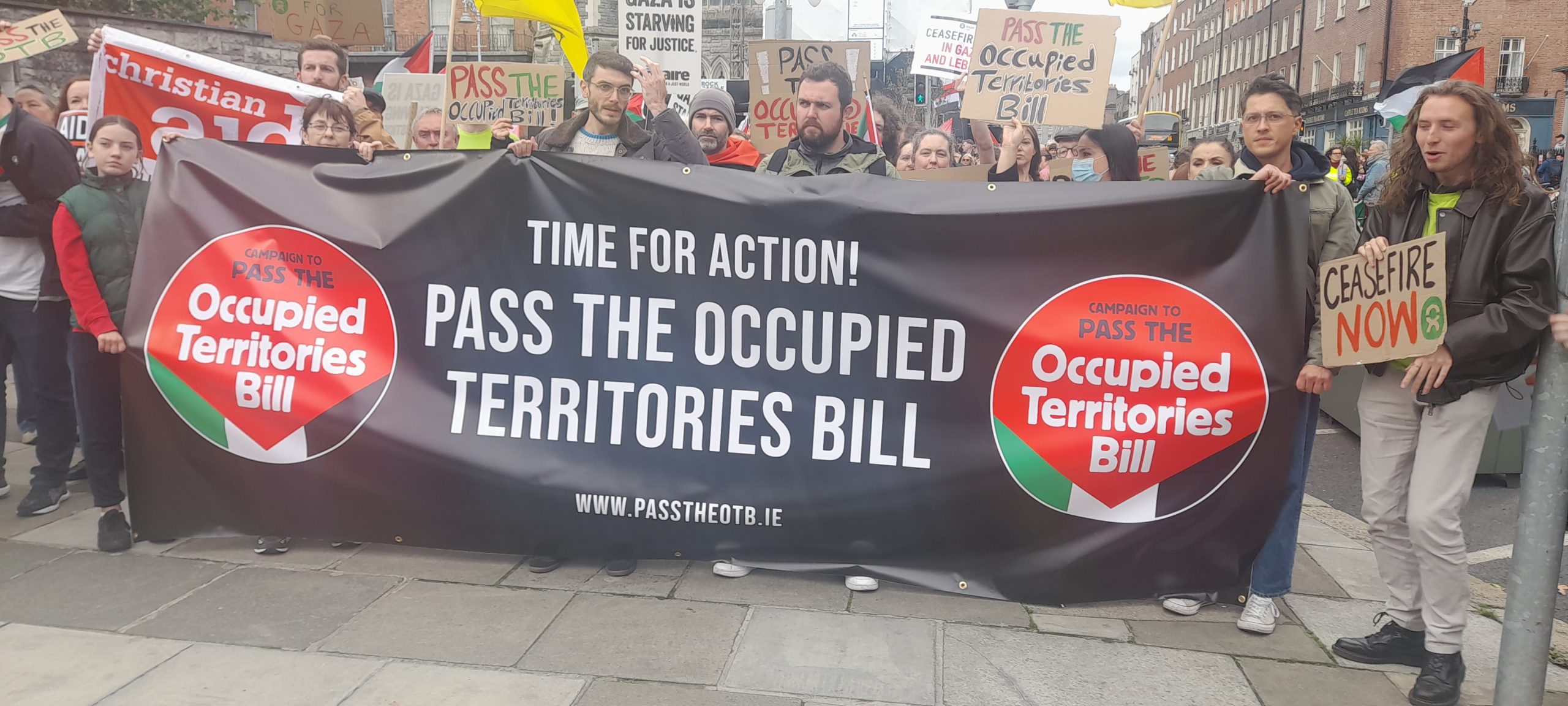
Since the start of Israel’s genocide in Gaza, the Irish people have been pounding the streets week after week in solidarity with Palestine, calling on their government to live up to promises made to implement the Occupied Territories Bill (OTB). This is legislation that would prohibit the importation into Ireland of goods and services from illegal Israeli colonies in the occupied West Bank. Both government parties (Fianna Fáil and Fine Gael) pledged to implement the OTB in their election manifestoes ahead of the November 2024 general election but since returning to power have stalled legislation and threatened to dilute the bill by removing trade in services. This is despite the Tánaiste (deputy prime minister), Simon Harris, describing an International Court of Justice (ICJ) July 2024 ruling on the illegality of settlements as a ‘game changer’. The ICJ placed an obligation on all states ‘not to render aid or assistance in maintaining the situation created by Israel’s illegal presence in the Occupied Palestinian Territory’. The ruling provided the Irish state with a legal prerogative and greater urgency to implement the OTB having prevaricated at length on the bill being at odds with European Union law. But Ireland’s Attorney General, Rossa Fanning, confirmed the Bill’s legality in 2024 which should have been the green light for implementation. But unlike Spain and Slovenia which have become the first European countries to sanction Israel, Ireland has failed to move beyond symbolic forms of support like recognising the state of Palestine in May 2024.
Profit over principle
So, why is Ireland dragging its feet on the OTB? Well, it seems that the Irish government is caving to warnings from Washington that passing the OTB would ‘cause economic uncertainty for almost 1,000 US companies operating in Ireland’. The Irish economy runs a significant trade surplus with the US which the Dublin government feared would result in punitive tariffs from the Trump administration if it passed the OTB. Although the Irish government reneged on its electoral pledge to implement the OTB, it was still hit with a 20 percent tariff as part of measures imposed by Trump on the EU. So, passing the OTB would arguably have made no difference to Trump’s tariff regime. More importantly, if it had passed the OTB, Ireland would have taken a principled position of standing in solidarity with Gaza where 71,000 Palestinians have been killed since 7 October 2023 and more than 400 killed since a ‘ceasefire’ was introduced on 10 October 2025.
But not only did Ireland forestall implementation of the OTB, it announced in January 2025 its endorsement of the International Holocaust Remembrance Alliance’s (IHRA) non-legally binding working definition of antisemitism. The IHRA working definition, as highlighted by UN representatives, Jewish scholars and Palestine Legal is deeply problematic and controversial owing to its conflating antisemitism with legitimate criticism of Israel’s policies vis-a-vis Palestinians. Amnesty International argued that the IHRA definition ‘has been weaponised to suppress criticism of human rights violations by the Israeli authorities’ and called for it to be withdrawn. In January 2025, the communications firm Edelman published a trust barometer based on surveys in 28 countries including Ireland. It found that 61 percent of respondents have a moderate or higher sense of grievance defined by a belief that government and business ‘make their lives harder and serve narrow interests’. This can hardly be a shock to government leaders in Ireland given their bad faith in failing to implement an electoral pledge to pass the OTB.
A complicit ‘third state’
In her latest report, Francesca Albanese, the UN rapporteur for the occupied Palestinian Territories, finds that Israel’s largest dual-use trade is with Ireland in integrated circuits valued at $3.2 billion in 2024. She writes that ‘Gaza is a collective crime, sustained by the complicity of influential Third States that have enabled longstanding systemic violations of international law by Israel’. Ireland is one of the ‘Third States’ named in the report and is cited not only for trading in dual-use items with Israel but enabling the use of Shannon Airport as a transit point by the United States military in contravention of Irish neutrality. Shannonwatch, a group of peace and human rights activists that monitors US military and military contracted aircraft that land at Shannon Airport or travel through Irish airspace, have reported a ‘flagrant abuse of Irish neutrality on a daily basis’. Moreover, The Ditch web site found that Israel had illegally transported ‘over a tonne of handguns’ through Irish airspace in January 2025. The same site found that another Israeli flight carrying munitions had flown through Irish airspace on 29 April 2025.
‘If Ireland acted according to international law’, said Francesca Albanese on a visit to Ireland in March 2025, ‘it probably wouldn’t need an Occupied Territories Bill’. But far from complying with the provisions of the ICJ ruling and taking what is really a minimal position of stopping trade with illegal colonies, Ireland has maintained ‘business as usual’ with Israel. At every wheel and turn of the genocide in Gaza, it has asserted economic precedence over action in solidarity with Palestinians. By doing so it has recklessly undermined international law, damaged its standing as a champion of the global South through its overseas aid programme and UN peacekeeping missions, and created distrust toward government among the Irish electorate. In a statement to the UN on the 77th anniversary of the Nakba, Noura Erakat, Professor of Africana studies and Criminal Justice at Rutgers University said:
“By relegating Palestine to a bilateral political issue beyond the reach of international norms, you have steadily normalized occupation. By failing to apply sanctions and engage in boycott, many of you normalized apartheid and now by failing to act, you are at risk of normalizing genocide”.
If there is no accountability for governments and corporations that trade with Israel, supply it with arms, goods and services, and continue to profit from occupation and genocide in Palestine then even more depraved violence will become normalised. Across the world, an enormous coalition of activists and civil society organisations has advanced the cause of Palestine by following the lead of the Palestinian-led BDS Movement like the striking port workers who have disrupted Israeli supply chains. With enough public support, this kind of activism can change the way politics are done everywhere to end state complicity with Israel’s settler colonialism of Palestine.
On 24 October 2025, Ireland elected a president, Catherine Connolly, who stood on a platform that condemned Israel’s genocide and strongly supported Irish neutrality. Connolly positioned herself as being part of a movement working toward a ‘new Republic’ connected to social values and political ideas that made it seem tangible rather than aspirational. She had overwhelming support among young voters, and her campaign was backed by a united alliance of political parties on the left in the Irish parliament. It was a firm indicator of a political shift to the left in Ireland and with it a hope that public support for Palestine can be converted into meaningful state action for Palestinians.
No comments:
Post a Comment