SPACE/COSMOS
Where The Elements Come From

Why are we here?” is humanity’s most fundamental and persistent question. Tracing the origins of the elements is a direct attempt to answer this at its deepest level. We know many elements are created inside stars and supernovae, which then cast them out into the universe, yet the origins of some key elements has remained a mystery.
Chlorine and potassium, both odd-Z elements — possessing an odd number of protons — are essential to life and planet formation. According to current theoretical models, stars produce only about one-tenth the amount of these elements observed in the universe, a discrepancy that has long puzzled astrophysicists.
This inspired a group of researchers at Kyoto University and Meiji University to examine supernova remnants for traces of these elements. Using XRISM — short for X-Ray Imaging and Spectroscopy Mission, an X-ray satellite launched by JAXA in 2023 — the team was able to perform high-resolution X-ray spectroscopic observations of the Cassiopeia A supernova remnant within the Milky Way.
The scientists utilized the microcalorimeter Resolve device onboard XRISM, providing high energy resolution an order of magnitude better than previous X-ray detectors, which allowed them to detect faint emission lines from rare elements. They then analyzed the X-ray spectrum from Cassiopeia A and compared the abundances of chlorine and potassium with several supernova nucleosynthetic models.
The team discovered clear X-ray emission lines of both elements at abundances far higher than predicted by standard supernova models. This provided the first observational evidence that a supernova can create sufficient chlorine and potassium. The team suggests that strong mixing inside massive stars caused by fast rotation, binary interaction, or shell-merger events, can significantly enhance the production of these elements.
“When we saw the Resolve data for the first time, we detected elements I never expected to see before the launch. Making such a discovery with a satellite we developed is a true joy as a researcher,” says corresponding author Toshiki Sato.
These results reveal that the elements vital for life were produced in harsh, intense environments deep inside stars, far removed from anything resembling the conditions needed for life to emerge. The study also demonstrates the power of high-precision X-ray spectroscopy for probing the origins of elements and physical processes deep inside stars.
“I am delighted that we have been able, even if only slightly, to begin to understand what is happening inside exploding stars,” says corresponding author Hiroyuki Uchida.
Next, the team plans to observe other supernova remnants with XRISM to determine whether the enhanced production of chlorine and potassium is common among massive stars or unique to Cassiopeia A. This will help reveal whether such internal mixing processes are a universal feature of stellar evolution.
“How Earth and life came into existence is an eternal question that everyone has pondered at least once. Our study reveals only a small part of that vast story, but I feel truly honored to have contributed to it,” says corresponding author Kai Matsunaga.
Could the Next Solar Flare Cripple Modern Technology?
- The Van Allen radiation belts, massive regions of charged particles trapped by Earth's magnetic field, have become "fully charged" due to repeated solar storms.
- A space weather observer warns that the next major solar storm could cause the energetic plasma in the belts to precipitate toward the planet's upper atmosphere.
- Intense solar storms pose a significant threat to modern infrastructure, potentially causing major disruptions to satellites, GPS, radio communications, and other space-based operations.The Van Allen radiation belts are massive, doughnut-shaped regions of charged particles trapped by Earth's magnetic field. When the Sun blasts Earth with strong solar wind or solar storms, energetic particles are injected into these belts, increasing their overall energy levels.
Now, the Van Allen radiation belts are "fully charged," according to space weather observer Stefan Burns. He warns that these belts of energetic particles have been building up due to repeated solar storms over the past few months.
"The next solar storm to hit could cause this plasma to precipitate downward toward the planet's upper atmosphere," Burns said.
The effects of intense solar storms are particularly significant for satellites, GPS, radio communications, and space operations, where disruptions can occur.
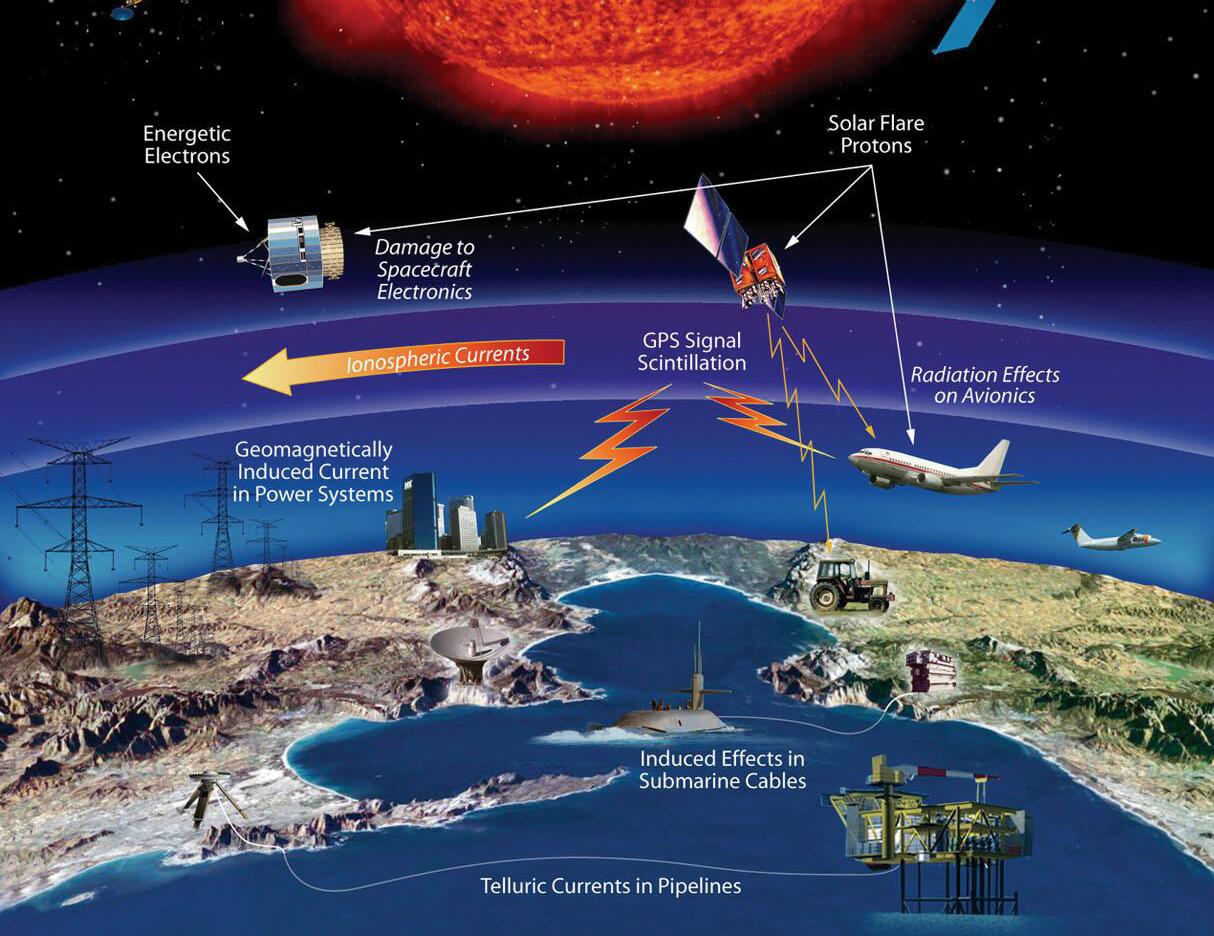
With growing discussion around space-based data centers and rapidly expanding satellite internet constellations, the question arises: can a modern society built on fragile semiconductors withstand repeated X-class solar flares or a Carrington-class coronal mass ejection?
By Zerohedge
Joint ground- and space-based observations reveal Saturn-mass rogue planet
Summary author: Walter Beckwith
Simultaneous ground- and space-based observations of a newly discovered free-floating planet have enabled direct measurement of its mass and distance from Earth, according to a new study. The findings offer insights into the diverse and dynamic pathways by which planets can be cast adrift into interstellar space. Although studies to date have only revealed a handful of such free-floating planets, detections are expected to increase in the coming years, particularly with the NASA Nancy Grace Roman Space Telescope campaign that is scheduled for launch in 2027, notes Gavin Coleman in a related Perspective. “Simultaneous space- and ground-based observations of microlensing events could be applied in the planning of future exploratory missions and could lead to a better understanding of how planets form across the Galaxy.”
Planets are most often found bound to one or more stars, yet a growing body of evidence shows that some wander the galaxy alone. These objects, called free-floating or rogue planets, lack any known stellar companion. And, since they don’t emit very much light, they reveal themselves only through their subtle gravitational effects – a phenomenon called microlensing. One of the main limitations of this discovery method is that it cannot determine the distance to these planets, making independent measurement of their mass difficult. As a result, much about this elusive population of solitary worlds remains speculative.
Here, Subo Dong and colleagues report the discovery of a new free-floating planet detected via a fleeting microlensing event. However, unlike previous detections, Dong et al. uniquely observed this microlensing event simultaneously from both Earth and space, using several ground-based surveys alongside the Gaia space telescope. Tiny differences in the timing of the light reaching these distantly separated vantage points enabled measurement of the microlensing parallax, which, when combined with finite-source point-lens modeling, allowed the authors to determine the planet’s mass and location. It is ~22% the mass of Jupiter and roughly 3,000 parsecs from the center of the Milky Way. Because this planet’s mass is comparable to that of Saturn, Dong et al. argue that it likely formed within a planetary system, rather than in isolation like a small star or brown dwarf. Such low-mass rogue planets are thought to be born around stars and later expelled from their orbital confines through gravitational upheavals, such as interactions with neighboring planets or unstable stellar companions.
Journal
Science
Article Title
A free-floating-planet microlensing event caused by a Saturn-mass object
Article Publication Date
1-Jan-2026
No comments:
Post a Comment