HMM and HD KSOE Start Demonstration and Testing of Wing Sail on Tanker
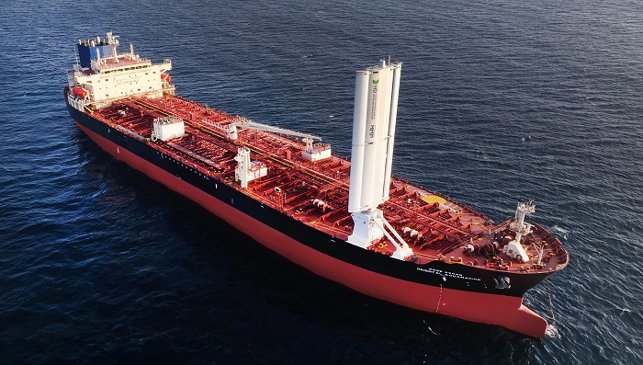
South Korea’s HD Korea Shipbuilding & Offshore Engineering and HMM are starting a demonstration and test period for Korea’s first domestically developed wing sail for wind-assisted propulsion. The shipbuilder has been developing its version of the technology as part of its efforts to advance value-added, green ship designs and technology.
The wing sail was recently installed on the product tanker Oriental Aquamarine (50,000 dwt). The vessel was built in 2020 and has been owned by HMM since 2023. Registered in Liberia, it is 183 meters (600 feet) in length.
Over the next two years, HMM reports it plans to assess the performance of wing sail based on actual operational data and, subject to the results, expand its installation across its entire bulk fleet. The company highlights that the technology is particularly suited to vessels that do not carry deck cargo, such as bulk carriers and tankers. It projects a fuel saving of between 5 and 20 percent with the deployment of wind-assisted technology.
HD KSOE reported in 2021 that it had been awarded an Approval in Principle from DNV as it worked to develop its wind-assisted technology concept for a wing sail. It reports that the design has undergone structural safety and basic performance verification through onshore demonstrations.
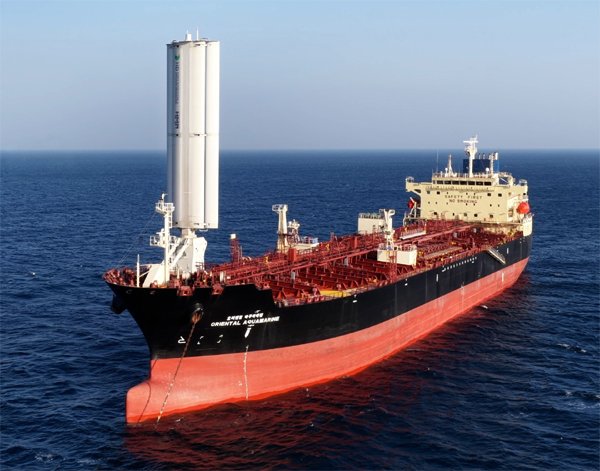
HMM plans to analyze the data as it looks to expand the technology across its fleet (HMM)
The version installed on the MR tanker is 30 meters (98 feet) high and 10 meters (33 feet) wide. In addition to the main sail, it uses auxiliary wings on both sides to enhance utilization efficiency. It also features a tilting function, which allows the wings to be folded during inclement weather or to increase air draft.
The shipbuilder reports that recent sea trials have confirmed normal operation. It has also undergone inspection by the Korean Register. They report that the data from this demonstration will be precisely analyzed to understand the operating characteristics of the wing sail in a real-world marine environment. They expect to use this data to develop commercial models of the technology.
Analysts expect wind-assisted propulsion to continue to grow in application as it requires relatively low capital expense and adds incremental fuel and emissions savings. They report that installations are doubling annually, nearing 100 large vessels equipped by year-end.
Lockheed Martin and Saildrone: Accelerating Maritime Readiness at Scale
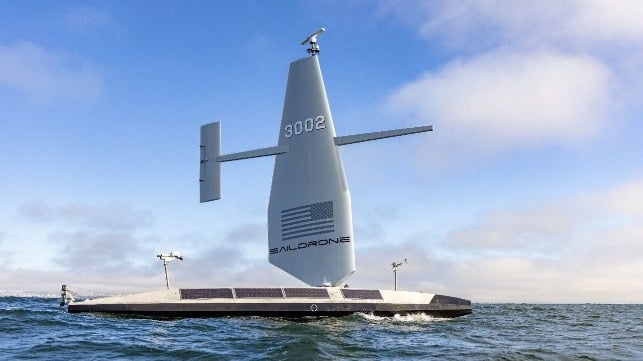
[By: Lockheed Martin]
With a $50 million investment in Saildrone, Lockheed Martin is forging a strategic collaboration to rapidly scale unmanned maritime defense capability.
Together, the companies will pair Saildrone’s proven unmanned surface vessel (USV) platforms with Lockheed Martin’s combat-tested defense tech and mission integration expertise —delivering powerful, defense-ready USVs to the fleet faster.
Anticipating Needs. Accelerating Capability
Saildrone’s USVs are built for endurance and autonomy. Their long-established track record includes more than a decade operating in remote, open-ocean environments, with millions of nautical miles logged. First deployed by the U.S. Navy in 2021, they are currently operational today, working around the clock, 365-days alongside American Sailors in combat theaters across the globe.
Recently, after months-long use of Saildrone’s USVs, more than 130,000 nautical miles over 2,700 cumulative mission days were logged with 116,000 unique contacts detected.
Starting with the JAGM Quad Launcher on Saildrone’s Surveyor platform, Lockheed Martin is integrating its defense payloads to transform commercial-grade autonomy into a multi-mission maritime solution capable of fleet defense, undersea surveillance, reconnaissance and strike.
Speed, Scale and Readiness
The partnership is designed to accelerate the Navy’s unmanned vision at scale. The teams will begin work immediately, integrating the JAGM Quad Launcher onto the Saildrone Surveyor and expanding to additional Lockheed Martin payloads across multiple platforms.
Lockheed Martin’s investment helps mitigate risk on the path to Distributed Maritime Operations and supports the Navy’s drive for affordable mass by 2027. The open-architecture approach and secure command-and-control framework ensure rapid, reliable integration while preserving security and interoperability.
By anticipating needs before they become requirements, this forward-looking approach reinforces Lockheed Martin’s commitment to turning innovation into decisive advantage for the United States and its allies.
What’s Next
Lockheed Martin and Saildrone plan to deliver proof-of-concept integrations and live fire demonstrations in 2026. Larger Saildrone vehicles are already in development to support significantly larger payloads and capabilities to include Lockheed Martin’s Mk70 VLS launcher and thin line towed arrays.
The strategic relationship brings together the best of commercial and defense technologies to deliver unparalleled naval solutions at speed and scale.
The products and services herein described in this press release are not endorsed by The Maritime Executive.
Dalian Shipbuilding's Wind-Assisted LNG Carrier Secures Bureau Veritas AiP
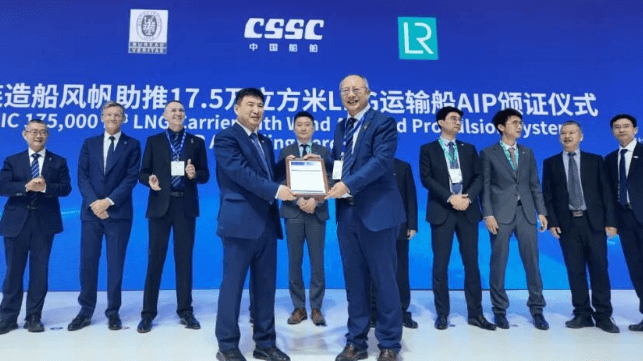
[By: Bureau Veritas]
Dalian Shipbuilding Industry Co., Ltd. (DSIC) has unveiled a new generation of decarbonization-focused vessel designs, including a wind-assisted 175,000 m³ LNG carrier that has received Approval in Principle (AiP) from Bureau Veritas Marine & Offshore (BV). The endorsement confirms the technical feasibility and regulatory readiness of integrating wind-assisted propulsion into mainstream LNG carrier operations.
Developed by DSIC, the wind-assisted LNG carrier introduces an integrated solution combining LNG dual-fuel propulsion with sail-assisted technology, offering a practical and cost-controlled upgrade pathway for the global fleet of 175,000 m³ LNG carriers. The concept is designed to deliver improved energy efficiency while maintaining operational reliability and ease of maintenance.
The vessel is equipped with three next-generation foldable wing sails based on proprietary technology. Manufactured using lightweight composite materials, the sails feature independent folding and rotation functions. An intelligent monitoring and control system continuously collects route-specific wind data and automatically adjusts sail angles in real time, ensuring optimal performance across different operating conditions.
On typical trading routes, the design is expected to achieve more than a 5% reduction in overall energy consumption and cut annual CO? emissions by approximately 2,900 tons. The resulting Energy Efficiency Design Index (EEDI) is projected to be around 58% below the baseline, supporting compliance with the IMO’s greenhouse gas reduction strategy while enhancing long-term asset value and competitiveness for shipowners.
As part of the AiP process, BV carried out targeted assessments covering structural strength, material durability, and operational safety to confirm the design’s suitability for demanding ocean-going LNG transport. The review also verified the technical feasibility of the vessel’s energy-efficiency objectives against the latest IMO standards.
The AiP marks another step in the long-standing cooperation between BV and DSIC in advancing low-carbon ship innovation. Building on previous collaboration in LNG carriers and alternative-energy vessels, both parties continue to support the transition of green ship concepts from design to commercial application, contributing to the sustainable development of LNG shipping.
The products and services herein described in this press release are not endorsed by The Maritime Executive.
No comments:
Post a Comment