It’s possible that I shall make an ass of myself. But in that case one can always get out of it with a little dialectic. I have, of course, so worded my proposition as to be right either way (K.Marx, Letter to F.Engels on the Indian Mutiny)
Bruce C project 'would boost GDP by CAD238 billion'
The proposed 4,800 MW Bruce C new nuclear project would contribute CAD238 billion (USD172 billion) over its lifetime to Canada's economy, according to a new study.
The Bruce site (Image: Bruce Power)
The figures come in the summary of findings of the Bruce C Economic Impact Assessment study by the Ontario Chamber of Commerce for Bruce Power and the Nuclear Innovation Institute.
It says that during the proposed plant's 80-year lifespan, it would contribute more than CAD217 billion to the province of Ontario's gross domestic product. During site preparation and construction it would create or support 18,900 jobs nationally, of which 15,900 would be in Ontario. During operations those figures are put at 6,700 jobs nationally and 5,900 in Ontario.
Stephen Lecce, Ontario Minister of Energy and Mines, said: "Ontario's nuclear advantage is powering our future and showcasing the very best of Canadian technology, resources, and workers … it is clear that Bruce Power C is essential to Ontario’s energy and economic future, as we build on-time and on-budget."
James Scongack, Bruce Power's Chief Operating Officer and Executive Vice-President, said: "The Ontario Chamber of Commerce independent economic impact analysis confirms what our communities already know - Bruce C has the potential to be a once‑in‑a‑generation economic engine."
Luke Charbonneau, Bruce County Warden and Mayor of the Town of Saugeen Shores, said: "The economic benefits, training opportunities, and long-term jobs will make life better for families and businesses throughout our region for decades."
Background
The Bruce site, 18 kilometres north of the town of Kincardine in Bruce County, is home to eight operating Candu units: units 1-4 are known together as Bruce A and units 5-8 as Bruce B. The new project would be sited within the existing 932-hectare site, with new intake and discharge structures in Lake Huron. Alternative cooling strategies will be evaluated as part of the impact assessment process.
Bruce Power formally notified Canadian regulators of its intention to launch an Impact Assessment process for up to 4,800 MWe of new capacity at the Bruce site in October 2023. The federal government announced CAD50 million of funding in February 2024 to support pre-development feasibility work. In August 2025 the Impact Assessment Agency of Canada, in collaboration with the Canadian Nuclear Safety Commission, issued the formal Notice of Commencement of Impact Assessment under the country’s Impact Assessment Act.
With nuclear currently responsible for 50% of Ontario's total generation and hydro contributing 24%, Ontario already has one of the cleanest grids in the world and the Energy for Generations plan published in June 2025 sees nuclear power - including required new capacity - "continuing to serve as the backbone of the province's electricity system providing the 24/7 baseload power the province's economy requires" as demand continues to rise.
Government funding for Saskatchewan SMR test facility
Western Canada's first Small Modular Reactor Safety, Licensing, and Testing Centre at the University of Regina is to receive nearly CAD6 million (USD4.3 million) in funding from the federal and provincial governments.
The funding was announced on 19 January - speaking is SaskPower CEO Rupen Pandya (Image: SaskPower)
The facility - the SMR-SLT - will be located at the Innovation Saskatchewan Research and Technology Park. It will house two test loops that simulate a part of a small modular reactor (SMR), modelling water-cooled systems using electrical heat, allowing researchers to test components under conditions similar to those in operating reactors.
The funding was announced by Buckley Belanger, Canada's Secretary of State (Rural Development), on behalf of Minister of Emergency Management and Community Resilience and Minister responsible for Prairies Economic Development Canada Eleanor Olszewski. The federal government is investing CAD1.96 million (USD1.4 million) in the SMR-SLT through Olszewski's department, PrairiesCan - a federal government department supporting business growth, innovation and community economic development across Alberta, Saskatchewan and Manitoba.
Provincial government support for the project is through SaskPower, the principal supplier of electricity in Saskatchewan, and a Crown Corporation - a commercial entity owned by the Government of Saskatchewan. It will be investing CAD4 million in the SMR-LT.
"Small modular nuclear reactors represent a fantastic opportunity for clean, low-emitting power, for good jobs, and for long-term economic growth right across the nuclear supply chain and across Saskatchewan," Belanger said. "Our province is already home to some of the largest uranium reserves on the planet, and Saskatchewan has huge potential to establish itself as a leader in Canadian nuclear power - but none of that happens unless we get the first step right. Making sure nuclear development can happen safely, responsibly, and under strong regulation is essential, and that's exactly what this investment in the University of Regina's SMR Safety, Licensing and Testing centre is all about."
"The Testing Centre will help to further establish Saskatchewan as a hub for nuclear excellence, advancing nuclear research, and supporting a local nuclear workforce and supply chain," said Jeremy Harrison, Minister Responsible for SaskPower. "Nuclear power is central to our Government's energy security strategy, which is why we are making the necessary investments to support industry readiness in the province."
Innovation Saskatchewan is contributing CAD1 million plus an in-kind contribution of the leased space at the Innovation Saskatchewan R+T Park for the first three years of operation. Canadian Nuclear Laboratories (CNL) will also provide in-kind design support. The centre will be led by University of Regina researchers, with the Global Institute for Energy, Minerals and Society (GIEMS) partnership between the University of Regina, University of Saskatchewan, and Saskatchewan Polytechnic playing a key role to ensure all three institutions have access to the test loops for training and research, SaskPower said.
The government of Saskatchewan signalled its commitment to incorporating nuclear capacity into its provincial electricity system in a long-term policy document released last year. SaskPower has previously selected GE Hitachi Nuclear Energy's BWRX-300 SMR for potential deployment in the province in the mid-2030s and has identified two potential sites for SMR deployment, both in the Estevan area in the south-east of the province.
According to PrairiesCan, the new test centre project will create 18 direct jobs, support 10 small businesses, and train a highly skilled workforce, while advancing Saskatchewan's preparation for the estimated 2,500 to 3,500 jobs required to build and operate nuclear power plants by the mid-2030s.
Arthur Situm, Canada Research Chair in SMR Safety and Licensing at the University of Regina, said the facility will help train the next generation of nuclear professionals by providing hands-on experience with safety systems and processes that define modern nuclear technology.
"Together, this work positions the University of Regina and Saskatchewan as a leader in safe, responsible, small modular reactor research with a global impact," he said on YouTube.
Tepco restarts Kashiwazaki-Kariwa reactor
Japan's Tokyo Electric Power Company announced it has begun the process of restarting unit 6 at its Kashiwazaki-Kariwa nuclear power plant, which has been offline for almost 14 years.
The Kashiwazaki-Kariwa plant (Image: Tepco)
"Today, we received approval from the Nuclear Regulation Authority (NRA) to begin test operation of the reactor to confirm the integrity of the equipment, including a pre-operational operator inspection to be conducted after reactor startup," the company said. "After submitting a pre-operational inspection change application on 24 December 2025, we proceeded with preparations for reactor startup, and at 19:02 [local time] today, we withdrew the control rods and started up the reactor."
Tokyo Electric Power Company (Tepco) had planned to restart Kashiwazaki-Kariwa 6 on Tuesday, but on Monday announced that it had postponed the restart due to an issue with a safety alarm, which has since been rectified.
The seven-unit Kashiwazaki-Kariwa plant was unaffected by the March 2011 earthquake and tsunami which damaged Tepco's Fukushima Daiichi plant, although the plant's reactors were previously all offline for up to three years following the 2007 Niigata-Chuetsu earthquake, which caused damage to the site but did not damage the reactors themselves. While the units were offline, work was carried out to improve the plant's earthquake resistance. All units have remained offline since the Fukushima Daiichi accident.
Although it has worked on the other units at the Kashiwazaki-Kariwa site, Tepco is concentrating its resources on units 6 and 7 while it deals with the clean-up at Fukushima Daiichi. These 1356 MWe Advanced Boiling Water Reactors began commercial operation in 1996 and 1997, respectively, and were the first Japanese boiling water reactors to be put forward for restart. Tepco received permission from the Nuclear Regulation Authority to restart units 6 and 7 in December 2017. Restarting those two Kashiwazaki-Kariwa units - which have been offline for periodic inspections since March 2012 and August 2011, respectively - would increase the company's earnings by an estimated JPY100 billion (USD633 million) per year.
The governor of Japan's Niigata Prefecture, Hideyo Hanazumi, gave his approval for the restart of Kashiwazaki-Kariwa units 6 and 7 in November last year, with the Prefectural Assembly backing his decision in December.
Tepco is prioritising restarting Kashiwazaki-Kariwa unit 6, where fuel loading was completed in June last year. The company has until September 2029 to implement anti-terrorism safety measures at unit 6. Kashiwazaki-Kariwa 6 would become the first reactor owned by Tepco to restart following the Fukushima Daiichi accident.
"We will continue to confirm the integrity of the plant equipment while actually using steam, and will respond diligently to the NRA's inspection," Tepco said. "As this is the first operation in approximately 14 years, we will carefully proceed with each step of the plant equipment integrity check. We will take appropriate action if we notice any issues and will provide thorough information on the status of each startup process."
International safety assessments of Finnish, French SMRs
Nuclear safety authorities from the Czech Republic, Finland, Poland, Sweden, and Ukraine are conducting a Joint Early Review to assess the safety of Steady Energy's LDR-50 reactor for district heating. Meanwhile, the third phase of a review of safety options for France's Nuward SMR has been started by eight European nuclear regulators.
A multiple LDR-50 unit plant (Image: Steady Energy)
The Finnish Radiation and Nuclear Safety Authority (STUK) conducted a preliminary safety assessment of the LDR-50 last year. In June, STUK said the draft concept assessment for Steady Energy's LDR-50 found that "nuclear and radiation safety, security arrangements, emergency arrangements and nuclear material safeguards solutions are such that they can be designed to meet safety requirements". Concept assessment is a procedure proposed in the new Nuclear Energy Act in which STUK assesses whether the power plant could meet safety requirements in general terms. It is separate to the construction permit process for the nuclear power plant. STUK said it used the draft concept as a basis for its assessment.
STUK is now coordinating an international safety assessment of the LDR-50, together with the Czech State Office for Nuclear Safety (SÚJB), Poland's National Atomic Energy Agency (PAA), the Swedish Radiation Safety Authority (SSM), and the State Nuclear Regulatory Inspectorate of Ukraine (SNRIU). Participating authorities will base their examination of the LDR-50 plant based on STUK's earlier work while conducting their own evaluations based on their national regulations.
As part of the review, experts will conduct a preliminary assessment of the key design assumptions of the LDR-50 reactor, such as the adopted design basis and safety objectives, the method of ensuring safety functions, the approach to defence-in-depth, and protection against internal and external threats. Solutions relevant to operation and emergency preparedness will also be verified.
Poland's PAA said a key element of the initiative was to examine the extent to which an assessment conducted by a nuclear regulator in one country can provide valuable support for safety assessments conducted by regulators in other countries, while maintaining the full autonomy of national regulatory competences. "These activities are part of broader international efforts to harmonise and standardise the regulatory approach to new nuclear technologies," it noted.
The Joint Early Review (JER) process began in October last year and is scheduled to run until May 2026. The first technical meeting under this project took place in December. The aim of the review is not to form a joint regulatory position - national findings will be compiled into a summary report, which will be delivered to Steady Energy.
"Early examination of the LDR‑50's safety solutions offers insight into how the design aligns with different national regulatory environments and helps Steady Energy and national regulators gain valuable experience in applying international expertise to national processes," Steady Energy said. "For Steady Energy, the project offers a chance to engage in structured dialogue with multiple nuclear authorities at once. Each participating country is highly relevant from both regulatory and market perspectives, making early feedback especially valuable. Every pre‑licensing step advances the path toward formal licensing process and strengthens overall project readiness in each country."
Steady Energy was spun out of Finland's VTT Technical Research Centre in 2023. The LDR-50 SMR, with a thermal output of 50 MW, is designed to operate at around 150°C. Unlike most SMRs being developed around the world, it is not designed to generate electricity - or electricity and heat. Instead, it is designed to only produce heat and is focused on district heating, as well as industrial steam production and desalination projects.
The company has already signed agreements for 15 reactors in Finland, with its reactor design currently being assessed by STUK. The aim is for construction of the first plant - to be the clean energy source for a district heating scheme - to begin in 2029.
"The Joint Early Review process allows Steady Energy to be better prepared for the formal licensing process in each of these countries once we get projects ongoing," said Juho Vierimaa, Steady Energy's Head of Licensing.
Nuward review progresses
France's Autorité de Sûreté Nucléaire et de Radioprotection (ASNR) has announced the launch of the third phase of the joint review of safety options for the Nuward reactor.
A rendering of a Nuward SMR plant (Image: Nuward)
In June 2022, EDF announced that the Nuward design would be the case study for a European early joint regulatory review led by the ASNR with the participation of Finland's STUK and the Czech Republic's SÚJB. The six areas covered during the year-long joint early review were: the general safety objectives; the list of design basis conditions and design extension conditions; the use of passive cooling systems; the development plan for computer codes; the integration of two reactor units in a single facility; and the Probabilistic Safety Assessment approach. The three regulators published their report on the first phase of the review in September 2023.
A second phase of the review was joined by Poland's PAA, Sweden's SSM and the Netherlands' Authority for Nuclear Safety and Radiation Protection (ANVS). This second phase built upon the successes of the pilot phase - particularly the work of reviewing a specific project and establishing a direct dialogue with the designer - while evolving to address new challenges, notably broader participation. During the second phase, the scope of the assessment was extended to new technical topics, including: management of extended design conditions; assessment of containment and radiological effects; architecture of electrical systems and measurement, control and management systems; and criticality risk management. The final report of the second phase was published in December last year.
The third phase has now been launched. In addition to the participation of the Dutch (ANVS), Polish (PAA), Swedish (SSM), Finnish (STUK), and Czech (SUJB) authorities, the initiative now includes Belgium's Federal Agency for Nuclear Control (FANC) and Italy's National Inspectorate for Nuclear Safety and Radiation Protection (ISIN). The evaluation of regulators during this third phase will focus on new themes: the approach to preventing the failure of main components, the approach to classifying the safety of equipment and the approach taken to take into account scenarios of loss of external power supply.
The conclusions of this review, expected by the end of 2026, will inform the ASNR's deliberations on the harmonisation of safety requirements and authorization processes for new reactors.
The Nuward project - launched in September 2019 by the French Alternative Energies and Atomic Energy Commission, EDF, Naval Group and TechnicAtome - is for a pressurised water reactor with a thermal power of 1,150 MW, which can be converted into up to 400 MWe and 115 MWt.
In September last year, a pre-licensing assessment of the EAGLES-300 lead-cooled small modular reactor was launched by the Belgian, Italian and Romanian nuclear regulators. Four European nuclear technology organisations launched the Eagles Consortium in June 2025 to develop and commercialise the EAGLES-300 SMR with the aim of delivering a first demonstration by 2035.
Cooling system tests at RA-10 multipurpose reactor
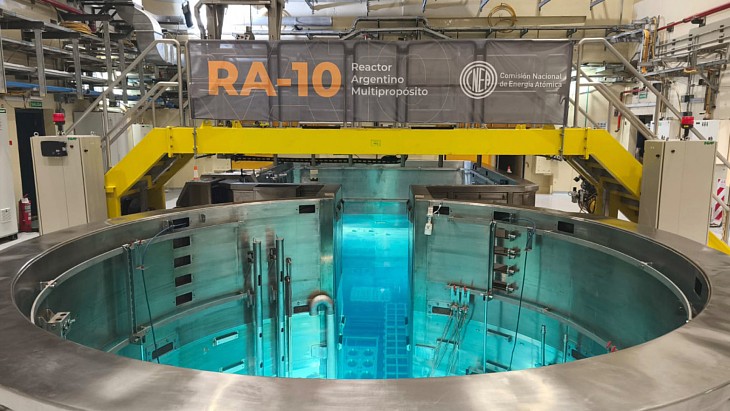
The commissioning of the first pump in the primary cooling circuit of the RA-10 multipurpose reactor has taken place as part of preparations for cold testing.
(Image: CNEA)
Argentina's National Atomic Energy Commission (CNEA) said the commissioning "allowed, for the first time, the observation of coolant circulation through the reactor's primary circuit. This milestone enables the comprehensive verification of the system's hydraulic performance and its compliance with design and safety parameters, an essential condition for proceeding with reactor commissioning".
Tests are to continue over the next two months to complete the functional validation of the reactor's primary cooling system.
Dummy fuel elements, supplied by the Fuel Element Manufacturing Plant for Research Reactors (ECRI), have allowed the configuration of the RA-10 core.
CNEA said: "This configuration allows for the necessary cold tests to be carried out to verify the performance of the cooling circuit under conditions representative of the operating configuration."
The RA-10 multipurpose reactor is a 30 MWt open pool type reactor. The project was approved by the government and officially started by CNEA in June 2010. Argentina's Nuclear Regulatory Authority granted a construction licence for RA-10 in November 2014. The civil works for the reactor began in 2016. Nuclear technology firm Invap is involved in the design and construction of the reactor facility and related installations, playing the role of main contractor.
The assembly of the RA-10 pool - which will house the core of the reactor - was completed in August 2018. The RA-10 will replace the RA-3 reactor on the same site, a 10 MWt pool-type reactor which began operations in 1967. The RA-10 will also have associated facilities such as the Argentine Neutron Beam Laboratory and the Laboratory for the Study of Irradiated Materials.
Argentina says the facility will guarantee self-sufficiency in radioisotopes for medical use and allow for exports to cover up to 20% of global demand. It will also enable the production of doped silicon for industrial applications as well as facilitating new research in a range of areas and training.
KHNP takes stake in TerraPower
South Korea's SK Innovation has transferred part of its stake in US small modular reactor developer TerraPower to Korea Hydro & Nuclear Power.
(Image: SK Innovation)
In May 2022, SK Group signed a memorandum of understanding with TerraPower to jointly develop "next-generational technologies" needed for small modular reactors (SMRs). In the August of that year, SK Inc and SK Innovation - both affiliates of SK Group, Korea's second-largest conglomerate - announced they had invested USD250 million in TerraPower, becoming the company's second-largest shareholder. SK Inc is a holding company of SK Group with specialisation in investment activities. Its strategic investment areas include advanced materials, biopharmaceutical, green energy and digital technologies. SK Innovation is an SK Group intermediate holding company in energy, petrochemical, lubricants, exploration and production, e-mobility battery, information and electronic materials businesses along with eight major subsidiaries.
TerraPower announced in April 2023 that it had signed a collaboration agreement with SK and Korea Hydro & Nuclear Power (KHNP) supporting the demonstration and commercialisation of its Natrium reactor and integrated energy system.
SK Innovation has now announced that it has transferred part of its stake in TerraPower to KHNP, "strengthening the three-way partnership to advance the global SMR market". It added: "This marks the first time a Korean public energy enterprise has directly invested in a world-leading SMR developer."
"SK Innovation aims to combine its global competitiveness in energy and materials with KHNP's world-class expertise in nuclear power plant construction and operation," the company said. "Together, they plan to establish SMR ecosystems for data centres and other industrial sites in Korea and overseas, and deliver customised integrated energy solutions to address the power supply challenges of the AI era."
KHNP and TerraPower successfully completed the US Committee on Foreign Investment review process in December 2025, "establishing a regulatory foundation for its entry into the global SMR market".
"KHNP joins TerraPower's current investors in supporting the first Natrium plant being built in Wyoming, along with the company's plans to rapidly deploy additional units in the US and abroad," TerraPower said. "This investment will accelerate ongoing efforts to explore both South Korean and other opportunities."
TerraPower's Natrium technology features a 345 MWe sodium-cooled fast reactor with a molten salt-based energy storage system. The storage technology can temporarily boost the system's output to 500 MWe when needed, enabling the plant to follow daily electric load changes and integrate seamlessly with fluctuating renewable resources. TerraPower began non-nuclear construction for its first Natrium plant, in Kemmerer, Wyoming, in June 2024, and expects construction of the plant - which it says will be the first commercial-scale, advanced nuclear project in the USA - to be complete in 2030. The first Natrium project is being developed through the US Department of Energy's Advanced Reactor Demonstration Program. The Natrium reactor is a TerraPower and GE Vernova Hitachi Nuclear Energy technology.
"We have strong relationships with multiple Korean entities across the nuclear energy supply chain, and today's announcement is one more step to realising the Natrium technology's promise to deliver next generation nuclear power not just in the United States, but around the world," said TerraPower President and CEO Chris Levesque. "TerraPower, SK and KHNP have been advancing our strategic collaboration for years, and I'm proud to add KHNP to our committed investor base."
Park In-sik, Executive Vice President and Head of the Export Business Division at KHNP, added: "This investment is a major milestone for KHNP in supporting the global deployment of next-generation nuclear energy. By combining our 50 years of experience in nuclear plant construction and operation with SK Innovation's competitiveness in energy and TerraPower's technology, we will play a leading role in expanding the advanced nuclear market. The three companies plan to sign definitive commercialisation agreements this year to establish a foundation for global projects."
"KHNP's investment in TerraPower solidifies our three-way collaboration in the global advanced nuclear business," said Moohwan Kim, Executive Vice President and Head of Energy Solution Business Division at SK Innovation. "SK Innovation will work closely with KHNP to support the Wyoming project, pursue new nuclear opportunities, and achieve innovative outcomes including localisation of key materials and components."
LR Launches Cross-Sector Nuclear Propulsion Consortium
Participants include Rolls-Royce's Advanced Modular Reactors division, which has designed a high temperature gas reactor like the illustration above (US DOE file image)
As the world looks for alternatives to bunker fuel, nuclear propulsion, by contrast, offers some attractive features. Regular bunkering is not required, so there is no need to build up a global fuel network. The basic concept of a shipboard reactor is established, and there is a community of engineers who understand the requirements. And the price of modern modular reactors - when looking at total cost of ownership - could be competitive. The latest serious entrant into the nuclear-power arena is Lloyd's Register: the world's first class society has convened a working group of professionals from the engineering, regulatory and insurance fields to piece together all of the requirements for a merchant-vessel reactor program.
The partners in the program include Rolls-Royce's Advanced Modular Reactors division, which has designed a gas-cooled particle fuel reactor in an appropriate power range for many merchant shipping applications. Rolls-Royce is one of a handful of companies with experience in building and servicing naval reactors, and it has powered Britain's nuclear submarine fleet since the Cold War.
Other participants include UK defense conglomerate Babcock, which has experience in shipbuilding and nuclear submarine design; Global Nuclear Security Partners, a specialized consultancy focused on nuclear threat reduction; law firm Stephenson Harwood, which has an established nuclear project legal team; and insurer NorthStandard, one of the largest P&I clubs.
The objective is to move quickly into the market with a British solution for nuclear propulsion. There are early efforts under way elsewhere, and LR sees opportunity in being a first mover. The nation that develops a nuclear-propulsion industrial ecosystem will benefit for the long term, LR suggests.
"Decarbonization demands cleaner power, higher standards and a duty to the generations that follow. Nuclear is ready to meet that test," said Nick Brown, CEO of Lloyd’s Register. "Used safely in naval fleets for decades, the next generation of advanced modular reactors brings tougher safeguards and the chance to bring nuclear power into everyday commercial shipping."
Next steps include pursuing UK regulatory approval for a site-licensed advanced modular reactor, a stepping stone known as a Statement of Design Acceptability. The consortium will also develop a class framework combining the requirements for nuclear and maritime regulation, and will define the security requirements needed for the reactor.
“With the right people applying the right standards and joined up regulation, maritime nuclear power can become a transformative force – advancing decarbonization, supporting commercial viability, and guiding the shipping industry towards net-zero emissions," said NorthStandard head of external affairs Mike Salthouse.
_80308.jpg)
_19812.jpg)
_84846.jpg)
_59286.jpg)
_21cbb9a8.jpg)
_25097.jpg)
No comments:
Post a Comment