
Alexander Willis
January 12, 2026
RAW STORY
President Donald Trump declared Sunday night that he was the new “acting president of Venezuela” by sharing a doctored image of his online biography bearing the new title — a declaration that produced shockwaves for onlookers.
“He’s spiraling into a singularity of narcissistic terror over [Jeffrey] Epstein, and decompensating with performative dictatoring,” wrote Jim Stewartson, a journalist and podcast host, in a social media post.
“His alternate reality is sealed and the people around him are riding his collapse to get what they want – total destruction of the world order. What a timeline.”
Trump took to his social media platform Truth Social to share the image of himself that's featured in his biography on Wikipedia — edited to list him as Venezuela’s “acting president.” The declaration comes just over a week after his unprecedented U.S. attack on Venezuela, which Trump said shortly thereafter would be run by the United States until a transfer of power could be facilitated.
Trump declaring himself to be Venezuela's interim president was just the latest sign, some critics said, that the president was potentially sparking even more civil unrest across the world.
“Not satire… Zero presidents have ever publicly declared executive authority over a foreign nation,” wrote author and analyst Shanaka Anslem Perera in a social media post on X, where he’s amassed more than 111,000 followers. “The greatest energy realignment since the 1973 embargo is hiding in plain sight as a ‘troll post.’ When the world realizes this isn’t a joke, the repricing won’t be gradual. It will be violent.”
Others, like Brian Berletic, a geopolitical analyst and former U.S. Marine, called Trump’s unprecedented declaration a “wake-up call to the rest of the world.”
“A US president declaring himself president of another nation 1000 miles from his own nation's borders is unhinged criminality,” Berletic wrote in a social media post on X, where he’s amassed nearly 120,000 followers.
“This is done to prime the US public for wider criminality to come. This is a wake-up call to the rest of the world, nations big and small, that this is no longer a matter of diplomacy, international relations, or deal-making.”
President Donald Trump declared Sunday night that he was the new “acting president of Venezuela” by sharing a doctored image of his online biography bearing the new title — a declaration that produced shockwaves for onlookers.
“He’s spiraling into a singularity of narcissistic terror over [Jeffrey] Epstein, and decompensating with performative dictatoring,” wrote Jim Stewartson, a journalist and podcast host, in a social media post.
“His alternate reality is sealed and the people around him are riding his collapse to get what they want – total destruction of the world order. What a timeline.”
Trump took to his social media platform Truth Social to share the image of himself that's featured in his biography on Wikipedia — edited to list him as Venezuela’s “acting president.” The declaration comes just over a week after his unprecedented U.S. attack on Venezuela, which Trump said shortly thereafter would be run by the United States until a transfer of power could be facilitated.
Trump declaring himself to be Venezuela's interim president was just the latest sign, some critics said, that the president was potentially sparking even more civil unrest across the world.
“Not satire… Zero presidents have ever publicly declared executive authority over a foreign nation,” wrote author and analyst Shanaka Anslem Perera in a social media post on X, where he’s amassed more than 111,000 followers. “The greatest energy realignment since the 1973 embargo is hiding in plain sight as a ‘troll post.’ When the world realizes this isn’t a joke, the repricing won’t be gradual. It will be violent.”
Others, like Brian Berletic, a geopolitical analyst and former U.S. Marine, called Trump’s unprecedented declaration a “wake-up call to the rest of the world.”
“A US president declaring himself president of another nation 1000 miles from his own nation's borders is unhinged criminality,” Berletic wrote in a social media post on X, where he’s amassed nearly 120,000 followers.
“This is done to prime the US public for wider criminality to come. This is a wake-up call to the rest of the world, nations big and small, that this is no longer a matter of diplomacy, international relations, or deal-making.”
Of course Trump has no Venezuela plan — look what made him attack it
John Stoehr
January 12, 2026
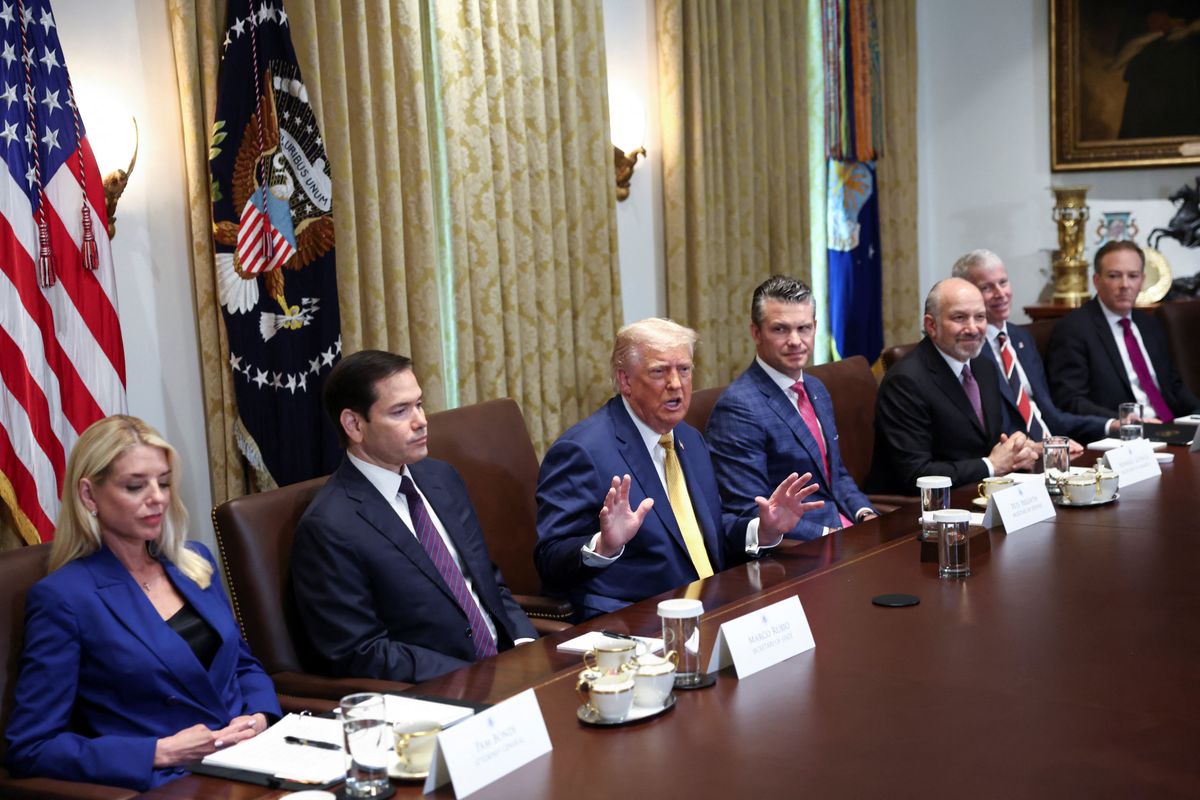
Donald Trump hosts a cabinet meeting at the White House. REUTERS/Kevin Lamarque
Why did Donald Trump invade Venezuela? His id made him.
Look at me, love me — every reason for doing anything is downstream from there.
I was telling you the other day that it’s not really clear why the president ordered the illegal and unconstitutional invasion of Venezuela and the kidnapping of its head of state. Regime officials provided reasons but were often contravened by Trump.
“Aren't We Tired of Trying to Interpret Trump's Foreign Policy Gibberish?” asked Marty Longman in the headline of a piece published after news of the attack. Indeed, we are, and I hasten to add that endless attempts to figure it all out are a form of oppression.
It isn’t normal.
Even if you disagreed with the 2003 invasion of Iraq, you understood the argument for it. George W Bush said Saddam Hussain had weapons of mass destruction. That was a lie, but at least the thinking above and below it was coherent.
In contrast, senior officials in the Trump regime are all over the place about why the US had to violate Venezuela’s sovereignty, giving the impression that no one above the level of military operations actually knows what they’re doing or why they’re doing it.
Meanwhile, critics can’t form a precise counterargument since the original “argument” is, well, no one really knows what it is. So, for the most part, liberals have decided to brush aside the confusion and incoherence to pinpoint two reasons that makes sense to them: Vladimir Putin and oil.
Don’t get me wrong. If you believe Trump is a tool of a Russian dictator, I’m with you. If you think Trump is a criminal president who is willing to use the awesome power of the United States military to commit international crimes, I’m with you.
But I also think these arguments tend to share a flaw.
They make more sense than Trump has ever made.
I’m reminded of that time Susie Wiles seemed to trash other people in the Trump regime. The White House chief of staff called Russ Vought “a rightwing absolute zealot,” for instance.
To savvy observers, she seemed to be looking for a scapegoat for her boss’s troubles. But in this White House, what you see is often what you get — if it looks like chaos, it probably is.
As I said at the time:
“There are no anchoring principles, no moral guideposts, no concept of national interest, no sense of the common good. It’s just mindless impulse and rationalizations after the fact.”
Set aside Putin and oil to consider something Trump values above everything else: “ratings.” He believes the more people watch him, the more they love him. What better way to get everyone’s attention than to be seen as a war president on TV?
Not just any war, though.
In a recent interview with me, the Secretary of Defense Rock (a pen name) said Trump “dislikes large, open-ended occupations that produce visible casualties and political backlash.”
(That’s almost certainly a result of watching coverage of the Iraq War in which images of death and destruction were common.)
Instead, he likes “coercive actions below the threshold of war — air strikes, sanctions, seizures, energy pressure, and threats that generate profit and leverage without requiring public buy-in.”
In other words, he likes one-and-done military ops. Venezuela was one of those. So was the bunker bombing of Iran last June. Though they look good on TV, they looked even better with Donald “War President” Trump at the center of it all.
That’s Trump’s id: look at me, love me.
Every reason for doing anything is downstream from there.
What does it all mean? That’s what everyone is asking, but the question itself is more dignified than the thing it’s questioning.
Trump got his made-for-TV war. He got everyone buzzing about what he’s going to do next about Greenland, Mexico, Canada, wherever.
Meanwhile, back in Venezuela, it looks like life is going to go on pretty much as it had been, the difference being that the new leader is even more tyrannical than the last one.
“The idea that she can't rig another election or the opposition will magically take over seems pretty far-fetched, especially because we don't have troops on the ground,” the Secretary of Defense Rock said.
The Secretary of Defense Rock doesn’t use his real name, because Trump is president. He’s the publisher of History Does Us, a newsletter about the intersection of military and civilian life. The last time we spoke, we discussed how the commander-in-chief undermines military discipline.
“The idea that we will launch more air strikes or raids or blockades if she doesn't play ball seems kind of dumb, given where the polling is,” he told me. “At this point, I kinda assume the status quo will hold, and that this entire episode will ultimately amount to little more than content-production and performative-posting.”
Here’s our conversation.
JS: The US now opposes democracies in Europe. We have invaded Venezuela. We are war-drumming about Greenland. Is Vladimir Putin's investment in Donald Trump finally bearing fruit?
SDR: I’d be careful with the phrase “investment bearing fruit,” because it implies command-and-control that we don’t have evidence for. What is clear is something more structural and, frankly, more troubling: Vladimir Putin doesn’t need to control Donald Trump to benefit from him. He benefits from Trump’s own instincts.
Putin’s core objective isn’t territorial conquest in the Cold War sense. It’s the erosion of Western cohesion, legitimacy and confidence. On that score, Trump has been extraordinarily useful without being directed. Attacking allies, casting doubt on democratic norms, treating sovereignty as transactional, and framing international politics as raw deal-making all weaken the post-1945 order that constrains Russia.
On Venezuela specifically, what you’re seeing isn’t a coherent imperial project so much as improvisational, performative power politics — noise that signals disregard for norms rather than a plan to replace them. That norm-breaking itself is the point. It tells allies that rules are optional and tells adversaries that the West no longer believes in its own system.
So no, this isn’t about Putin cashing in some secret investment. It’s about a global environment where authoritarian leaders benefit when the United States abandons restraint, consistency, and democratic solidarity—and Trump does that instinctively. The fruit isn’t conquest. It’s corrosion.
Most of the Democrats in the Congress seem to be pushing back against Trump's imperial overtures. Is that your perspective? If not, what do you think they should do?
There is meaningful pushback from a lot of Democrats (no matter what Democrats are complaining about on background on Axios), more quickly and more openly than during Trump’s first term.
You’re seeing sharper rhetoric and a greater willingness to use oversight, but they don't control any branch of government, so there isn't much they can do.
But with such tight margins, particularly in the House, I don't think it's crazy to shut down the government again (I believe funding expires at the end of the month?), or hold up an NDAA (National Defense Authorization Act). You have senior administration officials openly stating they want Greenland and would use military force, which is so insane that you might as well take extreme measures.
Sad to say, Stephen Miller might be right. 'Nobody is gonna fight the US militarily over the future of Greenland,' he said. If so, NATO could be a paper tiger. Is that what could happen?
I still can't believe this is a thing. Miller is probably right on the narrow, grim point that Denmark isn’t going to “fight the US military” in a conventional war over Greenland. But the leap from that to “NATO becomes a paper tiger” is not automatic — because NATO’s credibility isn’t just “can Denmark win a shooting war with the US.”
It’s whether the alliance remains a political commitment to mutual sovereignty. A US move to seize Greenland would be less a “test of NATO’s tanks” than a self-inflicted alliance-killer that destroys Atlanticism probably forever.
But it is a move that is so outrageous that I think there would be more alarm among congressional GOP's and the military.
Fighting foreign wars is as popular as Jeffrey Epstein's child-sex trafficking ring. Yet Trump continually takes the side of elite interests, in this case, oil companies. What is going on?
I think this is basically Marco Rubio.
I thought he would have very little influence because he came from the internationalist wing of the GOP, but being both secretary of state and national security advisor (and archivist if you care about that) clearly gives Rubio a lot of influence, and Venezuela has been a pet project of his for a while. Add support from Stephen Miller and this was probably an inevitability.
I'm not even sure a lot of the oil companies want anything to do with Venezuela, because of the security concerns, age of infrastructure, and the capital investment that would be required to get any meaningful profit. I also thought the US was supposed to be energy independent?
In addition, Trump’s “anti-war” image is real only in a very narrow sense. He dislikes large, open-ended occupations that produce visible casualties and political backlash. What he’s perfectly comfortable with are coercive actions below the threshold of war — air strikes, sanctions, seizures, energy pressure, and threats that generate profit and leverage without requiring public buy-in.
If a helo goes down, we're having a very different conversation.
There is no followup plan for Venezuela, is there? Trump is just winging it. He has no idea what he's doing. Every choice is made with how it looks on TV in his mind. Am I wrong?
Ya, this is why I never understood all the editorializing about how things have really changed and this is a really great success.
The structures and principals of the Venezuelan government that were set up by Maduro are still intact. From everything I have read, Delcy Rodriguez is a more ruthless political operator than Maduro was, so the idea that she can't rig another election or the opposition will magically take over seems pretty far-fetched, especially because we don't have troops on the ground.
The idea that we will launch more air strikes or raids or blockades if she doesn't play ball seems kind of dumb, given where the polling is. At this point, I kinda assume the status quo will hold, and that this entire episode will ultimately amount to little more than content-production and performative-posting.
Maduro loyalists stage modest rally as Venezuelan govt courts USJohn Stoehr
January 12, 2026
Donald Trump hosts a cabinet meeting at the White House. REUTERS/Kevin Lamarque
Why did Donald Trump invade Venezuela? His id made him.
Look at me, love me — every reason for doing anything is downstream from there.
I was telling you the other day that it’s not really clear why the president ordered the illegal and unconstitutional invasion of Venezuela and the kidnapping of its head of state. Regime officials provided reasons but were often contravened by Trump.
“Aren't We Tired of Trying to Interpret Trump's Foreign Policy Gibberish?” asked Marty Longman in the headline of a piece published after news of the attack. Indeed, we are, and I hasten to add that endless attempts to figure it all out are a form of oppression.
It isn’t normal.
Even if you disagreed with the 2003 invasion of Iraq, you understood the argument for it. George W Bush said Saddam Hussain had weapons of mass destruction. That was a lie, but at least the thinking above and below it was coherent.
In contrast, senior officials in the Trump regime are all over the place about why the US had to violate Venezuela’s sovereignty, giving the impression that no one above the level of military operations actually knows what they’re doing or why they’re doing it.
Meanwhile, critics can’t form a precise counterargument since the original “argument” is, well, no one really knows what it is. So, for the most part, liberals have decided to brush aside the confusion and incoherence to pinpoint two reasons that makes sense to them: Vladimir Putin and oil.
Don’t get me wrong. If you believe Trump is a tool of a Russian dictator, I’m with you. If you think Trump is a criminal president who is willing to use the awesome power of the United States military to commit international crimes, I’m with you.
But I also think these arguments tend to share a flaw.
They make more sense than Trump has ever made.
I’m reminded of that time Susie Wiles seemed to trash other people in the Trump regime. The White House chief of staff called Russ Vought “a rightwing absolute zealot,” for instance.
To savvy observers, she seemed to be looking for a scapegoat for her boss’s troubles. But in this White House, what you see is often what you get — if it looks like chaos, it probably is.
As I said at the time:
“There are no anchoring principles, no moral guideposts, no concept of national interest, no sense of the common good. It’s just mindless impulse and rationalizations after the fact.”
Set aside Putin and oil to consider something Trump values above everything else: “ratings.” He believes the more people watch him, the more they love him. What better way to get everyone’s attention than to be seen as a war president on TV?
Not just any war, though.
In a recent interview with me, the Secretary of Defense Rock (a pen name) said Trump “dislikes large, open-ended occupations that produce visible casualties and political backlash.”
(That’s almost certainly a result of watching coverage of the Iraq War in which images of death and destruction were common.)
Instead, he likes “coercive actions below the threshold of war — air strikes, sanctions, seizures, energy pressure, and threats that generate profit and leverage without requiring public buy-in.”
In other words, he likes one-and-done military ops. Venezuela was one of those. So was the bunker bombing of Iran last June. Though they look good on TV, they looked even better with Donald “War President” Trump at the center of it all.
That’s Trump’s id: look at me, love me.
Every reason for doing anything is downstream from there.
What does it all mean? That’s what everyone is asking, but the question itself is more dignified than the thing it’s questioning.
Trump got his made-for-TV war. He got everyone buzzing about what he’s going to do next about Greenland, Mexico, Canada, wherever.
Meanwhile, back in Venezuela, it looks like life is going to go on pretty much as it had been, the difference being that the new leader is even more tyrannical than the last one.
“The idea that she can't rig another election or the opposition will magically take over seems pretty far-fetched, especially because we don't have troops on the ground,” the Secretary of Defense Rock said.
The Secretary of Defense Rock doesn’t use his real name, because Trump is president. He’s the publisher of History Does Us, a newsletter about the intersection of military and civilian life. The last time we spoke, we discussed how the commander-in-chief undermines military discipline.
“The idea that we will launch more air strikes or raids or blockades if she doesn't play ball seems kind of dumb, given where the polling is,” he told me. “At this point, I kinda assume the status quo will hold, and that this entire episode will ultimately amount to little more than content-production and performative-posting.”
Here’s our conversation.
JS: The US now opposes democracies in Europe. We have invaded Venezuela. We are war-drumming about Greenland. Is Vladimir Putin's investment in Donald Trump finally bearing fruit?
SDR: I’d be careful with the phrase “investment bearing fruit,” because it implies command-and-control that we don’t have evidence for. What is clear is something more structural and, frankly, more troubling: Vladimir Putin doesn’t need to control Donald Trump to benefit from him. He benefits from Trump’s own instincts.
Putin’s core objective isn’t territorial conquest in the Cold War sense. It’s the erosion of Western cohesion, legitimacy and confidence. On that score, Trump has been extraordinarily useful without being directed. Attacking allies, casting doubt on democratic norms, treating sovereignty as transactional, and framing international politics as raw deal-making all weaken the post-1945 order that constrains Russia.
On Venezuela specifically, what you’re seeing isn’t a coherent imperial project so much as improvisational, performative power politics — noise that signals disregard for norms rather than a plan to replace them. That norm-breaking itself is the point. It tells allies that rules are optional and tells adversaries that the West no longer believes in its own system.
So no, this isn’t about Putin cashing in some secret investment. It’s about a global environment where authoritarian leaders benefit when the United States abandons restraint, consistency, and democratic solidarity—and Trump does that instinctively. The fruit isn’t conquest. It’s corrosion.
Most of the Democrats in the Congress seem to be pushing back against Trump's imperial overtures. Is that your perspective? If not, what do you think they should do?
There is meaningful pushback from a lot of Democrats (no matter what Democrats are complaining about on background on Axios), more quickly and more openly than during Trump’s first term.
You’re seeing sharper rhetoric and a greater willingness to use oversight, but they don't control any branch of government, so there isn't much they can do.
But with such tight margins, particularly in the House, I don't think it's crazy to shut down the government again (I believe funding expires at the end of the month?), or hold up an NDAA (National Defense Authorization Act). You have senior administration officials openly stating they want Greenland and would use military force, which is so insane that you might as well take extreme measures.
Sad to say, Stephen Miller might be right. 'Nobody is gonna fight the US militarily over the future of Greenland,' he said. If so, NATO could be a paper tiger. Is that what could happen?
I still can't believe this is a thing. Miller is probably right on the narrow, grim point that Denmark isn’t going to “fight the US military” in a conventional war over Greenland. But the leap from that to “NATO becomes a paper tiger” is not automatic — because NATO’s credibility isn’t just “can Denmark win a shooting war with the US.”
It’s whether the alliance remains a political commitment to mutual sovereignty. A US move to seize Greenland would be less a “test of NATO’s tanks” than a self-inflicted alliance-killer that destroys Atlanticism probably forever.
But it is a move that is so outrageous that I think there would be more alarm among congressional GOP's and the military.
Fighting foreign wars is as popular as Jeffrey Epstein's child-sex trafficking ring. Yet Trump continually takes the side of elite interests, in this case, oil companies. What is going on?
I think this is basically Marco Rubio.
I thought he would have very little influence because he came from the internationalist wing of the GOP, but being both secretary of state and national security advisor (and archivist if you care about that) clearly gives Rubio a lot of influence, and Venezuela has been a pet project of his for a while. Add support from Stephen Miller and this was probably an inevitability.
I'm not even sure a lot of the oil companies want anything to do with Venezuela, because of the security concerns, age of infrastructure, and the capital investment that would be required to get any meaningful profit. I also thought the US was supposed to be energy independent?
In addition, Trump’s “anti-war” image is real only in a very narrow sense. He dislikes large, open-ended occupations that produce visible casualties and political backlash. What he’s perfectly comfortable with are coercive actions below the threshold of war — air strikes, sanctions, seizures, energy pressure, and threats that generate profit and leverage without requiring public buy-in.
If a helo goes down, we're having a very different conversation.
There is no followup plan for Venezuela, is there? Trump is just winging it. He has no idea what he's doing. Every choice is made with how it looks on TV in his mind. Am I wrong?
Ya, this is why I never understood all the editorializing about how things have really changed and this is a really great success.
The structures and principals of the Venezuelan government that were set up by Maduro are still intact. From everything I have read, Delcy Rodriguez is a more ruthless political operator than Maduro was, so the idea that she can't rig another election or the opposition will magically take over seems pretty far-fetched, especially because we don't have troops on the ground.
The idea that we will launch more air strikes or raids or blockades if she doesn't play ball seems kind of dumb, given where the polling is. At this point, I kinda assume the status quo will hold, and that this entire episode will ultimately amount to little more than content-production and performative-posting.
By AFP
January 10, 2026

Hundreds of protesters rallied in Caracas - Copyright AFP Juan BARRETO
Javier TOVAR
Supporters of Venezuela’s deposed leader Nicolas Maduro staged protests Saturday, a week after his dramatic capture by US forces, but only hundreds turned out to demand his release as the interim government moved to revive ties with Washington.
Waving flags and placards with the face of the mustachioed ex-leader and his wife Cilia, around 1,000 protesters rallied in the west of Caracas and a few hundred in the eastern Petare district — far smaller than demonstrations Maduro’s camp has mustered in the past.
“I’ll march as often as I have to until Nicolas and Cilia come back,” said one demonstrator, Soledad Rodriguez, 69, of the presidential couple who were taken by US forces to New York to face trial on drug-trafficking charges.
“I trust blindly that they will come back — they have been kidnapped.”
Notably absent from the rallies were top figures from the government, which has said it is reviving diplomatic contact with Washington and discussing possible oil sales to the United States.
Interim president Delcy Rodriguez instead attended an agricultural fair, where she vowed in televised comments she would “not rest for a minute until we have our president back.”
The other two hardline powers in the government, Interior Minister and street enforcer Diosdado Cabello, and Defense Minister Vladimir Padrino Lopez, were not seen at the demos either.
– Diplomatic maneuvers –
Despite the shock of Maduro’s capture during deadly nighttime raids on January 3, signs emerged Friday of cooperation with Washington after US President Donald Trump’s claim to be “in charge” of the South American country.
Washington said US diplomats visited Caracas on Friday to discuss reopening the American embassy.
A State Department official told AFP on Saturday they left again on Friday “as scheduled.”
“The Trump Administration remains in close contact with interim authorities” in Venezuela, the official added.
The Venezuelan government did not reply when asked by AFP whether the US officials had met with Rodriguez.
She has pledged to cooperate with Trump over his demands for access to Venezuela’s huge oil reserves.
But she also moved to placate the powerful pro-Maduro base by insisting Venezuela is not “subordinate” to Washington.
The US embassy in Colombia warned American citizens on Saturday that “the security situation in Venezuela remains fluid” and advised its nationals to leave the country “immediately” as commercial flights become available.
– Anxiety over prisoners –
Anxious relatives meanwhile camped outside jails, awaiting the promised release of political prisoners by the interim government.
Rodriguez’s camp on Thursday began releasing prisoners jailed under Maduro, promising a “large” number would be freed in a gesture of appeasement that Washington took credit for.
However, prisoners’ rights groups said on Saturday that fewer than 20 had been freed, including several prominent opposition figures.
Families slept out overnight under blankets near El Rodeo prison east of Caracas, hoping for the release of their loved ones.
“I am tired and angry,” Nebraska Rivas, 57, told AFP, as she waited for her son to be released.
“But I have faith that they will hand him over to us soon,” she said, after sleeping out on the pavement for two nights.
– Oil talks –
Following Maduro’s capture, Trump vowed to secure access for US companies to Venezuela’s vast oil reserves.
Chevron is currently the only US firm licensed to operate in Venezuela, through a sanctions exemption.
The White House said Saturday Trump had signed an emergency executive order protecting US-held revenues derived from sales of Venezuelan oil, to prevent them from being seized by courts or creditors.
At a White House meeting on Friday, he pressed top oil executives to invest in Venezuela’s reserves, but was met with a cautious reception.
ExxonMobil chief executive Darren Woods dismissed the country as “uninvestable” without sweeping reforms.
Experts say Venezuela’s oil infrastructure is creaky after years of mismanagement and sanctions.
No comments:
Post a Comment