Since at least World War II, the most dynamic sectors of the American economy have been developed in large part by federal government planning and heavy financial investment.
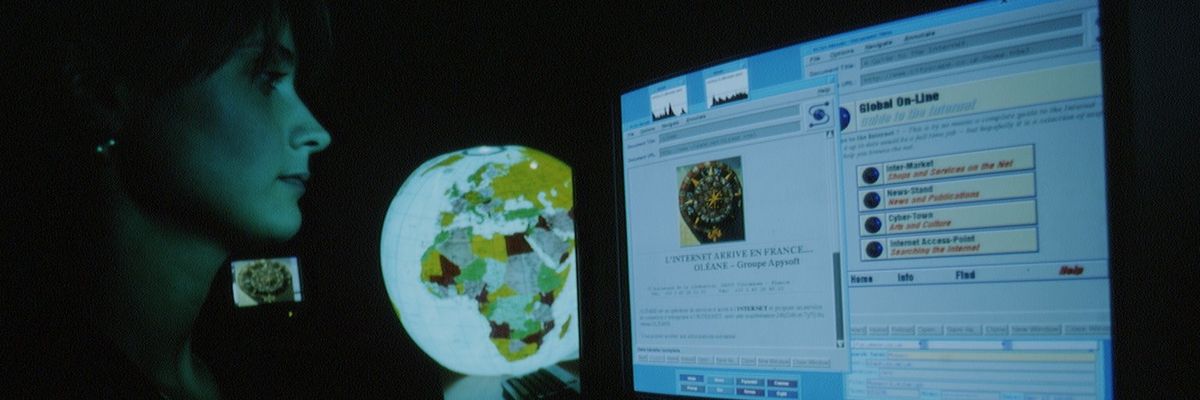
A person uses the internet in the 1990s.
(Photo by pitchal frederic / Contributor via Getty Images)
Chris Green
Jan 01, 2026
Common Dreams
Few epithets are more heavily utilized among President Donald Trump and his supporters than “socialist” and “communist.” In MAGA’s deeply paranoid Bircher sensibility, “socialism” and even “communism” are defined as even the slightest expansion of governmental intervention in the economy—especially in favor of marginalized groups. In MAGA’s worldview, such interventions are a harbinger of the sort of massive societal disintegration seen in recent years in President Nicolás Maduro’s Venezuela—if not the second coming of Stalinist totalitarianism.
As in so much else in the MAGA worldview, its views on economics have little relation to reality. For it is a fact that since at least World War II, the most dynamic sectors of the American economy (revolving around high tech) have been developed in large part by federal government planning and heavy financial investment. Since World War II, initially on the pretext of Cold War defense spending, technologies from computers and the internet to Google, lifesaving pharmaceuticals, and the components of cell phones have been developed by heavily government-subsidized researchers at universities and private companies. The government agencies providing the subsidies included the CIA, the National Science Foundation (NSF), the National Institutes of Health, and especially the Pentagon’s Defense Advanced Research Projects Agency (DARPA).
This crucial role of government investment in economic success (in the United States as well as Western Europe and East Asia) is generally unknown in MAGA world and even among Americans of a more educated and civilized worldview. But a small group of scholars have explored this fact, ranging from Noam Chomsky to former Richard Nixon adviser Kevin Phillips in his 2003 book Wealth and Democracy. In more recent years, it has been explored by Professor Mariana Mazzucato of University College, London. Mazzucato has served as an adviser to Jeremy Corbyn in the United Kingdom and US Sen. Elizabeth Warren (D-Mass.) in the United States.
As Bill Gates, a prime beneficiary of this government investment, explained in a 2015 interview with The Atlantic, “Since World War II, US government [funded] R&D has defined the state of the art” in almost every advanced sector of the American economy. Gates noted, for example, that it was the Pentagon’s DARPA which provided R&D investment in the 1960s and 70s which laid the foundation for the modern internet. DARPA’s investment was crucial, Gates noted, because as far as being a source of economic innovation, “the private sector is in general inept.” Because of a lack of guaranteed short-term profit, the private sector often refuses to invest in the early stages of development of technologies like the internet. By the 1980’s, the internet had developed to such an extent that many private companies saw its commercial potential and desired partnership with the federal government’s NSF—which had taken over the internet in the 1980s from the Pentagon’s DARPA—to pursue its further evolution. By the mid-1990s, in a somewhat opaque process, the NSF had fully transferred control of the internet to private sector companies.
AI: Big Government Drives Trump Economy
Then there is Artificial Intelligence (AI), the current massive private sector investment that is—according to many experts—the primary factor keeping an otherwise weak US economy afloat since Trump returned to the White House. The foundations for AI were laid by massive government investment in R&D beginning in the 1950s as the Center for Strategic and International Studies explained in October:
Although recent breakthroughs in AI have largely been funded by the private sector, the foundations of modern AI were built through decades of federally funded research. Following World War Two, government agencies like the National Science Foundation (NSF) and the National Institutes of Health (NIH) invested in early AI experiments, such as the first AI program in the 1950s, the first chatbot in the 1960s, and rules-based systems for medical diagnosis in the 1970s. Indeed, public funding advanced many core capabilities like machine learning, neural networks, computer vision, and natural-language processing, which the private sector then developed into the AI systems we use today. In 2024, the House Task Force on Artificial Intelligence released a report of its own, acknowledging that the United States “has maintained its AI leadership largely due to continued and consistent federal investments in AI R&D over decades.”
Big Government Trumpism
During the initial monologue on his November 2, 2015 radio program, Rush Limbaugh ridiculed the above quoted Bill Gates interview; he called Gates’ notion—that government subsidy of high tech R&D had fueled America’s post-World War II economic growth—as among the “craziest, most nonsensical things” he had ever heard in his life.
It seems fair to state that whatever else one might say about him, Bill Gates possesses a much more realistic view of how the world really works than the late Mr. Limbaugh did. It also seems fair to state that even Trump administration policymakers have the same better understanding than Limbaugh.
For all his anti-establishment grandstanding, Trump is just as committed—perhaps more so—to furthering militarism and the economic exploitation of the working class in the US and around the world as any of his Democrat or Republican predecessors.
After all, the Trump administration has been quietly putting tens of billions of taxpayer dollars in service of the private sector, particularly in subsidies for AI’s continued development. The publicly stated rational for such subsidies is national security, specifically the military and economic competition with China. Trump has even spearheaded the purchase by the federal government of shares in a handful of private sector companies in economically vital areas like minerals, steel, and semiconductors.
Normally Trump supporters would object to the federal government buying up shares of private companies. Relatively few of them seem to have even taken notice of Trump doing so, perhaps because Fox News, Newsmax, or their favorite talk radio demagogues have given little or no sustained coverage of it.
The bottom line is that even if some benefits from the Trump administration’s investments do trickle down to America’s working class—or they somehow help fuel long-term American economic dynamism—it is fair to say that his administration is using those investments first and foremost to benefit its billionaire supporters in Silicon Valley and the armaments industry. For all his anti-establishment grandstanding, Trump is just as committed—perhaps more so—to furthering militarism and the economic exploitation of the working class in the US and around the world as any of his Democrat or Republican predecessors. It would be nice if Americans—whether MAGA adherents or not—would become aware of this dynamic and mobilize against it.
Our work is licensed under Creative Commons (CC BY-NC-ND 3.0). Feel free to republish and share widely.
Chris Green
Chris Green has a master's degree in history from Western Washington University and has previously published with Counterpunch and Znetwork.
Full Bio >
Few epithets are more heavily utilized among President Donald Trump and his supporters than “socialist” and “communist.” In MAGA’s deeply paranoid Bircher sensibility, “socialism” and even “communism” are defined as even the slightest expansion of governmental intervention in the economy—especially in favor of marginalized groups. In MAGA’s worldview, such interventions are a harbinger of the sort of massive societal disintegration seen in recent years in President Nicolás Maduro’s Venezuela—if not the second coming of Stalinist totalitarianism.
As in so much else in the MAGA worldview, its views on economics have little relation to reality. For it is a fact that since at least World War II, the most dynamic sectors of the American economy (revolving around high tech) have been developed in large part by federal government planning and heavy financial investment. Since World War II, initially on the pretext of Cold War defense spending, technologies from computers and the internet to Google, lifesaving pharmaceuticals, and the components of cell phones have been developed by heavily government-subsidized researchers at universities and private companies. The government agencies providing the subsidies included the CIA, the National Science Foundation (NSF), the National Institutes of Health, and especially the Pentagon’s Defense Advanced Research Projects Agency (DARPA).
This crucial role of government investment in economic success (in the United States as well as Western Europe and East Asia) is generally unknown in MAGA world and even among Americans of a more educated and civilized worldview. But a small group of scholars have explored this fact, ranging from Noam Chomsky to former Richard Nixon adviser Kevin Phillips in his 2003 book Wealth and Democracy. In more recent years, it has been explored by Professor Mariana Mazzucato of University College, London. Mazzucato has served as an adviser to Jeremy Corbyn in the United Kingdom and US Sen. Elizabeth Warren (D-Mass.) in the United States.
As Bill Gates, a prime beneficiary of this government investment, explained in a 2015 interview with The Atlantic, “Since World War II, US government [funded] R&D has defined the state of the art” in almost every advanced sector of the American economy. Gates noted, for example, that it was the Pentagon’s DARPA which provided R&D investment in the 1960s and 70s which laid the foundation for the modern internet. DARPA’s investment was crucial, Gates noted, because as far as being a source of economic innovation, “the private sector is in general inept.” Because of a lack of guaranteed short-term profit, the private sector often refuses to invest in the early stages of development of technologies like the internet. By the 1980’s, the internet had developed to such an extent that many private companies saw its commercial potential and desired partnership with the federal government’s NSF—which had taken over the internet in the 1980s from the Pentagon’s DARPA—to pursue its further evolution. By the mid-1990s, in a somewhat opaque process, the NSF had fully transferred control of the internet to private sector companies.
AI: Big Government Drives Trump Economy
Then there is Artificial Intelligence (AI), the current massive private sector investment that is—according to many experts—the primary factor keeping an otherwise weak US economy afloat since Trump returned to the White House. The foundations for AI were laid by massive government investment in R&D beginning in the 1950s as the Center for Strategic and International Studies explained in October:
Although recent breakthroughs in AI have largely been funded by the private sector, the foundations of modern AI were built through decades of federally funded research. Following World War Two, government agencies like the National Science Foundation (NSF) and the National Institutes of Health (NIH) invested in early AI experiments, such as the first AI program in the 1950s, the first chatbot in the 1960s, and rules-based systems for medical diagnosis in the 1970s. Indeed, public funding advanced many core capabilities like machine learning, neural networks, computer vision, and natural-language processing, which the private sector then developed into the AI systems we use today. In 2024, the House Task Force on Artificial Intelligence released a report of its own, acknowledging that the United States “has maintained its AI leadership largely due to continued and consistent federal investments in AI R&D over decades.”
Big Government Trumpism
During the initial monologue on his November 2, 2015 radio program, Rush Limbaugh ridiculed the above quoted Bill Gates interview; he called Gates’ notion—that government subsidy of high tech R&D had fueled America’s post-World War II economic growth—as among the “craziest, most nonsensical things” he had ever heard in his life.
It seems fair to state that whatever else one might say about him, Bill Gates possesses a much more realistic view of how the world really works than the late Mr. Limbaugh did. It also seems fair to state that even Trump administration policymakers have the same better understanding than Limbaugh.
For all his anti-establishment grandstanding, Trump is just as committed—perhaps more so—to furthering militarism and the economic exploitation of the working class in the US and around the world as any of his Democrat or Republican predecessors.
After all, the Trump administration has been quietly putting tens of billions of taxpayer dollars in service of the private sector, particularly in subsidies for AI’s continued development. The publicly stated rational for such subsidies is national security, specifically the military and economic competition with China. Trump has even spearheaded the purchase by the federal government of shares in a handful of private sector companies in economically vital areas like minerals, steel, and semiconductors.
Normally Trump supporters would object to the federal government buying up shares of private companies. Relatively few of them seem to have even taken notice of Trump doing so, perhaps because Fox News, Newsmax, or their favorite talk radio demagogues have given little or no sustained coverage of it.
The bottom line is that even if some benefits from the Trump administration’s investments do trickle down to America’s working class—or they somehow help fuel long-term American economic dynamism—it is fair to say that his administration is using those investments first and foremost to benefit its billionaire supporters in Silicon Valley and the armaments industry. For all his anti-establishment grandstanding, Trump is just as committed—perhaps more so—to furthering militarism and the economic exploitation of the working class in the US and around the world as any of his Democrat or Republican predecessors. It would be nice if Americans—whether MAGA adherents or not—would become aware of this dynamic and mobilize against it.
Our work is licensed under Creative Commons (CC BY-NC-ND 3.0). Feel free to republish and share widely.
Chris Green
Chris Green has a master's degree in history from Western Washington University and has previously published with Counterpunch and Znetwork.
Full Bio >
No comments:
Post a Comment