Oregon Relaunches Its Only Container Terminal After Scheduled Closing
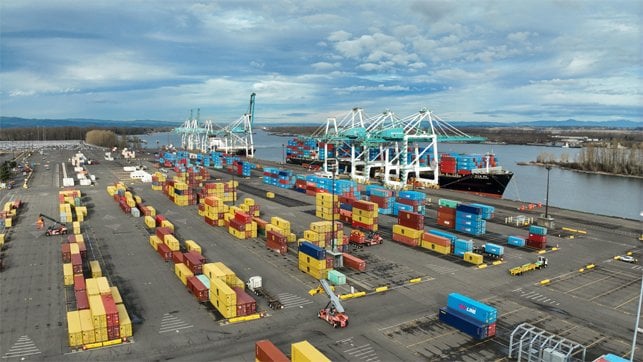
Officials gathered on January 7 at the Port of Portland, Oregon, to mark what they are calling a fresh start for a reborn container shipping terminal. The only one in the state, the small facility known for years as Terminal 6, had faced an imminent closure due to mounting financial losses and the lack of an operator.
Oregon’s Governor Tina Kotek intervened to save the operation while highlighting its critical contribution to the state’s economy and local businesses. The state committed to providing $40 million to bridge the operations while a new operator was located. It also committed to infrastructure improvements for a port that is located far upriver from the ocean.
The new lessee/operator, Harbor Industrial Services, assumed control of the operation on January 1, 2026, and renamed Terminal 6 to become the Oregon Container Terminal. The company has a seven-year lease with four renewal options, each for five years. It also purchased the facilities' seven cranes.
Like many smaller ports, the container operation in Portland faced a range of challenges, which made it difficult to attract carriers. Its location limits the size of vessels and requires more transit time. It is also a smaller economic market driven primarily by agriculture and some manufacturing. The terminal had also found itself caught in a labor jurisdiction dispute that ultimately saw the prior operator walk away, leaving the port attempting to run the terminal on its own.
Portland once had seven carriers operating from the port, but it is now down to two carriers, with the regular service limited to South Korea’s SM Line. The new operator, however, looks to follow the state's plans for strong growth at the terminal and said during yesterday’s ceremony that a third carrier is likely to join soon. It hinted that it would be MSC Mediterranean Shipping Company, which had previously operated from Terminal 6. The port lost most of its carriers in the 2015-2016 timeframe. It had enjoyed a small resurgence during the COVID-19 pandemic, providing an alternative to congested and backup ports on the Pacific Coast.
Harbor International said it wants to double the cargo shipments this year handled at the terminal. It plans to focus on Oregon shippers, which would otherwise have to truck goods to ports such as Seattle. As a first step, the company announced that as of January 16, the container terminal will be handling imports and exports five days a week, up from the current four days of operations.
Longer term, Harbor International looks to expand services, including vessels, railcars, and oversized cargo. Separately, the port continues its larger operations in dry bulk, breakbulk, and RoRo vehicle transport
Two U.S. Ports Add New STS Cranes to Boost Competitiveness
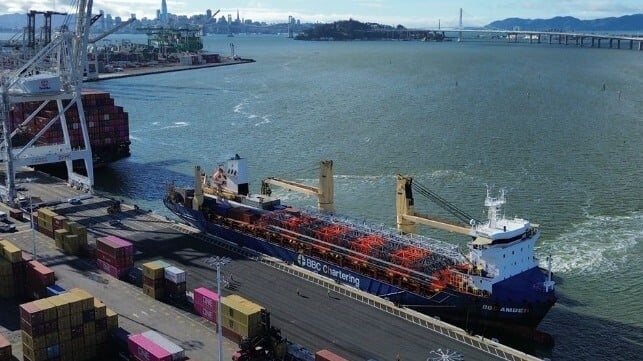
Two ports in the U.S. are enhancing their competitiveness by investing in new ship to shore cranes, which will improve operational efficiency, advance environmental goals and push growth. Jacksonville Port Authority (Jaxport) in Florida and California’s Port of Oakland have both made big strides with new infrastructure for business growth.
Jaxport reports that two new 50-gauge ship-to-shore container cranes have started operations at its Blount Island marine terminal, a move that significantly expands cargo-handling capabilities at the facility. Installed at a cost of $93 million, including $53 million in state funding, the cranes are designed to serve larger vessels and can reach up to 19 containers across a ship’s deck. They also have the ability to move an average of 33 containers per hour and a lift capacity of up to 65 long tonnes, with heavy-lift capability of up to 75 long tonnes for oversized, non-containerized cargo.
While the two cranes have already started moving containers, a third crane is currently being commissioned at the Talleyrand marine terminal. Featuring a 100-foot lift height and with the ability to reach across 17 containers wide, the crane is expected to be operational in the middle of the year.
Jaxport, which is Florida’s leading container port by volume and one of America's top vehicle-handling ports, says the cranes are central for enhancing energy efficiency and reducing emissions. This emanates from the fact that they feature regenerative power systems that consume energy during container lifts and capture electricity when lowering them.
The seaport that contributed $44 billion in annual economic impact is investing in the new cranes to boost container throughput that has only increased marginally in recent years from 1.2 million TEU in 2022 to 1.3 million in 2024.
“As cargo volumes grow, it’s essential that we continue investing in the equipment needed to serve our customers efficiently,” said Eric Green, Jaxport CEO.
Port of Oakland, on its part, has seen the arrival of two new electric container cranes that will be erected at its TraPac terminal and are expected to commence service in May this year. The new Liebherr cranes, which were manufactured in Ireland, mark the first time European-built ship-to-shore cranes have been deployed on the U.S. West Coast.
The two cranes, which will stand more than 440 feet tall, are the first of four new cranes planned for the TraPac terminal, and the remaining two are scheduled to arrive later this year.
The cranes, which will allow TraPac to handle large container ships more efficiently, are seen as critical in driving growth at Oakland port, where container volume has been stuck at 2-2 .5 million TEU per year over the past decade.
“These new cranes represent an important investment in the future of the terminal,” said Cameron Thorpe, TraPac CEO. “They improve efficiency today while helping move the port toward a greener future.”
Navigating Port Funding Uncertainty: Adaptation Unlocks Opportunities

The port funding landscape has shifted dramatically as federal discretionary grants become less predictable and debt capacity reaches its limits. Successful ports are adapting by diversifying funding sources, embracing innovative partnerships and developing strategic approaches that align projects with evolving political priorities. The key is building flexibility into funding strategies while maintaining focus on long-term operational needs.
The new funding reality
Port financing has undergone a fundamental transformation over the past two decades. What began as straightforward debt financing based on individual port authority revenue streams has evolved into a sophisticated ecosystem of public-private partnerships, federal grants and state programs. The recent reduction in federal discretionary funding has created an entirely new challenge: how to navigate an increasingly complex and politically sensitive funding environment.
The funding landscape is changing rapidly, and ports that were successful in securing multiple grant sources are now finding their entire project viability depends on political winds that can shift overnight. Long-term success requires much more strategic thinking about how to position projects and build in flexibility.
The challenge isn't just about finding money – it's about understanding that funding criteria can change dramatically with each new administration. What qualifies as a priority under one iteration of political leadership may become deprioritized or restructured under another. This creates a planning challenge that extends far beyond traditional financial modeling.
The ‘house of cards’ risk
Many ports have become skilled at layering multiple funding sources, using one grant as matching funds for another in increasingly complex arrangements. While this approach can unlock significant capital, it creates what we call the "house of cards" risk – when one funding source disappears, the entire project structure can collapse.
We've worked with port clients who successfully secured multiple grants, only to have a federal program change eliminate their required match and invalidate previously approved funding commitments. The interconnected nature of these funding arrangements means that losing even a small percentage of total project funding can make entire initiatives financially unfeasible.
The solution requires building flexibility into project design from the beginning. We help clients develop multi-benefit modular approaches that allow projects to be scaled or phased based on available funding, ensuring that losing one source doesn't destroy the entire initiative.
Strategic positioning matters
One of the most critical skills in today's funding environment is understanding how to position the same project to meet different political priorities. A port modernization project might emphasize job creation and economic development under one administration, then pivot to highlight climate resiliency and environmental benefits under another.
This isn't about changing the fundamental project – it's about understanding which benefits to emphasize in grant applications and how to describe project components to align with current funding criteria. We work closely with port clients to develop funding applications that can be adapted quickly as political priorities shift.
In many ways, it has become a language game. The projects themselves remain technically sound and necessary, but the ways the benefits are described and the applications structured have to evolve with changing federal and state priorities.
The rise of pass-through partnerships
An emerging trend we're seeing is ports serving as pass-through entities for private operator projects. Because federal and state grants typically go to public port authorities rather than private terminal operators, we're helping structure arrangements where the public port authority sponsors the grant application for a private operator project and then passes the benefits through to the tenant.
This model allows private operators to access public funding they couldn't secure independently while enabling public port authorities to support major infrastructure improvements without contributing their own capital.
These partnerships require careful legal and financial structuring to ensure all parties meet their obligations and avoid real or perceived conflicts of interest while maximizing the benefit of public investment in port infrastructure.
State funding fills federal gaps
As federal discretionary funding becomes less predictable, we're seeing increased reliance on state-level programs. States recognize that ports are significant economic generators and are developing their own funding mechanisms, where possible, to support critical infrastructure improvements.
California's recent Proposition 4, which allocates $475 million for port infrastructure related to offshore wind development projects, demonstrates how states are stepping up to fill funding gaps. However, this creates a patchwork approach where funding availability varies dramatically by location and state-specific financial health.
Resiliency funding remains robust
Despite overall reductions in federal discretionary spending, resiliency and hazard mitigation programs continue to receive strong support across political administrations. These programs recognize that investing in infrastructure protection now prevents much costlier disaster recovery expenses later.
We help clients identify how their infrastructure projects can be positioned to take advantage of resiliency funding while addressing other operational needs. Often, a project justified for storm protection can include electrical upgrades, modernized utilities and other improvements that enhance overall port functionality.
Building adaptive strategies
Success in today's funding environment requires developing what we call "adaptive funding strategies" – approaches that maintain flexibility while ensuring project viability across different scenarios. This includes designing multi-benefit projects that can be positioned for different funding streams, creating phased implementation plans that allow for partial funding and building relationships with diverse funding sources.
Our role as strategic advisors extends beyond traditional engineering services to include helping clients navigate grant applications, understand changing political priorities and structure partnerships that maximize funding opportunities. The ports that thrive in this environment will be those that embrace flexibility while maintaining focus on their fundamental infrastructure and operational needs.
The funding landscape may be more complex than ever, but for ports willing to adapt their strategies, new opportunities continue to emerge.
Michael Vanderbeek is Maritime and Coastal Planning Lead at GHD, and Rebecca Crow is the firm's Project Manager.
This post is sponsored by GHD, combining strategic planning advisory services with infrastructure engineering to help ports navigate complex challenges from energy transition to funding innovation. Discover how we're shaping the future of maritime infrastructure at https://info.ghd.com/funding-article.
The opinions expressed herein are the author's and not necessarily those of The Maritime Executive.
No comments:
Post a Comment