Sanja Kljajic
DW
After more than a year of protests, Serbia's students have shifted their focus to preparing for a parliamentary election. President Aleksander Vucic, however, is waiting for a date that will benefit him the most.

Serbia's protesting university students collected signatures in support of their demand for an early parliamentary election in Belgrade in December
Image: Darko Vojinovic/AP Photo/picture alliance
Serbia entered 2026 in full pre-election mode — even though a date for a parliamentary election has not yet been set.
After more than a year of protests, student blockades and political tension, Serbian President Aleksandar Vucic has accepted the challenge posed by students and citizens who have been demanding a snap election.
Nevertheless, just when the president will call that election remains to be seen.
Over the course of the past few months, Vucic has gradually narrowed down possible dates for a poll, moving from a vague promise that the election would take place "before the legal deadline," through information that it would be in "late 2026 or early 2027" to the latest announcement that suggests a vote could be held in October, November or December.
Could Vucic lose the election?
If the president keeps his word, he could lose that election, believes Dusan Spasojevic, professor at the Faculty of Political Sciences at the University of Belgrade.
Serbia entered 2026 in full pre-election mode — even though a date for a parliamentary election has not yet been set.
After more than a year of protests, student blockades and political tension, Serbian President Aleksandar Vucic has accepted the challenge posed by students and citizens who have been demanding a snap election.
Nevertheless, just when the president will call that election remains to be seen.
Over the course of the past few months, Vucic has gradually narrowed down possible dates for a poll, moving from a vague promise that the election would take place "before the legal deadline," through information that it would be in "late 2026 or early 2027" to the latest announcement that suggests a vote could be held in October, November or December.
Could Vucic lose the election?
If the president keeps his word, he could lose that election, believes Dusan Spasojevic, professor at the Faculty of Political Sciences at the University of Belgrade.
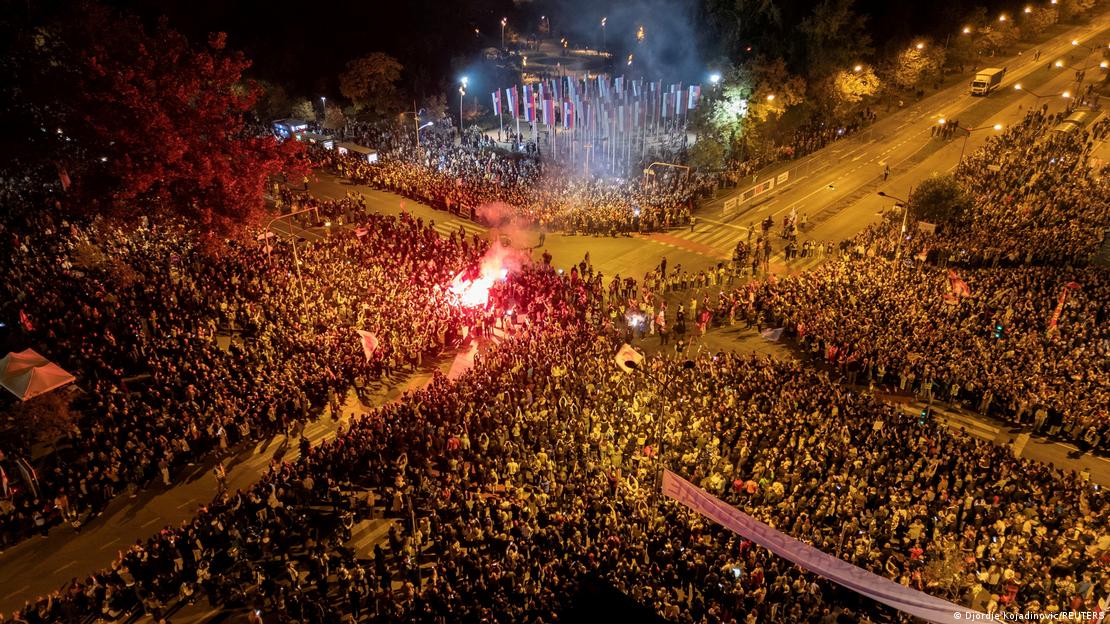
The collapse of the canopy at the entrance to the railway station in Novi Sad on November 1, 2024 killed 16 people and triggered accusations of corruption and negligence and a year of protests. Pictured here: demonstrators in Novi Sad last October
Image: Djordje Kojadinovic/REUTERS
"The greatest strength of the students and the opposition is the change we have seen in the electorate," Spasojevic told DW. "The bloc of [those in] power and the bloc of the opposition are now relatively equal, and for the first time, we will have elections in which the government not only could lose, but would probably lose."
"But that should not lull anyone into complacency," added Spasojevic. "There is still a lot of time before the elections, and the government still has enormous resources. It has repeatedly shown its ability to get out of difficult situations."
Students shift to campaign mode
By the end of 2025, the mass protests that had been taking place across Serbia since November 2024 had largely subsided: Faculty blockades were lifted, and students returned to class.
In short, the student movement entered a phase of transformation.
Instead of organizing protests, the focus shifted to preparing for an election.
After a lengthy internal process of selecting their own candidates for parliament, students are now setting up campaign headquarters, training election observers and shaping their political platform.
While one group of students goes door to door speaking to citizens, others are organizing actions such as "A student in every village," which sees students setting up improvised stands where they not only attempt to counter the image shaped by pro-government tabloids over the years but also to listen to people's criticism and concerns.
Mobilizing voters and building trust
Danilo Erdeljan and Sonja Hajdukovic, two students from Novi Sad, are regularly out and about, meeting citizens.
The goal, they say, is not only mobilization, but also building trust — learning about electoral rules and campaigning as they go.
"The greatest strength of the students and the opposition is the change we have seen in the electorate," Spasojevic told DW. "The bloc of [those in] power and the bloc of the opposition are now relatively equal, and for the first time, we will have elections in which the government not only could lose, but would probably lose."
"But that should not lull anyone into complacency," added Spasojevic. "There is still a lot of time before the elections, and the government still has enormous resources. It has repeatedly shown its ability to get out of difficult situations."
Students shift to campaign mode
By the end of 2025, the mass protests that had been taking place across Serbia since November 2024 had largely subsided: Faculty blockades were lifted, and students returned to class.
In short, the student movement entered a phase of transformation.
Instead of organizing protests, the focus shifted to preparing for an election.
After a lengthy internal process of selecting their own candidates for parliament, students are now setting up campaign headquarters, training election observers and shaping their political platform.
While one group of students goes door to door speaking to citizens, others are organizing actions such as "A student in every village," which sees students setting up improvised stands where they not only attempt to counter the image shaped by pro-government tabloids over the years but also to listen to people's criticism and concerns.
Mobilizing voters and building trust
Danilo Erdeljan and Sonja Hajdukovic, two students from Novi Sad, are regularly out and about, meeting citizens.
The goal, they say, is not only mobilization, but also building trust — learning about electoral rules and campaigning as they go.
\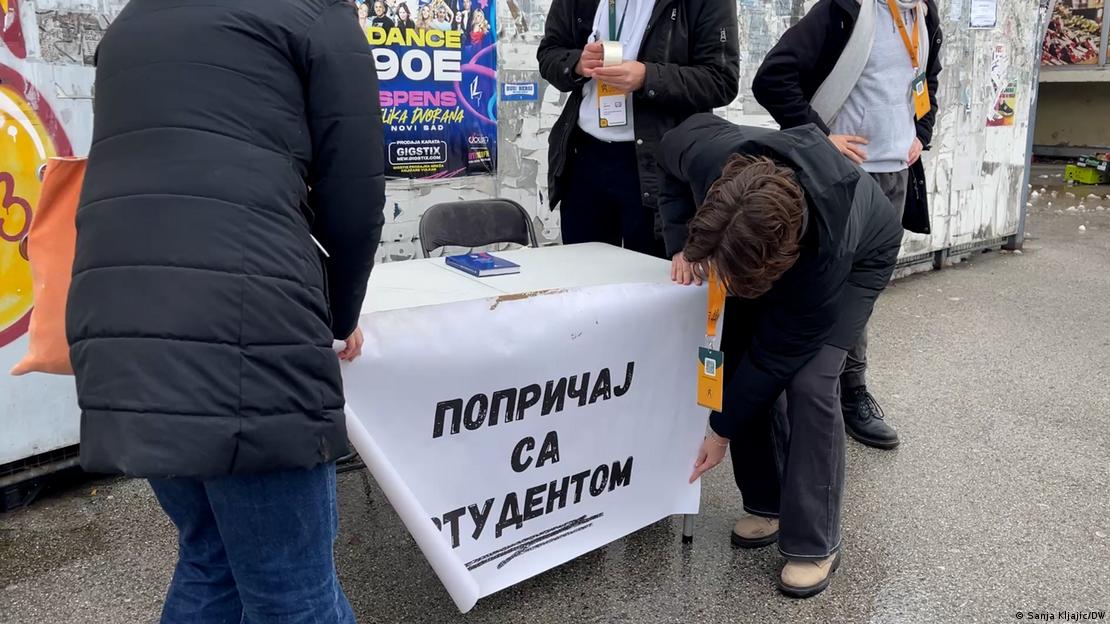
Students are out on the streets, talking to citizens and listening to their concerns. The sign at this improvised campaign stand reads 'Talk to a student'
Image: Sanja Kljajic/DW
They firmly believe that delaying the election benefits them more than the government because their organization is growing stronger by the day, and each participation in local elections brings new experience and logistical capacity.
"The government is waiting to see whether people will get tired and give up, but at the same time, it is giving us more time to prepare," Danilo Erdeljan told DW. "We have already seen how difficult it is for the ruling coalition to organize electoral fraud at the local level, and it will be much harder to do so nationwide when parliamentary elections come. And day by day, we are becoming more prepared to confront any irregularities on election day."
Growing opportunities — and challenges
That support for students has not faded was also demonstrated on December 28, when students collected signatures of support for an early election at over 500 stands in more than 100 cities and municipalities across the country.
The students say that they collected nearly 400,000 signatures in a single day, with many citizens also leaving contact information and expressing willingness to take part in future activities.
For the students, this was clear confirmation that the potential for mass mobilization has not disappeared but has just been temporarily subdued — and that calling an election could trigger a new wave of mobilization.
They firmly believe that delaying the election benefits them more than the government because their organization is growing stronger by the day, and each participation in local elections brings new experience and logistical capacity.
"The government is waiting to see whether people will get tired and give up, but at the same time, it is giving us more time to prepare," Danilo Erdeljan told DW. "We have already seen how difficult it is for the ruling coalition to organize electoral fraud at the local level, and it will be much harder to do so nationwide when parliamentary elections come. And day by day, we are becoming more prepared to confront any irregularities on election day."
Growing opportunities — and challenges
That support for students has not faded was also demonstrated on December 28, when students collected signatures of support for an early election at over 500 stands in more than 100 cities and municipalities across the country.
The students say that they collected nearly 400,000 signatures in a single day, with many citizens also leaving contact information and expressing willingness to take part in future activities.
For the students, this was clear confirmation that the potential for mass mobilization has not disappeared but has just been temporarily subdued — and that calling an election could trigger a new wave of mobilization.
Difficulties lie ahead
But as the opposition consolidates, the government, too, is closing ranks.
Under severe pressure because of the threat of US sanctions on Serbia's Russian-owned oil company NIS and the loss of support from former international partners — from the United States, through the European Union, to Russia — Aleksandar Vucic is carefully timing when to play his key election card, aiming to call the election at the moment that is politically most favorable for him.
\
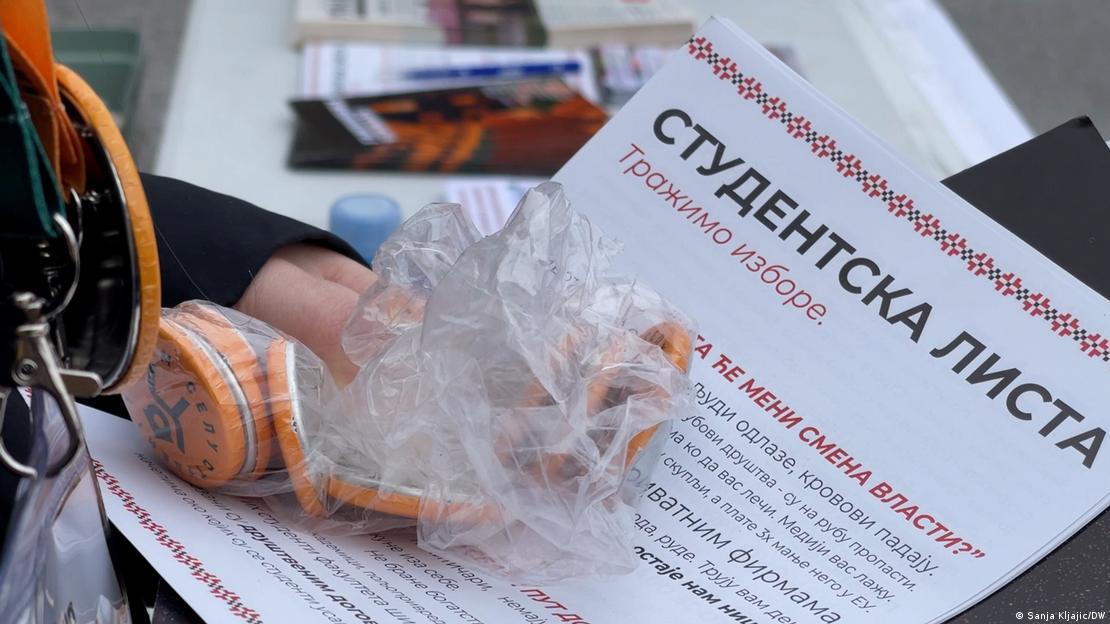
Students distribute flyers with information about the students' list of candidates for the next parliamentary election and their demand for a snap poll
Image: Sanja Kljajic/DW
According to DW's sources, this means that Vucic is likely to delay the election as long as possible — even at the risk of deepening the crisis.
At the same time, there has been evidence that the government is tightening its grip within the system: There have been hundreds of dismissals in the public sector in recent months, targeting not only those who took part in protests, but also those whose family members were involved and even those who remained neutral and were not apparently outspoken enough in their support for the government.
Legal proceedings have been initiated against numerous students on charges of allegedly undermining the constitutional order. Some remain in political exile.
The pressure being exerted on universities has also been ramped up. On Thursday, one professor who supported the protesting students was dismissed from her post without due process. In addition, the state has introduced a new system that centralizes all university finances and places them under state control. As a result, faculties have lost their financial independence, effectively making them easier to control.
Students are aware that the year ahead will be long and difficult.
"But if people have endured this far, they will endure longer," says Danilo Erdeljan. "From the start, we knew this was not a sprint, but a marathon, and I believe it is possible to persist for as long as necessary."
Edited by: Aingeal Flanagan

Sanja Kljajic Correspondent for DW's Serbian Service based in Novi Sad, Serbia@SSnajaKljajic
According to DW's sources, this means that Vucic is likely to delay the election as long as possible — even at the risk of deepening the crisis.
At the same time, there has been evidence that the government is tightening its grip within the system: There have been hundreds of dismissals in the public sector in recent months, targeting not only those who took part in protests, but also those whose family members were involved and even those who remained neutral and were not apparently outspoken enough in their support for the government.
Legal proceedings have been initiated against numerous students on charges of allegedly undermining the constitutional order. Some remain in political exile.
The pressure being exerted on universities has also been ramped up. On Thursday, one professor who supported the protesting students was dismissed from her post without due process. In addition, the state has introduced a new system that centralizes all university finances and places them under state control. As a result, faculties have lost their financial independence, effectively making them easier to control.
Students are aware that the year ahead will be long and difficult.
"But if people have endured this far, they will endure longer," says Danilo Erdeljan. "From the start, we knew this was not a sprint, but a marathon, and I believe it is possible to persist for as long as necessary."
Edited by: Aingeal Flanagan
Sanja Kljajic Correspondent for DW's Serbian Service based in Novi Sad, Serbia@SSnajaKljajic
No comments:
Post a Comment