'American? No!' says Greenland after latest Trump threat
Greenland's political parties said they did not want to be under Washington as US President Donald Trump again suggested using force to seize the mineral-rich Danish autonomous territory, raising concern worldwide.
Issued on: 10/01/2026 - RFI
Greenland's political parties said they did not want to be under Washington as US President Donald Trump again suggested using force to seize the mineral-rich Danish autonomous territory, raising concern worldwide.
Issued on: 10/01/2026 - RFI
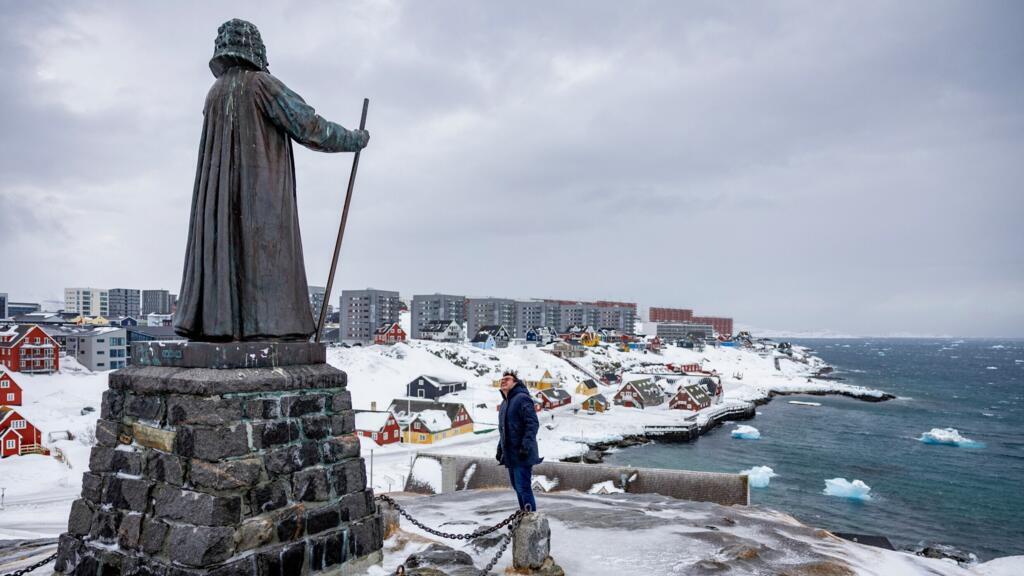
The statue of Hans Egede (1686-1758), a Dano-Norwegian Lutheran missionary, in Nuuk, Greenland, here photographed in March 2025. AFP - ODD ANDERSEN
The statement late Friday came after Trump repeated that Washington was "going to do something on Greenland, whether they like it or not".
European capitals have been scrambling to come up with a coordinated response after the White House said this week that Trump wanted to buy Greenland and refused to rule out military action.
"We don't want to be Americans, we don't want to be Danish, we want to be Greenlanders," the leaders of five parties in Greenland's parliament said in a joint statement.
"The future of Greenland must be decided by Greenlanders."
"No other country can meddle in this. We must decide our country's future ourselves -- without pressure to make a hasty decision, without procrastination, and without interference from other countries," they underscored.
Julius Nielsen, a 48-year-old fisherman in the capital Nuuk, told AFP: "American? No! We were a colony for so many years. We're not ready to be a colony again, to be colonised".
A Danish colony until 1953, Greenland gained home rule 26 years later and is contemplating eventually loosening its ties with Denmark.
Many Greenlanders remain cautious about making this a reality.
"I really like the idea of us being independent, but I think we should wait. Not for now. Not today," Pitsi Mari, who works in telecoms, told AFP.
"I feel like the United States' interference disrupts all relationships and trust" between Denmark and Greenland, said Inaluk Pedersen, a 21-year-old shop assistant.
The coalition currently in power is not in favour of a hasty independence. The only opposition party, Naleraq, which won 24.5 percent of the vote in the 2025 legislative elections, wants to cut ties as quickly as possible but it is also a signatory of the joint declaration.
"It's time for us to start preparing for the independence we have fought for over so many years," said MP Juno Berthelsen in a Facebook post.
According to a poll published on Saturday by Danish agency Ritzau, more than 38 percent of Danes think the United States will launch an invasion of Greenland under the Trump administration.
Vast natural resources
Denmark and other European allies have voiced shock at Trump's threats on Greenland, a strategic island between North America and the Arctic where the United States has had a military base since World War II.
Trump says controlling the island is crucial for US national security given the rising military activity of Russia and China in the Arctic.
"We're not going to have Russia or China occupy Greenland. That's what they're going to do if we don't. So we're going to be doing something with Greenland, either the nice way or the more difficult way," the US president said Friday.
Both Russia and China have increased military activity in the region in recent years, but neither has laid any claim to the vast icy island.
Greenland has also attracted international attention in recent years for its vast natural resources including rare earth minerals and estimates that it could possess huge oil and gas reserves.
Danish Prime Minister Mette Frederiksen has warned that an invasion of Greenland would end "everything", meaning the transatlantic NATO defence pact and the post-World War II security structure.
Flurry of diplomacy
"I'm a fan of Denmark, too, I have to tell you. And you know, they've been very nice to me," Trump said.
"But you know, the fact that they had a boat land there 500 years ago doesn't mean that they own the land."
Secretary of State Marco Rubio is due to meet next week with Denmark's foreign minister and representatives from Greenland.
A flurry of diplomacy is under way as Europeans try to head off a crisis while at the same time avoiding the wrath of Trump, who is nearing the end of his first year back in power.
Trump had offered to buy Greenland in 2019 during his first presidential term but was rebuffed.
The head of NATO's forces in Europe, US General Alexus Grynkewich, said Friday the military alliance was far from being in "a crisis", following Trump's threats to bring Greenland under US control.
(AFP)
The statement late Friday came after Trump repeated that Washington was "going to do something on Greenland, whether they like it or not".
European capitals have been scrambling to come up with a coordinated response after the White House said this week that Trump wanted to buy Greenland and refused to rule out military action.
"We don't want to be Americans, we don't want to be Danish, we want to be Greenlanders," the leaders of five parties in Greenland's parliament said in a joint statement.
"The future of Greenland must be decided by Greenlanders."
"No other country can meddle in this. We must decide our country's future ourselves -- without pressure to make a hasty decision, without procrastination, and without interference from other countries," they underscored.
Julius Nielsen, a 48-year-old fisherman in the capital Nuuk, told AFP: "American? No! We were a colony for so many years. We're not ready to be a colony again, to be colonised".
A Danish colony until 1953, Greenland gained home rule 26 years later and is contemplating eventually loosening its ties with Denmark.
Many Greenlanders remain cautious about making this a reality.
"I really like the idea of us being independent, but I think we should wait. Not for now. Not today," Pitsi Mari, who works in telecoms, told AFP.
"I feel like the United States' interference disrupts all relationships and trust" between Denmark and Greenland, said Inaluk Pedersen, a 21-year-old shop assistant.
The coalition currently in power is not in favour of a hasty independence. The only opposition party, Naleraq, which won 24.5 percent of the vote in the 2025 legislative elections, wants to cut ties as quickly as possible but it is also a signatory of the joint declaration.
"It's time for us to start preparing for the independence we have fought for over so many years," said MP Juno Berthelsen in a Facebook post.
According to a poll published on Saturday by Danish agency Ritzau, more than 38 percent of Danes think the United States will launch an invasion of Greenland under the Trump administration.
Vast natural resources
Denmark and other European allies have voiced shock at Trump's threats on Greenland, a strategic island between North America and the Arctic where the United States has had a military base since World War II.
Trump says controlling the island is crucial for US national security given the rising military activity of Russia and China in the Arctic.
"We're not going to have Russia or China occupy Greenland. That's what they're going to do if we don't. So we're going to be doing something with Greenland, either the nice way or the more difficult way," the US president said Friday.
Both Russia and China have increased military activity in the region in recent years, but neither has laid any claim to the vast icy island.
Greenland has also attracted international attention in recent years for its vast natural resources including rare earth minerals and estimates that it could possess huge oil and gas reserves.
Danish Prime Minister Mette Frederiksen has warned that an invasion of Greenland would end "everything", meaning the transatlantic NATO defence pact and the post-World War II security structure.
Flurry of diplomacy
"I'm a fan of Denmark, too, I have to tell you. And you know, they've been very nice to me," Trump said.
"But you know, the fact that they had a boat land there 500 years ago doesn't mean that they own the land."
Secretary of State Marco Rubio is due to meet next week with Denmark's foreign minister and representatives from Greenland.
A flurry of diplomacy is under way as Europeans try to head off a crisis while at the same time avoiding the wrath of Trump, who is nearing the end of his first year back in power.
Trump had offered to buy Greenland in 2019 during his first presidential term but was rebuffed.
The head of NATO's forces in Europe, US General Alexus Grynkewich, said Friday the military alliance was far from being in "a crisis", following Trump's threats to bring Greenland under US control.
(AFP)

Credit: Grok/AI GENERATED
January 10, 2026
Manohar Parrikar Institute for Defence Studies and Analyses (MP-IDSA)
By Ajey Lele
After a successful military intervention in Venezuela, United States President Donald Trump is now making efforts to seek control over Greenland. He appears to be considering two options: one, to purchase it from Denmark; two, to use military force to effect the takeover. Trump’s obsession with Greenland is not new. Even during Trump 1.0, he had expressed a desire to acquire Greenland. This issue is going to significantly strain the relations between the European Union (EU) and the US.
Leaders from France, Germany, Italy, Poland, Spain, Britain and Denmark have issued a statement mentioning that, “Greenland belongs to its people. It is for Denmark and Greenland, and them only, to decide on matters concerning Denmark and Greenland.”[1] The Prime Minister of Denmark, Mette Frederiksen, said that “if Trump took over Greenland, that would mark an end of the North Atlantic Treaty Organization (NATO)”, which is an inter-governmental military alliance between the EU and North America, founded in the aftermath of World War II.[2]
Geographically part of the North American continent, Greenland has been politically and culturally linked to Europe for over a thousand years. Today, Greenland functions as an autonomous territory within the Kingdom of Denmark, exercising self-governance while remaining under Danish sovereignty. It shares a small 1.2 km land border with Canada. Greenland does not share a land border with the US, but it’s geographically part of North America. Greenland’s inhabitants are full citizens of Denmark and, by extension, of the EU, reflecting its enduring European political affiliation.
Greenland’s population in 2025 was approximately 55,700–57,000. Greenland is the world’s largest island, covering approximately 2.16 million square km. Approximately 80 per cent of this area is covered by the massive Greenland Ice Sheet, with ice-free areas primarily along the coast. The key issue, therefore, is why the US is keen to acquire Greenland despite its harsh climate and challenging geography.
Geostrategic and economic considerations drive the US interest in acquiring Greenland. Greenland occupies a pivotal position in the Arctic. This region lies between the Atlantic and Arctic Oceans. It has key Arctic shipping lanes and is part of the crucial GIUK (Greenland, Iceland, United Kingdom) Gap, a chokepoint used by NATO to monitor Russian naval movements. NATO has concerns in this regard, particularly in light of Russia’s renewed naval activity.
The GIUK Gap (broader than classic maritime choke points) functions as a critical transit corridor that channels naval movement between northern European waters and the wider Atlantic. Since taking office as US president approximately one year ago, Trump has given indications that he is a NATO sceptic. Clearly, Trump wants only the US to dominate Arctic power politics.
In addition, Greenland possesses significant untapped reserves of rare earth elements (RREs), critical minerals and hydrocarbons. All these resources are central to technological and energy security. The Trump administration is already pursuing an assertive strategy to secure access to strategic minerals in other parts of the world. There are arrangements in place with Australia and resource-rich states in Southeast Asia, Africa and West Asia.[3] He has also sought Ukraine’s access to its mineral deposits. All efforts are being made to reduce the mineral-dependent reliance on China.
Greenland holds considerable strategic relevance for the US defence establishment. The region is essential for space and missile defence activities. Greenland’s geographic position between North America and Europe makes it vital for early-warning and surveillance missions. At the heart of this role is the Pituffik Space Base (formerly Thule Air Base), a key US Department of Defense installation operated by the 821st Space Base Group under the US Space Force’s Space Base Delta 1. The base supports ballistic-missile early-warning systems, satellite tracking, secure communications and space-domain awareness, forming the basis of the US homeland defence architecture against long-range missile threats.[4]
In May 2025, Donald Trump unveiled a new national defence initiative, the ‘Golden Dome’. The proposed missile defence system is envisioned as a space-based missile shield designed to counter threats from incoming nuclear (or non-nuclear) tipped ballistic missiles as well as emerging hypersonic weapons.[5] For this purpose, the US could deploy a constellation of satellite interceptors, possibly equipped with kinetic or directed-energy weapons. Greenland’s strategic geopolitical location could be of great importance for positioning various Golden Dome-related systems.
Beyond its military utility, Greenland also contributes significantly to cutting-edge scientific research, particularly in astronomy and space science. Its high latitude, cold and dry atmosphere, and minimal radio interference make it an ideal location for deep-space observation. Located at the Pituffik Space Base is the Greenland Telescope Project, which has a 12-metre scanning antenna. This telescope is part of a global network studying supermassive black holes and has contributed to breakthroughs, including the imaging of black hole environments. Taiwan leads this project. For the US, such engagements could have both scientific and strategic relevance.[6]
Trump may not accept the scientific rationale for climate change, but he is aware that accelerated ice melt is occurring in the Arctic. In the future, this could lead to the opening of shorter maritime routes linking the Atlantic and the Pacific. This would be very beneficial for global shipping. Obviously, this would have an impact on supply chains and trade. This would also allow the US to increase its maritime dominance. Broadly, it could be said that there is a method behind Trump’s thinking regarding the acquisition of Greenland. It is intended for mineral exploration, space exploration, scientific research and military applications. Trump is seeking to secure US interests in the Arctic for long-term geostrategic and economic reasons.
Views expressed are of the author and do not necessarily reflect the views of the Manohar Parrikar IDSA or of the Government of India.
[1] Jude Sheerin, “US Discussing Options to Acquire Greenland, Including Use of Military, Says White House”, BBC, 7 January 2026.
[2] Anders Kongshaug, Claudia Ciobanu and Stefanie Dazio, “Danish Prime Minister Says a US Takeover of Greenland Would Mark the End of NATO”, Associated Press, 6 January 2026.
[3] “Historic Critical Minerals Framework Signed by President Trump and Prime Minister Albanese”, Prime Minister of Australia, 21 October 2025.
[4] Miranda Bryant, “‘Welcome to the Top of the World’: The Pituffik US Space Base in Greenland”, The Guardian, 28 March 2025.
[5] Bernd Debusmann Jr, “Trump Unveils Plans for ‘Golden Dome’ Defence System”, BBC, 21 May 2025.
[6] “Greenland Telescope”, Center for Astrophysics.About the author: Group Captain (Dr)
Ajey Lele (Retd.) is the Deputy Director General, MP-IDSA. Earlier, he was a Senior Fellow at the Manohar Parrikar Institute for Defence Studies and Analyses and a part of its Centre on Strategic Technologies. He started his professional career as an officer in the Indian Air Force, and took early retirement from the service to pursue his academic interests.
Source: This article was published by Manohar Parrikar Institute for Defence Studies and Analyses
Manohar Parrikar Institute for Defence Studies and Analyses (MP-IDSA)
The Manohar Parrikar Institute for Defence Studies and Analyses (MP-IDSA), is a non-partisan, autonomous body dedicated to objective research and policy relevant studies on all aspects of defence and security. Its mission is to promote national and international security through the generation and dissemination of knowledge on defence and security-related issues. The Manohar Parrikar Institute for Defence Studies and Analyses (MP-IDSA) was formerly named The Institute for Defence Studies and Analyses (IDSA).
Manohar Parrikar Institute for Defence Studies and Analyses (MP-IDSA)
The Manohar Parrikar Institute for Defence Studies and Analyses (MP-IDSA), is a non-partisan, autonomous body dedicated to objective research and policy relevant studies on all aspects of defence and security. Its mission is to promote national and international security through the generation and dissemination of knowledge on defence and security-related issues. The Manohar Parrikar Institute for Defence Studies and Analyses (MP-IDSA) was formerly named The Institute for Defence Studies and Analyses (IDSA).
No comments:
Post a Comment