
Ukrainian President Volodymyr Zelenskiy listens to US President Donald Trump, after Trump said that Russian President Vladimir Putin expressed willingness to help Ukraine "succeed", during a press conference at Trump's Mar-a-Lago club, in Palm Beach, Florida, US, Dec 28, 2025.
PHOTO: Reuters file
WASHINGTON — US President Donald Trump told Reuters that Ukraine — not Russia — is holding up a potential peace deal, rhetoric that stands in marked contrast to that of European allies, who have consistently argued Moscow has little interest in ending its war in Ukraine.
In an exclusive interview in the Oval Office on Wednesday (Jan 14), Trump said Russian President Vladimir Putin is ready to wrap up his nearly four-year-old invasion of Ukraine. Zelenskiy, the US president said, was more reticent.
"I think he's ready to make a deal," Trump said of the Russian president. "I think Ukraine is less ready to make a deal."
Asked why US-led negotiations had not yet resolved Europe's largest land conflict since World War Two, Trump responded: "Zelenskiy."
Trump's comments suggested renewed frustration with the Ukrainian leader. The two presidents have long had a volatile relationship, though their interactions seem to have improved over Trump's first year back in office.
At times, Trump has been more willing to accept Putin's assurances at face value than the leaders of some US allies, frustrating Kyiv, European capitals and US lawmakers, including some Republicans.
In December, Reuters reported that US intelligence reports continued to warn that Putin had not abandoned his aims of capturing all of Ukraine and reclaiming parts of Europe that belonged to the former Soviet empire. Director of National Intelligence Tulsi Gabbard disputed that report at the time.
'Having a hard time getting there'
After several fits and starts, US-led negotiations have been centred in recent weeks on security guarantees for a post-war Ukraine to ensure that Russia does not invade it again after a potential peace deal. In broad terms, US negotiators have pushed Ukraine to abandon its eastern Donbas region as part of any accord with Russia.
Ukrainian officials have been deeply involved in recent talks, which have been led on the US side by special envoy Steve Witkoff and Jared Kushner, Trump's son-in-law. Some European officials have cast doubt on the likelihood of Putin agreeing to some terms recently hashed out by Kyiv, Washington and European leaders.
Trump told Reuters he was not aware of a potential upcoming trip to Moscow by Witkoff and Kushner, which Bloomberg reported earlier on Wednesday.
Asked if he would meet Zelenskiy at the World Economic Forum in Davos, Switzerland, next week, Trump said he would but implied no plans were set.
"I would — if he's there," Trump said. "I'm going to be there."
Asked why he believed Zelenskiy was holding back on negotiations, Trump did not elaborate, saying only: "I just think he's, you know, having a hard time getting there."
Zelenskiy has publicly ruled out any territorial concessions to Moscow, saying Kyiv has no right under the country's constitution to give up any land.
How Russia's and Ukraine's Neighbors See Them
Kyiv's lead in approval over Moscow narrows, but varies by region
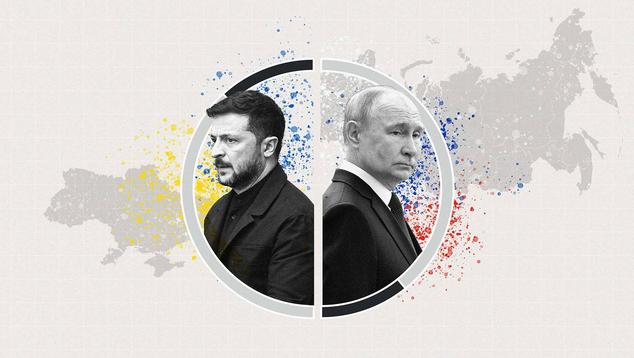
This article is part of a series on global leadership approval ratings. Read more on approval of the U.S. and China among NATO countries and on EU approval among its member states.
LONDON — Nearly four years after Russia’s full-scale invasion of Ukraine, neither country’s leadership earns high approval in its own backyard, and Ukraine’s slight edge has faded.
Across 25 countries in Eastern and Southern Europe, the Caucasus, and Central Asia, a median of 24% of adults approved of Ukraine’s leadership in 2025, down slightly from 27% in 2024. Approval of Russia’s leadership stood at 22%, mostly unchanged from the previous year.
Gallup has measured approval of Ukraine’s leadership throughout the region since 2024, while it has tracked views of Russia’s leadership since 2007. Russia’s current 22% average approval rating is marginally higher than where it stood after its full-scale invasion of Ukraine in 2022. At that time, regional approval of Russia had fallen to 19% from 31% in 2021. It has hovered near 20% ever since. Russia’s current approval rating is less than half of what it was at its highest point in 2008, when it stood at 45%.
Median approval of Ukraine’s leadership across the region has inched downward since 2024, from 27% to 24%. This mostly reflects sharp declines in Kazakhstan (down 16 percentage points), Romania and Georgia (both down 10 points) since 2024, while approval has been steadier elsewhere.
Clear Regional Divisions in Allegiances to Kyiv, Moscow
The region shows significant divides in relative approval of Kyiv and Moscow. Ten countries favor Kyiv (meaning their approval of Ukraine’s leadership exceeds their approval of Russia’s by at least 10 percentage points), eight are more aligned with Moscow, and seven show no clear preference — a picture similar to 2024.
The Baltic states show the strongest support for Ukraine over Russia, led by Lithuania (66-point gap), Latvia (52 points) and Estonia (51 points). Central Asia leans heavily toward Russia, with Tajikistan showing a 58-point gap and Kyrgyzstan 50 points. Four countries where Russia leads show gaps in approval exceeding 20 points. By contrast, all 10 countries favoring Kyiv do so. Countries with no clear preference, including Romania, Slovakia, Moldova, Greece and Hungary, cluster in Southern and Eastern Europe.
These regional allegiances reflect a mixture of broader historical ties and economic interests. In the Baltics, Ukraine’s struggle is often seen as their own, and they view Russia’s military actions as a potential threat to their sovereignty.
On the other hand, countries in Central Asia share close economic, cultural and media ties with Russia. Many Central Asian migrants work in Russia and send remittances home, boosting their national economies.
Countries in Southern and Eastern Europe, where there is no clear lead in approval, have historical ties and economic dependencies with both the European Union and Russia. The economic pain of decoupling from Russian energy continues to weigh on the region. At the same time, many of these countries are deeply integrated within the EU, and EU leadership approval is higher than that of both Russia and Ukraine.
Significant Political Divides in Key EU Countries Hungary and Slovakia
Although their populations offer low approval of both Russia’s and Ukraine’s leadership, EU member states Slovakia and Hungary have been the bloc’s most vocal opponents of military support for Kyiv.
Led by Prime Ministers Robert Fico and Viktor Orban, respectively, these nations are the most aligned with the Kremlin’s positions, international networks and economic interests. Because many EU decisions regarding sanctions and aid require unanimity, Slovakia and Hungary have the power to delay or dilute actions aimed at bolstering Ukraine.
In both countries, views of Ukraine and Russia are sharply divided along partisan lines. Supporters of Fico’s Direction Party are nearly three times as likely to approve of Moscow (38%) as Kyiv (14%), while supporters of the opposition Progressive Slovakia Party are much more approving of Kyiv (45%) than Moscow (3%).
The Russia-Ukraine divide runs deeper in Hungary, where a majority of Orban’s Fidesz Party supporters approve of Russia’s leadership (55%), compared with only 3% who approve of Ukraine’s. By contrast, 41% of those aligned with the opposition TISZA Party approve of Kyiv, while 13% approve of Moscow.
These partisan gaps help explain why EU support for Ukraine remains contested in some member states. Hungary and Slovakia have delayed EU sanctions on Russia and questioned military aid to Ukraine. Supporters of the parties currently in power (Direction, Fidesz) are largely aligned with this more favorable stance toward Russia, giving their leaders more domestic backing to resist EU consensus. But elections could shift these positions quickly. Hungary votes in April 2026, with polls forecasting a close race between Fidesz and TISZA.
Bottom Line
As the war in Ukraine continues, Kyiv and Moscow earn similar approval ratings from the wider region, with a slight slip in approval of Kyiv over the past year. However, relative approval of the two countries’ leadership varies considerably by geography, with the Baltics leaning heavily toward Kyiv, Central Asia favoring Moscow, and several Southern and Eastern European nations not clearly aligned with either.
Many efforts have been made to bring the war to an end in recent months, with U.S. President Donald Trump recently hosting Ukrainian President Volodymyr Zelenskyy in Florida to discuss options. This concluded with Trump acknowledging that some “thorny issues” remain unresolved. However, if the war does end in the near future, regional approval ratings could factor into the regional political landscape Ukraine faces as it rebuilds, as well as which countries fall into Kyiv’s or Moscow’s orbit in the years to come.
Stay up to date with the latest insights by following @Gallup on X and on Instagram.
For complete methodology and specific survey dates, please review Gallup's Country Data Set details. Learn more about how the Gallup World Poll works.


No comments:
Post a Comment