DW
Even as France and the UK offer a written commitment to Ukraine to deploy troops in the event of a peace deal, doubts remain whether the US will back those troops in case they come under a Russian attack.

European leaders face many challenges as they try to build a long-term security architecture for Ukraine
Image: Stefan Rousseau/empics/picture alliance
As allies met in Paris to firm up security guarantees for Ukraine, the presence of peace envoys sent by Donald Trump offered hope that the US was still listening to the EU despite the president's threats to annex Greenland.
"We have largely finished the security protocols," said Steve Witkoff, one of the two emissaries, as he stood alongside the leaders of France, Germany, the UK and Ukraine at the presidential palace in Paris.
"This is important so that when this war ends, it ends forever," he said.
Even as France and the UK inked their resolve to deploy troops to Ukraine in a postwar scenario, the US did not offer to protect those troops in case Russia threatened their security.
As allies met in Paris to firm up security guarantees for Ukraine, the presence of peace envoys sent by Donald Trump offered hope that the US was still listening to the EU despite the president's threats to annex Greenland.
"We have largely finished the security protocols," said Steve Witkoff, one of the two emissaries, as he stood alongside the leaders of France, Germany, the UK and Ukraine at the presidential palace in Paris.
"This is important so that when this war ends, it ends forever," he said.
Even as France and the UK inked their resolve to deploy troops to Ukraine in a postwar scenario, the US did not offer to protect those troops in case Russia threatened their security.
What could deployment look like?
This week France, the UK and Ukraine signed a declaration of intent relating to the deployment of what they described as a multinational force in support of Ukraine's defense, reconstruction and strategic sustainability.
Experts said that given that the declaration was a written and signed document, it was a firmer and more formal assurance to Ukraine.
On Tuesday, German Chancellor Friedrich Merz announced that Germany could also play a military role and deploy "forces on NATO territory neighboring Ukraine," after a ceasefire has been achieved.
For the first time, Spanish Prime Minister Pedro Sanchez also expressed a willingness to send troops as part of a peacekeeping mission in Ukraine although the extent of the contribution remains unclear.
Jacob Funk Kirkegaard, a senior fellow at Brussels-based think tank Bruegel, told DW that a two-nation force is deliberately described as multinational, to allow other European but also non-Europeans, to join in.
"Who could it be? I think maybe Australia, or definitely Turkey which is a major player in the Black Sea," Kirkegaard said.
The meeting in Paris was held under the framework of the coalition of the willing, which comprises about 30 countries, minus the United States, that have decided to help Ukraine and offer some sort of security guarantees.
In a statement the grouping said they would help build "defensive fortifications" inside Ukraine without offering more detail.
Kirkegaard said that, while it is unclear exactly the kind of fortifications these would be, they could be similar to those being erected in NATO member states in Russia's vicinity. "Like in Finland," he said, it could involve "laying more mines and barbed wire" at the very least.
The statement also said the coalition would participate in a proposed US-led monitoring-and-verification mechanism after a ceasefire, to keep an eye on Russian violations of a future peace. This would involve procuring and operating equipment needed to observe activity along the contact line, such as drones, sensors and satellites.
The statement added the Ukrainians will "remain the first line of defence and deterrence" while experts told DW that coalition troops would mainly be present as trainers and not in a combat role.
Unanswered questions on deployment
Some in Europe are pushing ahead to establish a long-term security architecture for Ukraine. But, even at this stage, there are more questions than answers as details remain sketchy.
President Emmanuel Macron said France could deploy "several thousands" of troops to Ukraine. But it might be difficult for him to get France's parliament to approve the funding needed to maintain the troops abroad, especially wiith the countr mired in a political and economic crisis, Kirkegaard said.
Starmer's signature on the declaration has raised hackles among opposition leaders and experts who say Britain doesn't have enough soldiers to spare.
The UK's strategic defense review last year said the size and readiness of the Armed Forces declined as the cold war ended and the threat posed by the Soviet Union receded. The report stated that "only a small set of forces" are ready to deploy at any given moment. The fall in the number of soldiers happened in parallel with a drop in defense spending, the review noted.
While addressing the parliament, Starmer said the number of soldiers to be sent to Ukraine "will be determined in accordance with our military plans, which we are drawing up and looking to other members to support."
In Germany, the suggestion by Chancellor Merz to deploy troops to NATO countries neighboring Ukraine will also first have to be approved by the Bundestag.
Several other members of the coalition of the willing have been less clear about exactly how they will aid Ukraine, kicking the can to reveal their contributions once there was peace.
"Would all the COW (coalition of the willing) partners give a strong response if Russia attacks again? That's a hard question. I ask all of them, and I still have not gotten a clear answer," Ukrainian President Volodymyr Zelenskyy told reporters on Wednesday.
Until the security guarantees were approved by parliaments, by the US Congress, "we cannot answer the question if partners are ready to protect us," he added.
Some in Europe are pushing ahead to establish a long-term security architecture for Ukraine. But, even at this stage, there are more questions than answers as details remain sketchy.
President Emmanuel Macron said France could deploy "several thousands" of troops to Ukraine. But it might be difficult for him to get France's parliament to approve the funding needed to maintain the troops abroad, especially wiith the countr mired in a political and economic crisis, Kirkegaard said.
Starmer's signature on the declaration has raised hackles among opposition leaders and experts who say Britain doesn't have enough soldiers to spare.
The UK's strategic defense review last year said the size and readiness of the Armed Forces declined as the cold war ended and the threat posed by the Soviet Union receded. The report stated that "only a small set of forces" are ready to deploy at any given moment. The fall in the number of soldiers happened in parallel with a drop in defense spending, the review noted.
While addressing the parliament, Starmer said the number of soldiers to be sent to Ukraine "will be determined in accordance with our military plans, which we are drawing up and looking to other members to support."
In Germany, the suggestion by Chancellor Merz to deploy troops to NATO countries neighboring Ukraine will also first have to be approved by the Bundestag.
Several other members of the coalition of the willing have been less clear about exactly how they will aid Ukraine, kicking the can to reveal their contributions once there was peace.
"Would all the COW (coalition of the willing) partners give a strong response if Russia attacks again? That's a hard question. I ask all of them, and I still have not gotten a clear answer," Ukrainian President Volodymyr Zelenskyy told reporters on Wednesday.
Until the security guarantees were approved by parliaments, by the US Congress, "we cannot answer the question if partners are ready to protect us," he added.
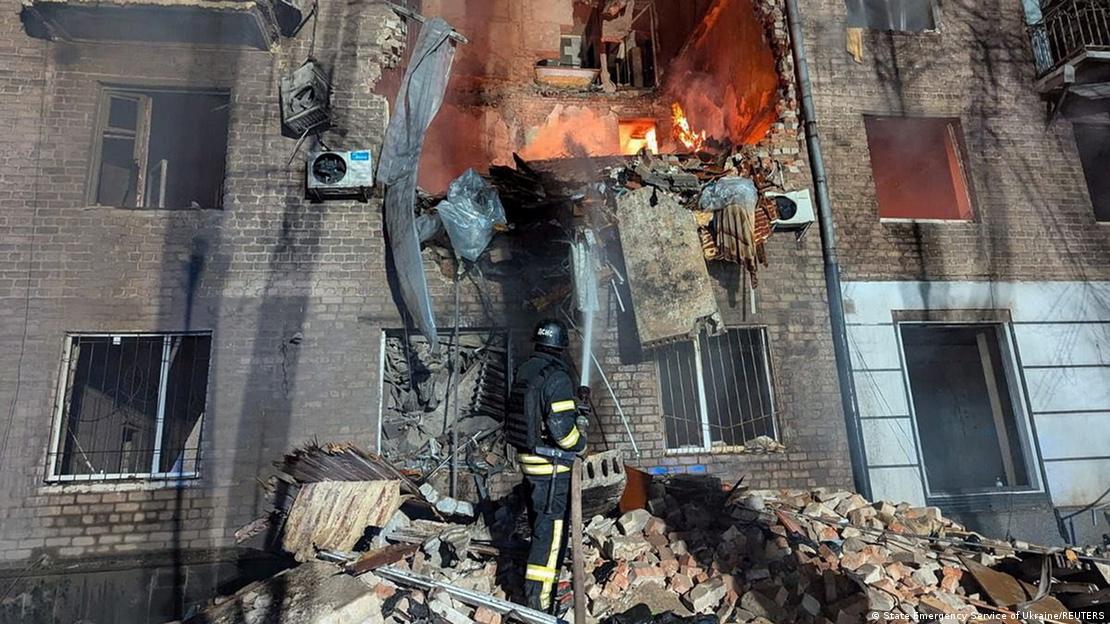
Russia continues to target Ukraine with missile strikes
Image: State Emergency Service of Ukraine/REUTERS
Absence of US remains biggest obstacle
The biggest impediment to a European presence in post-war Ukraine emanates from the bloc's once closest ally across the Atlantic.
Trump's envoys who attended the meeting in Paris did not mitigate European concerns over whether the US will come to the rescue of their troops were Russia to violate the terms of the deal.
Markus Reisner, Austrian military historian, lecturer at the Theresian Military Academy in Vienna, told DW that the core message of the adopted draft declaration in Paris was to encourage the US to commit to supporting a future European deployment.
"Without this assurance, or rather, this commitment from the US, Europe is not prepared to continue. This means it is now up to the US to make a corresponding commitment," he said.
"It currently seems inconceivable that European armed forces would establish a large-scale presence in Ukraine without US support and its specialized military capabilities, and without a guarantee of US military intervention in the event of a Russian attack."
"This is especially true as long as Russia considers Western soldiers in Ukraine to be military targets," Reisner warns.
Edited by: Andreas Illmer
The biggest impediment to a European presence in post-war Ukraine emanates from the bloc's once closest ally across the Atlantic.
Trump's envoys who attended the meeting in Paris did not mitigate European concerns over whether the US will come to the rescue of their troops were Russia to violate the terms of the deal.
Markus Reisner, Austrian military historian, lecturer at the Theresian Military Academy in Vienna, told DW that the core message of the adopted draft declaration in Paris was to encourage the US to commit to supporting a future European deployment.
"Without this assurance, or rather, this commitment from the US, Europe is not prepared to continue. This means it is now up to the US to make a corresponding commitment," he said.
"It currently seems inconceivable that European armed forces would establish a large-scale presence in Ukraine without US support and its specialized military capabilities, and without a guarantee of US military intervention in the event of a Russian attack."
"This is especially true as long as Russia considers Western soldiers in Ukraine to be military targets," Reisner warns.
Edited by: Andreas Illmer
No comments:
Post a Comment