USCG Icebreakers Aid Great Lakes Shipping as Arctic Front Ices the Lakes
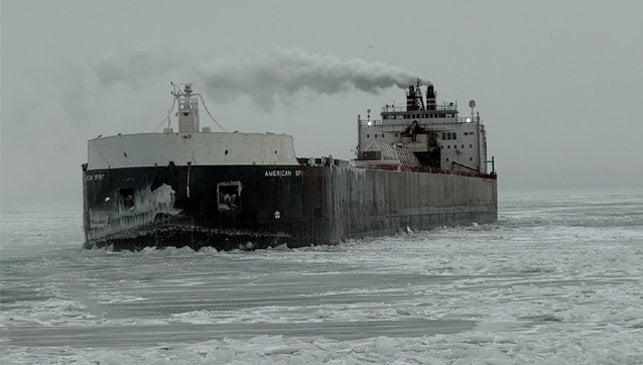
The U.S. Coast Guard Great Lakes is reporting a series of callouts in the past days as an Arctic Front crossed the Midwestern region of the United States and interrupted shipping. Some of the shipping is providing critical winter supplies of coal and fuel, while others were attempting to reach port to begin their winter lay up as the shipping season on the Lakes has come to an end.
The local TV news station in Toledo, Ohio, WTOL News 11, reports ice coverage developed quickly on the Lakes and is now above average for this time in the season. It cites NOAA data reporting that Lake Erie quickly went to nearly 80 percent ice coverage as of January 20.
The Coast Guard reports it dispatched two icebreakers in recent days to aid shipping. On Lake Erie, the American Spirit, a 1,004-foot freighter operating on the Lakes since 1978, requested assistance on Wednesday, January 21. The Coast Guard said the vessel was making slow headway but was not stuck, although the TV station reports early on Wednesday, it appeared the vessel was stationary.
The USCG Cutter Neah Bay was dispatched to the American Spirit. It helped by breaking the ice, and WTOL says the vessel was back underway by midday. The USCG escorted the vessel, and it reached Toledo, where it is going into winter layup.
It was the second time in days for the Neah Bay to aid shipping. On January 15 with was directed to aid the Lee A. Tregurtha, a 1942-built vessel that has been sailing the Great Lakes since 1961. The cutter aided in getting the vessel through 6 to 8 inches of brash ice in the St. Marys River and to proceed to the Soo Locks in Sault Ste. Marie, Michigan. It was the last day of the season for the Soo Locks, which were closing for the winter navigation season.
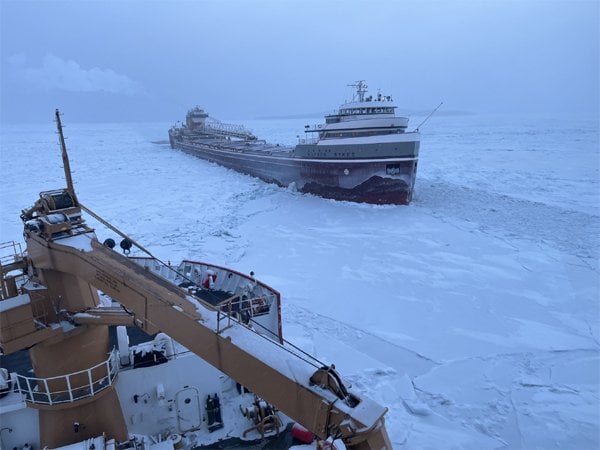
Wilfred Sykes was stuck on Lake Huron (USCG)
The Cutter Mackinaw was also called out on Lake Huron yesterday, January 21, to free the Wilfred Sykes, a 661-foot vessel operating on the Lakes since 1950, from the ice. It was escorted into the Straits of Mackinac.
The U.S. Coast Guard highlights that it has two operations, Coal Shovel and Taconite, in service on different parts of the Lakes to aid shipping and maintain winter navigation. Taconite, which focuses on Lake Michigan and Lake Superior, began in mid-December. Coal Shovel launched at the beginning of January, focusing on the region ranging from southern Lake Huron to the St. Clair-Detroit River and into Lake Erie and Lake Ontario, to maintain channels to icebound communities and for vessels carrying critical supplies such as food and heating oil.
USCG Polar Star Marks 50 Years by Freeing Cruise Ship Caught in Pack Ice
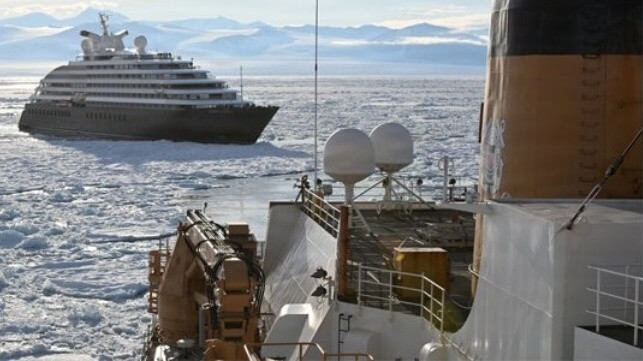
USCG Cutter Polar Star marked 50 years since her commissioning with a special achievement, freeing a luxury expedition cruise ship that had been beset by pack ice. The United States’ only active heavy icebreaker is on her 29th deployment to Antarctica in support of the annual resupply and tactical mission named Operation Deep Freeze.
Commissioned on January 17, 1976, Polar Star is 13,500 tons and, according to the U.S. Coast Guard, remains the world’s most powerful non-nuclear icebreaker. The vessel, which is 399 feet (122 meters) in length and has a 34-foot (10-meter) draft, USCG data says, is capable of breaking through solid ice up to 21 feet (6.4 meters) thick using a backing and ramming technique. It can steam continuously through 6 feet (1.8 meters) of ice at 3 knots. She produces up to 75,000 shaft horsepower.
According to the report, the icebreaker, which has been on station in the Antarctica region all month, received a call Friday night, January 16, from the Scenic Eclipse II (17,592 GT) reporting it had “become beset in pack ice roughly eight nautical miles from McMurdo Sound.” The luxury yacht cruise ship has an ice-rated hull and carries up to 200 passengers when in Antarctica.
Polar Star went to the aid of the cruise ship, making two close passes to break the ice and free the cruise ship. The cutter then escorted the cruise ship approximately four nautical miles to open water.
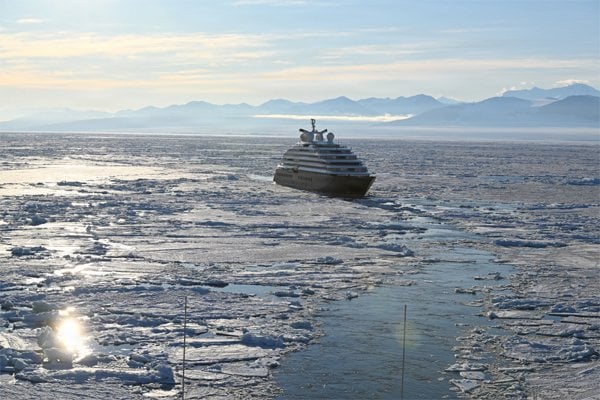
Scenic Eclipse II was escorted to open water (USCG)
“At 50 years old, Polar Star remains the world’s most capable non-nuclear icebreaker,” said Cmdr. Samuel Blase, Polar Star’s executive officer. “That’s a testament to the crews that have maintained it over the decades. With years of service left to give, Polar Star will continue to guide the way in the high latitudes well into the future.”
The icebreaker departed Seattle on November 20 for the annual mission to Antarctica. While on station, her role includes breaking a navigable channel through miles of dense ice to allow the cargo and fuel vessels to reach the McMurdo Station. During the second week of January, the icebreaker was spotted in the Ross Sea and was recently seen bringing the fuel tanker Stena Polaris to the dock at the McMurdo Station ice pier.
The Stena Polaris (65,000 dwt) operates as a U.S.-flagged tanker to support operations. She came into Antarctica from South Africa with the key fuel delivery. The Dutch-flagged heavy lift vessel Plantijngracht is transporting containers and heavy cargo from California to Antarctica. She is currently reaching New Zealand before making her way to McMudro.
Polar Star has received extensive life extension work during the offseason in recent years. She is expected to remain in service at least till 2030, when the first of the new U.S. heavy icebreakers is due to be delivered.
No comments:
Post a Comment