
Issued on: 08/01/2026
FRANCE24
Play (12:47 min)
From the show
In an interview with FRANCE 24, veteran Venezuelan opposition figure Diego Arria criticised US President Donald Trump's approach following the capture of President Nicolas Maduro by US special forces on January 3. "I was very concerned that the president does not speak of the recovery of freedom (...) of liberating the political prisoners, but speaks fundamentally of oil," he said.
Speaking to FRANCE 24 from Miami in Florida, Arria also expressed concern about the Trump administration's decision to work with Maduro's vice president, Delcy Rodriguez, who is now the acting president in the Chavist system.
"When I see Miss Rodriguez surrounded by the whole team of Mr Maduro, I begin to be very concerned," he stated.
Asked about opposition leader and Nobel Peace Prize laureate Maria Corina Machado, whom Trump has dismissed as "a very nice woman" but who "doesn't have the support or the respect within the country", Arria countered: "She has the support of more than 70 percent of Venezuelans."
In an interview with FRANCE 24, veteran Venezuelan opposition figure Diego Arria criticised US President Donald Trump's approach following the capture of President Nicolas Maduro by US special forces on January 3. "I was very concerned that the president does not speak of the recovery of freedom (...) of liberating the political prisoners, but speaks fundamentally of oil," he said.
Speaking to FRANCE 24 from Miami in Florida, Arria also expressed concern about the Trump administration's decision to work with Maduro's vice president, Delcy Rodriguez, who is now the acting president in the Chavist system.
"When I see Miss Rodriguez surrounded by the whole team of Mr Maduro, I begin to be very concerned," he stated.
Asked about opposition leader and Nobel Peace Prize laureate Maria Corina Machado, whom Trump has dismissed as "a very nice woman" but who "doesn't have the support or the respect within the country", Arria countered: "She has the support of more than 70 percent of Venezuelans."
ANALYSIS
US President Donald Trump has openly set his sights on Venezuela’s vast oil reserves, claiming Friday that US oil giants were going to invest upward of $100 billion in the country’s gutted industry. But analysts warn that relaunching Venezuela’s oil production could cost dearly in both time and money – even if the enduring Chavista administration continues to bend under US pressure.
Issued on: 09/01/2026 - RFI
By: Paul MILLAR
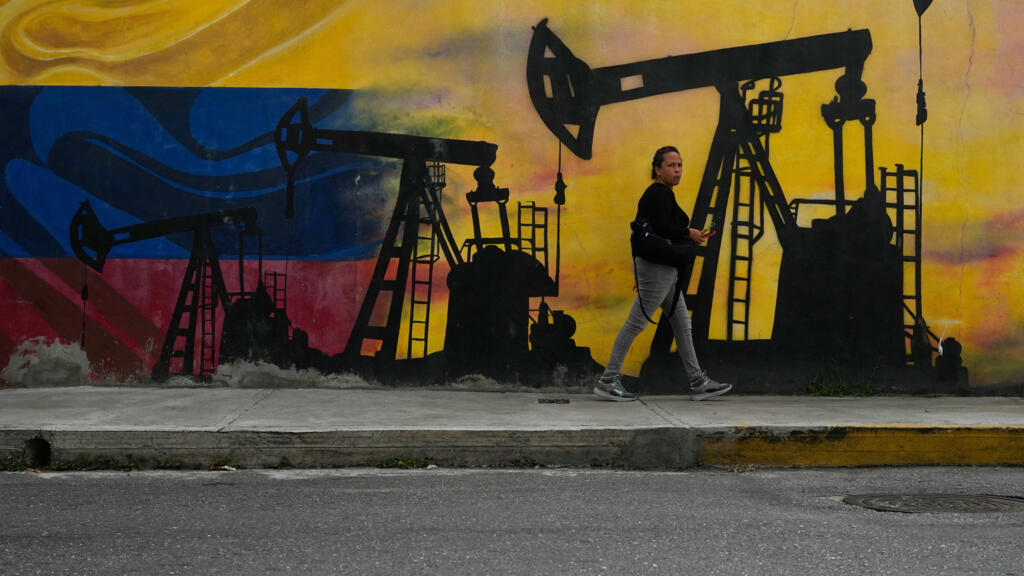
A local walks past a mural featuring oil pumps and wells in Caracas, Venezuela, January 6, 2026. © Matias Delacroix, AP
The dust is settling in Caracas, and the oil must flow. All along the US Gulf Coast, a tangle of towering refineries stands ready to receive boatloads of Venezuelan heavy crude oil.
This is what they were built for: almost three-quarters of US refining capacity, built before the Fracking Revolution of the 2010s ripped open the country’s shale bedrock to unleash untapped domestic oil and gas reserves, is set up to process the kind of thick, sulphurous crude buried under Venezuelan soil.
US President Donald Trump has not been coy about his ambitions for these oil reserves, often described as the largest in the world. On Tuesday, the president announced that the Venezuelan government – led by former oil minister Delcy Rodriguez after the armed seizure of President Nicolas Maduro and his wife by American troops – would deliver up to 50 million barrels of oil to the US, who would sell it.
Trump has claimed that he will personally manage the profits, and that any proceeds that go to Venezuela will have to be spent on US-made products.
Speaking at a Goldman Sachs energy conference in Miami Wednesday, former fracking executive and current US Energy Secretary Chris Wright said that US control of the sale of Venezuela’s oil would continue “indefinitely”.
The dust is settling in Caracas, and the oil must flow. All along the US Gulf Coast, a tangle of towering refineries stands ready to receive boatloads of Venezuelan heavy crude oil.
This is what they were built for: almost three-quarters of US refining capacity, built before the Fracking Revolution of the 2010s ripped open the country’s shale bedrock to unleash untapped domestic oil and gas reserves, is set up to process the kind of thick, sulphurous crude buried under Venezuelan soil.
US President Donald Trump has not been coy about his ambitions for these oil reserves, often described as the largest in the world. On Tuesday, the president announced that the Venezuelan government – led by former oil minister Delcy Rodriguez after the armed seizure of President Nicolas Maduro and his wife by American troops – would deliver up to 50 million barrels of oil to the US, who would sell it.
Trump has claimed that he will personally manage the profits, and that any proceeds that go to Venezuela will have to be spent on US-made products.
Speaking at a Goldman Sachs energy conference in Miami Wednesday, former fracking executive and current US Energy Secretary Chris Wright said that US control of the sale of Venezuela’s oil would continue “indefinitely”.
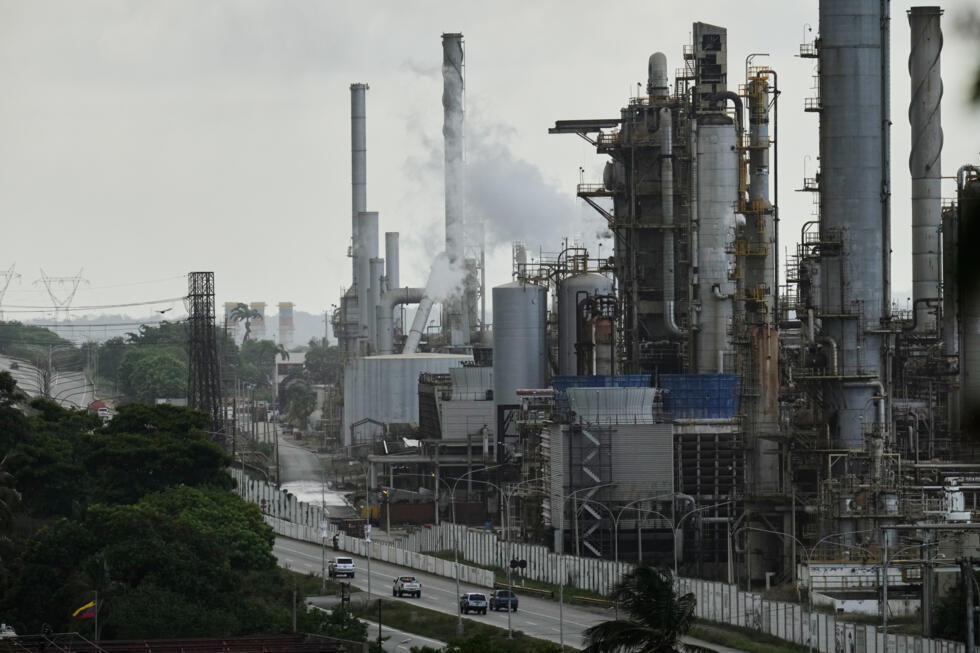
Vehicles drive past the El Palito oil refinery in Puerto Cabello, Venezuela, December 21, 2025. © Matias Delacroix, AP
And why not? The US naval blockade on Venezuela remains firmly in place, with US troops boarding and seizing at least five oil tankers allegedly trying to transport oil from the country. US sanctions that have for years throttled the country’s already struggling oil industry – responsible for 90 percent of Venezuela’s exports – have also not budged.
If Trump is to be believed, using force to reroute millions of barrels of crude oil sitting stagnant in Venezuela’s storage facilities is only the first step.
On Friday, the former real estate mogul is meeting with senior US oil executives in the White House to discuss what it will take to open the country’s broken-down oil industry to American capital.
In a Truth Social post ahead of the meeting, Trump claimed that “at least 100 billion dollars will be invested by Big Oil” in the nation’s struggling sector.
But analysts warn that breathing new life back into Venezuela’s oil industry could cost dearly in both time and money – even if the Chavista administration still in place continues to bend under US pressure.
And why not? The US naval blockade on Venezuela remains firmly in place, with US troops boarding and seizing at least five oil tankers allegedly trying to transport oil from the country. US sanctions that have for years throttled the country’s already struggling oil industry – responsible for 90 percent of Venezuela’s exports – have also not budged.
If Trump is to be believed, using force to reroute millions of barrels of crude oil sitting stagnant in Venezuela’s storage facilities is only the first step.
On Friday, the former real estate mogul is meeting with senior US oil executives in the White House to discuss what it will take to open the country’s broken-down oil industry to American capital.
In a Truth Social post ahead of the meeting, Trump claimed that “at least 100 billion dollars will be invested by Big Oil” in the nation’s struggling sector.
But analysts warn that breathing new life back into Venezuela’s oil industry could cost dearly in both time and money – even if the Chavista administration still in place continues to bend under US pressure.
Decline and fall
Antulio Rosales, assistant professor at York University’s Department of Social Science, Business and Society programme, said that Venezuela’s oil industry has been hollowed out by years of sanctions and under-investment.
“The Venezuelan oil industry in general has been decimated in terms of investment, but also in terms of technical capacity,” he said. “I think it’s very important to highlight that many workers with the technical knowledge of oil extraction and transportation and so on have left the industry – they’ve migrated to other countries.”
Cut off from international markets and finance by US sanctions during the first Trump administration, Venezuelan oil production has slumped to roughly one million barrels a day, down from roughly three times that in the late 1990s.
Even before the sanctions, former president Hugo Chavez’s decision in the 2000s to effectively force foreign oil companies to renegotiate their contracts with the government put many to flight – and turned those who stayed into junior partners with the state-owned oil and gas company PDSVA. Some of the companies whose heads have been summoned to the White House Friday are still owed billions of dollars in compensation from Caracas that was awarded under international arbitration.
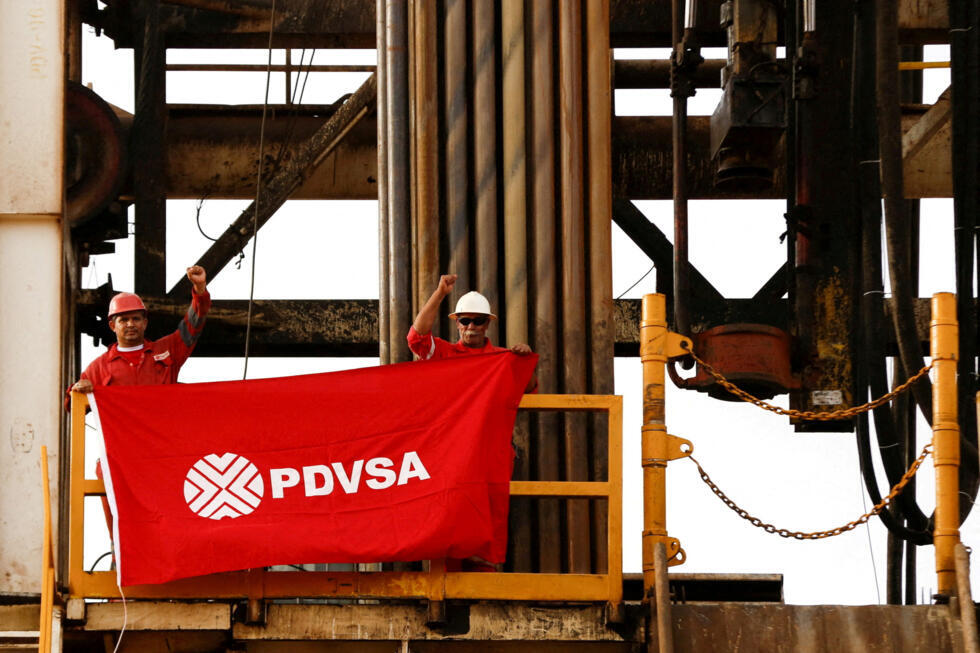
Oilfield workers hold a flag with the corporate logo of Venezuela's state oil company PDVSA on a drilling rig at an oil well operated by them in the Orinoco belt, near Cabrutica, Anzoategui, April 16, 2015. © Carlos Garcia Rawlins, Reuters
Accusations of chronic mismanagement and heavy-handed political interference have dogged the company, and Chavez’s programme of ploughing oil profits into social programmes to lift the population out of poverty came crashing down when oil prices collapsed in 2014.
The country’s oil infrastructure is now in ruins. One estimate by Oslo-based energy research agency Rystad Energy suggested Venezuela would need at least $183 billion worth of investments to restore its oil production to 3 million barrels per day by 2040.
“You cannot just set the incentives right and expect things to work immediately,” Rosales said. “And for that you need not only the lifting of sanctions, but the improvement overall of conditions in Venezuela, and those have to do with infrastructure, with public services and so on.”
Luisa Palacios previously served as chairwoman at Citgo Petroleum Corporation, a Houston-based refiner majority-owned by PDVSA. Now an adjunct senior research scholar at Columbia University’s Centre on Global Energy Policy, Palacios said that major multinationals were unlikely to make long-term investments in the country’s oil industry while the way forward remained murky.
Accusations of chronic mismanagement and heavy-handed political interference have dogged the company, and Chavez’s programme of ploughing oil profits into social programmes to lift the population out of poverty came crashing down when oil prices collapsed in 2014.
The country’s oil infrastructure is now in ruins. One estimate by Oslo-based energy research agency Rystad Energy suggested Venezuela would need at least $183 billion worth of investments to restore its oil production to 3 million barrels per day by 2040.
“You cannot just set the incentives right and expect things to work immediately,” Rosales said. “And for that you need not only the lifting of sanctions, but the improvement overall of conditions in Venezuela, and those have to do with infrastructure, with public services and so on.”
Luisa Palacios previously served as chairwoman at Citgo Petroleum Corporation, a Houston-based refiner majority-owned by PDVSA. Now an adjunct senior research scholar at Columbia University’s Centre on Global Energy Policy, Palacios said that major multinationals were unlikely to make long-term investments in the country’s oil industry while the way forward remained murky.
Venezuela's crude concessions: US vows to exert control over world's largest oil reserves
PEOPLE & PROFIT © FRANCE 24
12:32
"You can still attract investments, because in the oil business there are all kinds of companies with all kinds of risk profiles, but my sense is you cannot attract the kind of investments needed for the kind of economic recovery that the country needs," she said.
She said that oil multinationals would likely be seeking assurances from both the US and Venezuelan governments that their investments would be protected.
“The optimism is because there’s a lot of potential – it is the above-the-ground risk that is really very difficult,” she said.
“My sense is that you would need government guarantees so that if something goes wrong, you can go and claim. And the other part of the deal is you need to make sure that there are assurances on the ground. You actually need minimum guarantees of rule of law and improvements in governance.”
Unnamed sources from US oil giants told the New York Times Friday that the companies were discussing the possibility of receiving financial guarantees from the federal government before they committed to Venezuela. It’s unclear what form these guarantees would take, or who would ultimately foot the bill should those investments go under.
12:32
"You can still attract investments, because in the oil business there are all kinds of companies with all kinds of risk profiles, but my sense is you cannot attract the kind of investments needed for the kind of economic recovery that the country needs," she said.
She said that oil multinationals would likely be seeking assurances from both the US and Venezuelan governments that their investments would be protected.
“The optimism is because there’s a lot of potential – it is the above-the-ground risk that is really very difficult,” she said.
“My sense is that you would need government guarantees so that if something goes wrong, you can go and claim. And the other part of the deal is you need to make sure that there are assurances on the ground. You actually need minimum guarantees of rule of law and improvements in governance.”
Unnamed sources from US oil giants told the New York Times Friday that the companies were discussing the possibility of receiving financial guarantees from the federal government before they committed to Venezuela. It’s unclear what form these guarantees would take, or who would ultimately foot the bill should those investments go under.
The law of the land
Rosales said that the Trump administration’s blunt announcements that the Venezuelan government was firmly under its thumb could be intended to convince major oil companies that the country was ready to be reshaped to their wishes.
“That is perhaps the kind of image that Donald Trump is trying to send at the moment – that he controls the government of Venezuela, that the government of Venezuela will do whatever they want – in a way, to say that they will have carte blanche to extract as much benefits as possible,” he said.
“Of course, it’s quite hard to see the feasibility of it, because the Venezuelan legal framework requires majority stakes with the Venezuelan state ... [Oil companies] would perhaps like to see changes in the legal framework, and I don’t know to what extent the regime will be willing to do that.”
Under Venezuelan law, the state-owned PDSVA takes a majority stake in all joint ventures around oil and gas production. Palacios said that it was hard to imagine foreign multinationals lining up to work alongside the company.
“PDVSA is a company that has defaulted on its debts, that has lost its technical capacity – it’s a politicised company with a heavy military presence,” she said. “It has become a huge liability.”
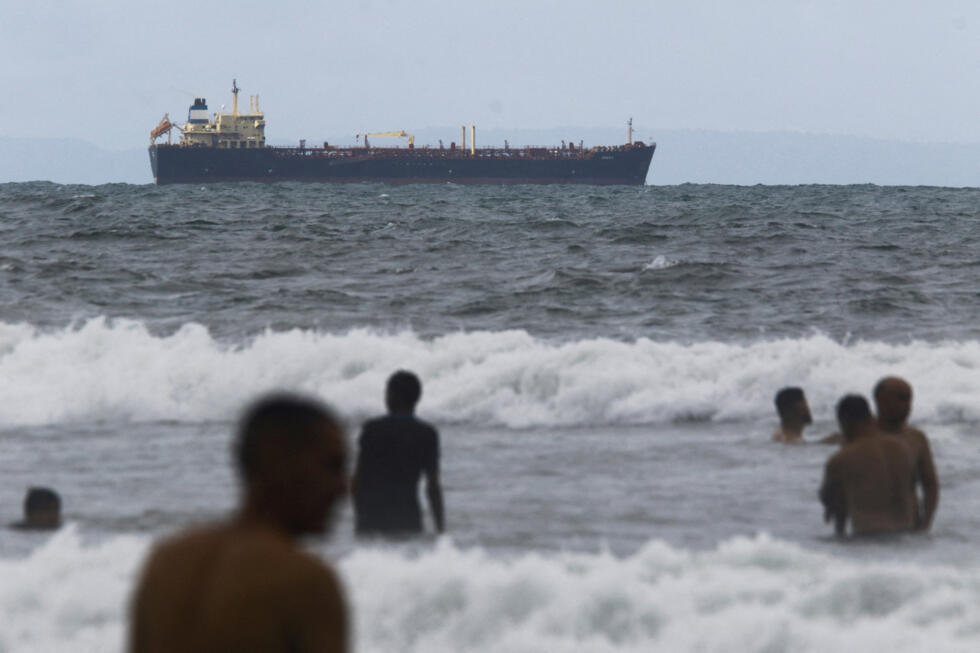
People enjoy the ocean near the Comoros-flagged oil tanker Evana, used to move oil between domestic ports in Venezuela, near El Palito terminal, in Puerto Cabello, Venezuela on December 29, 2025. © Juan Carlos Hernandez, Reuters
Driven into a corner by US sanctions, the Venezuelan government has already shown some willingness to back down from its Bolivarian ideals. Under an Anti-Blockade Law passed in 2020, the executive branch now has broad powers to bypass the country’s National Assembly and secretly sign contracts with foreign corporations on more favourable terms, opening the country up to private investment and paving the way for the privatisation of selected state-owned industries.
Whatever Trump is prepared to promise US oil giants, his administration’s stranglehold on the Venezuelan oil and gas industry could allow for a modest increase in crude oil production in the short term, keeping gasoline prices low as the country’s crucial mid-term elections draw near.
US oil company Chevron continues to pump oil in Venezuela, having been granted a sanctions exemption by the Biden administration after the Ukraine war threw global energy markets into turmoil. Analysts say its now operating well under capacity.
“I do think that you have the ability to bring back some of the oil production that have been lost – I think going back to 1.5 million barrels a day, which is what you had before sanctions, is reasonable,” Palacios said. “They have some capacity to increase oil production without major, big, big changes. Some level of investment is needed, but it’s about brownfield investments – companies on the ground who are going to increase their production.”
READ MOREHow Maduro's capture in Venezuela weakens China in Latin America
Beyond Venezuela’s borders, though, analysts have struggled to make sense of Trump’s single-minded focus on Venezuela’s oilfields. Across the world, demand for oil is still sagging, outstripped by a global glut that threatens to push oil prices below what oil companies need to make large-scale new investments profitable.
Securing their future
And while the US president has made no secret of the fact that falling gas prices would be a welcome sight ahead of the upcoming mid-term elections, heavyweights in the country’s costly oil shale industry – an industry that has turned the US into the world’s leading producer of oil and gas – are worried that a further drop in crude oil prices could be another blow to fracking companies already forced to abandon their less-profitable rigs after failing to break even.
Rosales said that Trump’s desire to give US corporations unrivalled access to Venezuela’s vast reserves could be less about short-term politicking and more about securing resources that companies can pump for decades after the domestic fracking boom has wound down.
“The Trump administration’s view is that Venezuela having the largest oil reserves in the world could mean a way to secure long-term future reserves for American companies,” he said. “Regardless of whatever happens with the global oil market, having long-term certainty of reserves is something that may interest these companies for sure. So that kind of gives them some form of insurance for future oil extraction, regardless of what happens to the demand.”
Driven into a corner by US sanctions, the Venezuelan government has already shown some willingness to back down from its Bolivarian ideals. Under an Anti-Blockade Law passed in 2020, the executive branch now has broad powers to bypass the country’s National Assembly and secretly sign contracts with foreign corporations on more favourable terms, opening the country up to private investment and paving the way for the privatisation of selected state-owned industries.
Whatever Trump is prepared to promise US oil giants, his administration’s stranglehold on the Venezuelan oil and gas industry could allow for a modest increase in crude oil production in the short term, keeping gasoline prices low as the country’s crucial mid-term elections draw near.
US oil company Chevron continues to pump oil in Venezuela, having been granted a sanctions exemption by the Biden administration after the Ukraine war threw global energy markets into turmoil. Analysts say its now operating well under capacity.
“I do think that you have the ability to bring back some of the oil production that have been lost – I think going back to 1.5 million barrels a day, which is what you had before sanctions, is reasonable,” Palacios said. “They have some capacity to increase oil production without major, big, big changes. Some level of investment is needed, but it’s about brownfield investments – companies on the ground who are going to increase their production.”
READ MOREHow Maduro's capture in Venezuela weakens China in Latin America
Beyond Venezuela’s borders, though, analysts have struggled to make sense of Trump’s single-minded focus on Venezuela’s oilfields. Across the world, demand for oil is still sagging, outstripped by a global glut that threatens to push oil prices below what oil companies need to make large-scale new investments profitable.
Securing their future
And while the US president has made no secret of the fact that falling gas prices would be a welcome sight ahead of the upcoming mid-term elections, heavyweights in the country’s costly oil shale industry – an industry that has turned the US into the world’s leading producer of oil and gas – are worried that a further drop in crude oil prices could be another blow to fracking companies already forced to abandon their less-profitable rigs after failing to break even.
Rosales said that Trump’s desire to give US corporations unrivalled access to Venezuela’s vast reserves could be less about short-term politicking and more about securing resources that companies can pump for decades after the domestic fracking boom has wound down.
“The Trump administration’s view is that Venezuela having the largest oil reserves in the world could mean a way to secure long-term future reserves for American companies,” he said. “Regardless of whatever happens with the global oil market, having long-term certainty of reserves is something that may interest these companies for sure. So that kind of gives them some form of insurance for future oil extraction, regardless of what happens to the demand.”
No comments:
Post a Comment