Sunday, January 11, 2026

Zohran Mamdani Has Quickly Gotten Down to Business
Sworn in as mayor of New York just over one week ago, Zohran Mamdani is wasting no time beginning to govern. In his first week in office, his administration issued twelve executive orders, including two emergency executive orders. The previous administration took several months to hit that number.

Many of the administration’s first-week executive orders, which are available on the mayor’s website and linked throughout, pertain to the campaign’s signature issue of housing affordability. Executive Order 3 revives the Mayor’s Office to Protect Tenants. The agency was created in 2019 but defunded and sidelined under Mayor Eric Adams. The new order charges it with coordinating tenant protection efforts across city government, cracking down on repeat-offending landlords, and advocating for renters’ interests in housing policy decisions.

“For too long, bad landlords have been allowed to mistreat their tenants with impunity. That ends today,” said Mamdani at a press conference announcing the order. Mamdani appointed longtime tenant advocate and organizer Cea Weaver to helm the office, citing her “peerless record of standing up for tenants in our city.” Weaver has since been embroiled in an absurd scandal over resurfaced, since-deleted social media posts made at the high-water mark of wokeism in left politics. (I thought the era of canceling people for their old tweets ended?) But Mamdani is rightly sticking by her appointment, citing her long history as one of the city and state’s most effective tenant organizers with a long track record of fighting for affordable housing, a central plank of the now-mayor’s campaign.

Two additional orders establish task forces aimed at expanding housing supply. The Land Inventory Fast Track (LIFT) task force, created by Executive Order 4, will comb through city-owned and city-affiliated properties to identify sites capable of supporting at least twenty-five thousand new units over the next decade. It lays the groundwork for the administration’s plan, unveiled during the campaign, to build two hundred thousand new housing units over the next decade, aimed at providing affordable shelter to many and bringing rents down for everyone else.

Executive Order 5 creates a parallel body, the Streamlining Procedures to Expedite Equitable Development (SPEED) task force, charged with identifying bottlenecks in the city’s notoriously arduous permitting and approval processes and recommending fixes within one hundred days. Together, these orders signal an administration that sees housing production and tenant protection — objectives that have often been pitted against each other in the “yes in my backyard” (YIMBY)-versus-tenant-advocate fights of the last decade — as complementary rather than competing goals.

A fourth housing order, Executive Order 8, directs multiple departments to collaboratively conduct public “Rental Ripoff” hearings throughout the city. The hearings will collect testimony from tenants, advocacy groups, and legal service providers about illegal fees, retaliation, neglected repairs, economic discrimination, and other abusive landlord practices. The agencies must then produce a public report with a concrete plan for using existing enforcement powers and proposing policy changes. The process is designed to surface the problems tenants face under bad landlords and translate them into government action.

Beyond housing, the Mamdani administration signed consumer protection measures that affect affordability more broadly — a direction consistent with the appointment of progressive former FTC commissioner Lina Khan, who has focused on such measures in her past work. Executive Order 9 establishes a task force to combat junk fees and hidden charges that inflate prices at checkout. Executive Order 10 targets subscription traps, the business practices that make it easy to sign up for a service and maddeningly difficult to cancel. Both measures frame consumer protection as an affordability issue: when corporations deceive customers about what things actually cost, ordinary working-class people pay the price.

Additional early executive orders focus on addressing health and safety issues at the city jail Riker’s Island, improving the city’s homeless shelter system, and reforming the process of appointing judges to city courts.

Finally, Executive Order 7 creates the Office of Mass Engagement, intended to mobilize everyday New Yorkers and invite them into the governing process and led by longtime democratic socialist organizer Tascha Van Auken (who recently sat for an extended interview with Jacobin on her previous role as campaign manager). The order seeks to address current political structures that box working-class people out of the democratic process, making it hard to get the ear of government officials unless you have time, money, and connections. The new office is charged with leading campaigns to get working-class New Yorkers engaged with city politics, creating accessible venues for public feedback, conducting outreach to underrepresented communities, and making sure the public’s input has a measurable impact on the administration’s policymaking.

If you believe, as I do, that there is a genuine crisis of democracy in this country, and that the muscle for bottom-up engagement in public life has withered in an era of corporate capture of our politics, you should be heartened by this intention of the order. The Office of Mass Engagement, at its best, could bring large numbers of everyday people into the political process in New York, in an embodiment of the “Not Me, Us” motto of Senator Bernie Sanders’s presidential campaigns (which Mamdani says inspired him to go into politics). Sanders argued that no one leader could actually carry out a pro-worker agenda alone; the pushback from corporations and the rich would prevent it. The only power great enough to surmount the obstacles erected by elite interests is the power of ordinary people in collective action, which Mamdani mobilized to great effect in the mayoral campaign but now must be sustained into his mayoralty.

Throughout his campaign, Mamdani faced the ubiquitous prediction that his administration would fail to follow through on its policy plans. In a way, the critique was flattering — the last resort of detractors who were forced to concede the reasonableness of Mamdani’s demands and the popular appeal of his program. If there isn’t anything particularly objectionable about his ideas themselves, then those who oppose his pro-worker politics are forced to argue that the real issue is that they’ll never happen. The new Mamdani administration appears eager to implement concrete changes that can both deliver swift economic relief for working-class New Yorkers and prove these critics wrong.

Mamdani’s agenda will be difficult to achieve, of course, thanks in large part to political pushback from opponents in politics and in the donor class. Still, early developments indicate that even some of his more ambitious plans are not only possible, but already underway.

One of Mamdani’s major campaign promises, universal childcare, was dismissed as pie-in-the-sky promises. But on Thursday, January 8, Mamdani was joined by New York State Governor Kathy Hochul to announce the rollout of free childcare for two-year-olds in New York City, backed by $1.7 billion in state funds. The initial rollout will be phased in over time and is currently only funded for two years, but it’s a strong start for an expensive but desperately needed social policy that Mamdani campaigned on.

And on Wednesday, Mamdani joined workers from the New York Department of Transportation as they fixed the infamous Williamsburg Bridge bump, a dangerously narrow and sharply inclined ramp at the foot of the bridge’s bike lane in Manhattan. Known for sending bicyclists flying over their handlebars, the bump had been a safety hazard for so long that it had turned into a running joke about the city’s priorities and its bureaucratic sluggishness. As of this week, thanks to Mayor Mamdani, the bump is no more.

It’s a small action, only one part of a larger plan to improve cyclist and pedestrian safety in the area. But it was intended as a message to New York that Mamdani intends to “usher in a new era of excellence,” as writer Corey Robin recently characterized the mayor’s larger approach. If Mamdani succeeds, he will do more than improve working-class New Yorkers’ circumstances. He will lay to rest the axiomatic American belief that efficiency and innovation belong to the private sector and the governments most deferential to it.Email

Meagan Day is an associate editor and former staff writer at Jacobin. She is the coauthor of Bigger than Bernie: How We Go from the Sanders Campaign to Democratic Socialism.


Source: Originally published by Z. Feel free to share widely.

But why, in these dark times, attach so much importance to what the new mayor of New York, Zohran Mamdani, says and does, while Trump bombs Venezuela and kidnaps Maduro and his wife? Or while Netanyahu and his Israel persist in exterminating the Palestinians and Putin rains bombs and missiles on Ukrainian cities? Why talk about Mamdani when the daily international news is dominated by the countless macabre exploits of capitalist and imperialist barbarism? Our answer is categorical: we attach so much importance to what Zohran Mamdani says and does because this new mayor of the megalopolis par excellence that is New York, together with the mass movement that supports him, currently represents the greatest, if not the only, hope for humanity, for those from below, to begin to resist and even defeat Trump and his Brown International at the very heart of their US stronghold! As Bernie Sanders so aptly stated in his speech, just before investing Mamdani as mayor of New York, in front of thousands of New Yorkers: ” In a moment when people in America, and, in fact, throughout the world, are losing faith in democracy, over 90,000 of you in this city volunteered for Zohran’s campaign. You knocked on doors. You shared your dreams and your hopes for the future of this city. And in the process, you took on the Democratic establishment, the Republican establishment, the president of the United States and some enormously wealthy oligarchs, and you defeated them in the biggest political upset in modern American history.”

So let’s talk about Zohran Mamdani who, despite most of the international media and all those who—obviously on the right but, unfortunately, also on the left—persist in calling him a “Democrat” or “belonging to the left wing of the Democratic Party,” inaugurated his term as mayor of New York by declaring: “I was elected as a Democratic Socialist and I will govern as a Democratic Socialist.” Mamdani’s statement is nothing short of sensational when you consider that Democratic Socialists are members of the far-left organization called Democratic Socialists of America (DSA)! And to leave no room for doubt, addressing the tens of thousands of New Yorkers gathered in front of City Hall despite the freezing cold, Mamdani added: “. ” We will govern without shame and insecurity, making no apology for what we believe. I was elected as a democratic socialist, and I will govern as a democratic socialist.”

That said, it must be noted that the most important thing about Mamdani’s memorable inauguration day on January 1, 2026, was not his aforementioned statement/clarification. The most important thing was the overall atmosphere, that very rare mixture of emotion, brotherly affection, and elation created by everything that was said, recited, sung, and applauded, not only by Mamdani, but also by those who spoke or attended this historic event. For example, the extraordinary Imam Khalid Latif punctuated his tremendously inspiring, profound, poetic, and radical speech with advice to Mamdani, such as this: ” There will be days ahead when the pressures of power will test you. When compromise will be dressed up as pragmatism, when silence will be offered as wisdom, and when the cost of truth will feel heavier than its reward. In those moments, I pray you remember who you have always been: someone who chose conviction over convenience, justice over comfort, and people over position. Hold fast to that. It is rarer than you know, and more needed than ever.” And while surrounded by religious leaders of different faiths, Imam Khalid Latif roused the crowd with his speech, just behind him was the representative of the Jewish faith, Rabbi Ellen Lippmann, who seemed to be in seventh heaven, approving the imam’s words with very eloquent smiles and grimaces…

Echoing the good imam’s exhortations, Mamdani later stated from the same podium that “ In writing this address, I have been told that this is the occasion to reset expectations, that I should use this opportunity to encourage the people of New York to ask for little and expect even less. I will do no such thing. The only expectation I seek to reset is that of small expectations.“ Mamdani hastened to explain his remarks with this universally valid statement: ” For too long we have turned to the private sector for greatness while accepting mediocrity from those who serve the public. I cannot blame anyone who has come to question the role of government, whose faith in democracy has been eroded by decades of apathy. We will restore that trust by walking a different path, one where government is no longer solely the final recourse for those struggling, one where excellence is no longer the exception.”

Moreover, it is certainly no coincidence that Mamdani has the rare “privilege” of seeing the broadest coalition of reactionary, obscurantist, and murderous figures rally against him, including Trump of the United States, Netanyahu of Israel, Modi of India, and the cream of the crop of Nazifascism and the international far right. Not to mention Russia’s Putin, whose RT channel has displayed the most delirious Islamophobia by hastening to warn good Americans that Mamdani “puts Sharia law above American law” simply because Mamdani dared to take the oath of office on the Koran! This whole bunch of dictators and other executioners of humanity know very well why they hate to death the young mayor of New York, the Democratic Socialist Zohran Mamdani…

Of course, the memorable day of Mamdani’s inauguration cannot be summed up in the few excerpts from speeches that we have just quoted. Having had the chance to attend a little, following it live despite being… in Athens, we can only want to share with others the rare moments of emotion and excitement that it gave us. (1) In these dark, barbaric, and desperate times, knowing that there are tens of thousands of young and not-so-young men and women in the very lair of the ferocious fascist beast who are standing up to it and fighting tooth and nail to defend the rights of those at the bottom, gives rise to hope, restores optimism and inspires millions of people not only in the United States but also throughout our planet…


Notes

1. See the video (1h 41 m) of the celebrations for Zohran Mamdani’s inauguration:  https://www.democracynow.org/live/coming_up_the_inauguration_of_nyc

What lessons can be learned from Zohran Mamdani’s successful campaign to be Mayor of New York?


JANUARY 09, 2026

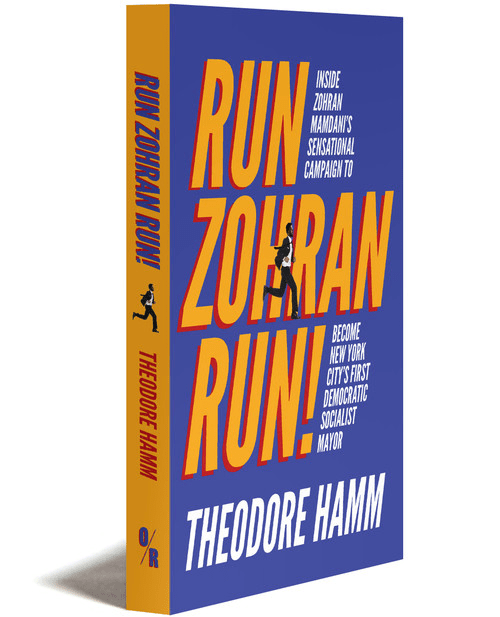
Mike Phipps reviews Run Zohran Run! by Theodore Hamm, published by OR Books.

Trump bombing Venezuela and kidnapping its President, Palestine Action hunger strikers close to death, ICE agents shooting dead an innocent woman in Minneapolis – it’s been a bleak start to 2026. Perhaps the only ray of hope was provided by the inauguration of Zohran Mamdani as the new Mayor of New York.

So the question arises: in the era of Trump, how did a 34-year old democratic socialist Muslim immigrant from Uganda win first the Democratic primary and then the general election to become Mayor of New York City?

Theodore Hamm’s book is the first comprehensive account of the origins of Zohran Mamdani’s victory and provides the key answers.

First, Mamdani was an inspiring candidate. A one-time rapper, he was charismatic and  comfortable with a range of media, including Hindi commercials and Bollywood music, through which he engaged his diverse supporters. “His campaign’s always stylish, often humorous use of social media made him a star,” Hamm tells us. He is also a man of courage and integrity, underlined by his commitment to Palestinian rights, almost unique among New York politicians.

Palestine could not but be a feature of the campaign, given the way Mamdani’s opponents tried to weaponise the issue against him, in particular Andrew Coumo, who was a member of Israeli Prime Minister Netanyahu’s legal defence team. Determined to keep control of his own narrative, Mamdani spoke out against the Israeli occupation of Gaza and condemned the New York police’s storming of the Columbia University campus to break up a pro-Palestinian protest.

Secondly, Mamdani’s win was a collective effort. He had the support of not only the influential Democratic Socialists of America, but also a wide range of unaffiliated community organisations. By the time of the summer primary, 50,000 activists were working for his victory, including many Muslim and South Asian volunteers mobilising for the first time. Pro-Palestine activists, anti-poverty campaigners and tenants were also active in his campaign. By the end of his campaign, 100,000 volunteers had knocked on 3 million doors.

Third, programme. Socialist ideas have a considerable history in New York City but it was Bernie Sanders who brought them back into the national conversation and Alexandria Ocasio-Cortez who underlined their electoral potency. Mamdani focused laser-like on cost-of-living issues: a rent freeze, more affordable housing, fast, free transit, universal free childcare and higher taxes on millionaires to pay for this.

What was especially noteworthy about Mamdan’s campaign was his ability to connect every issue to affordability, for example linking the bribes received by his predecessor with the latter’s praise for New York police officers who opened fire at a subway station “over the crime of stealing £2.90 of a subway fare.”

Fourth, Mamdani faced a truly lacklustre opposition. The embattled incumbent, Eric Adams, dogged by corruption allegations, ducked out of the primary and attempted a failed independent run. Andrew Cuomo was also mired in scandal and ran as an independent after losing to Mamdani in the Democratic primary. In the final election, he was comprehensively defeated with just 41% to Mamdani’s 51%.

Hamm’s fast-paced account takes us up to Mamdani’s historic Democratic primary win in June, “one of the greatest accomplishments by the left and the socialist movement in the last century,” according to NYC-DSA co-chair Gustavo Gordillo. It contains a lot about the increasingly desperate antics of Mamdani’s opponents, but socialists elsewhere will perhaps be more interested in the organisation and tactics of his campaign, and the demographics who supported him. These included a majority of all18 to 50 year olds, people earning up to $300,000 a year, and a majority of homeowners and renters. It was this that helped Mamdani win four out of five of the City’s boroughs.

One important shift was in the Bronx, the City borough with the highest official poverty rate. It had backed Cuomo in June’s Democratic primary, but in the final election Mamdani scored 52% of the borough’s vote, with majority Black wards that had favoured Cuomo in the primary swinging decisively to Mamdani.

Overall, Mamdani won 64% of the vote in neighbourhoods with a plurality of Black residents — a 25 percentage point jump from the June primary. The leap attested to the work the campaign had put in to address scepticism about a political programme, as one analyst said, “intended to benefit working New Yorkers of all races whose message was often delivered by white canvassers perceived as transplants or gentrifiers before they were seen as neighbours.”

Holding together the electoral coalition that catapulted Mamdani into office will be, in the words of one of his campaigners, “a Herculean feat”. The key is “ensuring that the administration reflects the amazingly diverse tapestry of the city, so people can continue to see themselves.”

Mamdani himself understands this and the responsibility he now carries for the future of progressive politics in the US. In his victory speech on election night, he said: “We have bowed at the altar of caution, and we have paid a mighty price. Too many working people cannot recognize themselves in our party, and too many among us have turned to the right for answers.”

How far he will be allowed to deliver on his promises and maintain his popular support, in the context of a far right White House administration determined to thwart him, remains to be seen.

For more information, see Bryn Griffiths’ Labour Left Podcast interview with Professor Theodore Hamm about his book and the campaign here.

Mike Phipps’ book Don’t Stop Thinking About Tomorrow: The Labour Party after Jeremy Corbyn (OR Books, 2022) can be ordered here.

No comments:

Post a Comment