It’s possible that I shall make an ass of myself. But in that case one can always get out of it with a little dialectic. I have, of course, so worded my proposition as to be right either way (K.Marx, Letter to F.Engels on the Indian Mutiny)
Saturday, March 07, 2026
Hormuz Shock Sends China and India Racing for Russian Crude
The effective halt of tanker traffic through the Strait of Hormuz has instantly jeopardized more than 1/3 of Asian crude imports, forcing China and India to urgently search for non-Gulf supply.
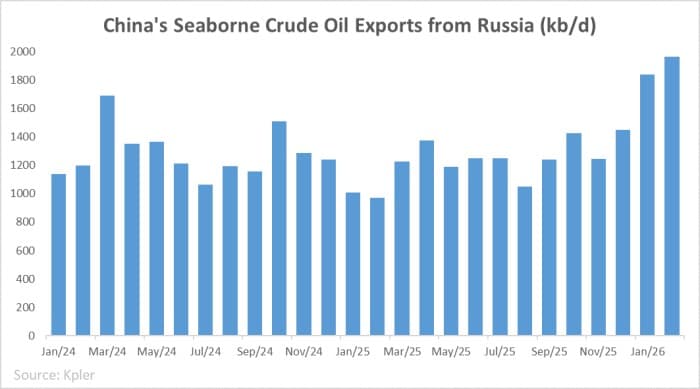
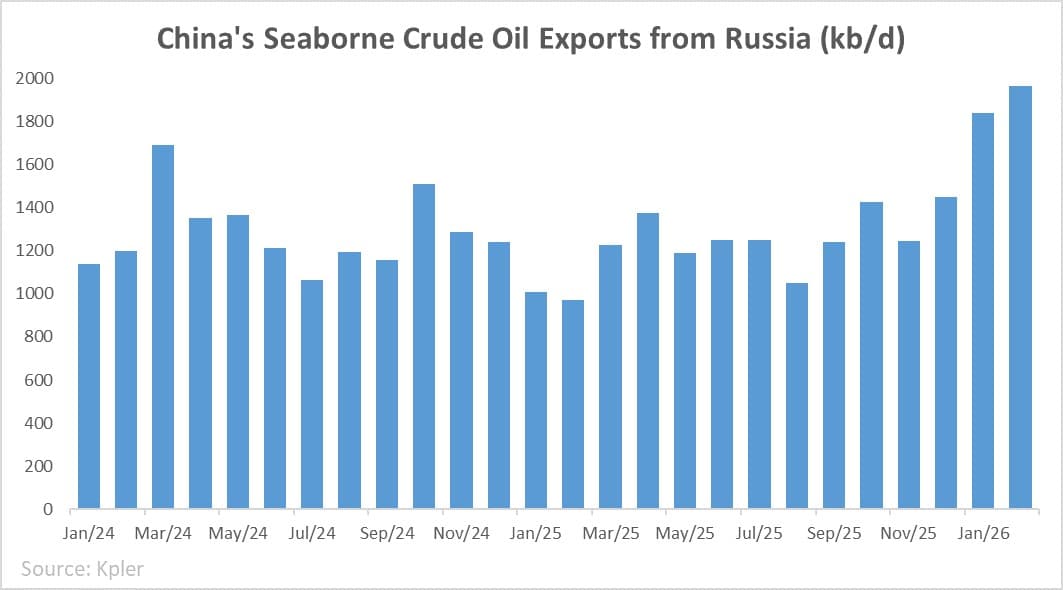
As Gulf cargoes stall at sea, Russian crude – already near record flows to China at 1.92 million b/d – has emerged as the most immediate alternative for Asia’s largest oil buyers.
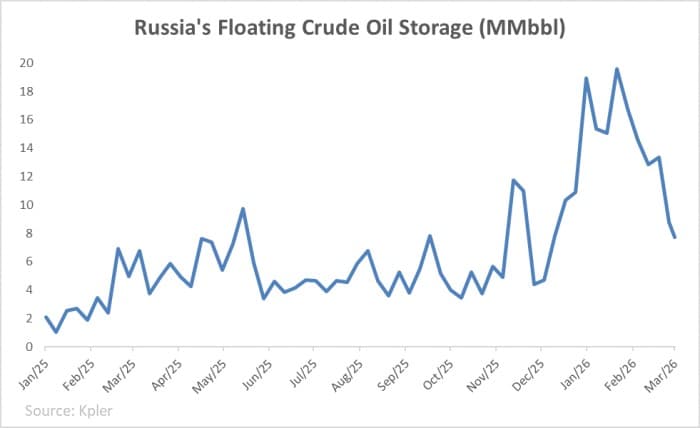
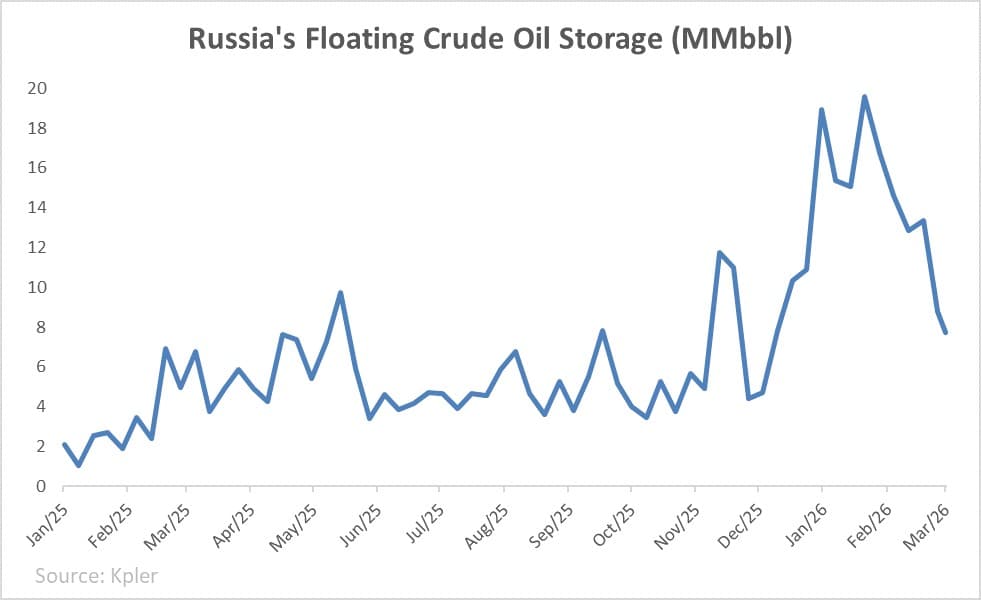
Shrinking floating storage and narrowing Urals discounts suggest Moscow may exploit the disruption to tighten supply and drive prices higher by playing Chinese and Indian demand against each other.
The crisis around the Strait of Hormuz has become a severe stress test for both Gulf crude suppliers and their key buyers. Despite repeated assurances from U.S. officials that the waterway was never formally blocked, satellite tracking suggests that no oil or product tankers transited the strait since March 1. The disruption immediately placed the world’s largest importers under pressure. China and India together consume tens of millions of barrels per day, and both remain structurally dependent on Gulf crude. China has steadily expanded purchases of Russian oil since 2022, yet roughly 1/3 of its crude imports originate in the Gulf. India, meanwhile, has been deliberately reducing its earlier heavy reliance on Russian barrels and replacing them with Middle Eastern supplies. With the Iranian crisis unfolding and no quick normalization of Hormuz traffic in sight, both Asian giants may turn to their long-standing supplier in Moscow like never before. The key question is: does Russia have sufficient export capacity to meet the sudden surge in demand?
The shift in India’s purchasing pattern has been particularly visible in recent months. Indian imports of Russian crude declined steadily from 1.85 million b/d in November 2025 to just 1.06 million b/d in February 2026. Much of the remaining flow has been concentrated in a single outlet: the Vadinar refinery operated by Nayara Energy, partly owned by Rosneft. By February, roughly half of the Russian crude delivered to India (around 510,000 b/d out of the 1.06 million b/d total) was imported there. In November 2025, the share was markedly smaller, with 560,000 b/d flowing to Vadinar out of the 1.85 million b/d imported overall. The retreat from Russian supply was largely driven by mounting pressure from Washington, prompting Indian refiners to stop buying Russian barrels. By February 2026 crude from Iraq, Saudi Arabia, the United Arab Emirates and Kuwait accounted for more than half of India’s total imports of 5.18 million b/d, reaching roughly 2.8 million b/d compared with just 2 million b/d in November 2025. The nearly 1 million b/d increase reflected a belief that Gulf crude offered legal stability and relatively low prices. That assumption is now being severely tested, as a significant share of those cargoes is effectively stranded in Gulf waters waiting for safe passage through the Strait of Hormuz. The disruption is likely to force New Delhi to reconsider its recent distancing from Russian supply – assuming those barrels are still available.
China faces a challenge of its own. In February 2026, its seaborne imports of Russian crude reached a new record of 1.92 million b/d. Yet the Iranian crisis affects Chinese refiners on two fronts. Unlike India, China was also a major buyer of Iranian crude, importing roughly 1 million b/d in February. Combined imports from Kuwait, Iraq, the UAE and Saudi Arabia totalled about 3.4 million b/d in the same month. Taken together, the potential loss of Iranian supply and disruption to Gulf shipments threatens more than 1/3 of China’s crude imports. In this context, Russian barrels appear both politically and logistically attractive. Overland pipeline flows and shipments from Russia’s Far Eastern ports offer one of the few large-scale supply channels that bypass the Gulf entirely.
Recent tanker movements underline how the market is already adjusting. A wave of U.S. enforcement actions against Venezuelan oil exports has left a number of numerous VLCCs idle in Asian waters. Many of these vessels had previously been used to collect Venezuelan crude through ship-to-ship (STS) transfers. With those flows disrupted, several of the VLCCs became redundant. Russia appears to have quickly stepped into that logistical vacuum. Although Russian exporters rarely relied on VLCCs in the past, at least 8 such vessels are currently positioned in the Arabian Sea and near Singapore, either en route to China or waiting offshore. There’s 12 million barrels of medium sour Urals alone that are carried by VLCCs, not counting Russia’s Far Eastern grades, surpassing the previous record carry of 9.8 million barrels from February 2023. Most of the cargoes they carry are already committed to Chinese buyers, offering little hope for India’s supply concerns.
How much of the spare Russian oil is available now? Floating storage suggests that Russia’s spare export capacity may be limited. Inventories of Russian crude at sea climbed steadily through late January 2026, reaching about 19.6 million barrels. Since then, they have declining continuously. By early March, only 12 vessels remain in floating storage, holding roughly 7 million barrels in total, and several of those tankers are already anchored near Chinese ports awaiting a signal to offload. In other words, the pool of unsold Russian crude available on short notice has shrunk significantly.
Pricing dynamics are shifting as well. Market insiders report that the Hormuz disruption has narrowed the discount of Russia’s Urals grade to Brent from roughly $10/bbl to $5-6/bbl. At the same time, Russia itself may soon have additional crude available for export because domestic refining activity has slowed. Russian refinery throughput fell from about 5.5 million b/d in December 2025 to roughly 5.15 million b/d in February 2026. Part of the decline followed drone strikes on two refining facilities, including the Volgograd refinery (300,000 b/d capacity) and the Ukhta refinery (80,000 b/d capacity). Planned maintenance at several other plants scheduled for March and April is expected to further reduce domestic crude demand, potentially freeing additional barrels for exports.
Moscow’s most likely strategy in the current environment will be to play its two largest Asian customers against each other. In previous months, Russian exporters often stored unsold cargoes in tankers near Singapore or along the Chinese coast, a tactic that unintentionally signalled oversupply and widened price discounts. The current market situation is markedly different. With most floating cargoes already allocated and supply chains disrupted across the Gulf, the next wave of Russian barrels is not yet visible. That scarcity gives Russian sellers leverage to raise prices by pointing to strong demand from competing buyers. For both India and China, the Hormuz crisis may therefore lead to the same conclusion: Russian crude remains one of the few reliable alternatives – but it may no longer come as cheaply and abundantly as before.
By Natalia Katona for Oilprice.com
Reliance Industries Pivots Back to Russian Oil with U.S. Waiver
India’s largest private refiner, Reliance Industries, is sounding the market for buying Russian crude, an anonymous source told Bloomberg on Friday, after the United States on Thursday issued a temporary one-month license to India allowing it to purchase Russia-origin crude loaded on vessels before or on March 5.
Even before the waiver was issued, India was considering returning to buying Russian crude amassed in floating storage in Asia as the war in Iran and Tehran’s retaliatory strikes in the region have severely disrupted oil flows from the Middle East.
India, the world’s third-largest crude importer, depends on Middle East supply for about 60% of its imports, and the de facto halted tanker traffic in the Strait of Hormuz has put severe pressure on its supplies.
So the U.S. Treasury’s Office of Foreign Assets Control (OFAC) on Thursday issued a general license to India for Indian refiners to buy Russian crude loaded on any vessel, including blocked vessels, on or before March 5, 2026, until April 4, 2026.
Currently, as many as 15 million barrels of Russia-origin crude are sitting on tankers close to India – in the Arabian Sea and Bay of Bengal – while another 7 million Russian crude barrels are idling near Singapore, per vessel-tracking data compiled by Bloomberg.
Before the U.S. sanctions on Russia’s top producers Rosneft and Lukoil in October 2025, Reliance Industries of Indian billionaire Mukesh Ambani was the biggest buyer of Russian crude oil, importing more than 500,000 barrels per day (bpd) thanks to a long-term deal with Rosneft.
However, the Indian refiner halted all Rosneft purchases in the wake of the U.S. sanctions and took to procuring crude from non-Russian sources.
Now Reliance Industries has a one-month window to buy Russian crude that’s on tankers and, most importantly, these tankers are not blocked in the Strait of Hormuz.
The largest private refiner in India plans to use that window to buy part of the Russian oil and process it at a refinery unit producing fuels for the domestic Indian market, according to Bloomberg’s source.
A separate unit processing fuels for exports will continue to use non-Russian crude, as the EU enacted on January 21 a ban on imports into the bloc of petroleum products obtained in third countries that are derived from Russian-origin crude oil.
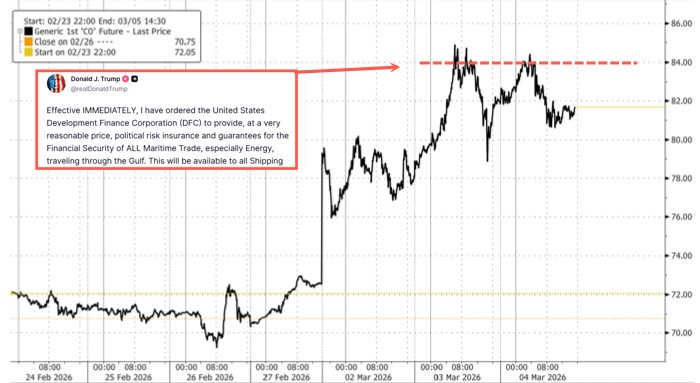
It's been a wild ride in crude over the past few days, with Brent crude futures were capped near $84 a barrel on Tuesday afternoon before sliding down to the $81 level late Wednesday afternoon, only to surge back up to $84 this morning...
...as shipping industry insiders and Wall Street analysts await exact details on the Trump administration's proposal to keep tankers transiting the Strait of Hormuz. The critical maritime chokepoint remains paralyzed, raising the risk of an energy shock in parts of the world that rely heavily on those flows, particularly in Asia.
President Trump wrote in a Truth Social post that the U.S. will provide insurance for "ALL Maritime Trade" through the U.S. Development Finance Corporation (DFC) and will provide Navy escorts "if necessary."
The shutdown is already hitting global energy flows:
Now comes the hard part, with the shipping industry and Wall Street analysts all asking the same question: how will every tanker transiting the Arabian Sea through the Gulf of Oman, into the Strait, and onward to the Persian Gulf be protected by U.S. or allied air or naval forces?
"Nothing is sure and we need immediate clarity," said Khalid Hashim, managing director of Precious Shipping Pcl, a Thai firm that owns bulk carriers.
Hashim said, "Lives are at risk, cargoes are at risk, ships are at risk. We need immediate cover that protects us from all this."
While some shipowners say they're mulling over joining escorted convoys, many remain very cautious, noting that escorts do not eliminate the risk of the IRGC's asymmetric warfare, such as the use of drones.
Analysts also question whether the Trump administration has done enough planning to make the proposal bulletproof in the near term. Overall, the market sees Trump's plan as a temporary fix to restart flows in the Strait, with Brent crude futures capped at $84 since the announcement and currently trading around $81.
UBS analyst Benjamin Benson, "Improved risk sentiment following US President Trump's announcement on maritime insurance and US Navy security support further aided the recovery in prices."
Current activity in the Strait of Hormuz:
"The core thing shipowners are thinking about is the real risk of loss," said Karnan Thirupathy, partner at Kennedys Law LLP, who specializes in commodities and shipping. "No one goes into the trade if the risk of loss is simply too high."
RBC Capital Markets LLC analysts noted, "President Trump's comments about insurance and tanker escorts caused a pullback in oil prices, we question how much planning has been done on the insurance backstop thus far and think there could be a number of challenges in executing this plan quickly."
Wall Street Journal noted by late afternoon that the Trump administration was in talks with one major insurance broker about how to get ships moving through the Strait of Hormuz:
A team from insurance broker Marsh Risk met with administration officials Tuesday and offered to help the U.S. government create an insurance mechanism that could lower shipping risk and make insuring ships more affordable, said Marcus Baker, the firm's global head of marine, cargo and logistics. Energy prices have soared since Iran warned it could start attacking ships in the strategic waterway, slowing oil shipping to a standstill.
"Providing protection for all tankers operating in areas currently threatened by Iran is unrealistic as this would require a very high number of warships and other military assets," Bimco security analyst Jakob Larsen noted.
Let's remind readers that the U.S. and its allies had a difficult time securing the Bab el-Mandeb chokepoint, where Houthi rebels repeatedly launched missiles and drones at commercial ships linked to the U.S. and Israel. That certainly matters now. It also comes as the U.S. and its allies are burning through significant volumes of air-delivered munitions in Operation Epic Fury.


No comments:
Post a Comment